Tragedy of the Commons: Models & Solutions
Learning Goal: Apply economic models of common-pool resources to analyze solutions to the Tragedy of the Commons, comparing private property rights, government mandates, and community-based management.
- Prerequisites: Basic understanding of microeconomic principles (supply and demand, marginal benefit vs. marginal cost). No prior knowledge of game theory or resource economics is required.
- Estimated Total Study Time: 8 hours
Module 1: Classifying Economic Goods: The Matrix of Scarcity
This module builds the foundational taxographical framework used by economists to classify goods. You will explore how goods are divided into four quadrants—Private, Public, Club, and Common-Pool Resources—defined strictly by two distinct parameters: rivalry (whether one person's consumption limits another's) and excludability (whether access can be restricted to paying customers). Understanding this matrix is critical, as the Tragedy of the Commons is fundamentally a structural problem inherent to common-pool resources (high rivalry, low excludability).
Recommended Videos
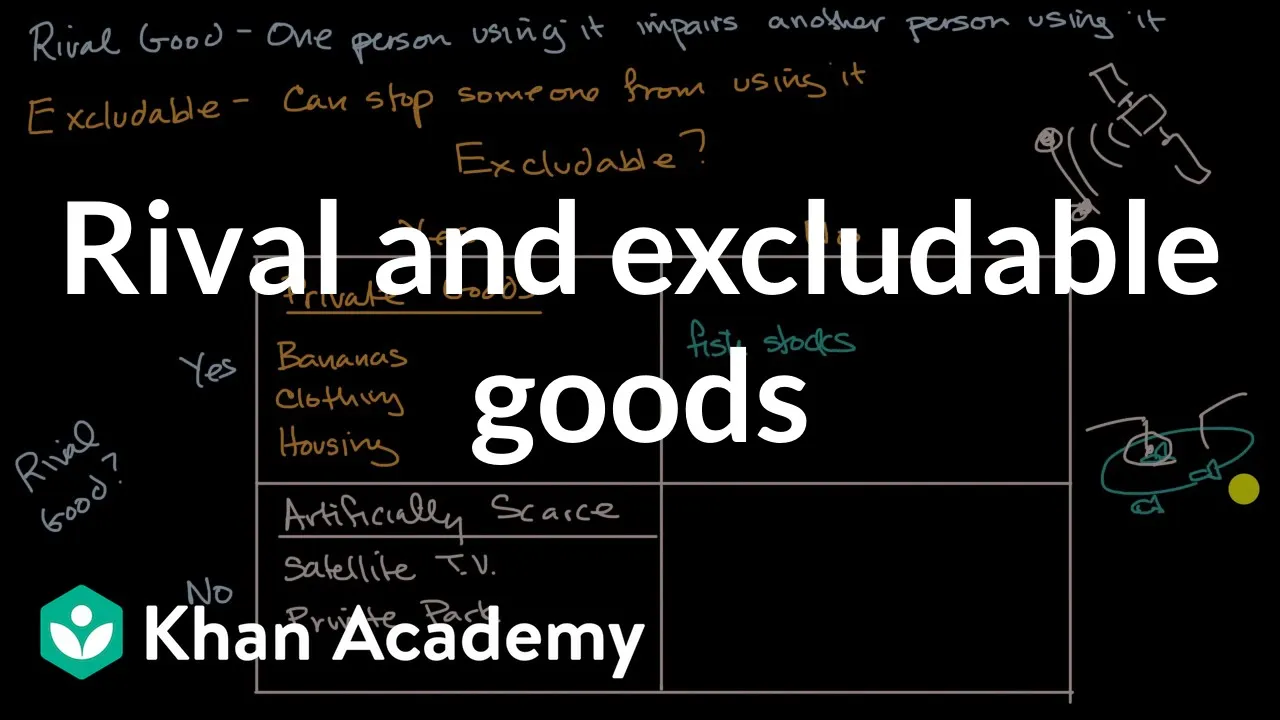
- Why this video: This video provides a precise mathematical and conceptual breakdown of the differences between rivalry and excludability. Khan Academy clearly delineates why certain goods fall into specific quadrants and sets up the critical terminology necessary for the rest of this curriculum.
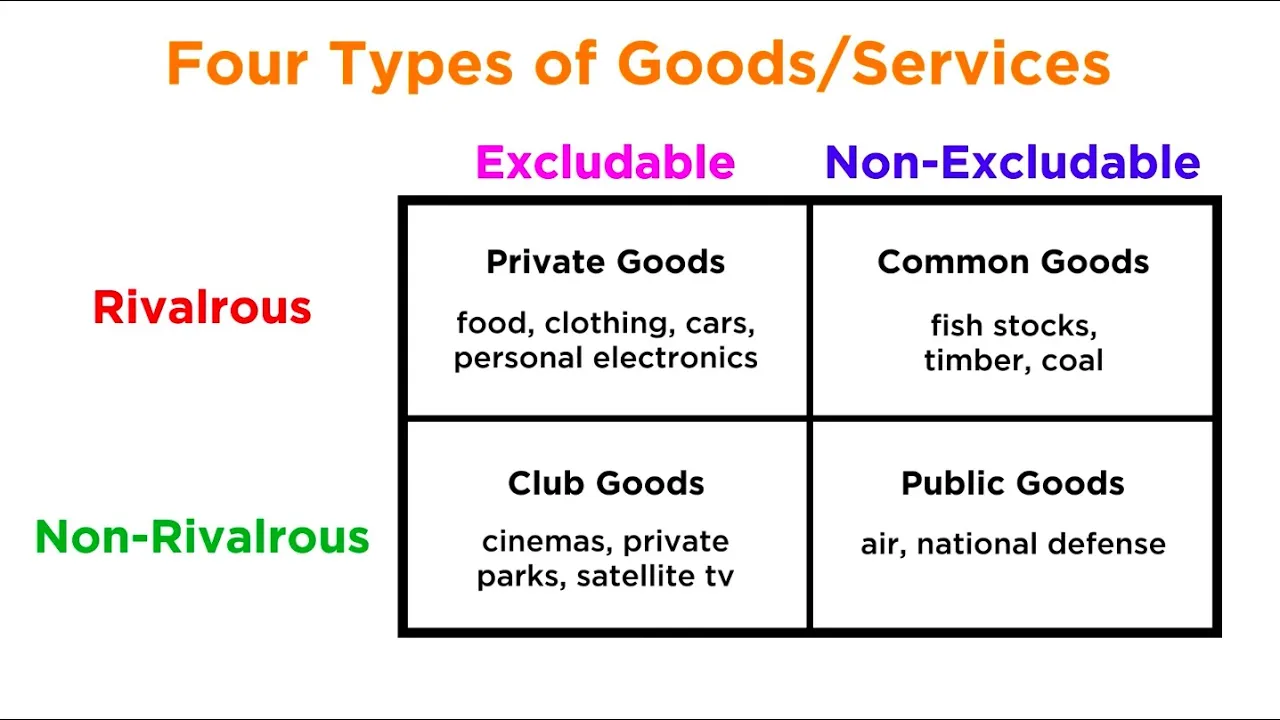
- Why this video: Professor Dave simplifies the classic four-quadrant economic matrix. By comparing public goods (like national defense) with common resources (like fish in the ocean), the video helps solidify how resource scarcity manifests differently across different property regimes.

- Why this video: This video focuses directly on common-pool resources (CPRs), isolating the specific pairing of characteristics—non-excludability and rivalry—that makes them vulnerable to market failures. It explains how non-excludability leads to free-rider issues, while rivalry results in physical depletion.
Knowledge Checkpoint
- Draw the 2x2 matrix of economic goods, labeling the axes with "Excludability" and "Rivalry," and place Private, Public, Club, and Common-Pool Resources in their correct quadrants.
- Define why a pasture or a fishery is "rival" but "non-excludable."
- Distinguish between the "free-rider" problem (associated with public goods) and the "overuse" problem (associated with common-pool resources).
Module 2: The Mechanics of the Tragedy of the Commons
This module explores the analytical mechanics behind Garrett Hardin’s 1968 classic model of the Tragedy of the Commons. Using game theory frameworks—specifically the Prisoner's Dilemma—you will dissect how individual rational choices aggregate into collective devastation. This module shifts the focus from simple definitions to active behavioral modeling, proving why voluntary restraint fails when actors behave as self-interested utility maximizers.
Recommended Videos
![PHILOSOPHY - Rational Choice Theory: The Prisoner's Dilemma [HD]](https://i.ytimg.com/vi_webp/YGyZX0VoRpI/maxresdefault.webp)
- Why this video: To understand the tragedy of the commons, one must first grasp the core game-theoretic concept of the Prisoner's Dilemma. This video clearly explains how two rational actors can arrive at a Nash Equilibrium that is socially sub-optimal.

- Why this video: This video directly bridges the gap between game theory and Garrett Hardin's 1968 paper. It covers why individual incentives to exploit common land outweigh the personal costs, which are distributed across the entire collective, forcing a system-wide collapse.
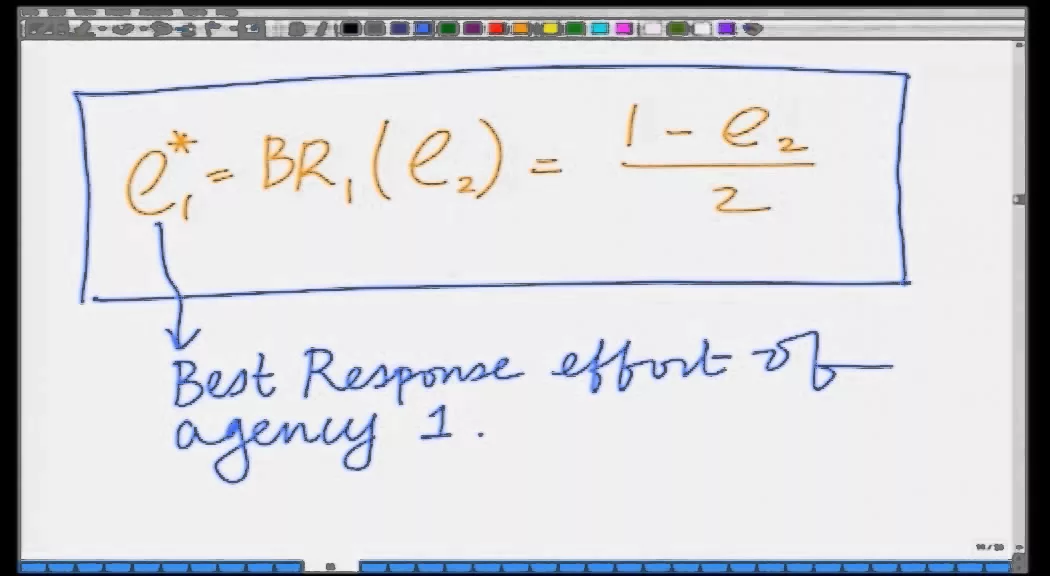
- Why this video: A rigorous academic lecture that mathematically explores the strategic interactions of actors sharing a common resource. It details the structural payoff matrices that lead to resource overexploitation, modeling the Tragedy of the Commons with formal clarity.
Knowledge Checkpoint
- Explain why a herdsman receives 100% of the benefit of adding an extra animal to a common pasture, while bearing only a fraction of the ecological cost.
- Map the strategic interactions of two competing resource users into a 2x2 Prisoner's Dilemma payoff matrix, identifying the dominant strategy and the Nash Equilibrium.
- Define the term "carrying capacity" in the context of resource extraction and ecological limits.
Module 3: Market and Mandate Solutions: Privatization & Regulation
This module introduces the two historical solutions to the Tragedy of the Commons: privatization (the allocation of private property rights) and top-down government mandates (command-and-control regulations, quotas, and taxes). You will study how assigning property rights internalizes externalities and assess Ronald Coase's Nobel Prize-winning Coase Theorem, analyzing how negotiation can lead to efficient resource allocation when transaction costs are low.
Recommended Videos
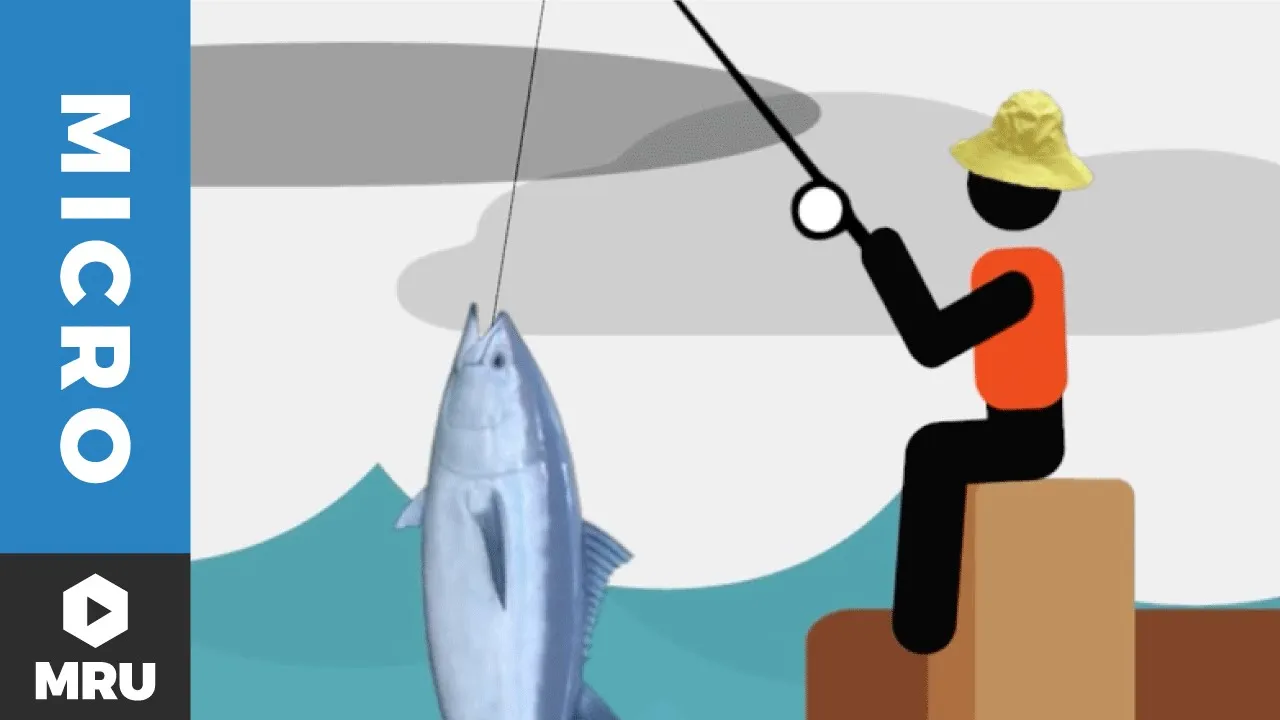
- Why this video: MRU outlines the structural solutions typically proposed by economists: command-and-control regulation (such as restricting gear or seasons), cultural norms, and property rights creation. It serves as an excellent taxonomy of standard policy instruments.
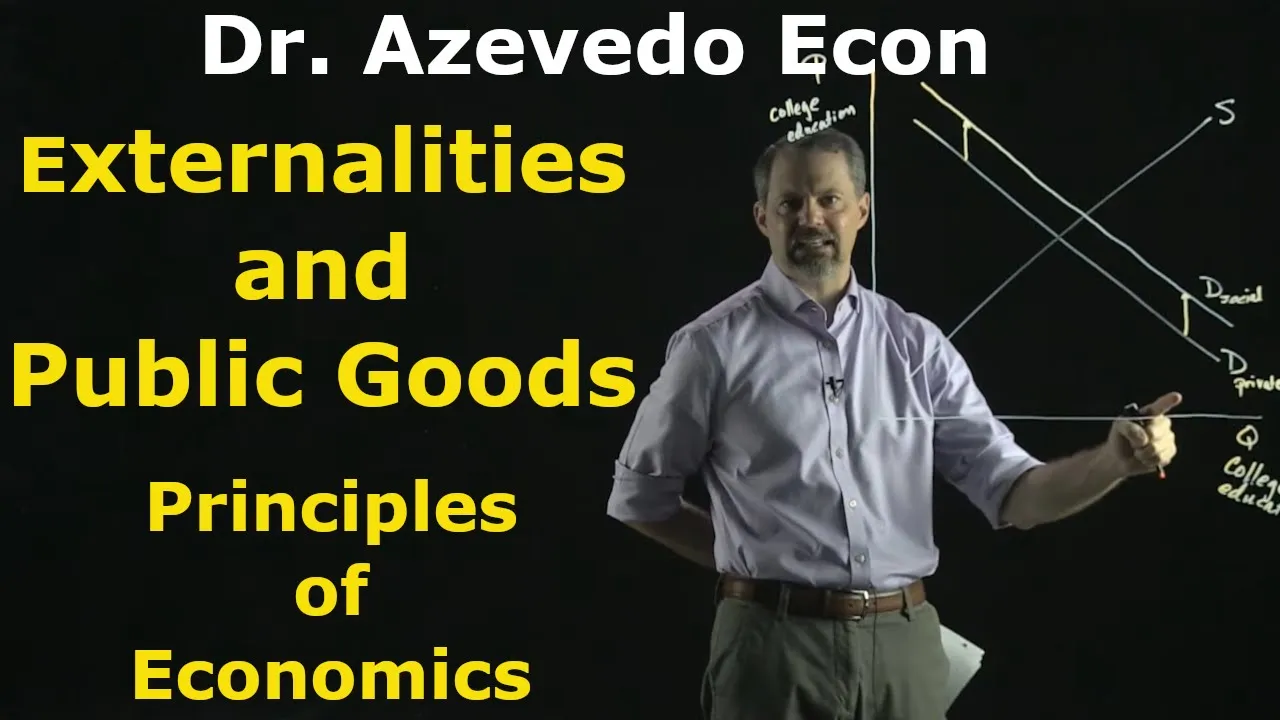
- Why this video: This lecture directly targets the theoretical gap of how externalities arise from incomplete property structures. It explains how clearly defined, enforceable, and transferable property rights allow parties to negotiate efficient outcomes, introducing the Coase Theorem as a key solution.

- Why this video: This video focuses on the mechanics of the Coase Theorem. It shows how, when transaction costs are zero or very low, bargaining leads to socially optimal outcomes regardless of which party is originally assigned the property rights.
- Why this video: This video presents the classical liberal and libertarian perspective on the efficiency of private property. Through historical and modern case studies, it contrasts the failure of communal resource regimes with the stewardship incentives generated by private ownership.
Knowledge Checkpoint
- Define how privatization "internalizes" a negative externality.
- State the Coase Theorem and explain its two primary assumptions (clearly defined property rights and low/zero transaction costs) when applied to common-pool resource disputes.
- Contrast "command-and-control" regulations with market-based solutions (like pigouvian taxes) in terms of administrative costs and economic efficiency.
Module 4: Ostrom's Third Way: Community-Based Management
This module explores the groundbreaking work of Elinor Ostrom, the first woman to win the Nobel Prize in Economic Sciences (2009). Ostrom challenged the traditional dichotomy of "state control vs. privatization," proving empirically that local communities can successfully self-govern shared resources without top-down intervention or market division. This module provides a step-by-step breakdown of her famous 8 Design Principles for managing common-pool resources sustainably.
Recommended Videos

- Why this video: An excellent overview of Ostrom's institutional economics work. It introduces how Ostrom gathered real-world data from communal pastures and forests to show that self-regulation is not only possible but often superior to state coercion or privatization.
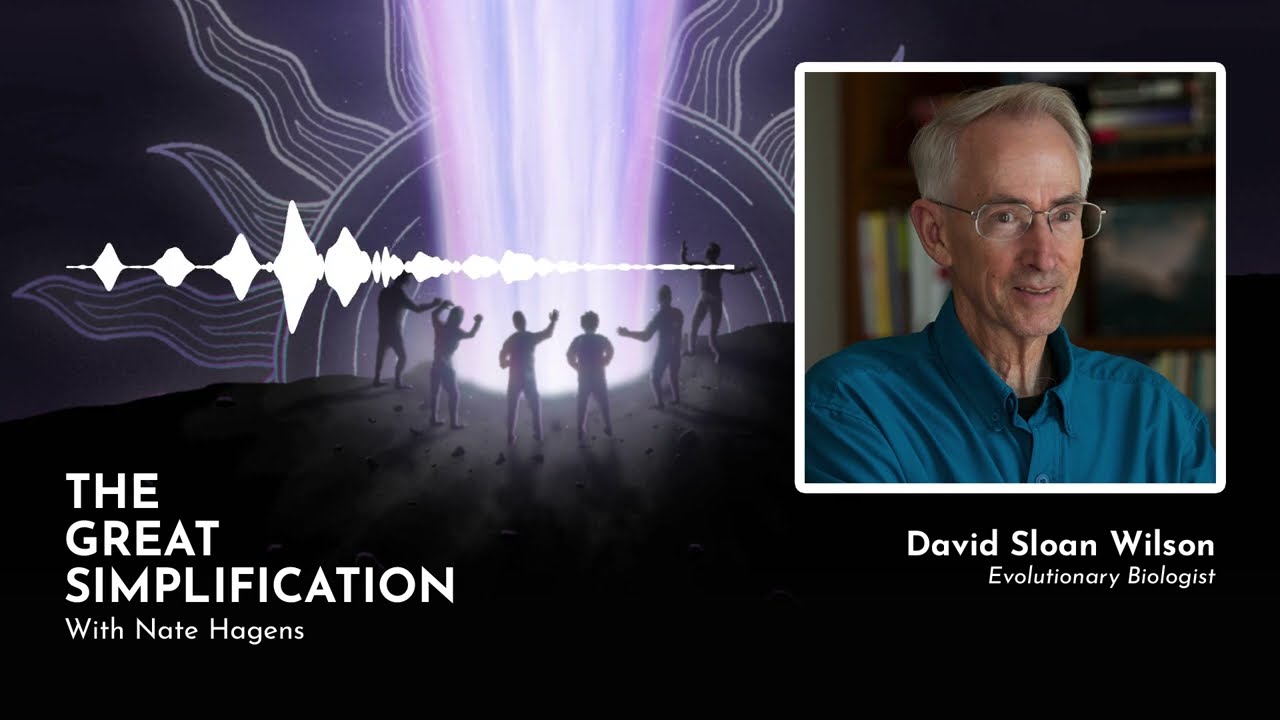
- Why this video: This video directly addresses the gap regarding Ostrom's 8 Design Principles. Evolutionary biologist David Sloan Wilson breaks down the principles in detail (group identity, graduated sanctions, fast conflict resolution) and explains how they facilitate human cooperation in managing shared pools.
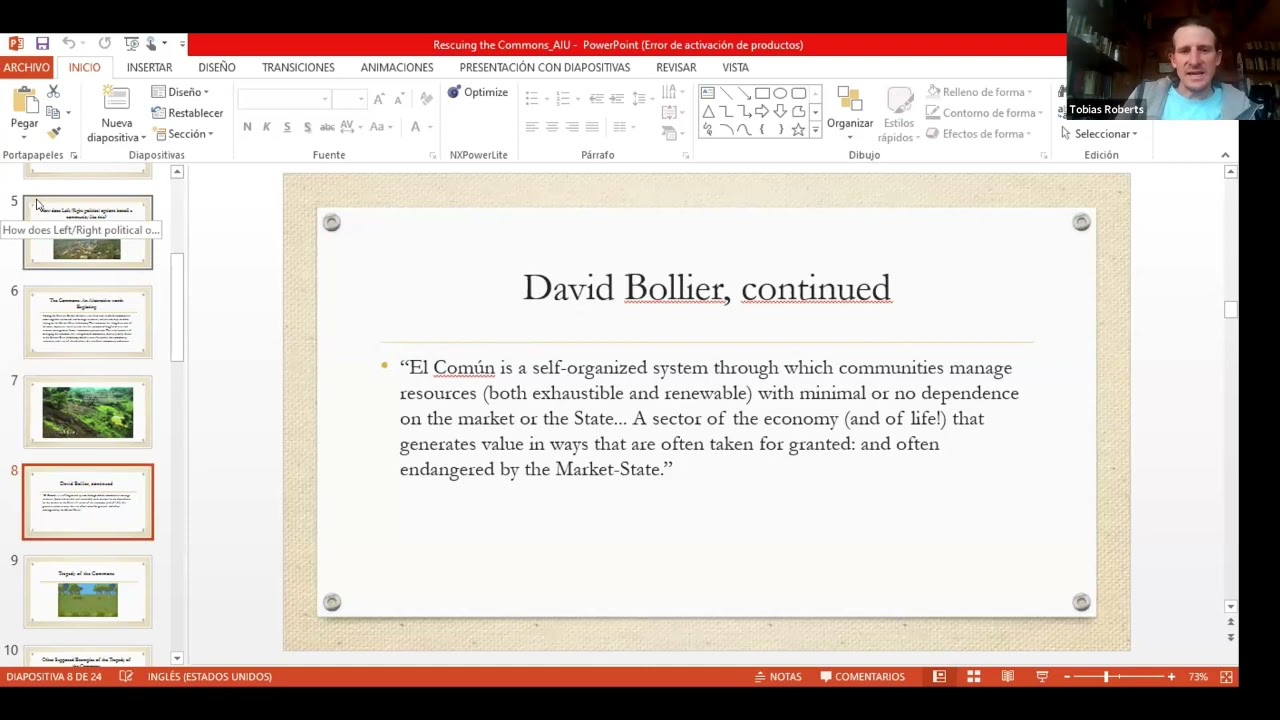
- Why this video: This lecture dives deep into the sociological and spatial aspects of Ostrom's principles. It explores how defining boundaries, matching rules to local conditions, and establishing democratic monitoring mechanisms can operationalize community-based natural resource management.
Knowledge Checkpoint
- List at least five of Elinor Ostrom’s 8 Design Principles for managing common-pool resources.
- Explain how "graduated sanctions" work to preserve trust within a community-managed resource pool.
- Contrast Ostrom's "third way" with the state control (Leviathan) model championed by early resource economists.
Module 5: Comparative Analysis: Solving Modern Commons Dilemmas
This capstone module evaluates and compares the three major paradigms of resource management across modern, real-world case studies. Focus will be placed on fisheries—contrasting Individual Transferable Quotas (ITQs) with community-managed models—as well as global issues like climate change and international water basins. You will learn how to diagnose which institutional solution (private, public, or collective) is best suited for a given environmental and social context.
Recommended Videos

- Why this video: This video provides a comprehensive breakdown of Individual Transferable Quotas (ITQs) as a market solution. It demonstrates how ITQs align incentives by granting fishermen property rights over a fraction of the Total Allowable Catch (TAC), preventing "the race to fish."

- Why this video: This economic lecture directly addresses the gap of contrasting ITQs against top-down regulation (such as seasonal closures or gear limits). It demonstrates how command-and-control can generate massive economic inefficiencies and safety hazards compared to quota-based systems.

- Why this video: This video targets the gap of community-based fishery management by showcasing a real-world case study: the Eskasoni First Nation fishery. It illustrates how local indigenous communities develop, monitor, and enforce their own sustainable limits based on traditional governance, bypassing top-down state control.

- Why this video: This video scales up the tragedy of the commons to the ultimate global public good: the atmosphere. It explores why international climate change agreements are incredibly difficult to monitor and enforce, linking back to the free-rider and collective action dilemmas covered in earlier modules.
Knowledge Checkpoint
- Explain how Individual Transferable Quotas (ITQs) transform an open-access fishery into a market-based property system.
- Compare the economic and safety outcomes of "season length restrictions" versus ITQs in commercial fisheries.
- Analyze why Ostrom's community-level solutions are harder to apply to global commons challenges like climate change, and describe what kind of mixed institutional arrangements are required to address them.
Course Map
Key People Index
- Elinor Ostrom (1933–2012): An American political economist who was awarded the 2009 Nobel Memorial Prize in Economic Sciences for her groundbreaking analysis of economic governance, especially the commons. She demonstrated that communities can self-govern common-pool resources sustainably without relying entirely on privatization or state intervention.
- Garrett Hardin (1915–2003): An American ecologist who popularized the term "Tragedy of the Commons" in his influential 1968 paper published in Science. Hardin argued that unchecked population growth and open access to scarce resources would inevitably lead to ruin, necessitating either "private property or coercive state regulation."
- Ronald Coase (1910–2013): A British economist who received the 1991 Nobel Memorial Prize in Economic Sciences. He is best known for developing the "Coase Theorem," which argues that in the presence of externalities, clearly defined property rights and low transaction costs will lead to economically efficient market allocations through private negotiation.
Final Self-Assessment
Perform a self-directed review of your understanding of this curriculum by answering and checking off the following master objectives:
- I can classify any given economic good into its correct quadrant based on its level of rivalry and excludability.
- I can explain why the Nash Equilibrium in a standard open-access resource game results in resource depletion.
- I can mathematically and conceptually illustrate how Garrett Hardin's classic model of the pasture operates.
- I can list and define the mechanisms of the Coase Theorem and outline its limitations in the real world (e.g., high transaction costs).
- I can compare command-and-control regulation (such as quotas and gear bans) with market-based approaches (such as Pigouvian taxes and transferable permits).
- I can describe Elinor Ostrom's 8 Design Principles and identify how they are applied in local, community-governed commons.
- I can distinguish between the institutional designs of an Individual Transferable Quota (ITQ) fishery and a traditional community-managed fishery (like the Eskasoni model).
- I can apply models of common-pool resource solutions to analyze the strengths and weaknesses of international agreements addressing global climate change.