Conceptual Metaphors: Lakoff, Domains & Speech
Learning Goal: Map conceptual metaphors in political discourse and everyday speech by applying Lakoff and Johnson's Conceptual Metaphor Theory to identify target and source domains.
- Prerequisites: No prior knowledge of linguistics is required, though a basic familiarity with rhetoric and political communication is beneficial.
- Estimated Study Time: 9 hours
Module 1: Introduction to Metaphor: Beyond Literary Devices
In this module, you will transition from viewing metaphors as mere poetic embellishments or stylistic ornaments to understanding them as fundamental cognitive mechanisms. You will learn the difference between the traditional literary definition of metaphor and its contemporary definition within cognitive linguistics, realizing that we think, act, and reason through metaphorical frameworks.

Why this video
This video provides a concise baseline distinction. It contrasts the literary view of metaphor (as a highly specific, decorative textual device) with the linguistic view, laying the groundwork for studying metaphor as an active cognitive structure.
- Explain how literary scholars define metaphor differently than cognitive linguists.
- Articulate the core difference between a stylistic device and a cognitive framework.

Why this video
Jane Hirshfield provides a highly accessible visual exploration of how metaphors function beyond literal declarations. The video illustrates how metaphors bypass analytical defenses by connecting abstract sensations directly to our imaginative and sensory pathways.
- Identify how metaphors bridge abstract ideas with sensory experiences.
- Define how a metaphorical expression alters the way an audience evaluates a statement compared to a literal declaration.

Why this video
James Geary presents compelling statistical and historical proof of the ubiquity of metaphorical language, showing that we use approximately six metaphors per minute in regular speech. This video is crucial for understanding how deeply metaphorical thinking is integrated into daily life.
- Recognize the average frequency of metaphor usage in everyday communication.
- Explain Aristotle's classical definition of metaphor ("giving a thing a name that belongs to something else") and how it relates to modern cognitive views.

Why this video
This lecture bridges the gap between language and actions. Kevlin Henney references the pioneering work of George Lakoff and Mark Johnson, demonstrating how metaphorical systems govern our logic and problem-solving processes within technical fields like software development.
- Describe how metaphors influence practical actions and systems design.
- Give an example of a non-literary field where metaphors are used as foundational structural tools.
Module 2: Lakoff & Johnson's Conceptual Metaphor Theory
This module focuses on the core mechanics of Conceptual Metaphor Theory (CMT) as developed by George Lakoff and Mark Johnson in their seminal work, Metaphors We Live By (1980). You will master the terminology of "source domains" and "target domains," understand how unidirectional mappings are constructed, and explore how these mappings are rooted in physical, embodied experiences.

Why this video
This animated summary outlines the key premises of Metaphors We Live By. It offers a visual layout of how our human conceptual system is fundamentally structured and defined by metaphorical mappings, making abstract reasoning possible.
- State the foundational thesis of George Lakoff and Mark Johnson's 1980 work.
- Explain what it means for human concepts to be "fundamentally metaphorical in nature."

Why this video
Linguist Martin Hilpert provides a rigorous introduction to CMT's structural terms. He introduces the precise definitions of "source domain" and "target domain," demonstrating how cognitive linguistics treats metaphor as a conceptual process rather than a lexical decoration.
- Define "source domain" and "target domain" with linguistic accuracy.
- Explain the unidirectional nature of cognitive mappings (mapping from concrete to abstract).
Why this video
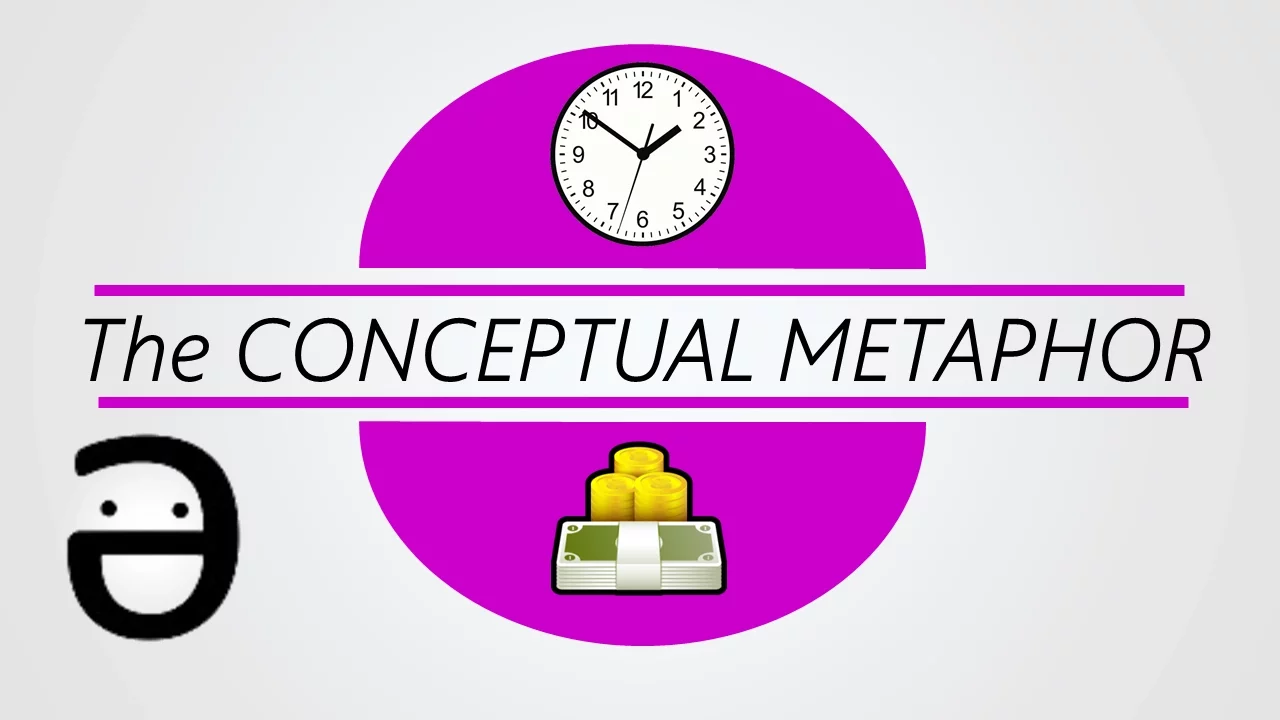
This short, highly focused explainer reinforces the cognitive mechanics of conceptual metaphors. It helps clarify how we use familiar, concrete experiences (source) to conceptualize and discuss unfamiliar or highly abstract experiences (target).
- Identify the source and target domains in a given conceptual metaphor.
- Contrast a linguistic "metaphorical expression" with an overarching "conceptual metaphor."
Why this video
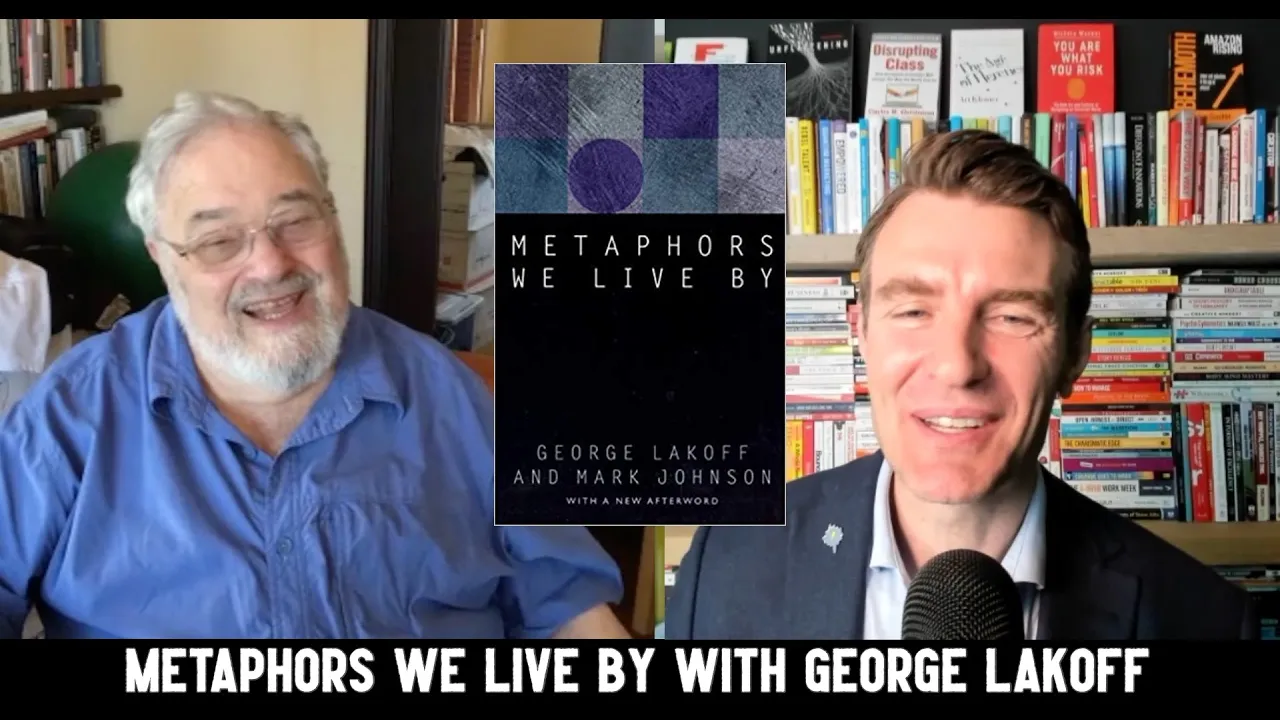
This extensive, deep-dive interview features George Lakoff himself discussing his life's work. Watching Lakoff discuss CMT firsthand provides an unparalleled look into the intellectual history of cognitive science, embodiment, and how our neural circuitry forms connections between physical experience and abstract thought.
- Describe the "embodiment hypothesis" and how abstract metaphors develop from physical, sensory-motor experiences.
- Discuss the relationship between physical environments and the cognitive development of conceptual domains.
Module 3: Analyzing Conceptual Metaphors in Everyday Speech
This module explores how conceptual metaphors construct our everyday language. To address gaps identified in standard video curricula, we will focus specifically on categorizing and comparing Lakoff & Johnson's three main types of conceptual metaphors: Structural, Orientational, and Ontological metaphors.
Typology Primer:
- Structural Metaphors: Where an abstract concept is systematically structured and understood in terms of another concrete concept (e.g.,
ARGUMENT IS WARorTIME IS MONEY). - Orientational Metaphors: Metaphors that organize a whole system of concepts with respect to spatial orientations (e.g.,
HAPPY IS UP/SAD IS DOWN,CONTROL IS UP). - Ontological Metaphors: Metaphors where events, activities, emotions, or ideas are conceptualized as physical objects or substances, allowing us to quantify, group, or refer to them as bounded entities (e.g.,
THE MIND IS A MACHINE, or referring to inflation as an entity that "combats" or "grows").

Why this video
This concise explanation highlights the structural nature of complex metaphorical systems. It shows how entire systems of thought are transferred from a concrete domain to construct our view of abstract targets.
- Define a structural metaphor and explain how it maps a multi-layered concrete system onto an abstract one.
- Provide two distinct examples of structural metaphors used in daily speech.

Why this video
Cognitive scientist Lera Boroditsky demonstrates how space-to-time mappings differ across cultures. This video is an excellent resource for analyzing orientational metaphors (spatial dimensions) and structural representations of time, proving that our conceptualization of abstract domains depends heavily on our spatial metaphors.
- Explain how horizontal versus vertical spatial orientations are used to map time in English versus Mandarin.
- Detail how an orientational metaphor relies on physical, bodily coordinates (such as front/back, up/down).

Why this video
Lakoff explains "primary metaphors" in this talk. He shows how simple pairings (like pouring water into a glass resulting in MORE IS UP, or feeling parental warmth resulting in AFFECTION IS WARMTH) establish foundational orientational and ontological mappings in early human development.
- Explain how the orientational metaphor
MORE IS UPis physically acquired in childhood. - Differentiate between a primary metaphor and a complex conceptual metaphor.

Why this video
This video breaks down everyday idiomatic expressions—specifically treating time as currency and life as a physical journey. It shows how structural metaphors like TIME IS MONEY and LIFE IS A JOURNEY shape how we frame personal stagnation and success.
- Break down the structural mappings of
LIFE IS A JOURNEY(identifying travelers, paths, and obstacles). - Explain how everyday phrases (e.g., "wasting time," "spending hours") stem from a singular underlying conceptual mapping.
Module 4: Political Framing and Metaphorical Discourse
This module focuses on political communication. You will learn how politicians, media outlets, and interest groups use conceptual metaphors to frame public policy issues, guide public opinion, and activate specific moral models. We will examine Lakoff’s "strict father" versus "nurturant parent" models of the nation-as-family.
Why this video
In this presentation, George Lakoff introduces cognitive framing and its critical role in political discourse. He details the two competing moral frames that structure American politics, both of which are mapped from our understanding of the family domain.
- Define "cognitive frames" and how they organize linguistic meaning.
- Summarize the primary differences between the Strict Father model and the Nurturant Parent model.

Why this video
This recording of Lakoff’s classic "Don't Think of an Elephant" lecture is highly recommended. It details the NATION AS A FAMILY metaphor and explains why political arguments often fail when they attempt to argue against an opponent's frame using their opponent's own terms.
- Explain the linguistic rule of frame negation ("Don't think of an elephant!").
- Identify how political positions on taxation, social safety nets, and crime stem from the
NATION AS A FAMILYconceptual metaphor.

Why this video
This comprehensive Google Talk challenges Enlightenment-era notions of pure rationalism. Lakoff demonstrates that voters do not make decisions based on simple fact-checking; rather, they process facts through subconscious conceptual frameworks, frames, and metaphors.
- Explain why fact-based arguments can fail to change public opinion if they do not fit existing cognitive frames.
- Describe the role of neural circuitry in political reasoning and decision-making.

Why this video
This video essay provides a detailed look at political metaphors in action. It explains how metaphors highlight certain features of a political issue while hiding others. It focuses specifically on the "War on Terror" metaphor, showing how framing policy as "war" shapes public expectations of government action.
- Describe the "highlighting and hiding" effect of conceptual metaphors in policy debates.
- Analyze how framing a social or geopolitical issue as a "War" (e.g., War on Drugs, War on Terror) shapes policy options and limits alternative approaches.
Module 5: Hands-On Metaphor Mapping and Discourse Analysis
This module teaches you how to conduct empirical metaphor analysis on raw texts. We will focus on two formal academic methodologies: the Metaphor Identification Procedure (MIPVU) developed by the Pragglejaz Group (further refined by Gerard Steen), and Critical Metaphor Analysis (CMA) by Jonathan Charteris-Black.
Methodology Overview:
- MIPVU Step-by-Step Procedure:
- Step 1: Read the entire text/discourse to establish a general understanding.
- Step 2: Identify individual lexical units (words).
- Step 3: For each word:
- Determine its meaning in context (the contextual meaning).
- Determine if there is a more basic, concrete, physical, or historically older meaning.
- Check if the contextual meaning contrasts with the basic meaning but can be understood in comparison to it.
- Step 4: If yes, mark the word as metaphorical.
- Critical Metaphor Analysis (CMA): Integrates cognitive linguistics with critical discourse analysis (CDA) to reveal the underlying ideologies and power dynamics behind why specific metaphors are used in public texts.

Why this video
This academic video details the MIPVU method. It outlines the four steps required to systematically identify and verify metaphors in raw text, helping you move from intuitive identification to rigorous academic analysis.
- List the four major steps of the MIPVU methodology.
- Distinguish between a word's "contextual meaning" and its "basic concrete meaning" to determine if a metaphor is present.

Why this video
This video explains Jonathan Charteris-Black’s Critical Metaphor Analysis (CMA) framework. It shows how researcher Anna Góral combines CMT, corpus linguistics, and critical discourse analysis to study historical press materials and track how metaphors shift over time to build social narratives.
- Define the three pillars of Critical Metaphor Analysis (CMA).
- Explain how analyzing historical metaphors can reveal shifts in societal power dynamics and underlying ideologies.
Why this video
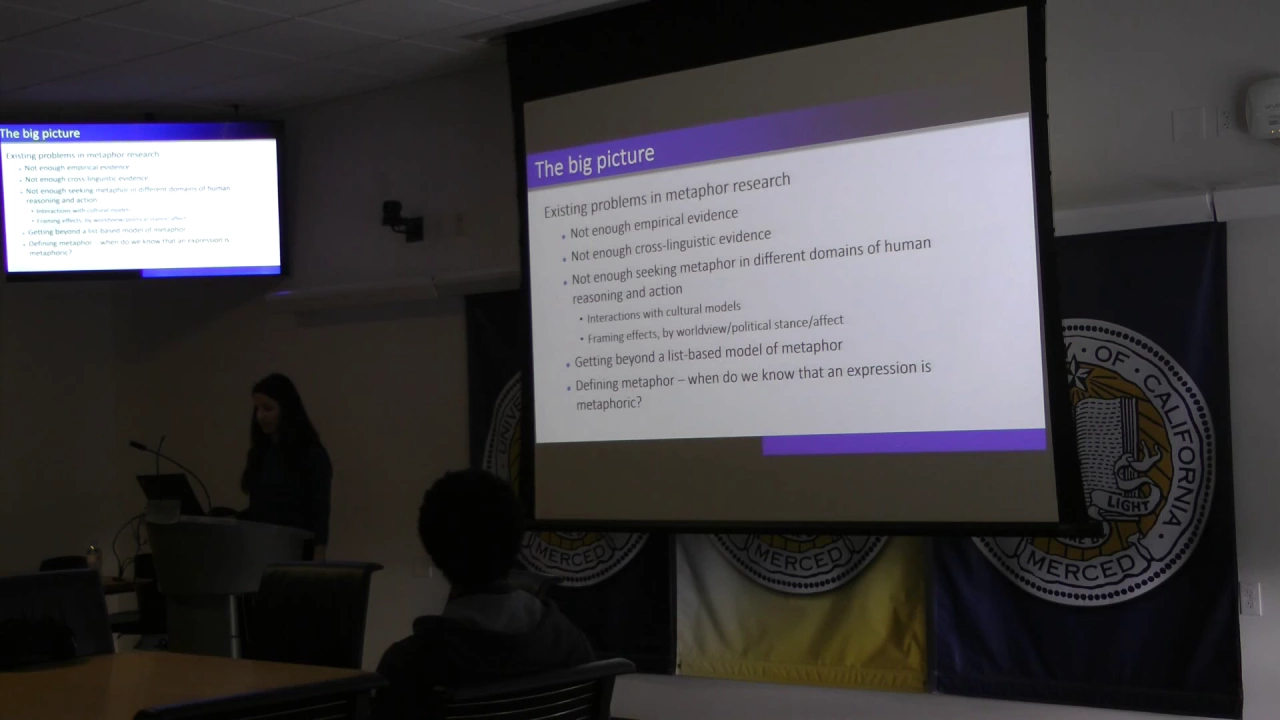
Dr. Oana David discusses "metaphor ontologies." She explains how conceptual metaphors are structured in complex, hierarchical networks (such as a "journey" frame containing roles like paths, obstacles, and destinations), helping us map how specific words evoke broader conceptual frameworks.
- Explain how a metaphor ontology maps linguistic elements to specific structural roles within a source frame.
- Map three distinct physical roles of a "Journey" source domain to an abstract political target domain (e.g., passing a bill).
Methodological Self-Study Recommendation:
Because short videos can rarely demonstrate a full qualitative coding session, you are encouraged to download and read the original Pragglejaz Group (2007) paper: "MIP: A Method for Identifying Metaphorically Used Words in Discourse" alongside your video work to practice hands-on coding.
Course Map
This flowchart maps the recommended learning path, showing how foundational cognitive theory leads to political discourse analysis and empirical research methods.
Key People Index
- George Lakoff: Distinguished Professor Emeritus of Cognitive Science and Linguistics at UC Berkeley. Co-founder of Cognitive Linguistics and co-author of Metaphors We Live By (1980) and author of Don't Think of an Elephant! (2004).
- Mark Johnson: Knight Professor of Liberal Arts and Sciences in the Department of Philosophy at the University of Oregon. Co-author of Metaphors We Live By (1980); developer of the theory of embodied mind and image schemata.
- Lera Boroditsky: Cognitive Scientist and Professor at UC San Diego. Renowned for her research on linguistic relativity and how spatial conceptual metaphors shape our perception of time and agency across cultures.
- Jonathan Charteris-Black: Professor of Linguistics at the University of the West of England. Developed Critical Metaphor Analysis (CMA), integrating CMT with corpus-based critical discourse studies.
- Gerard Steen: Professor of Language and Communication at the University of Amsterdam. Refined the Pragglejaz Group's Metaphor Identification Procedure into the standardized MIPVU framework.
Final Self-Assessment
Test your understanding of the curriculum by completing this comprehensive self-assessment:
- Distinguish between a traditional literary metaphor and a conceptual metaphor as defined by cognitive linguistics.
- Define the terms "source domain" and "target domain" and explain why mapping between them is unidirectional.
- Explain the "embodiment hypothesis" and identify how physical experience shapes our abstract metaphors.
- Classify a set of daily metaphors into Lakoff & Johnson's three categories: Structural, Orientational, and Ontological.
- Identify and map the source and target domains of the structural metaphor
TIME IS MONEY. - Detail the cognitive mechanisms of Lakoff's "Strict Father" and "Nurturant Parent" political frames.
- Explain the concept of "frame negation" and describe its importance in political debate.
- Apply the four step-by-step rules of the Metaphor Identification Procedure (MIPVU) to a short text sample.
- Outline how Critical Metaphor Analysis (CMA) combines CMT with Critical Discourse Analysis to examine power dynamics in public texts.