Distributive Justice: Rawls, Nozick & Nussbaum
Learning Goal: Compare contemporary theories of distributive justice, analyzing John Rawls's justice as fairness, Robert Nozick's libertarian entitlement theory, and the capabilities approach developed by Martha Nussbaum and Amartya Sen.
- Prerequisites: None (An introductory background in basic political science or ethical theory is helpful but not required).
- Estimated Total Study Time: 10 Hours
Module 1: Introduction to Distributive Justice
This module introduces the foundational questions of economic and social justice. You will explore how societies grapple with the allocation of resources, rights, opportunities, and burdens. By contrasting fundamental conceptions of justice (equality, equity, merit, and need), you will establish the necessary philosophical groundwork to critically engage with modern distributive frameworks.

Why this video
This video provides a rapid, engaging, and highly accessible entry point into the core debates of distributive justice. It structures the landscape by breaking down the four major competing criteria for distribution: strict equality, need-based distribution, merit-based distribution, and utility. This high-level categorization helps you see the fundamental trade-offs involved in designing any social system.
Knowledge checkpoint
- Define the primary concern of distributive justice as distinct from corrective or retributive justice.
- Explain the difference between justice based on strict equality and justice based on need.
- Identify how merit-based distribution differs from utilitarian or welfare-maximizing approaches.
Why this video
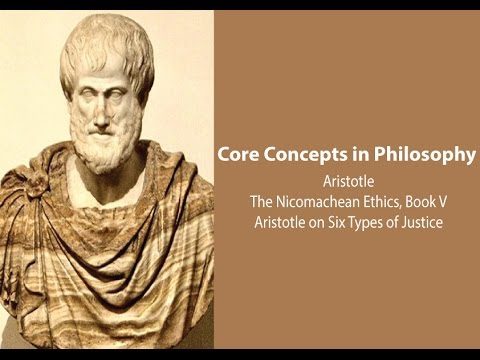
To understand contemporary debates, you must trace them back to their classical roots. Professor Gregory Sadler unpacks Aristotle’s classification of justice from the Nicomachean Ethics. This video clarifies that distributive justice is fundamentally about distributing shareable goods (money, honors, and opportunities) based on geometric proportion—meaning what is "fair" is tied to a relevant baseline of desert or criteria.
Knowledge checkpoint
- Articulate Aristotle’s distinction between general justice and particular justice.
- Explain how "geometric proportion" operates in Aristotelian distributive justice.
- Distinguish between distributive justice and rectificatory (corrective) justice.
Module 2: John Rawls and Justice as Fairness
This module dives deeply into John Rawls’s monumental contractarian masterpiece, A Theory of Justice (1971). You will explore his famous thought experiment—the Original Position—and the cognitive constraint known as the "Veil of Ignorance." You will study his two fundamental principles of justice: the Equal Liberty Principle and the joint principles of Fair Equality of Opportunity and the Difference Principle.

Why this video
This animated short by BBC Radio 4 offers an intuitive, visually striking explanation of Rawls's most famous heuristic device: the Veil of Ignorance. It demonstrates how stripping away self-knowledge (of our class, gender, race, talents, and vulnerabilities) forces us to design a society that is fair to everyone, particularly the most vulnerable, because we ourselves might end up in that position.
Knowledge checkpoint
- Explain the mechanics of the "Veil of Ignorance" thought experiment.
- Describe why rational actors behind the veil would reject utilitarianism.
- Clarify how the veil is designed to neutralize arbitrary natural and social contingencies (moral luck).
Why this video
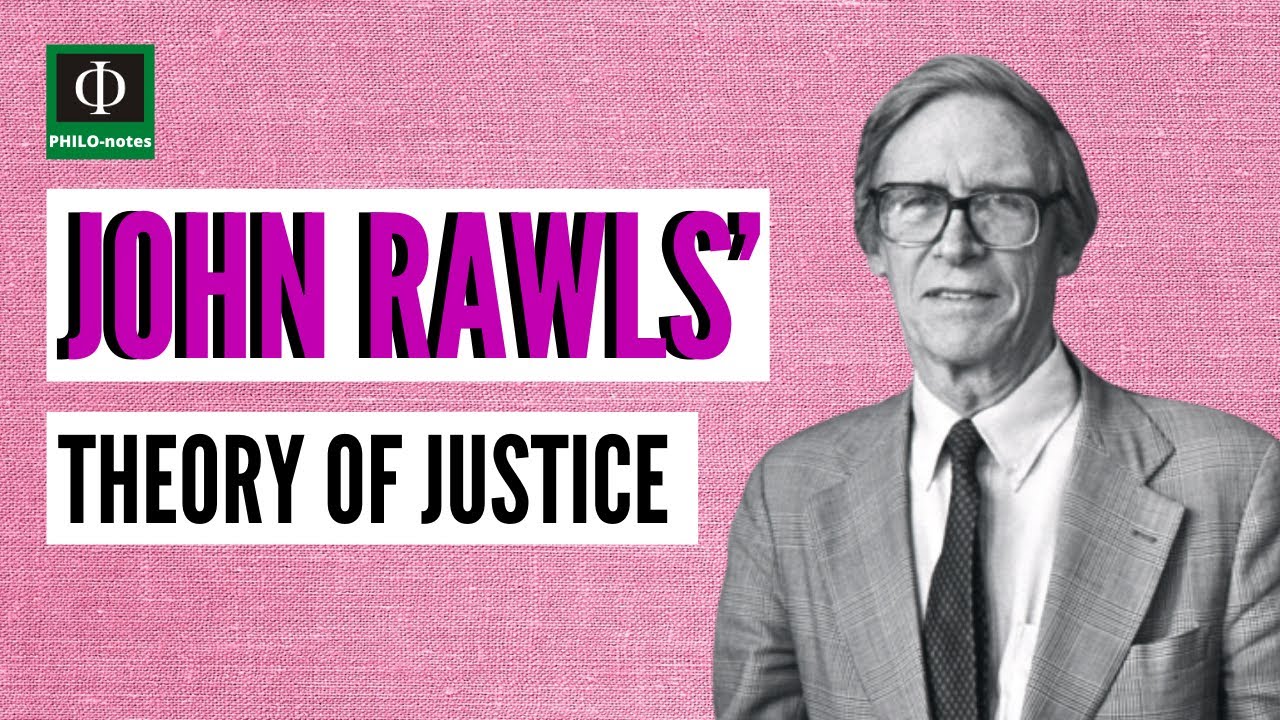
This video provides a systematic, clear overview of Rawls's complete philosophical architecture. It moves beyond the thought experiments to explain how they generate his two specific principles of justice, showing how Rawls balances personal liberty with social and economic equality.
Knowledge checkpoint
- State Rawls’s First Principle (the Equal Liberty Principle).
- Explain the two parts of Rawls's Second Principle: Fair Equality of Opportunity and the Difference Principle.
- Analyze how Rawls justifies inequalities under the Difference Principle (i.e., only if they work to the maximum benefit of the least advantaged).

Why this video
Dr. Gregory Sadler offers a precise, close-reading analysis of Rawls’s two principles. This video is crucial because it highlights the lexical ordering of Rawls’s principles: liberty cannot be traded off for economic efficiency or greater redistribution. Understanding this priority is essential for distinguishing Rawls from both pure libertarians and state socialists.
Knowledge checkpoint
- Define what "lexical priority" means in the context of Rawls's principles.
- Explain why basic liberties (Principle 1) take absolute priority over socioeconomic arrangements (Principle 2).
- Define "primary social goods" and explain why Rawls uses them as his currency of justice.
Module 3: Robert Nozick and Libertarian Entitlement Theory
This module examines the primary libertarian challenge to Rawlsian liberalism, formulated by Robert Nozick in Anarchy, State, and Utopia (1974). You will analyze Nozick’s historical, non-patterned "Entitlement Theory," explore the concepts of self-ownership and property rights, and dissect his famous Wilt Chamberlain thought experiment.
Curriculum Note on Gaps: Standalone, highly polished video explainers specifically targeting Nozick are less common online. To master this module, focus carefully on the structural breakdown in the videos below and supplement your study by searching for terms like "Nozick's critique of end-state justice" or reading Chapter 7 of Anarchy, State, and Utopia.
Why this video
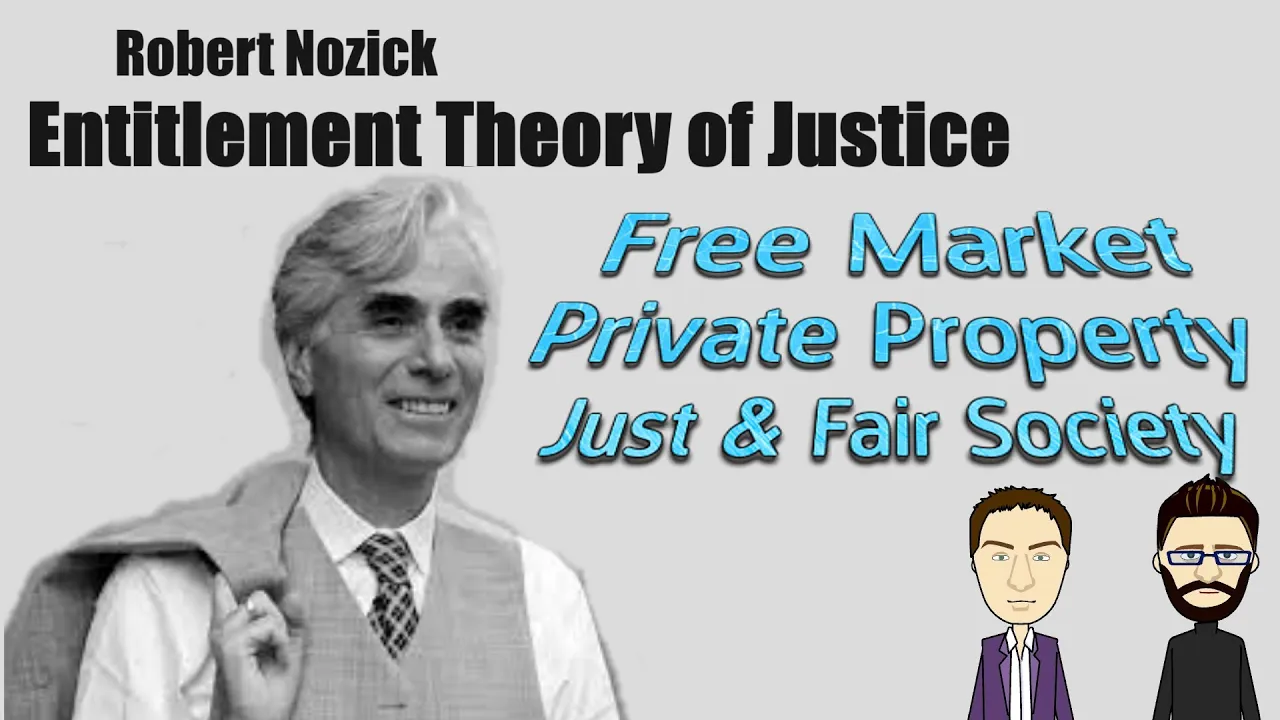
This video is a comprehensive resource for understanding Nozick’s philosophy. It uses a structured debate format to walk you through the three pillars of the Entitlement Theory: justice in acquisition, justice in transfer, and rectification of past injustices. It also outlines Nozick's arguments for why taxation of earnings from labor is morally equivalent to forced labor.
Knowledge checkpoint
- Outline the three core principles of Nozick's Entitlement Theory.
- Explain the difference between historical theories of justice and "end-state" (or patterned) theories of justice.
- Reconstruct Nozick’s argument comparing income taxation to forced labor.

Why this video
This short, historic archival clip features the eminent legal philosopher Ronald Dworkin explaining Nozick's "Wilt Chamberlain" argument. Dworkin explains how voluntary transactions among individuals inevitably disrupt any pre-established, patterned distribution of wealth. This demonstrates why Nozick believed that maintaining a preferred distribution requires continuous, unjustifiable interference with individual liberty.
Knowledge checkpoint
- Reconstruct the Wilt Chamberlain thought experiment.
- Explain the phrase: "Liberty upsets patterns."
- Articulate why Nozick believes patterned distribution principles violate individual self-ownership.
Why this video
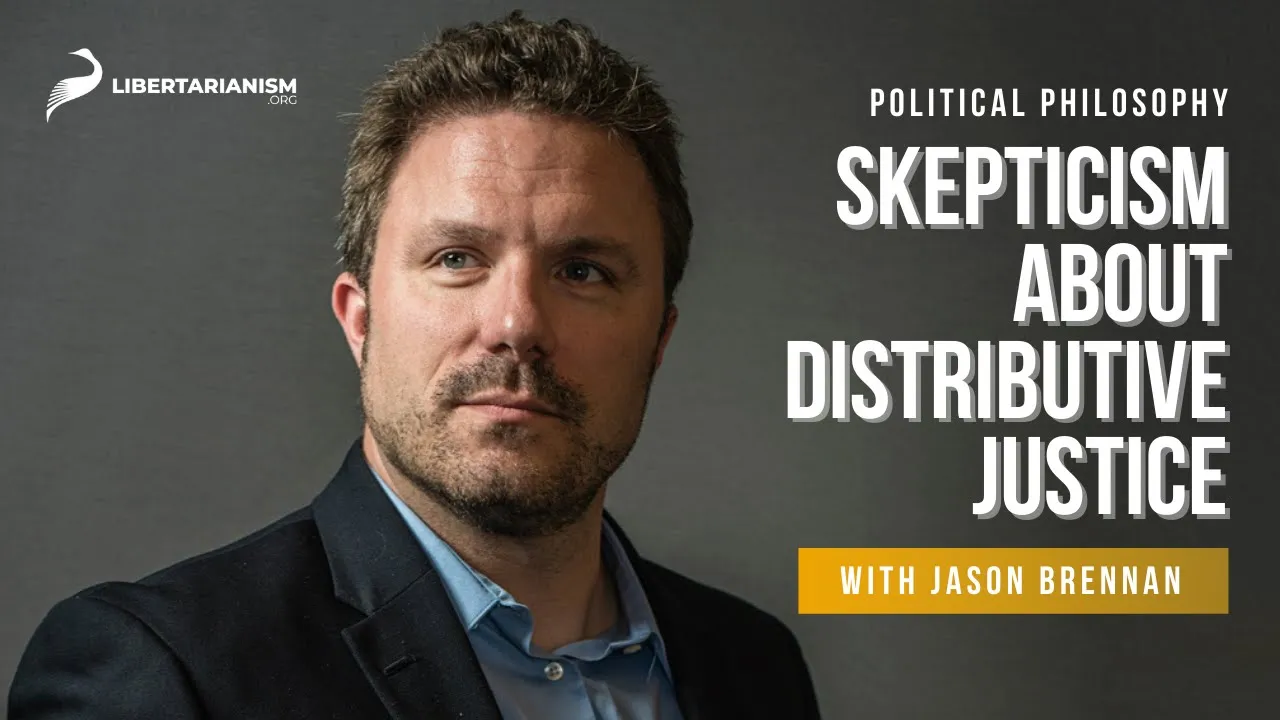
Presented by political philosopher Jason Brennan, this video explores the structural skepticism libertarians hold toward the very term "distributive justice." Brennan explains how markets are spontaneous orders rather than centralized machines, meaning there is no central "distributor" who can allocate wealth fairly.
Knowledge checkpoint
- Explain why libertarians argue that "distribution" is a misleading metaphor for market economies.
- Distinguish between procedural justice (focusing on the rules of the game) and outcome justice (focusing on the final score).
- Explain the role of the "Lockean Proviso" in Nozick’s theory of property acquisition.
Module 4: The Capabilities Approach: Sen and Nussbaum
This module explores the Capabilities Approach, developed by economist Amartya Sen and philosopher Martha Nussbaum. You will examine their critique of resource-based metrics (like GDP or Rawlsian primary goods) and utility-based metrics. Instead, you will study justice as the expansion of "capabilities" (what people are actually able to do and be) and "functionings" (achieved states of being), focusing on Nussbaum’s list of Ten Central Capabilities.

Why this video
In this segment from the documentary Examined Life, Martha Nussbaum walks through Chicago and explains her philosophy in real-world terms. She contrasts the Capabilities Approach with traditional economic metrics (GDP per capita), demonstrating how resource-focused measures can ignore deep social inequalities, bodily integrity, and basic human dignity.
Knowledge checkpoint
- Define the Capabilities Approach in your own words.
- Explain Nussbaum’s critique of GDP as a metric for measuring human development or justice.
- Describe how the Capabilities Approach integrates the physical vulnerability and social interdependencies of human life.

Why this video
Published by Harvard University Press, this video features Nussbaum explaining her structured framework from her book Creating Capabilities. She details why resource-based approaches like Rawls's "primary goods" are insufficient because different people require different amounts of resources to achieve the same level of capability (e.g., a person in a wheelchair requires different resources for mobility than an able-bodied person).
Knowledge checkpoint
- Distinguish between a "capability" (a potential or freedom) and a "functioning" (an active realization).
- Explain why Nussbaum believes we must focus on capabilities rather than final achievements to protect individual freedom.
- Identify several of Nussbaum's "Ten Central Capabilities" (e.g., Life, Bodily Health, Senses/Imagination/Thought).

Why this video
This video provides a helpful conceptual breakdown of Amartya Sen's original economic formulation of the approach. It clarifies how Sen views development as freedom and emphasizes the conversion factors (personal, social, and environmental) that dictate how effectively individuals can turn resources into real-world capabilities.
Knowledge checkpoint
- Explain Amartya Sen's concept of "conversion factors" (personal, social, environmental).
- Explain why Sen's version of the Capabilities Approach avoids prescribing a fixed list of capabilities, contrasting with Nussbaum's approach.
- Describe how the Capabilities Approach redefines "poverty" (as capability deprivation, not merely income deficit).
Module 5: Comparative Synthesis and Real-World Applications
This final module synthesizes the three theoretical frameworks—Rawls's Justice as Fairness, Nozick's Entitlement Theory, and the Capabilities Approach—and applies them to modern policy crises. You will explore how these competing perspectives analyze wealth redistribution, taxation, public health, and global climate change.
Curriculum Note on Gaps: There is no single video in the wild that summarizes Rawls, Nozick, and Nussbaum side-by-side in one sitting, nor one that applies all three to climate justice. Use the structural synthesis below, alongside the targeted application videos, to build your comparative framework.

Why this video
This lecture segment from Yale University compares John Rawls and Robert Nozick on the issue of "moral luck." It provides a clear contrast between Rawls's view that our natural talents and social starting positions are arbitrary and should be shared collectively, and Nozick's view that we own our talents and are entitled to whatever we can produce with them.
Knowledge checkpoint
- Explain the concept of "moral luck" and how Rawls and Nozick differ in their treatment of it.
- Contrast Rawls’s collectivist view of natural assets with Nozick’s individualistic self-ownership view.
- Evaluate how each theorist would view the justice of a highly progressive inheritance tax.
Why this video
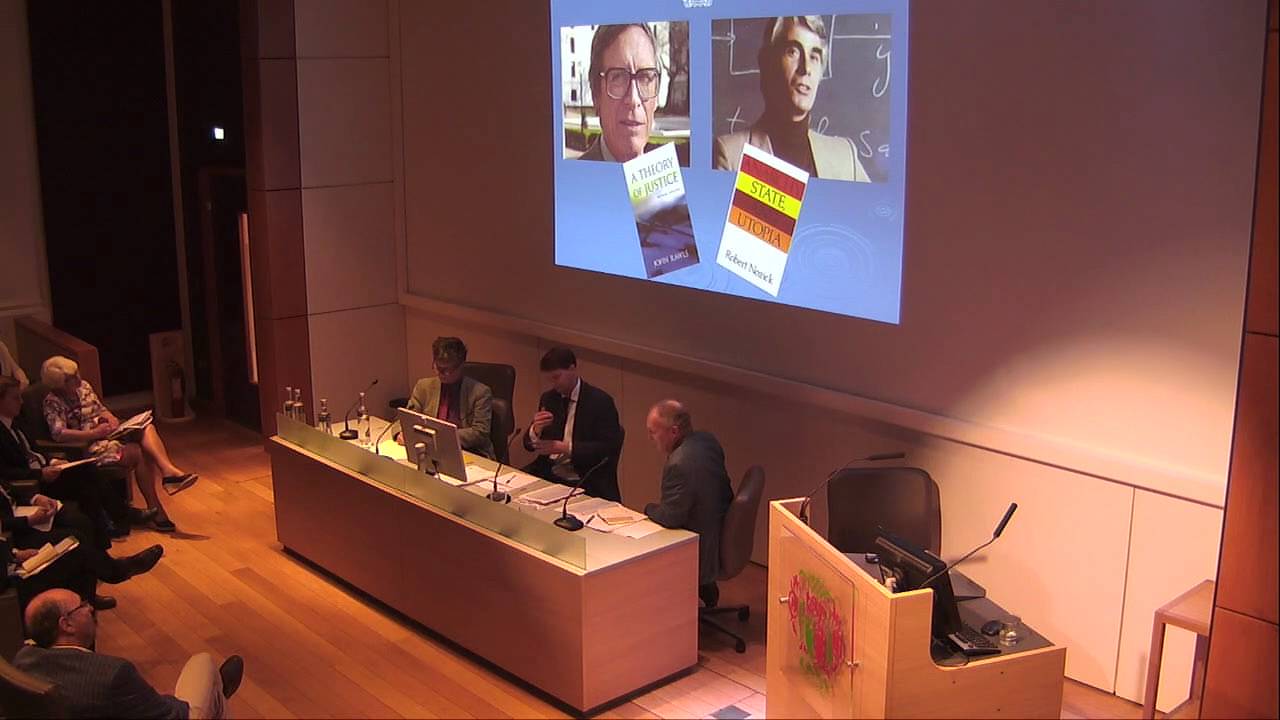
This deep-dive panel discussion from Oxford University provides a high-level academic comparison of Rawls and Nozick. It traces the legacy of their 1970s debate and analyzes how their differences continue to shape modern public policy, property rights, welfare state design, and the limits of individual liberty.
Knowledge checkpoint
- Summarize the core disagreement between Rawls and Nozick regarding the legitimate role of the state.
- Explain how a Rawlsian state differs from a Nozickian "minimal state" in practice.
- Discuss how the two frameworks evaluate the moral status of welfare programs.

Why this video
This TEDx talk applies debates over wealth, taxation, and democratic redistribution to a real-world context. This case study allows you to apply Rawls's Difference Principle, Nozick's Entitlement Theory, and the Capabilities Approach to a real-life situation involving inherited wealth.
Knowledge checkpoint
- Apply Nozick's historical justice principles to inherited wealth: is it just for a person to inherit millions without working?
- Analyze wealth tax proposals through the lens of Rawls's Difference Principle.
- Evaluate how a Capabilities theorist would argue for taxing extreme wealth to fund public "conversion factors" (like public education and health systems).

Why this video
This video addresses global climate justice, exploring how the costs and burdens of climate change should be distributed. By watching this panel, you can see how contemporary policy debates draw on principles of distributive justice—ranging from historical liability (similar to Nozick's "rectification") to safeguarding vulnerable groups (similar to Rawls's "Difference Principle" and Nussbaum's "central capabilities").
Knowledge checkpoint
- Define "distributive climate justice" (who should bear the economic and physical costs of climate mitigation).
- Apply Nozick's "rectification of past injustices" to the debate over historical carbon emissions by industrialized nations.
- Explain how the Capabilities Approach assesses the impact of climate change on human freedom and basic functionings (e.g., health, shelter, clean air).
Course Map
This map outlines the recommended learning path and shows how the modules build on each other conceptually.
Key People Index
| Name | Key Framework / Concept | Historical Significance & Context |
|---|---|---|
| John Rawls | Justice as Fairness, Original Position, Veil of Ignorance | Reinvigorated modern normative political philosophy in 1971 with A Theory of Justice. Proposed a liberal-egalitarian alternative to utilitarianism based on social contract theory. |
| Robert Nozick | Libertarian Entitlement Theory, Self-Ownership | Rawls’s colleague at Harvard who published Anarchy, State, and Utopia (1974). Developed a leading libertarian theory arguing for property rights, voluntary exchange, and a minimal state. |
| Amartya Sen | Capabilities Approach, Development as Freedom | Nobel Prize-winning economist who critiqued resource-based welfare economics. Argued that justice and development should focus on what people can actually do and be. |
| Martha Nussbaum | Capabilities Approach, Ten Central Capabilities | Philosopher who collaborated with Sen to develop the Capabilities Approach. Added a list of essential human capabilities to ground political constitutional guarantees in human dignity. |
| Michael Sandel | Communitarian Critique of Liberalism, Limits of Markets | Harvard professor whose lectures and books (e.g., Justice, The Tyranny of Merit) critique the unencumbered self of Rawlsian liberalism and the expansion of market values into non-market spheres. |
Final Self-Assessment
Test your understanding of the entire curriculum by verifying that you can confidently complete each of the following tasks:
- Reconstruct the primary structural disagreements between Rawls's contractarianism, Nozick's libertarianism, and Sen/Nussbaum's Capabilities Approach.
- Explain why John Rawls believes that natural talents are a "common asset" and how Robert Nozick counters this with his principle of "self-ownership."
- Demonstrate how a change in resource distribution behind the "Veil of Ignorance" would protect the least-advantaged members of society.
- Reconstruct Nozick's "Wilt Chamberlain" argument and explain why it poses a challenge to patterned principles of distribution.
- Explain why the Capabilities Approach critiques both utility-based and resource-based (income/wealth) metrics of well-being.
- List at least five of Martha Nussbaum’s "Ten Central Capabilities" and explain how they define a baseline of human dignity.
- Analyze a contemporary policy debate (such as progressive taxation or universal healthcare) from the perspectives of Rawls, Nozick, and Nussbaum.
- Explain how Nozick’s third principle—the rectification of past injustices—can be used to argue for historical climate reparations or resource redistribution.
- Define "lexical priority" and explain its significance in Rawls's theory of justice.
- Differentiate between "capabilities" and "functionings" within the framework developed by Sen and Nussbaum.