Metaphysics of Time: Theories & Paradoxes
Learning Goal: Examine the metaphysics of time, contrast Presentism and Eternalism, analyze the A-theory and B-theory of time, and evaluate the logical coherence of time travel paradoxes.
- Prerequisites: Introduction to basic metaphysical concepts (identity, change, and ontology). No prior physics background is required, though basic familiarity with Einstein’s Special Relativity is helpful.
- Estimated Total Study Time: 10 Hours
Module 1: Introduction to the Philosophy of Time
This module transitions your understanding of time from an intuitive, everyday experience to a rigorous metaphysical inquiry. You will explore whether time is a fundamental, independent feature of reality (Absolutism) or merely a relation between events (Relativism), and address the profound philosophical question: Is the flow of time an illusion?
Recommended Videos

Why this video: This video serves as an engaging entry point to the metaphysics of time, framing the core debate between tensed and tenseless frameworks. It bridges the gap between everyday intuitions and formal philosophy by unpacking how we conceptualize the "flow" of moments and presenting the fundamental questions that define the field.

Why this video: For students seeking a academic foundation, this lecture transitions the topic from pop-philosophy to rigorous scholarly analysis. It introduces the transition from spatial metaphysics to temporal metaphysics, laying the groundwork for McTaggart's historical challenge to the reality of time.

Why this video: This video introduces the historic debate between Absolutism (time exists independently of events, advocated by Newton) and Relativism (time is merely an order of relations between events, advocated by Leibniz). Understanding this dichotomy is essential before diving into 20th-century spacetime developments.
Knowledge Checkpoint
- Explain the core difference between temporal Absolutism (Substantivalism) and Relativism (Relationism).
- Define what philosophers mean when they query if the "passage" of time is an illusion.
- Articulate how temporal properties (past, present, future) differ from spatial properties (here, there).
Module 2: The Ontology of Time: Presentism vs. Eternalism
This module dives into the ontological status of temporal states. What actually exists? You will contrast Presentism (only the present exists) with Eternalism (past, present, and future are equally real). Additionally, we will cover the Growing Block Universe theory, a critical middle-ground position where the past and present are real, but the future is not.
Recommended Videos

Why this video: Led by physicist and philosopher Sean Carroll, this lecture provides an exceptionally clear breakdown of Presentism and Eternalism. Carroll details the conceptual tension between our subjective psychological experience of time and the objective "block" described by modern physics.

Why this video: This concise video introduces the Growing Block Universe theory, explaining how it attempts to respect human intuitions regarding the open, unwritten nature of the future while still treating the past as ontologically secure and real.

Why this video: This short presentation reinforces the specific arguments supporting the Growing Block model, focusing on how we justify the reality of the past through empirical evidence, contrasted with the ontological emptiness of the future.
Gap Alert: Independent Study on Growing Block Theory
While the pool videos introduce the Growing Block model, they are highly summarized. To master this concept, independently research the Growing Block Theory (originally formulated by C.D. Broad). Focus on the "dead past" objection: if past moments exist, what makes our current moment uniquely "present" and active, rather than just another static slice of the block?
Knowledge Checkpoint
- Contrast the ontological commitments of a Presentist with those of an Eternalist.
- Explain how the Growing Block Universe theory differs from both Presentism and Eternalism.
- Articulate the "No-Presenter" or "Dead Past" problem that challenges Growing Block theorists.
Module 3: McTaggart's A-Theory and B-Theory
In 1908, J.M.E. McTaggart published a famous proof claiming to show the unreality of time. This module deconstructs his proof and analyzes the resulting division in philosophy: the tensed A-theory (which asserts that past, present, and future are objective, changing properties of events) and the tenseless B-theory (which reduces time to static, permanent relations of "earlier than," "simultaneous with," and "later than").
Recommended Videos
Why this video: This lecture carefully steps through the logic of McTaggart's original argument. It explains the distinction between the A-series and the B-series, clarifying how McTaggart used these concepts to claim that our core understanding of time is fundamentally self-contradictory.
Why this video: This animation breaks down the core logical contradiction that McTaggart identified: that every event must possess the properties of being past, present, and future, yet these properties are mutually exclusive. It outlines McTaggart's proof in an easy-to-follow, visual format.

Why this video: This video introduces the A-theory, B-theory, and even C-theory frameworks, placing them within a broader metaphysical and theological context. It clarifies how a B-theory block operates without an objective, moving spotlight of "now."

Why this video: This short video highlights how B-theorists explain change without relying on an objective "flow" of time. It introduces the concept of "temporal parts," where objects are extended in time just as they are in space.
Knowledge Checkpoint
- Reconstruct McTaggart's proof for the unreality of time, explaining why he believes the A-series is contradictory.
- Distinguish between A-properties (tensed) and B-relations (tenseless).
- Explain how a B-theorist accounts for the perception of change through "temporal parts" (four-dimensionalism).
Module 4: Physics Meets Philosophy: The Relativity of Simultaneity
This module bridges physical science with metaphysics. Einstein's Special Relativity destroyed the concept of absolute, universal simultaneity. If what is "now" depends entirely on an observer's frame of reference, Presentism faces a devastating challenge. We will analyze how physics supports the B-theory/Eternalist block universe and evaluate the famous Rietdijk-Putnam argument.
Recommended Videos

Why this video: This video directly focuses on the Rietdijk-Putnam argument. It explains how Cornelis Rietdijk and Hilary Putnam used the relativity of simultaneity to prove that observers in relative motion have different "nows." This leads to the conclusion that future events must already exist, dealing a devastating blow to Presentism.
Why this video: This video unpacks the Andromeda Paradox, the thought experiment at the heart of the Rietdijk-Putnam argument. It illustrates how two people walking past each other on Earth can have different realities regarding whether an alien invasion fleet on Andromeda has launched or not.

Why this video: Physicist Sabine Hossenfelder outlines the core principles of Einstein’s Special Relativity. This video provides the underlying physics—specifically, the constant speed of light and the resulting relativity of simultaneity—needed to evaluate metaphysical claims about time.
Gap Alert: Presentist Responses to Relativity
The Rietdijk-Putnam argument is often presented as a complete defeat for Presentism. However, metaphysicians have fought back. For a balanced view, research Presentist replies to Rietdijk-Putnam, such as "Neo-Lorentzian Presentism" (which posits a privileged, albeit empirically undetectable, absolute reference frame) or "Point-Presentism" (which limits existence to a single spacetime point).
Knowledge Checkpoint
- Explain why the "relativity of simultaneity" makes it impossible to define a single, universal "now."
- Detail the steps of the Rietdijk-Putnam argument (using the Andromeda Paradox as a model) and explain how it supports Eternalism.
- Evaluate how a Presentist might respond to the threat posed by Special Relativity.
Module 5: The Metaphysical Coherence of Time Travel
Is time travel logically possible? This module evaluates the metaphysics of time travel, distinguishing between physical possibility (what the laws of physics allow) and logical coherence (what avoids contradiction). We will analyze the Grandfather Paradox and the Bootstrap Paradox, and examine David Lewis’s elegant solutions using four-dimensionalist frameworks.
Recommended Videos
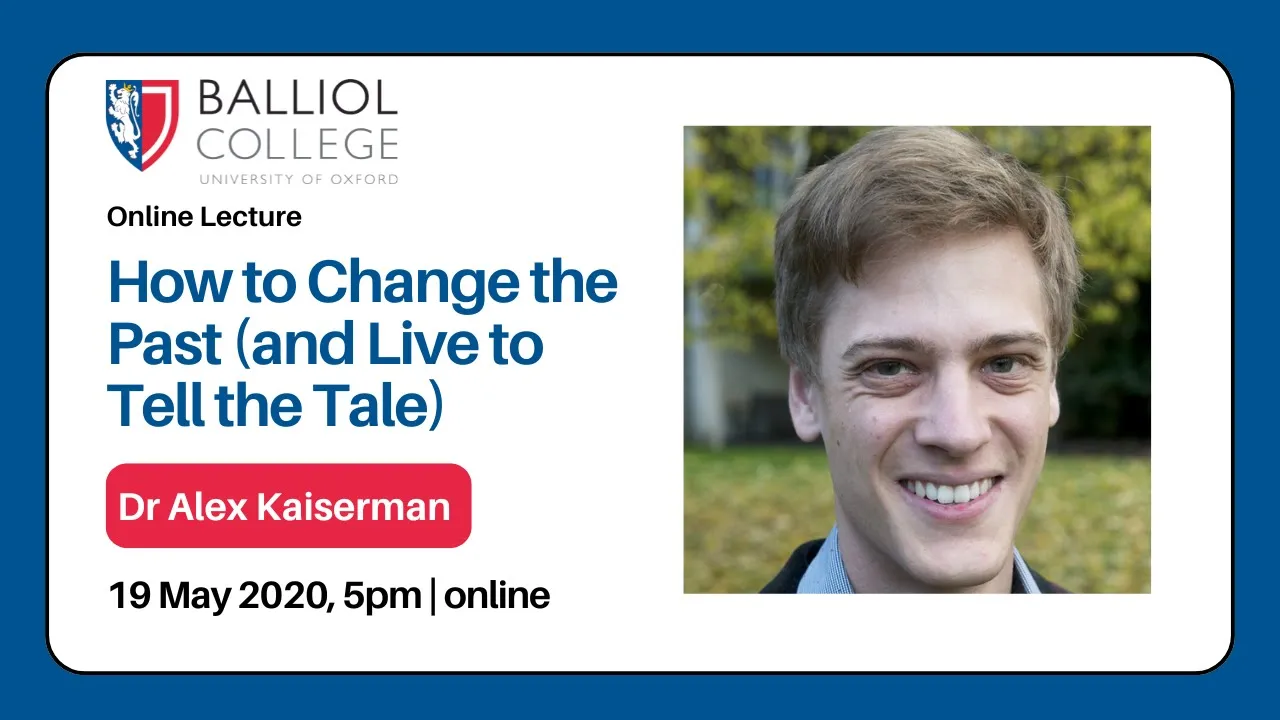
Why this video: This Oxford lecture addresses the philosophical definition of time travel and the apparent paradox of "changing" the past. Dr. Kaiserman introduces David Lewis’s distinctions—specifically personal time (the traveler's internal clock) versus external time (the background coordinate time of the universe)—to show how travelers can affect the past without changing it.

Why this video: Physicist Jim Al-Khalili explores the physics of Closed Timelike Curves (CTCs) and the logical constraints they impose, demonstrating how standard physics requires self-consistent loops to prevent paradoxes from occurring.

Why this video: Using a famous pop-culture monologue, this clip explains the Bootstrap Paradox (causal loop). While entertaining, it presents a key philosophical question: can information exist without an original creation event?
Gap Alert: David Lewis, Compossibility, and the Grandfather Paradox
Pop-culture videos often suggest that a time traveler "can" kill their grandfather but "chooses" not to, or that a new timeline branches off. To understand David Lewis's actual 1976 paper "The Paradoxes of Time Travel", you must grasp his concept of compossibility:
Can Tim kill his grandfather? In one sense, yes: he has the gun, the training, and the opportunity (it is compossible with his physical abilities). In another sense, no: it is not compossible with the fact that his grandfather survived, and Tim was born. There is no change to the past; Tim's attempt was always destined to fail in a logically consistent, single-universe block.
Knowledge Checkpoint
- Define the difference between "personal time" and "external time" as formulated by David Lewis.
- Explain the Grandfather Paradox and resolve it using Lewis’s concept of compossibility.
- Describe the Bootstrap Paradox and analyze whether a causal loop is logically impossible or merely strange.
Course Map
Key People Index
- John M.E. McTaggart (1866–1925): British idealist philosopher who proposed the unreality of time by introducing the concepts of the A-series (tensed) and B-series (tenseless).
- Albert Einstein (1879–1955): Theoretical physicist whose theories of Special and General Relativity revolutionized our understanding of time, replacing absolute time with relative spacetime.
- Cornelis Rietdijk & Hilary Putnam: Physicist and philosopher, respectively, who independently formulated the Rietdijk-Putnam argument, showing that Special Relativity demands an Eternalist/Block Universe ontology.
- David Lewis (1941–2001): Influential American philosopher who defended the possibility of time travel in a single, four-dimensional block universe using the concepts of personal/external time and compossibility.
- Sean Carroll (1966–Present): Theoretical physicist and philosopher of science who excels at explaining how the laws of physics intersect with the metaphysics of time and entropy.
Final Self-Assessment
Test your mastery of the Metaphysics of Time with these comprehensive questions:
- Can you define and contrast Presentism, Eternalism, and the Growing Block Universe theory?
- Do you understand McTaggart's proof for the unreality of time? Can you explain why he believes the A-series is contradictory and why the B-series alone cannot construct time?
- Can you explain the difference between the tensed A-theory of time and the tenseless B-theory of time?
- Do you understand the concept of four-dimensionalism (or perdurantism) and how objects can have "temporal parts"?
- Can you articulate the relativity of simultaneity and explain why it poses a major challenge to the Presentist perspective?
- Can you reconstruct the Rietdijk-Putnam argument (the Andromeda Paradox) and explain its support for Eternalism?
- Can you define the Grandfather Paradox and explain David Lewis’s logical resolution of it using compossibility?
- Can you explain the difference between personal time and external time?
- Can you define the Bootstrap Paradox and explain why a causal loop, while strange, does not contain a logical contradiction?