Cosmic Rays: Fermi Acceleration & GRBs
Learning Goal: "Exploring the origins of high-energy cosmic rays, the mechanisms of Fermi acceleration, and the observational signatures of gamma-ray bursts"
Prerequisites
- Physics Fundamentals: Classical Electromagnetism (Maxwell's Equations, Lorentz Force)
- Mathematical Background: Vector Calculus (cross products, gradients), basic Differential Equations
- Relativity: Basic concepts of Special Relativity (Lorentz factors, length contraction, time dilation)
Estimated Study Time
- Total Duration: ~14 Hours (including video runtime, mathematical derivations, notes reflection, and supplementary research)
Module 1: Introduction to Cosmic Rays and Astrophysics
This module establishes the foundational history, physical characteristics, and scales of cosmic rays. You will study how these relativistic charged particles were discovered, analyze their massive energy span across twelve orders of magnitude, and examine the astrophysical environments that sustain them.
Video Lectures
Why this video
This video provides an elegant conceptual introduction to ultra-high-energy cosmic rays (UHECRs), specifically highlighting the famous "Oh-My-God" particle detected in 1991. It clarifies the common misconception that cosmic rays are electromagnetic "rays" rather than individual relativistic atomic nuclei (mainly protons), while laying the groundwork for understanding particle kinematics at extreme relativistic thresholds.
Knowledge Checkpoint
- Distinguish between high-energy cosmic "rays" (which are actually massive, charged particles) and high-energy electromagnetic radiation.
- Understand the energy scale of the Oh-My-God particle (~300 exa-electronvolts or eV) and contrast it with particles accelerated in human-made colliders like the LHC.
- Identify the cosmic microwave background (CMB) interaction limits (the GZK cutoff limit) that restrict how far these ultra-high-energy particles can travel through deep space.
Why this video
This short, highly visual presentation traces the historical timeline of cosmic ray discovery, notably Victor Hess's 1912 high-altitude balloon flight which proved that ionizing radiation increases with altitude. It introduces the chemical composition of cosmic rays, showing how they act as direct matter samples from the wider universe.
Knowledge Checkpoint
- Explain the methodology Victor Hess used to prove that ionizing radiation originates from outer space rather than from Earth's crust.
- List the primary particle constituents of cosmic rays (roughly 90% protons, 9% helium nuclei/alpha particles, and 1% heavier elements and electrons).
- Define how atmospheric collision cascades (air showers) are initiated when primary cosmic rays strike nuclei in Earth's upper atmosphere.
Why this video
This video focuses on the unresolved questions surrounding the origin points of ultra-high-energy cosmic rays (UHECRs). It visually details the differences between galactic and extragalactic cosmic rays, clarifying why high-energy particles are less deflected by interstellar magnetic fields, thereby making cosmic ray point-source astronomy theoretical yet extremely challenging.
Knowledge Checkpoint
- Describe the structural change (the "knee" and the "ankle") in the cosmic ray energy spectrum flux graph.
- Understand why magnetic field deflections of low-energy cosmic rays scramble their trajectories, rendering direction-of-arrival backtracking useless for tracing their source coordinates.
- Explain why the extreme energy of UHECRs implies they must originate from active extragalactic engines like Active Galactic Nuclei (AGN) or Gamma-Ray Bursts (GRBs).
Module 2: Charged Particles and Magnetic Fields
To understand how cosmic rays propagate and accelerate, we must study the physics of moving charges within cosmic magnetic fields. This module focuses on the Lorentz force, relativistic mechanics, and how magnetic fields act as "deflectors" and "mirrors" for high-energy cosmic particles.
Video Lectures

Why this video
Presented by world-renowned educator Walter Lewin, this lecture excerpt outlines the physical basis of the magnetic Lorentz force. It visually explains how particles behave when their velocity vector is either perpendicular or diagonal to magnetic field lines, establishing the foundation for helical motion and cosmic magnetic confinement.
Knowledge Checkpoint
- Calculate the Lorentz force vector using the equation .
- Calculate the Larmor (gyroradius) radius of a charged particle () and analyze how it changes as velocity approaches relativistic speeds.
- Explain how parallel and perpendicular components of particle velocity combine to create a helical trajectory around magnetic field lines (the foundation of the Aurora Borealis and cosmic ray trapping).

Why this video
This intuitive and mathematically sound conceptual video explains why moving charges produce magnetic fields. It derives this phenomenon directly from Special Relativity, showing that magnetic fields are relativistic transformations of electric fields caused by length contraction in different frames of reference.
Knowledge Checkpoint
- Explain how length contraction affects charge densities in moving frames of reference.
- Describe how a magnetic field can be mathematically viewed as a relativistic correction of Coulomb's electrostatic force.
- Synthesize how cosmic relativistic particles interact with large-scale magnetic fields in the interstellar medium (ISM).

Why this video
This Stanford University physics lecture derives the relativistic equations of motion of a charged particle using the electromagnetic Lagrangian formulation. It shows how classical forces translate to 4-vectors, which is necessary for calculating high-energy cosmic ray paths near magnetic engines.
Knowledge Checkpoint
- Apply Euler-Lagrange equations to the electromagnetic Lagrangian density to yield relativistic equations of motion.
- Understand the definition of the 4-momentum and how its time derivative behaves under relativistic Lorentz force dynamics.
- Grasp why extreme relativistic momentum prevents standard classical physics from predicting UHECR trajectories in galactic fields.
Module 3: Cosmic Ray Acceleration & Fermi Mechanisms
This module addresses the core acceleration mechanics behind high-energy cosmic rays. We analyze how charged particles gain massive kinetic energy by bouncing off magnetized gas clouds (Fermi's second-order mechanism) and how high-speed astrophysical shock fronts in supernova remnants produce highly accelerated particles (Fermi's first-order mechanism).
Video Lectures

Why this video
This video explains how supernova remnants (SNRs) act as magnetic particle mirrors. It demonstrates how shockwaves from collapsing stars produce magnetic field irregularities that act as "walls," trapping particles and accelerating them to relativistic velocities.
Knowledge Checkpoint
- Define a supernova shock wave front and explain how it differs from a typical subsonic wave.
- Explain how magnetic field turbulence on both sides of a shock front forces cosmic rays to repeatedly cross the shock boundary.
- Describe how particles gain energy on each crossing of the shock front, mimicking a ball bouncing between two closing walls.

Why this video
This video connects the observational morphology of supernova remnants (like the expanding gas shells of exploded stars) with the mechanics of magnetic confinement and Fermi acceleration. It describes how magnetic turbulence is generated and how it drives the high-energy spectrum of galactic cosmic rays.
Knowledge Checkpoint
- Diagram a basic shock acceleration model, marking the "upstream" (unshocked) and "downstream" (shocked) regions.
- Explain how magnetic scattering centers (turbulent magnetic fields) act as the reflecting barriers in Fermi acceleration.
- Identify the energy limits of supernova remnants, explaining why they can accelerate particles to galactic scales but struggle to produce extragalactic UHECRs.

Why this video
In this high-level talk, Roger Blandford (co-creator of the Blandford-McKee and Blandford-Znajek models) analyzes diffusive shock acceleration (DSA). He evaluates the total energy output of supernovae versus cosmic ray energy density in the Milky Way, confirming the astrophysical feasibility of the SNR acceleration hypothesis.
Knowledge Checkpoint
- Understand the power budget requirement for galactic cosmic rays ( ergs/sec) and how it matches of the kinetic energy output of galactic supernovae.
- Explain Diffusive Shock Acceleration (DSA) and why it yields a universal power-law energy spectrum () with a spectral index .
- Trace why relativistic shock structures in active galaxies (AGN) are modeled differently than non-relativistic supernova shock fronts.
🔍 Self-Directed Math & Physics Deep-Dive
Because online videos rarely detail the full mathematical derivations of Fermi acceleration, you must work through the following mathematical systems independently:
-
Second-Order Fermi Acceleration (Statistical Cloud Scattering):
- Imagine a particle with initial energy colliding with a magnetized cloud moving at velocity .
- Using relativistic coordinate transformations, derive the average fractional energy gain per collision: where .
- Note: Because this energy gain depends on , it is "second-order" and highly inefficient since cloud speeds are small ().
-
First-Order Fermi Acceleration (Diffusive Shock Acceleration):
- Analyze a planar shock moving at speed . Let the gas upstream have speed and gas downstream have speed in the shock's rest frame.
- Prove that in the frame of reference of either side of the shock, the opposing side appears to be moving toward it at velocity .
- Show that the average fractional energy gain per round-trip crossing of the shock front is:
- Since this depends on rather than , it is "first-order," explaining why shock fronts are highly efficient particle accelerators.
Module 4: Gamma-Ray Bursts (GRBs) and Extreme Stellar Deaths
Gamma-Ray Bursts (GRBs) are the most energetic electromagnetic events in the universe, releasing more energy in seconds than our Sun will in its entire lifetime. This module covers the core engines, models, and progenitors of both long-duration and short-duration GRBs.
Video Lectures
Why this video
This animated introduction provides a clear conceptual overview of GRB mechanics. It visualizes the jet collimation process, demonstrating how massive stellar collapses focus radiation into highly narrow beams, and highlights their extreme energetic impact on local space environments.
Knowledge Checkpoint
- Understand the basic definition of a Gamma-Ray Burst and its duration scale (ranging from milliseconds to several minutes).
- Describe the process of jet collimation, explaining how the relativistic outflow is focused into narrow cones.
- Analyze why we only detect a small fraction of universe-wide GRBs due to beaming geometry constraints.
Why this video
This video explains the observational classification of GRBs. It introduces the two major classes of bursts (long-duration vs. short-duration), linking each class to distinct stellar progenitor events.
Knowledge Checkpoint
- Define the duration threshold () that separates short GRBs ( seconds) from long GRBs ( seconds).
- Identify the progenitor event of a long-duration GRB as a hypernova/collapsar (the core collapse of a massive star).
- Identify the progenitor event of a short-duration GRB as a compact binary merger (neutron star-neutron star or neutron star-black hole).
Why this video
This video deepens your understanding of the physical engines behind GRBs. It introduces Stan Woosley’s "collapsar model" for long GRBs and discusses how rapidly rotating black holes with accretion disks generate the relativistic jets that pierce through host stars.
Knowledge Checkpoint
- Explain the collapsar model, tracking how a massive Wolf-Rayet star's iron core collapses into a black hole while its outer layers are still falling inward.
- Describe how magnetic fields are organized during neutron star mergers to produce short GRB relativistic particle jets.
- Distinguish between the prompt emission phase (highly variable, high-energy gamma rays) and the multiwavelength afterglow phase.
Module 5: Observational Signatures and Multi-Messenger Astronomy
This module examines how we detect high-energy cosmic rays, neutrinos, and GRBs. It highlights ground-based arrays, Antarctic ice sheet sensors, and how different signals combine in modern "multi-messenger" astrophysics to build a complete picture of the universe's most violent events.
Video Lectures
Why this video
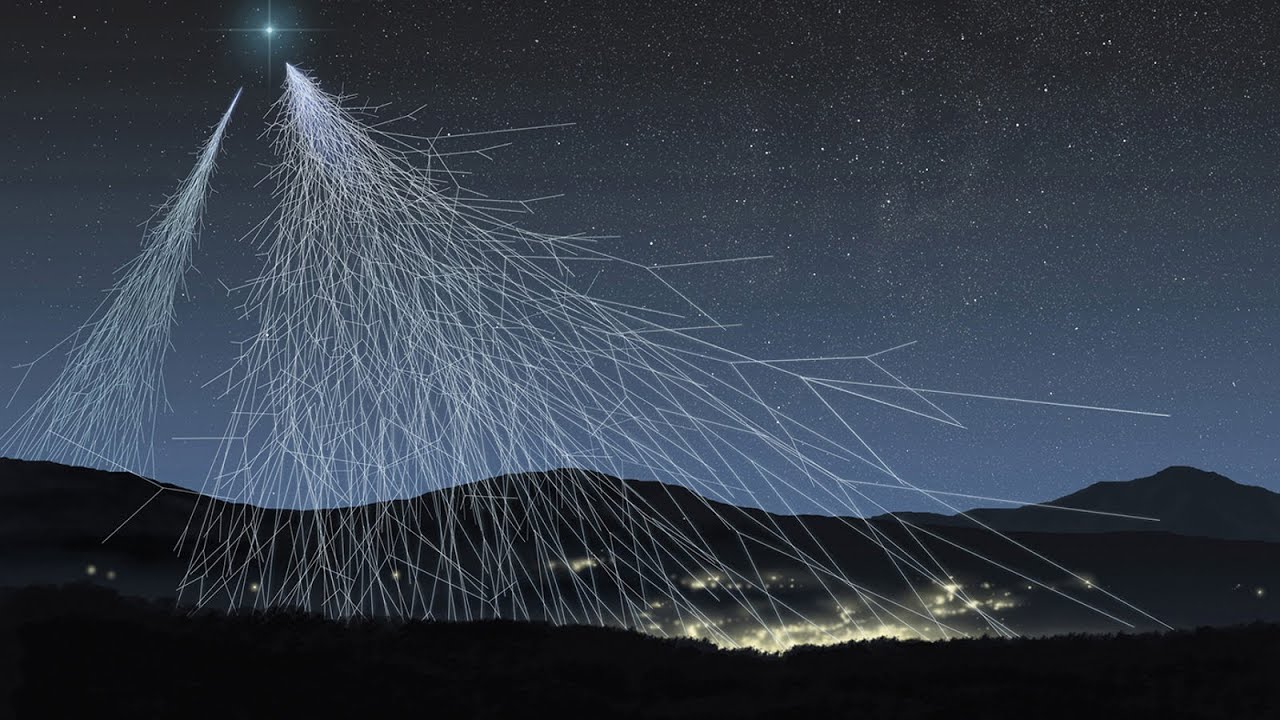
This comprehensive video addresses the ground-based cosmic ray detection gap. It explains the design and operational physics of the Pierre Auger Observatory in Argentina, which uses a massive 3,000-square-kilometer hybrid array of water Cherenkov detectors and fluorescence telescopes to measure extensive air showers.
Knowledge Checkpoint
- Explain how an extensive air shower (EAS) is formed when a single high-energy primary cosmic ray collides with atmospheric nuclei, producing millions of secondary particles (pions, muons, electrons).
- Describe how water Cherenkov detectors record the timing and energy of these secondary particles as they travel faster than the speed of light in water.
- Explain how fluorescence telescopes detect the faint ultraviolet nitrogen glow produced by air showers, and how combining these two methods (hybrid detection) improves measurement accuracy.
Why this video
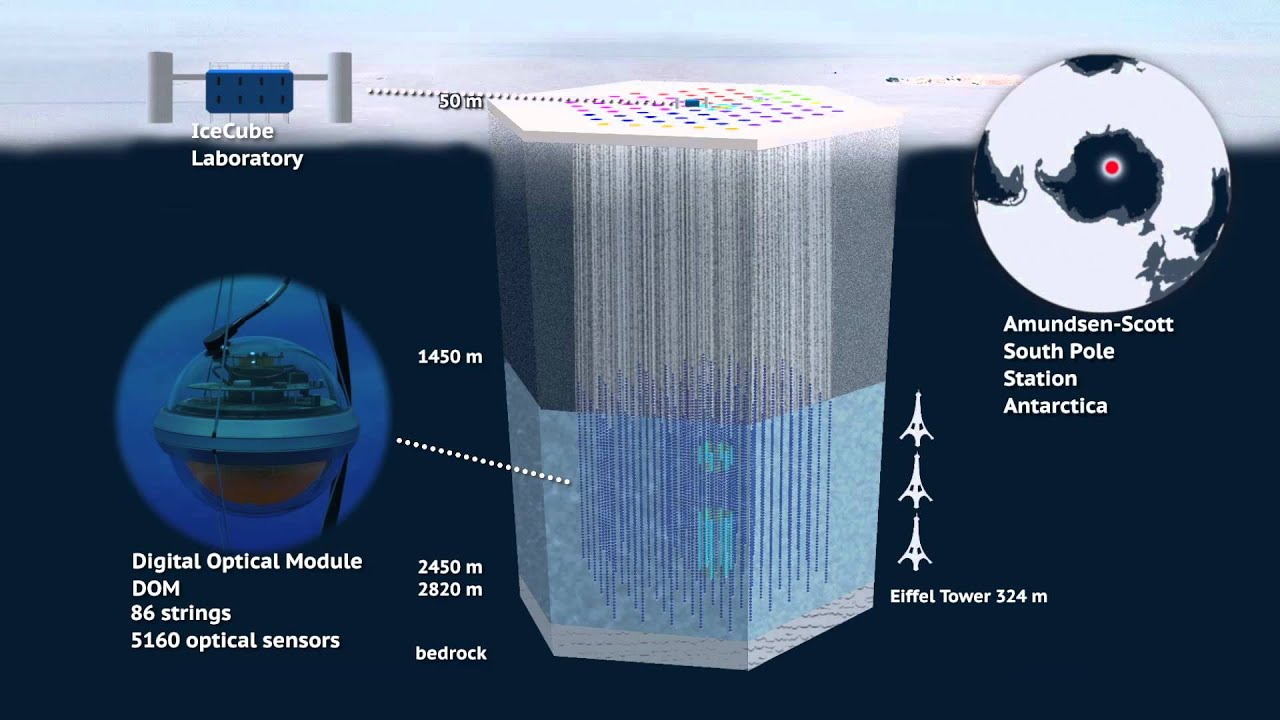
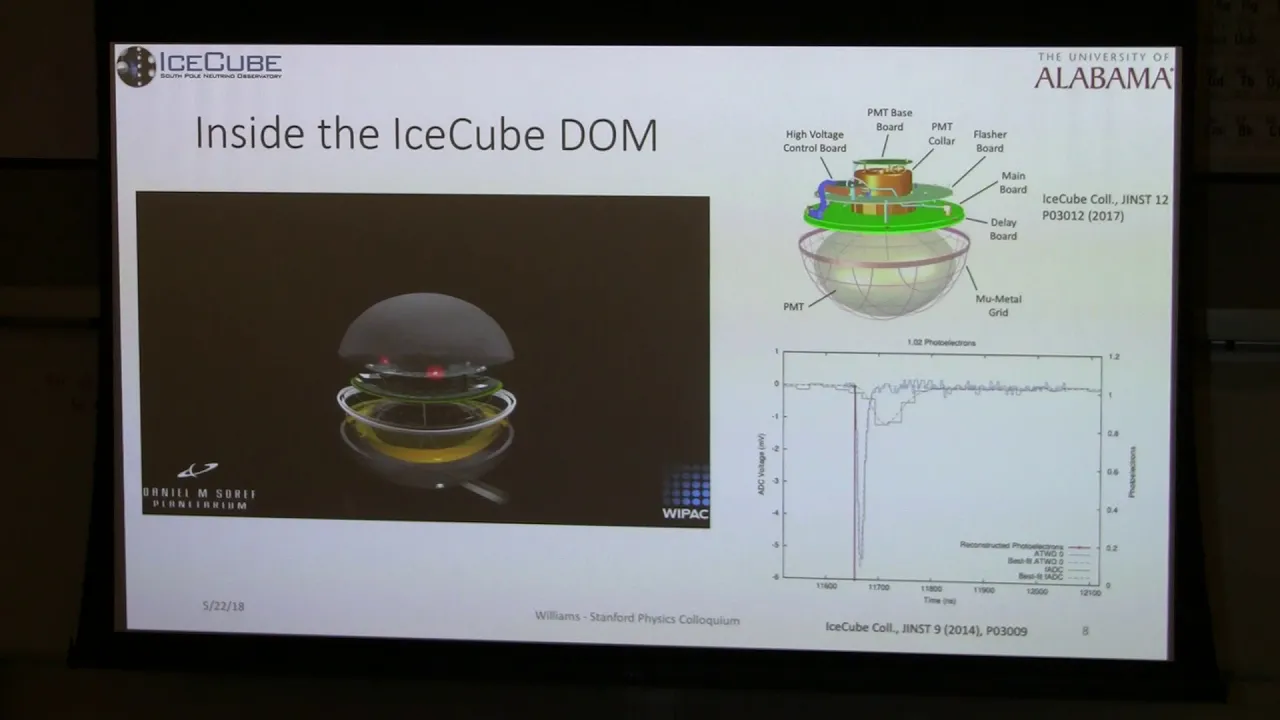
Presented by the IceCube collaboration, this video outlines how we detect high-energy astrophysical neutrinos. Neutrinos are crucial "messengers" because, unlike charged cosmic rays, they are neutral and travel in straight lines directly from their cosmic sources without magnetic deflection.
Knowledge Checkpoint
- Explain why neutrinos are valuable cosmic messengers compared to charged cosmic rays.
- Describe how the IceCube array uses PMTs (photomultiplier tubes) frozen deep in the Antarctic ice to detect Cherenkov radiation from muon tracks.
- Trace how neutrino arrival vectors are used to identify distant point sources, such as active blazars.
Why this video
This Stanford lecture excerpt introduces the framework of Multi-Messenger Astronomy. It explains how combining four fundamental cosmic signals—electromagnetic waves, gravitational waves, cosmic rays, and neutrinos—allows us to construct a complete physical model of highly energetic events like neutron star mergers.
Knowledge Checkpoint
- List the four messengers used in modern astrophysics: electromagnetic radiation, gravitational waves, neutrinos, and cosmic rays.
- Describe how the historic detection of GW170817 (a neutron star merger) linked gravitational waves directly with a short-duration Gamma-Ray Burst (GRB 170817A).
- Explain why combining multiple observation methods is necessary to resolve the internal physics of highly dense cosmic environments.
🔍 Self-Directed Physics Deep-Dive: GRB Afterglow Light Curves
Because video tutorials rarely show the complex mathematics of GRB afterglows, you should study the following physical concepts independently:
- The Fireball Model: A Gamma-Ray Burst begins as an opaque "fireball" of electrons, positrons, and photons. Because this mixture is extremely dense, it expands relativistically () until it becomes optically thin.
- Internal vs. External Shocks:
- Internal Shocks: Faster shells of matter catch up to slower shells within the outflow, generating highly variable prompt gamma-ray emission.
- External Shocks: The relativistic jet collides with the surrounding interstellar medium (ISM). This creates a blast wave that accelerates ambient electrons, producing synchrotron radiation that powers the fading, multiwavelength afterglow (from X-rays to radio).
- Analyzing Afterglow Light Curves:
Afterglow brightness decays over time as a power law: .
- If you plot this on a log-log scale, the data forms a straight line.
- A sudden change in the slope of this line (a jet break) occurs when the relativistic jet slows down enough that its beaming angle () becomes wider than the physical opening angle of the jet (). Measuring when this break occurs allows astrophysicists to calculate the true energy output of the burst.
Course Map
Key People Index
- Victor Hess (1883–1964): Discovered cosmic rays in 1912 through bold high-altitude balloon experiments. He was awarded the Nobel Prize in Physics in 1936.
- Enrico Fermi (1901–1954): Developed the foundational statistical models for particle acceleration (first-order and second-order Fermi mechanisms) in 1949.
- Roger Blandford (b. 1949): A leading theoretical astrophysicist who helped formulate the physics of diffusive shock acceleration and relativistic jets from black holes.
- Pierre Auger (1899–1993): Discovered extensive air showers in 1938, proving that ultra-high-energy cosmic rays collide with atmospheric nuclei to produce large cascades of secondary particles.
- Stan Woosley (b. 1944): Developed the "collapsar model," which is now the widely accepted explanation for long-duration Gamma-Ray Bursts.
Final Self-Assessment
Test your understanding of the entire curriculum with these core questions:
- Can you explain why cosmic rays are mostly relativistic protons and atomic nuclei rather than high-energy electromagnetic waves?
- Can you derive the gyroradius of a relativistic cosmic ray moving through a uniform galactic magnetic field?
- Do you understand the physical and mathematical differences between Second-Order (slow, statistical) and First-Order (fast, shock-driven) Fermi acceleration?
- Why do expanding supernova remnants have a physical energy limit that prevents them from producing ultra-high-energy cosmic rays (UHECRs)?
- How does the collapsar model explain the duration, jet formation, and host-star environment of a long-duration Gamma-Ray Burst?
- What physical processes during a neutron star merger generate the magnetic jets responsible for a short-duration Gamma-Ray Burst?
- How do hybrid ground detectors like the Pierre Auger Observatory reconstruct the energy and direction of a cosmic ray using both surface water tanks and air fluorescence telescopes?
- Why are neutrinos and gravitational waves called "unobscured" cosmic messengers, whereas high-energy cosmic rays are deflected by magnetic fields and high-energy gamma rays are blocked by cosmic dust and background radiation?
- Can you identify a "jet break" in a log-log plot of a GRB afterglow light curve, and explain how it reveals the jet's physical opening angle?