Thermodynamics: Entropy, Gibbs & Phase
Learning Goal: Applying Chemical Thermodynamics: Entropy, Gibbs Free Energy, and Phase Equilibria in Multi-Component Systems. Students will build a solid progression from the foundational definitions of energy, enthalpy, and the First Law of Thermodynamics, up through statistical interpretations of entropy, the predictive power of Gibbs Free Energy, chemical equilibrium math, and multi-component phase thermodynamics.
- Prerequisites: College-level General Chemistry, basic multi-variable calculus (optional but helpful for partial derivatives), and algebra.
- Estimated Total Study Time: 16 Hours
Module 1: Foundations of Energy and the First Law
This module covers the core components of thermodynamic systems. You will learn to differentiate between open, closed, and isolated systems, comprehend the mechanical definitions of heat () and work (), understand state functions vs. path functions, and analyze how energy is conserved through the mathematical statement of the First Law of Thermodynamics: . Additionally, we introduce enthalpy () as a crucial state function for constant-pressure systems.
Recommended Videos

- Why this video: This video introduces enthalpy in an intuitive and highly visual manner. It clarifies why enthalpy is considered a state function and demonstrates practical applications such as Hess's Law and calorimeter enthalpy calculations.
- Knowledge Checkpoint:
- Differentiate between an endothermic process and an exothermic process in terms of system-surroundings heat exchange.
- Explain why standard enthalpies of formation can be utilized to calculate the net enthalpy change of a reaction using Hess's Law.
- State why enthalpy is classified as a state function while heat and work are path functions.
- Why this video: A deeper academic lecture on the mechanical derivation of the First Law ( or ). It details the sign conventions of heat and work, expansion work (), and the formal mathematical definition of enthalpy ().
- Knowledge Checkpoint:
- Identify sign conventions: when is positive or negative? When is positive or negative from the system's perspective?
- Derive why the enthalpy change is exactly equal to heat transferred at constant pressure ().
- Calculate work performed by an expanding gas against a constant external pressure.
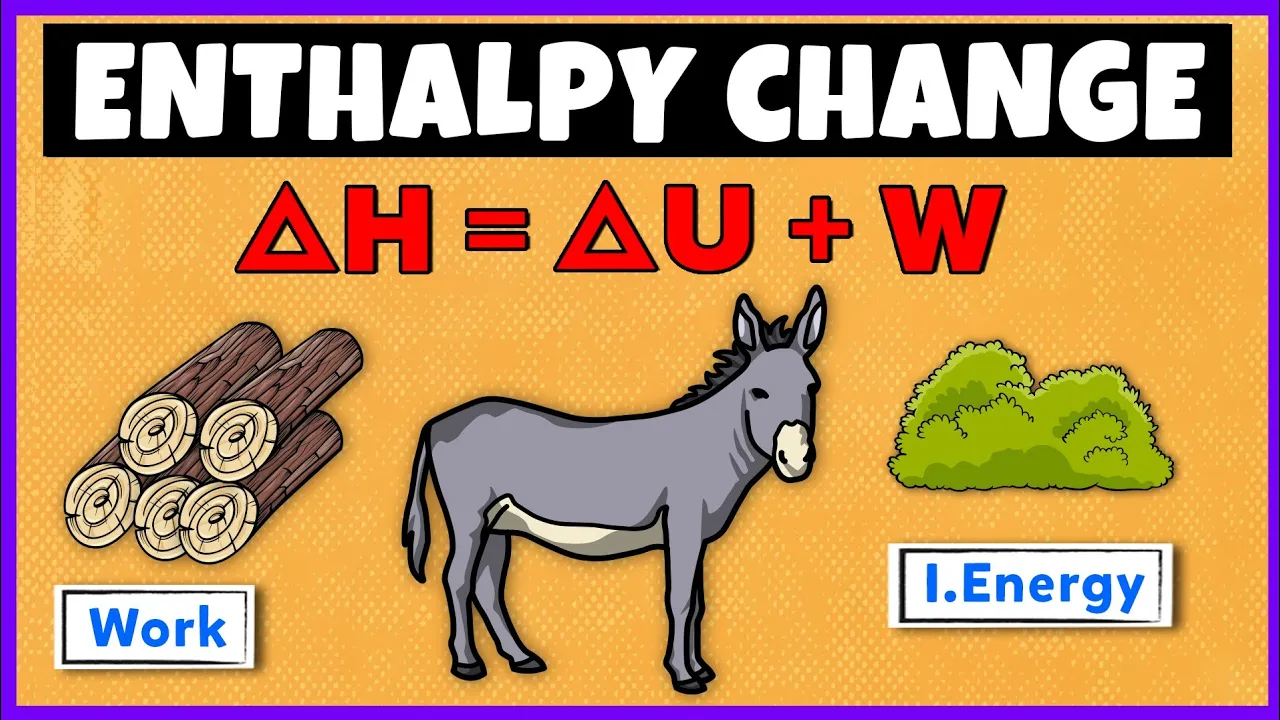
- Why this video: This supplementary video offers a clear, highly simplified conceptual breakdown of enthalpy () to solidify your grasp on the relationship between a system's internal energy and the energy required to "push back" the surroundings.
- Knowledge Checkpoint:
- Explain the physical meaning of the term in the enthalpy equation.
- Define internal energy () as the sum of a system's microscopic kinetic and potential energies.
Module 2: Entropy and the Second Law
This module shifts focus from energy quantity (First Law) to energy dispersal and directionality (Second Law). You will explore the thermodynamic definition of entropy (), the Second Law's statement that the entropy of the universe always increases for spontaneous processes, and the microscopic statistical definition of entropy developed by Ludwig Boltzmann ().
Recommended Videos

- Why this video: This video bridges Module 1 and Module 2 by introducing entropy () as a thermodynamic measure of randomness, outlining the Second Law of Thermodynamics, and showing how the universe's total entropy dictates spontaneity.
- Knowledge Checkpoint:
- State the Second Law of Thermodynamics in terms of the system, surroundings, and universe.
- Predict qualitative changes in entropy for phase changes (e.g., solid to liquid, liquid to gas) and chemical reactions that produce gas.
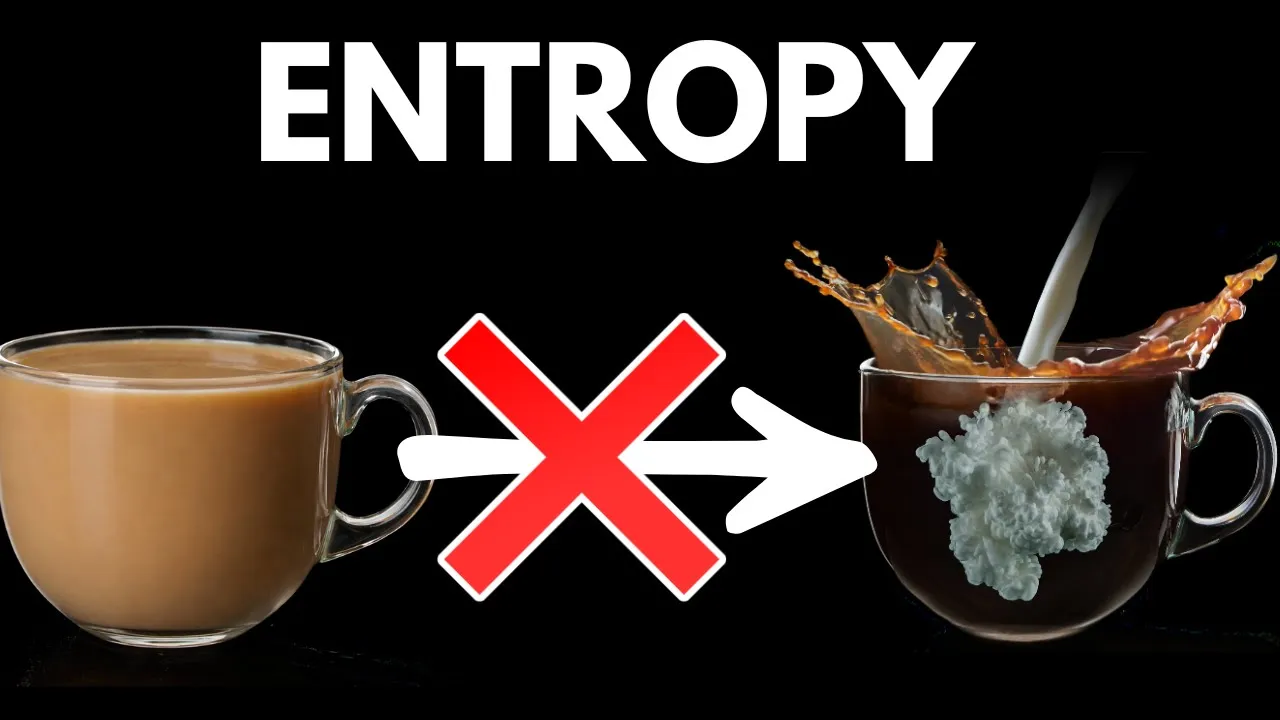
- Why this video: An exceptionally thorough pedagogical deep-dive that deconstructs the common misconception of entropy as mere "disorder." Instead, it models entropy as the count of microscopic arrangements (microstates) that yield a specific macroscopic state.
- Knowledge Checkpoint:
- Explain the difference between a macrostate and a microstate.
- Describe how heat addition at lower temperatures creates a larger relative entropy increase compared to heat addition at higher temperatures.

- Why this video: Focuses explicitly on Boltzmann's equation . It features quantitative examples calculating microstates for particle distributions across containers, demonstrating why gas expansion is statistically inevitable.
- Knowledge Checkpoint:
- State Boltzmann's statistical entropy equation and define the variables , , and .
- Calculate the change in entropy () when a system transitions from a macrostate with microstates to one with microstates ().
Module 3: Gibbs Free Energy and Spontaneity
In this module, you will learn to combine system enthalpy and system entropy into a single thermodynamic potential: Gibbs Free Energy (). This enables us to predict chemical spontaneity at constant temperature and pressure without calculating the entropy change of the surroundings. We will study the master equation and analyze how temperature dictates the feasibility of endothermic/exothermic and exentropic/endentropic processes.
Recommended Videos
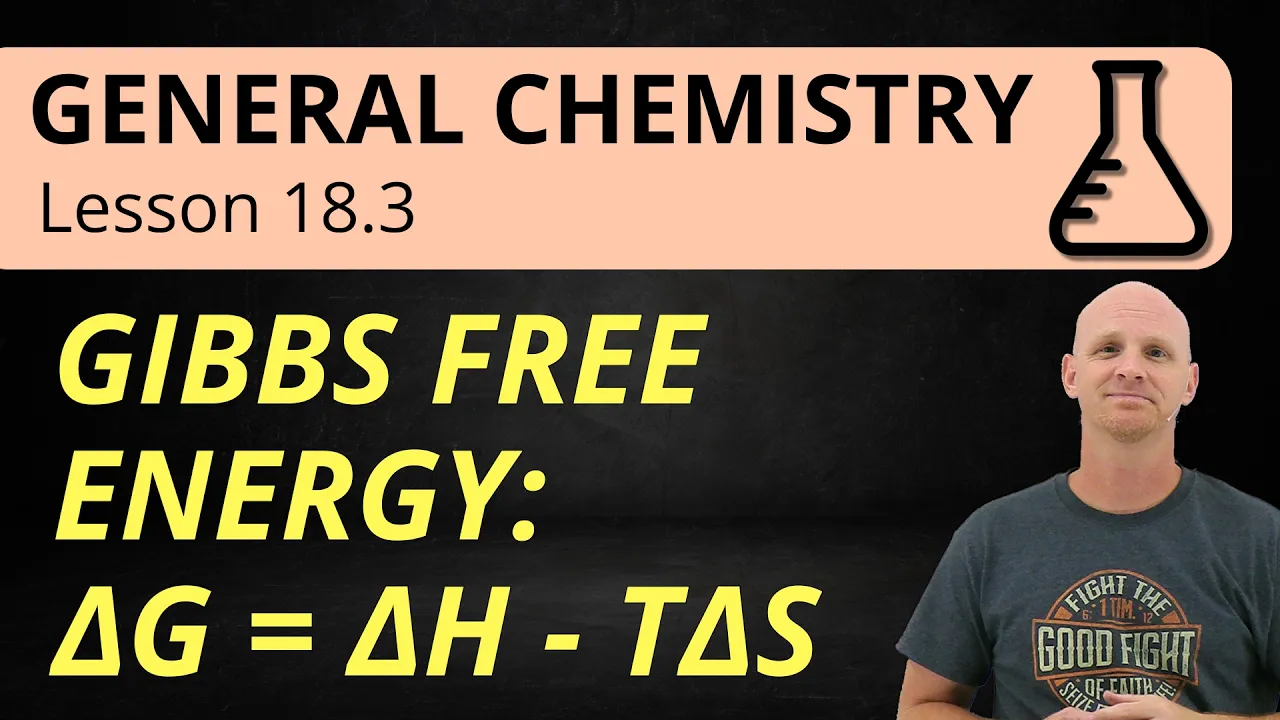
- Why this video: This video offers a clear, highly quantitative guide to calculating Gibbs Free Energy and analyzing its temperature dependence. It details the four main thermodynamic combinations of and and identifies the transition temperature where spontaneity changes.
- Knowledge Checkpoint:
- State the sign of for spontaneous, non-spontaneous, and equilibrium processes.
- Determine the conditions under which a reaction is: (a) spontaneous at all temperatures, (b) non-spontaneous at all temperatures, (c) spontaneous only at low temperatures, (d) spontaneous only at high temperatures.
- Calculate the crossover temperature () at which a reaction shifts spontaneity, given standard values of and .

- Why this video: An MIT OpenCourseWare lecture that provides a rigorous physical chemistry derivation of Gibbs Free Energy starting from the Clausius Inequality and the Second Law of Thermodynamics. It bridges foundational physics with chemical thermodynamic parameters.
- Knowledge Checkpoint:
- Explain how the definition of directly originates from the condition that .
- Describe what standard state means for thermodynamic quantities (, , ).
Module 4: Chemical Equilibrium and Free Energy
This module connects thermodynamics to real, reversible chemical systems. You will transition from standard state properties () to non-standard state conditions (), deriving the mathematical relationship between the reaction quotient () and the equilibrium constant (). We will focus heavily on calculations using the equations and the standard-state equilibrium relationship .
Recommended Videos
- Why this video: This segment focuses heavily on the thermodynamic aspects of chemical equilibrium. It shows how the reaction quotient () and equilibrium constant () map to and , highlighting that is the criteria for dynamic equilibrium.
- Knowledge Checkpoint:
- Differentiate between (the instantaneous free energy change) and (the standard free energy change).
- Write the equation linking standard free energy to the equilibrium constant () and perform calculations to solve for .
- Explain why must equal zero at dynamic equilibrium.

- Why this video: Solves specific multiple-choice quantitative problems linking standard Gibbs Free Energy change () to the equilibrium constant (). It provides practice with signs and values: when , ; when , .
- Knowledge Checkpoint:
- Given , calculate the numerical value of at a specified temperature (using the correct value of the gas constant ).
- Explain how a negative standard free energy change dictates a product-favored equilibrium.
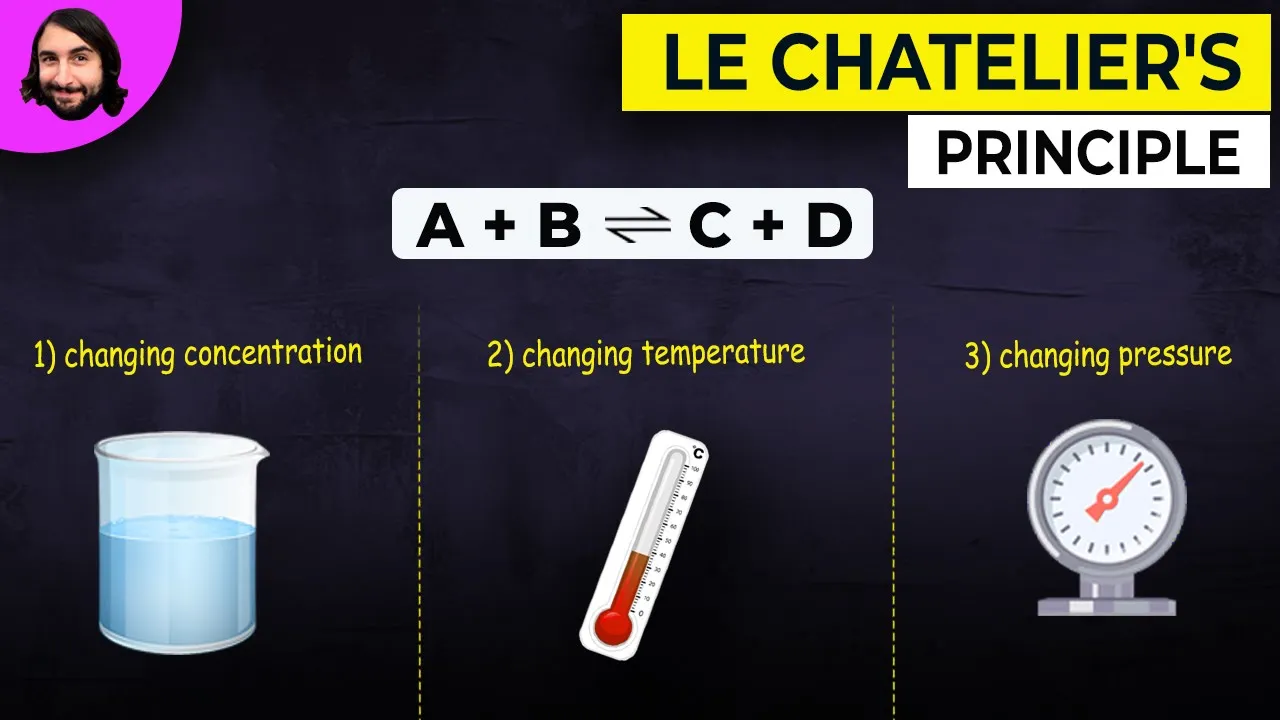
- Why this video: A clear exposition of how systems at chemical equilibrium respond to external stresses. This video provides the qualitative framework necessary to understand how changing pressure, concentration, or temperature shifts a system, matching the thermodynamic changes in and .
- Knowledge Checkpoint:
- Predict the direction of shift when reactants or products are added or removed using the relationship between and .
- Explain how changing the temperature of an exothermic or endothermic system changes the value of itself.
Module 5: Phase Equilibria and Multi-Component Systems
This module introduces advanced physical chemistry concepts, applying thermodynamics to mixtures, multi-component systems, and phase equilibria. We will cover the chemical potential (), which is defined as the partial molar Gibbs free energy. We will also examine Raoult's Law, partial molar properties, and how to interpret ternary and multicomponent phase diagrams.
- Self-Directed Study Note on Gaps: While the provided video pool has excellent introductory phase and chemical potential videos, we highly recommend reading standard physical chemistry textbook chapters (such as Atkins or McQuarrie) to supplement calculations of partial molar volume, Gibbs-Duhem derivations, and plotting ternary tie lines.
Recommended Videos
- Why this video: Provides a mathematical and conceptual definition of chemical potential (). It explains how chemical potential acts as the driving force for phase transitions and material transport across phases.
- Knowledge Checkpoint:
- Write the mathematical definition of chemical potential ().
- Explain the criteria for phase equilibrium between two phases and in terms of chemical potential ().
- Why this video: Outlines the concept of partial molar properties in mixtures. It highlights why the partial molar Gibbs Free Energy is given the distinct title of chemical potential and introduces the Gibbs-Duhem equation.
- Knowledge Checkpoint:
- Explain why a thermodynamic property (like volume or free energy) of a mixture is not simply the sum of the properties of its pure, isolated components.
- State the physical consequence of the Gibbs-Duhem equation regarding the interdependent changes of chemical potentials in a mixture.

- Why this video: A clear and intuitive visualization of partial molar volume. Using water and ethanol mixtures, it shows how adding a mole of substance to a mixture changes the total property by a different increment than the pure component molar property.
- Knowledge Checkpoint:
- Describe the physical experiment (e.g., mixing water and ethanol) that demonstrates why partial molar volume varies with mixture composition.
- Write the equation for calculating the total property of a binary system from its partial molar components: .
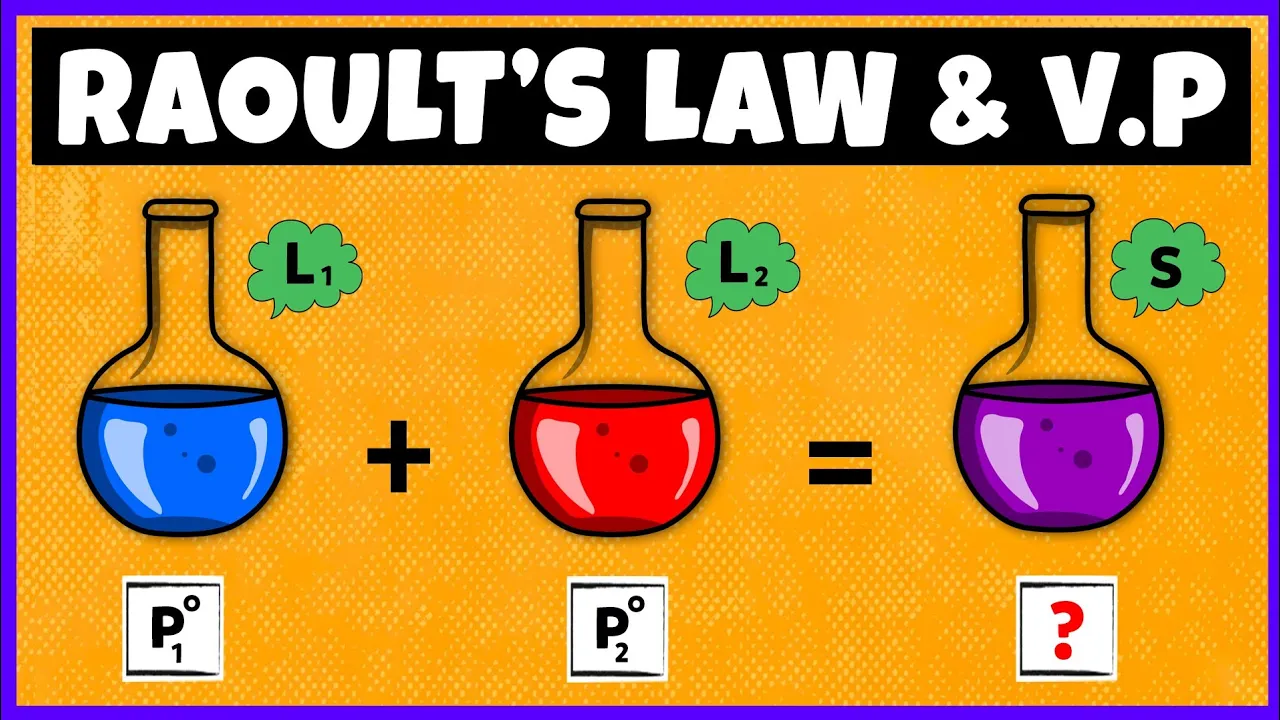
- Why this video: This lecture outlines vapor pressure, ideal solutions, and Raoult's Law. It builds the foundation for multi-component liquid-gas equilibrium.
- Knowledge Checkpoint:
- State Raoult's Law mathematically () and identify ideal vs. non-ideal solution behaviors.
- Calculate the total vapor pressure of a binary liquid mixture using Raoult's Law and Dalton's Law of partial pressures.

- Why this video: This video serves as an introductory guide to ternary phase diagrams. It walks through reading compositions in a three-component triangle plot, which is critical for multi-component geological and material systems.
- Knowledge Checkpoint:
- Locate and identify a single point on a triangular ternary plot, reading off the precise weight or mole percentages of all three components (adding up to 100%).
- Explain how binary eutectic curves boundary lines on a ternary diagram outline different mineral crystallization zones.
Course Map
Key People Index
- Ludwig Boltzmann (1844–1906)
- Context: Austrian physicist who established the statistical interpretation of thermodynamics. He connected macroscopic entropy () with the number of microstates (), carving his famous formula () on his tombstone.
- Rudolf Clausius (1822–1888)
- Context: German physicist who formulated the Second Law of Thermodynamics, introduced the term "entropy" in 1865, and proposed the fundamental definition based on heat exchange ().
- Josiah Willard Gibbs (1839–1903)
- Context: American scientist who unified chemical, physical, and electromagnetic processes into a coherent thermodynamic framework. He created the concepts of chemical potential and free energy, paving the way for chemical engineering.
- François-Marie Raoult (1830–1901)
- Context: French chemist who formulated the vapor-pressure relationship of solutions (Raoult's Law), showing how solute concentration affects solvent chemical potential and vapor pressure.
Final Self-Assessment
Complete this comprehensive self-assessment to verify your mastery over physical chemical thermodynamics:
- Explain the difference between enthalpy () and internal energy (), and calculate change in internal energy () using heat and work parameters.
- Statistically calculate system entropy change when a partition is removed and a gas doubles its volume, using .
- Differentiate between the thermodynamic entropy definition () and statistical entropy definition ().
- Determine the spontaneity of any chemical reaction by calculating its Gibbs Free Energy change () at various temperatures.
- Mathematically derive the relation starting from the general non-standard equation at equilibrium conditions.
- Calculate the final equilibrium constant () for a given reaction at and given standard enthalpies of formation () and standard absolute entropies ().
- Define chemical potential () as a partial molar derivative and explain why chemical potentials must equalize across boundaries at phase equilibrium.
- State the physical and mathematical significance of the Gibbs-Duhem equation for multi-component systems.
- Correctly read and extract binary and ternary composition values from a three-component phase diagram.
- Use Raoult's Law to calculate both liquid phase mole fractions () and vapor phase mole fractions () for an ideal binary solution.