Analyzing AAVE: Grammar, Phonology & History
Learning Goal: Analyze the systematic syntactic and phonological rules of African American Vernacular English (AAVE) to counter linguistic prejudice and explain the mechanics of dialect variation.
- Prerequisites: None (though a basic curiosity about how language works is highly recommended).
- Estimated Total Study Time: 8 hours
Module 1: Introduction to Sociolinguistics and Dialect Variation
This module introduces the foundational concepts of sociolinguistics. You will dismantle the pervasive social myth of "correct" or "standard" English and discover why linguists view all dialects as systematic, rule-governed, and structurally complete communication systems.

Why this video
This video is the perfect conceptual anchor for the course. It explains how language varies across geographical, social, and demographic lines (such as race, class, and gender). It introduces the crucial distinction between prescriptive grammar (rules imposed by society) and descriptive grammar (how people actually speak), laying the groundwork to analyze AAVE objectively.

Why this video
In under a minute, this video challenges the fundamental misconception that dialects are "deviations" from a pure, standard form. It explains that the "Standard English" dialect is simply one regional variety that historically gained political, economic, and social dominance over others.
Why this video
This highly accessible and engaging explainer transitions the learner from general sociolinguistics to the specific structural reality of African American English (AAE). It directly counters the stereotype that AAVE is "lazy" or "ungrammatical" by demonstrating its sophisticated internal grammar rules.
Knowledge Checkpoint
- Explain the difference between prescriptive and descriptive linguistics.
- Define what a sociolect is and how it differs from a regional dialect.
- Explain why linguists argue that no dialect is inherently superior or inferior to another.
Module 2: The History and Origins of AAVE
This module traces the historical roots of AAVE, exploring the linguistic contact scenarios of the transatlantic slave trade, the plantation era in the American South, and the Great Migration. It evaluates the primary academic theories regarding AAVE's origins: the Creolist hypothesis and the Anglicist hypothesis.
Academic Context: Debating AAVE's Origins
Because the videos below touch on these histories, it is vital to explicitly frame the two dominant linguistic theories:
- The Creolist Hypothesis: Proposes that AAVE originated as a creole language. During the transatlantic slave trade, enslaved Africans from highly diverse linguistic backgrounds developed pidgins to communicate. Over time, these pidgins acquired native speakers and developed into a complex creole (similar to Gullah Geechee), which later underwent "decreolization" as it came into closer contact with Standard English.
- The Anglicist (or Dialectologist) Hypothesis: Proposes that AAVE's unique grammatical and phonological features are primarily retentions of regional British dialects spoken by early white settlers (e.g., Scotch-Irish, West of England) with whom enslaved populations had close contact in the colonial South.
Why this video
This TEDx talk provides an excellent historical overview of AAVE's evolution. It explains how the systematic separation of enslaved Africans speaking the same language forced the rapid creation of a new, shared medium of communication on plantations, which has persisted and adapted across centuries of segregation.

Why this video
This video breaks down the linguistic contact mechanics between West African languages (such as Mandinka and Yoruba) and Elizabethan/Early Modern English. It shows how grammatical structures from West African languages were superimposed onto English vocabulary, supporting the Creolist framework of AAVE's development.

Why this video
Though short and framed within a broader podcast context, this clip introduces Thomas Sowell's argument—reflecting the Anglicist view—that features of AAVE (such as certain verb forms) can be traced back to the regional dialects of early British immigrants from the South and West of England. It is a useful resource for comparing the competing historical theories.
Gap Alert & Independent Search Suggestion
The discovered videos touch on the historical timeline, but do not deeply analyze the Great Migration's role in distributing and regionalizing AAVE across the Northern and Western United States. To supplement this gap, independently search for: "The Great Migration and the regional variation of AAVE" or "William Labov AAVE sound changes in Northern cities."
Knowledge Checkpoint
- Contrast the Creolist Hypothesis with the Anglicist Hypothesis regarding AAVE's origins.
- Define how a pidgin differs from a creole, and name an active creole language spoken by African Americans in the coastal South (e.g., Gullah).
- Explain how historical racial segregation post-Reconstruction preserved and further distinguished AAVE from surrounding dialects.
Module 3: Phonology: Pronunciation Patterns in AAVE
This module shifts focus to the physical sounds of the dialect. You will study how sound patterns in AAVE are governed by precise phonological rules, rather than arbitrary "errors." You will analyze features such as consonant cluster reduction, th-stopping, and the vocalization of liquids (/l/ and /r/).
Why this video
To understand AAVE phonology, you must first understand phonological theory. This Crash Course video explains how linguists analyze sound patterns, distinguishing between raw sounds (phones) and mental categories of sound (phonemes), and how rule-governed changes operate in natural speech environments.

Why this video
This video is a treasure trove of direct phonological analysis. It specifically details AAVE features including the vocalization of post-vocalic liquids (/r/ and /l/), medially shifting /v/ to /f/ (e.g., them to dem), and—crucially—the systematic reduction of word-final consonant clusters (e.g., fast to fas).

Why this video
This short, professional demonstration by a dialect coach illustrates three classic AAVE phonological rules: th-stopping (pronouncing "that" as /dæt/), l-vocalization (converting the dark /l/ sound into a vowel sound, making "pull" sound like "poo"), and non-rhoticity (omitting or reducing the /r/ sound).
Phonology Rule Explainer
To ensure you understand the mechanics, read the following three rule breakdowns:
- Consonant Cluster Reduction (CCR): In AAVE, word-final consonant clusters (like /st/ in test, or /nd/ in hand) are reduced only when both consonants share the same voicing state (both are voiced, or both are voiceless). For example, west (/st/, both voiceless) becomes wes. Pant (/nt/, /n/ is voiced, /t/ is voiceless) is not typically reduced in the same way because they have different voicing states. This is a highly systematic rule!
- Th-Stopping: The dental fricatives (/θ/ as in "thin", /ð/ as in "them") are realized as alveolar stops (/t/ or /d/). Thus, them becomes dem and with becomes wit.
- L/R-Vocalization (Liquid Deletion): The liquid consonants /l/ and /r/, when occurring after a vowel (post-vocalic position), are often unpronounced or transformed into a weak glide/vowel sound (e.g., sister -> sista, toll -> toe).
Knowledge Checkpoint
- Explain the linguistic rule that determines when a word-final consonant cluster can be reduced in AAVE.
- Define th-stopping and provide an example of how it applies to both voiced and voiceless dental fricatives.
- Explain how liquid vocalization (/l/ and /r/) changes the pronunciation of words like "dollar" and "bold."
Module 4: Syntax and Grammar: The Aspect and Verb System
This module deconstructs the complex verb system of AAVE. While mainstream culture often misinterprets AAVE's grammatical differences as errors, you will analyze how its aspect markers—such as habitual be, remote past been, copula absence, and negative concord—allow for subtle temporal distinctions that do not even exist in Standard English.

Why this video
This video explains the grammatical rule of "zero copula" (or copula absence). It shows how AAVE systematically drops the helping verbs "is" and "are" in the present tense (e.g., "he learning" instead of "he is learning"). Crucially, it notes that this omission is only allowed in the exact same environments where Standard English allows contractions (e.g., "he's learning").

Why this video
Presented by a Gullah/AAVE language instructor, this lesson breaks down the syntactic rules of "habitual be" (invariant be). It explains that saying "she be singing" does not mean "she is singing right now." Instead, it denotes a recurring, habitual state or action—a highly specific grammatical aspect that Standard English lacks a single verb form to express.

Why this video
This short linguistic analysis contrasts the simple tense system of Standard English with the sophisticated "aspectual" system of AAVE. It argues that AAVE's verb structures are grammatically more complex than Standard English because they explicitly encode the durative and habitual nature of actions.

Why this video
(Note: Watch from the beginning to the 10-minute mark for the relevant content). This video highlights a famous sociolinguistic study: when shown a picture of Cookie Monster sick in bed with no cookies, and Elmo eating a cookie nearby, children were asked "Who is eating cookies?" and "Who be eating cookies?" Standard English speakers got confused, but AAVE-speaking children correctly identified Cookie Monster as the one who be eating cookies—demonstrating their innate, rule-governed understanding of habitual aspect.
Key Syntactic Structures of AAVE
- Habitual "Be": Verb "be" left uninflected to indicate a repeated action (e.g., "He be working late" = He habitually works late).
- Copula Absence: Omission of "is/are" in present tense. Restricted by rules: cannot be deleted at the end of a sentence (e.g., "I know who they are" cannot become "I know who they").
- Remote Past "Been" (stressed): Specifying an action occurred a long time ago (e.g., "She BEEEN married" = She has been married for a very long time and still is).
- Negative Concord (Double Negatives): Multiplying negative markers to emphasize a negative statement (e.g., "He don't know nothing"). This is common in many world languages (like French and Spanish) and was standard in Old English.
Knowledge Checkpoint
- Translate "He is running" vs. "He be running" into Standard English and explain the grammatical difference in aspect.
- State the rule that prevents copula deletion in certain syntactic positions (such as sentence-final positions).
- Explain how negative concord functions in AAVE, and contrast it with how double negatives are treated in Standard English.
Module 5: Linguistic Justice: AAVE in Education, Law, and Society
In this final module, you will analyze the real-world consequences of linguistic prejudice. You will examine how dialect discrimination functions as a proxy for racial bias in classrooms, employment, and courtrooms, and study pivotal historical cases like the 1996 Oakland Ebonics controversy.
Why this video
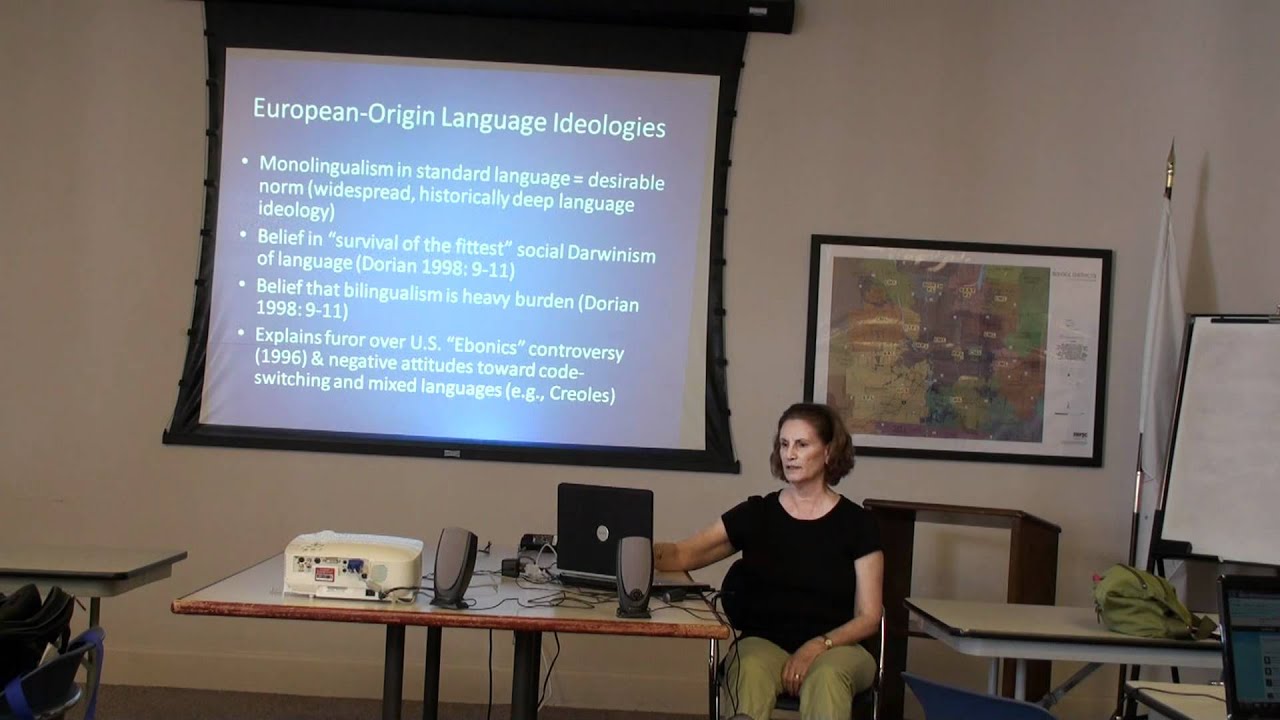
This video introduces the infamous 1996 Oakland School Board Ebonics resolution. It explains how the school board attempted to recognize "Ebonics" (AAVE) as a legitimate, rule-governed language system not to teach it instead of Standard English, but to use contrastive analysis (bilingual techniques) to help AAVE-speaking students acquire literacy in Standard English.
Why this video
This segment highlights a critical legal study by linguist John Rickford on courtroom transcription. It details how Rachel Jeantel, a key witness in the 2013 Trayvon Martin trial, had her systematic AAVE testimony completely misunderstood, dismissed, and mistranscribed by court stenographers—demonstrating how dialect bias directly undermines judicial equity.
Why this video
This comprehensive video essay explores the sociological concept of "linguistic profiling." It details how accents and sociolects are utilized as socially acceptable proxies for racial and class discrimination, explaining how people's intelligence, trustworthiness, and competence are unfairly judged based on their speech.
Case Study Deep-Dive: John Rickford's Stenographer Study & Rachel Jeantel
In 2019, linguist John Rickford and his colleagues published a landmark study testing Philadelphia court reporters (who are certified at 95% transcription accuracy). They found that when asked to transcribe routine sentences spoken in AAVE:
- Stenographers got more than 40% of the sentences incorrect.
- They frequently misconstrued grammatical aspects (e.g., interpreting habitual "be" as past tense).
- They often labeled witnesses' speech as "incomprehensible," showing how dialect bias in legal reporting can literally alter the official record of a trial.
Knowledge Checkpoint
- Summarize the actual goal of the 1996 Oakland School Board Ebonics resolution, and why media hysteria misrepresented it.
- Describe the findings of John Rickford's study on Philadelphia court stenographers and its implications for civil rights in the legal system.
- Define linguistic profiling and explain how it acts as a legal loop-hole for racial discrimination.
Course Map
Key People Index
- Dr. John Rickford: Professor of Linguistics at Stanford University. Famous for his extensive research on AAVE syntax and his groundbreaking work exposing dialect bias among court stenographers.
- Thomas Sowell: Academic and economist. Associated with the Anglicist view that many aspects of African American culture, including language features, are historical retentions of Southern/British regional subcultures.
- Rachel Jeantel: Key prosecution witness in the 2013 State of Florida v. George Zimmerman trial. Her systematic use of AAVE was heavily criticized and misunderstood by the jury and press, sparking national academic research into legal dialect prejudice.
Final Self-Assessment
Complete this comprehensive self-assessment to verify your mastery of the curriculum:
- I can explain the difference between a dialect and a language from a scientific linguistic perspective.
- I can articulate the core differences between the Creolist and Anglicist hypotheses of AAVE's origins.
- I can identify and write out the exact phonological rules of Consonant Cluster Reduction (CCR) in AAVE.
- I can define th-stopping and provide IPA phonetic approximations of how the dental fricatives change.
- I can successfully translate sentences featuring the habitual aspect (e.g., "They be laughing") and explain why "be" is not a tense error.
- I can define the syntactic limitations of copula absence (where it can and cannot occur in a sentence).
- I can explain what "negative concord" is and reference another global language where it is grammatically mandatory.
- I can outline how the 1996 Oakland School Board planned to use Ebonics to teach Standard English using "contrastive analysis."
- I can detail the statistical and systemic findings of John Rickford's court reporter study.
- I can explain how linguistic profiling allows accent discrimination to stand in for racial discrimination in legal and professional settings.