Gating Working Memory: PFC & Executive Control
Learning Goal: Deconstruct the neural mechanisms of working memory and executive control, focusing on how the prefrontal cortex maintains representations, gates attention, and coordinates goal-directed behavior.
- Prerequisites: Basic high school biology/anatomy recommended but not strictly required.
- Estimated Total Study Time: 15 Hours
Module 1: Neuroscience Foundations: Neurons and Brain Anatomy
To understand how the brain coordinates complex goal-directed behaviors, you must first master the biological substrates of cognition. This module builds a foundational understanding of macroscopic neuroanatomy (the cerebral cortex, its lobes, and laminar structures) and microscopic neurophysiology (how individual neurons generate action potentials and communicate across synapses).
Recommended Videos

- Why this video: This video provides a highly intuitive and structurally detailed walkthrough of the cerebral cortex, explaining how the surface area is expanded via folds (sulci and gyri) and breaking down the specific responsibilities of the four major lobes (frontal, parietal, temporal, and occipital). This is a critical prerequisite for locating the prefrontal cortex within the frontal lobe.
- Why this video: Understanding the cellular mechanisms of how a single neuron fires is fundamental to later understanding how networks of neurons maintain information. This Osmosis video clearly explains resting membrane potential, depolarization, hyperpolarization, and the role of voltage-gated sodium and potassium channels in propagating an action potential.

- Why this video: The mammalian neocortex is organized into six distinct horizontal layers. This video provides a detailed structural breakdown of these layers (e.g., Layer 4 as the primary sensory input receiver, Layers 2/3 for corticocortical communication, and Layer 5/6 for subcortical output). This cellular-laminar perspective is crucial for understanding how the prefrontal cortex processes recurrent, feedback, and feedforward signals.
Knowledge Checkpoint
- Locate and define the anatomical boundaries of the frontal, parietal, temporal, and occipital lobes.
- Explain how a neuron moves from a resting membrane potential of -70 mV to an action potential threshold of -55 mV, emphasizing sodium ion influx.
- Describe the key structural and functional differences between cortical Layers 2/3 (recurrent processing) and Layer 4 (sensory thalamic input).
Module 2: The Prefrontal Cortex and Executive Function
The Prefrontal Cortex (PFC) is the anatomical seat of cognitive control. This module transitions from general neuroanatomy to the specific structural subdivisions of the PFC (dorsolateral, ventrolateral, and ventromedial/orbitofrontal cortices) and explores how damage to these areas impairs executive functions like working memory, rule switching, and behavioral regulation.
Recommended Videos

- Why this video: This video from the Yale School of Medicine acts as a bridge addressing a key curriculum gap: it explicitly outlines the topographic organization of the prefrontal cortex. It illustrates how the dorsolateral prefrontal cortex (dlPFC) regulates the external world through working memory and flexible attention, establishing a spatial and functional map of the executive brain.
- Why this video: This lecture from NYU details historical and experimental evidence of frontal lobe function. It discusses how lesions to the dlPFC cause profound deficits on classic neuropsychological delayed-response tasks and introduces the conceptual foundation of how single-unit recordings in primates demonstrate active firing during periods where sensory stimuli are absent.

- Why this video: Featuring world-renowned computational neuroscientist Matt Botvinick, this deep dive explains cognitive flexibility—the prefrontal cortex's ability to override habit, transition between rules, and dynamically scale attention based on changing task demands. It connects biological executive control directly to modern artificial intelligence architectures.
Knowledge Checkpoint
- Differentiate the anatomical locations and primary functional profiles of the dorsolateral prefrontal cortex (dlPFC) and the ventromedial prefrontal cortex (vmPFC).
- Explain how a patient with dlPFC damage would perform on a delayed-response task compared to a control subject.
- Define "cognitive flexibility" and describe an everyday scenario where the brain must override a habitual motor program in favor of a goal-directed rule.
Module 3: Neurophysiology of Working Memory: Persistent Activity
How does the brain keep a phone number, a visual shape, or a spatial target "in mind" once the physical stimulus has vanished? This module targets a critical curriculum gap by examining cellular and circuit-level neurophysiology. You will study delay-period firing, persistent neural activity, and computational models of recurrent microcircuits (such as attractor networks).
Recommended Videos

- Why this video: This high-level scientific seminar addresses the cellular-level gap directly. Dr. Martinez-Trujillo explains how single neurons in the prefrontal cortex exhibit persistent firing during delay periods. He unpacks how neural populations encode precise sensory parameters (like visual motion direction) over seconds of delay when nothing is on the screen, showing the biophysical reality of working memory.
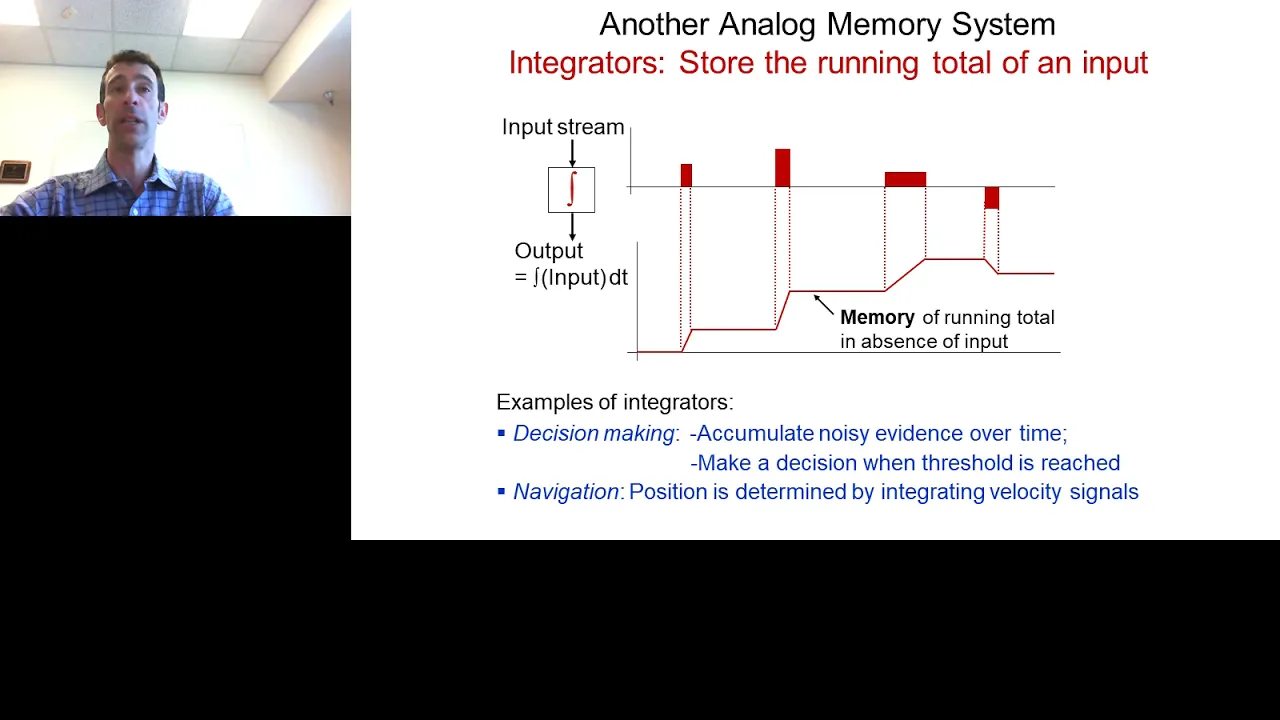
- Why this video: This presentation provides the mathematical and computational framework for persistent activity. It introduces the "attractor network model," detailing how populations of neurons form a continuous, stable ring of recurrent excitation, allowing a localized "bump" of electrical activity to persist across time to represent a visual or spatial location.
- Why this video: This video focuses on circuit-level neurophysiology. It addresses how persistent neural activity can endure across seconds even when individual constituent neurons operate on rapid millisecond timescales, illustrating the power of recurrent microcircuits and lateral inhibition in maintaining representations.
Knowledge Checkpoint
- Define "delay-period firing" and explain how it differs from sensory-evoked neural responses.
- Describe the basic architecture of a recurrent attractor network model and how mutual excitation between similarly-tuned neurons sustains a memory representation.
- Explain how a neural circuit with short individual synaptic time-constants can maintain stable information over several seconds.
Supplemental Self-Study Tip: Because cellular-level neurophysiology is a complex topic with limited general videos, we highly recommend searching independent platforms for academic articles using the query:
"neural basis of working memory persistent activity lecture". Focus on papers detailing glutamatergic NMDA receptors in the PFC, which possess slow deactivation kinetics that are mathematically ideal for sustaining persistent activity.
Module 4: Gating Mechanisms, Basal Ganglia, and Dopamine
Maintaining memory is not enough; the brain must also dynamically update memory when relevant new information arrives, while protecting it from distraction. This module deconstructs the Prefrontal Cortex-Basal Ganglia (PFC-BG) gating loop. You will learn how the basal ganglia acts as a physical gate, and how dopamine acts as the biophysical switch that modulates whether the prefrontal cortex is in a "gate open" (updating) or "gate closed" (robust maintenance) state.
Recommended Videos
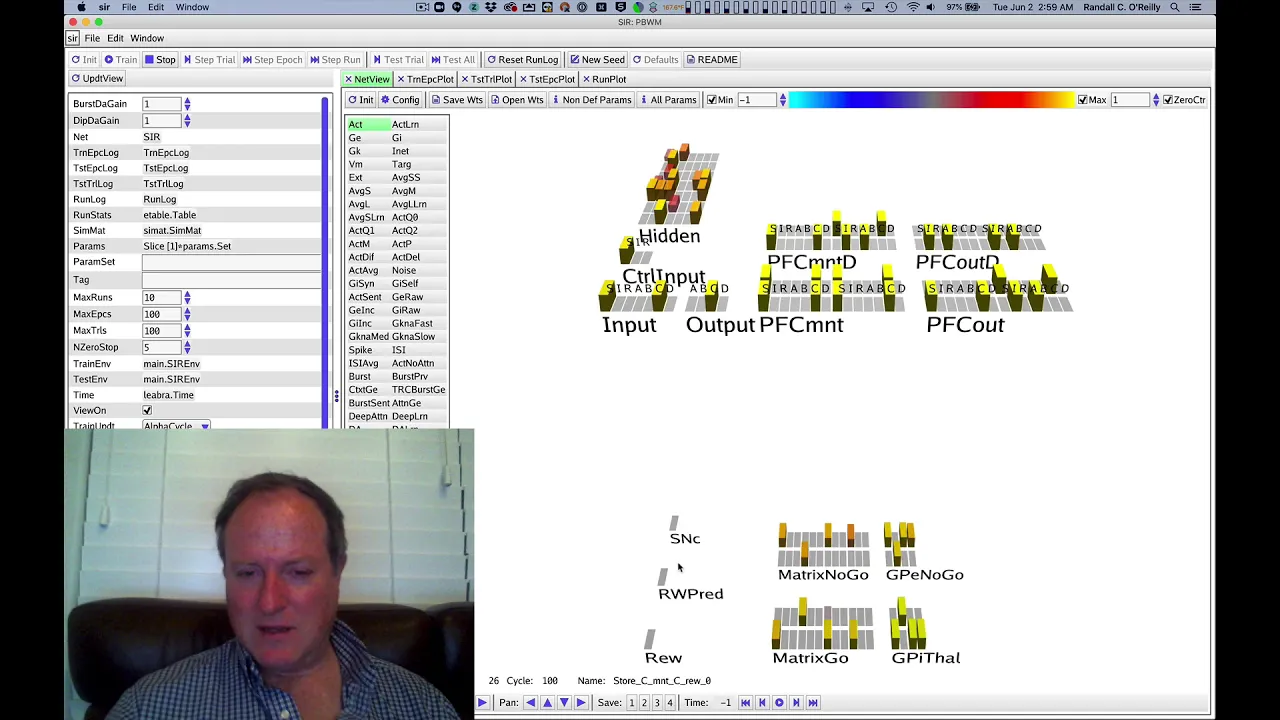
- Why this video: Dr. Randall O'Reilly is the primary pioneer of the PBWM (Prefrontal Cortex Basal Ganglia Working Memory) model. In this video, he explicitly details how the basal ganglia uses competing "Go" (direct pathway) and "No-Go" (indirect pathway) neural signals to disinhibit the thalamus, letting new representations flow into the PFC. This directly addresses the complex gating loop gap in our feedback.

- Why this video: Dr. Mark D'Esposito (UC Berkeley) is a leading neuroscientist studying working memory. In this discussion, he details how dopamine acts as a neuromodulator in the prefrontal cortex, showing that there is an optimal "inverted-U" shape relationship where too little or too much dopamine impairs working memory performance, and how dopamine dictates the stability versus flexibility of cortical states.

- Why this video: In this brief but highly concentrated theoretical clip, renowned cognitive neuroscientist Jonathan Cohen emphasizes how the basal ganglia-PFC loops act as a physical gating mechanism that determines what information is allowed to flow between distinct cortical areas, providing a systems-level view of cognitive control.
Knowledge Checkpoint
- Sketch the loop connecting the PFC, Basal Ganglia, and Thalamus, showing how the "Go" pathway disinhibits the thalamic-cortical projection to open the gate.
- Explain the "inverted-U" hypothesis of dopamine function in the prefrontal cortex.
- Describe how the brain resolves the computational trade-off between maintenance (protecting working memory from noise) and updating (incorporating new, highly relevant task instructions).
Supplemental Self-Study Tip: To enrich your understanding of the subcortical neurophysiology of executive control, search scholarly databases or video repositories for:
"prefrontal cortex basal ganglia loops executive control"and"dopamine modulation of prefrontal cortex working memory". Note how D1 receptors are typically associated with stabilizing memory representations, whereas D2 receptors are associated with gating and flexibility.
Module 5: Top-Down Attention and Coordinating Goal-Directed Behavior
In the final module, you will observe the ultimate behavioral output of cognitive control: top-down attention and goal-directed action. Learn how the prefrontal cortex functions as the "conductor" or "bouncer" of the brain, actively maintaining goal representations and projecting top-down bias signals to sensory areas to filter out noise and coordinate complex tasks in dynamic environments.
Recommended Videos
- Why this video: Dr. Adam Gazzaley outlines the fundamental difference between bottom-up attention (stimulus-driven, automatic survival mechanisms) and top-down attention (voluntary, goal-directed control guided by the PFC). This provides a clear, high-level behavioral context for how our cognitive priorities modulate raw perception.
- Why this video: This TED talk focuses on the physical neurobiological filtering mechanism in the frontal areas. It explains how attentional networks actively suppress distracting frequencies (such as alpha waves in the sensory regions representing ignored space) while boosting the processing of attended locations, illustrating top-down sensory modulation in action.

- Why this video: Derived from MIT’s famous "Society of Mind" lectures, this segment conceptually explains how the prefrontal cortex maintains active goal states and transmits "bias signals" to other, more posterior sensory and motor regions, overriding baseline reflexes to coordinate task-appropriate behavior.
Knowledge Checkpoint
- Contrast bottom-up (exogenous) attention with top-down (endogenous) attention in terms of trigger mechanisms and brain regions.
- Explain how a top-down "bias signal" from the prefrontal cortex alters neural firing in primary sensory cortices (such as visual area V4).
- Describe the cognitive deficits that arise when the prefrontal cortex's "bouncer" function fails in noisy, distracting real-world environments.
Course Map
Key People Index
- Dr. Julio Martinez-Trujillo (FUI/Western University): Renowned for recording directly from primate PFC neurons to show how spatial visual and physical features are sustained by population code persistent firing during working memory delays.
- Dr. Randall O'Reilly (UC Davis): Computational neuroscientist who designed the biologically realistic PBWM model, demonstrating how the basal ganglia gates prefrontal cortical structures.
- Dr. Adam Gazzaley (UCSF): Cognitive neuroscientist specializing in top-down control networks, focusing on how aging and technology affect distraction filtering and visual processing.
- Dr. Mark D'Esposito (UC Berkeley): Renowned cognitive neurologist who laid down modern models of the prefrontal cortex, showing how dopamine pharmacologically modulates delay-period memory in humans.
- Dr. Matthew Botvinick (DeepMind/Princeton): Computational neuroscientist known for research on cognitive control, hierarchical planning, and reinforcing deep learning systems with prefrontal-like architectures.
Final Self-Assessment
Complete this comprehensive self-assessment after watching all videos and reading the suggested materials.
- Can you define the physical boundaries and functions of the frontal, parietal, temporal, and occipital lobes?
- Can you explain the electrical mechanics of the action potential, including resting potential, sodium influx (depolarization), and potassium efflux (repolarization)?
- Can you identify the six-layered laminar structure of the neocortex and state which layers coordinate feedback versus feedforward signals?
- Can you map out the distinct roles of the dlPFC (working memory/external world) and the vmPFC (internal states/emotional regulation)?
- Can you explain delay-period firing and how single-unit recordings substantiate that the brain holds objects "in mind"?
- Can you describe how a computational attractor network model explains stable, persistent neural activity without continuous external sensory inputs?
- Can you explain the anatomical loop of the PBWM gating model, detailing how the Basal Ganglia disinhibits the Thalamus to let information enter the PFC?
- Can you explain the inverted-U shape curve of dopamine modulation in the PFC, explaining what happens when dopamine levels are too high or too low?
- Can you clearly distinguish between bottom-up (exogenous) attention and top-down (endogenous) attention?
- Can you explain how the PFC exerts top-down bias signals over sensory areas to filter out environmental distraction?