Educational Inequality: Capital & Mobility
Learning Goal: Analyze how modern educational systems reproduce social inequality, examining the roles of cultural capital, the hidden curriculum, and standardized testing in shaping social mobility.
- Prerequisites: None (Introductory-level familiarity with general sociological concepts is helpful but not required).
- Estimated Total Study Time: 8 hours
Module 1: Foundations of Educational Sociology & Social Mobility
This module introduces the sociological study of education, establishing the baseline tension between education's promised role as an engine of upward social mobility and its empirical reality as an instrument of social reproduction. You will critically examine the concept of meritocracy—the belief that success is determined solely by individual effort and ability—and explore how socioeconomic positioning influences life outcomes across generations.
Recommended Videos
Why this video
This video provides a comprehensive, visually engaging foundation for analyzing how class, race, and systemic resource distribution undermine the ideal of a level playing field. It serves as an excellent entry point into dismantling the myth of meritocracy by exposing the structural variables that define student achievement long before a child sets foot in a classroom.

Why this video
A concise conceptual anchor, this video introduces the core definition of "social reproduction." It illustrates how capital is transmitted intergenerationally, ensuring that children of wealthy parents typically inherit high social status, while children from low-income backgrounds face systemic friction when trying to climb the socioeconomic ladder.
Why this video
This resource defines social mobility metrics. It explains how researchers track movement up or down the income distribution relative to one's birth position. This provides a quantitative perspective to complement qualitative theories of class stratification.
Knowledge Checkpoint
- Define the difference between absolute and relative social mobility.
- Explain how "social reproduction" challenges the foundational premises of educational meritocracy.
- Identify at least three external socioeconomic barriers that prevent education from acting as an equalizing force.
Module 2: Pierre Bourdieu & Cultural Capital
In this module, you will explore the theories of French sociologist Pierre Bourdieu. You will analyze his three major forms of capital (economic, social, and cultural) and investigate how schools convert the "cultural capital" of elite families into academic credentials. Additionally, you will unpack the concepts of habitus and field to understand how class-based dispositions shape a student's confidence and comfort level within elite educational spaces.
Recommended Videos
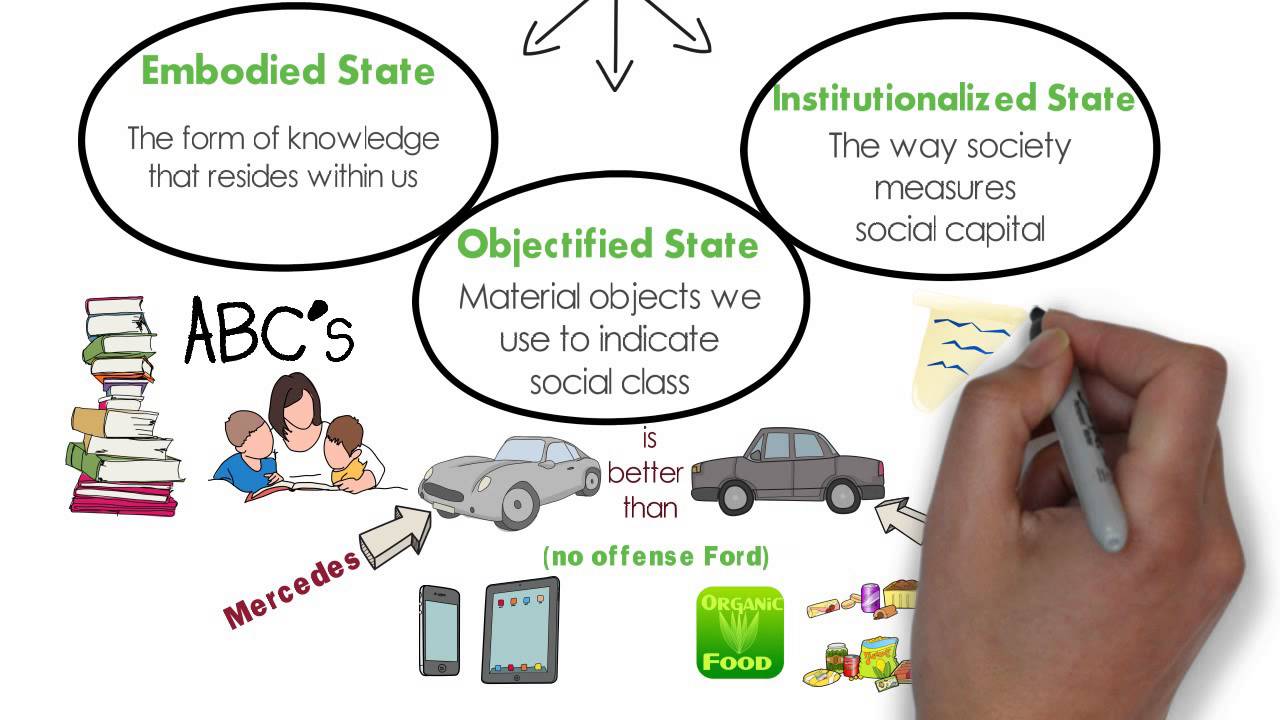
Why this video
This video offers a clear, structured explanation of cultural capital and its three distinct states (embodied, objectified, and institutionalized). It demonstrates how familiarity with "legitimate" cultural cues (such as high art, linguistic registers, and classical knowledge) is misrecognized by schools as natural intelligence or superior work ethic.

Why this video
Focusing directly on educational outcomes, this video maps Bourdieu’s theoretical framework onto practical class advantages. It explains how middle- and upper-class parents deploy their own cultural and economic resources to navigate school selection, communicate with educators, and secure systemic advantages for their children.

Why this video
This lecture provides an in-depth exploration of Bourdieu’s more complex concepts: habitus (internalized, class-based cognitive structures) and field (the social arenas in which individuals compete for power). Understanding this relationship is critical to analyzing why marginalized students often feel alienated in higher education settings, which operate as fields designed for elite habitus.
Knowledge Checkpoint
- List and provide educational examples of the three states of cultural capital: embodied, objectified, and institutionalized.
- Describe how a student's habitus can create an unconscious advantage or disadvantage in a university seminar.
- Explain the concept of "symbolic violence" in the context of academic grading systems prioritizing upper-class speech patterns.
Module 3: The Hidden Curriculum & Tracking
This module shifts focus to the internal practices of school systems. You will analyze the "hidden curriculum"—the unspoken rules, social values, and compliance standards schools teach alongside formal academics. Furthermore, you will address a major structural gap highlighted in educational research: how student sorting mechanisms (known as tracking, streaming, or ability grouping) reinforce preexisting class hierarchies and racial divisions through self-fulfilling prophecies.
Recommended Videos
Why this video
This video explains how tracking systems disproportionately assign working-class, Black, and Latinx students to lower academic tiers, whereas White and Asian students are more frequently routed to gifted or advanced placement classes, thereby widening initial resource divides.

Why this video
Addressing the international concept of "streaming" or "ability grouping," this short segment presents research on how sorting cohorts by perceived ability lowers overall academic expectations and outcomes for average and lower-tracked students while limiting their social mobility.

Why this video
This speech details the rigid, psychological limits imposed by tracking. It explains how separating kids into "advanced," "average," and "remedial" categories creates persistent self-fulfilling expectations that trap students in their assigned social track for their entire educational journey.
Why this video
This video defines the "hidden curriculum" as the informal transmission of values, norms, and beliefs (such as obedience, punctuality, and competition) through daily school structures. It demonstrates how schools socialize students to fit into hierarchical labor roles.
Knowledge Checkpoint
- Differentiate between the "formal curriculum" and the "hidden curriculum," giving real-world examples of each.
- Explain how academic "tracking" or "streaming" can generate a self-fulfilling prophecy for low-income or minority students.
- Describe how the hidden curriculum of working-class schools differs from that of elite prep schools (e.g., preparing for manual/low-wage labor vs. managerial/creative positions).
Module 4: Standardized Testing & Structural Bias
In this module, you will critically analyze standardized assessments (such as the SAT, ACT, and IQ tests). You will study the history of testing in the 19th and 20th centuries, tracing its ties to early eugenics programs designed to justify racial hierarchies. Finally, you will explore how modern high-stakes tests function as filters that correlate more strongly with parent income and tutoring access than academic potential.
Recommended Videos

Why this video
This critical history lesson traces the development of modern intelligence testing back to eugenicists who explicitly engineered assessments to confirm predefined biases against Black, immigrant, and low-income communities, revealing the deeply political roots of objective "merit-based" sorting.

Why this video
Wayne Au, a leading critic of standardization in education, explains how standardized testing emerged alongside the Industrial Revolution as an efficient sorting tool to rank children for the labor market, cementing class stratification under the guise of scientific objectivity.

Why this video
This video explains the rise of the SAT in American higher education admissions. It illustrates how the increasing weight placed on these examinations restricted access to elite colleges for disadvantaged cohorts while giving wealthier families an avenue to use coaching to secure admission.

Why this video
This clip addresses the high statistical correlation between a student's SAT score and their parents' socioeconomic status. It raises critical questions about whether standardized tests measure innate cognitive aptitude or simply the financial and cultural resources of a student's household.
Knowledge Checkpoint
- Detail the historical relationship between early eugenics movements and the invention of intelligence/SAT testing.
- Explain how "norm-referenced tests" guarantee that 50% of test-takers score below average, regardless of their absolute knowledge level.
- Identify two ways wealthy school districts and affluent parents convert economic capital into higher standardized test scores.
Module 5: Resource Allocation & Systemic Solutions
This final module focuses on macro-level structures and policy reforms. You will examine the structural funding inequalities embedded in the United States public education system, specifically analyzing how tying school budgets to local property taxes systematically starves low-income neighborhoods. To understand alternatives, you will conduct a comparative analysis of the Finnish education system, which prioritizes absolute funding equality, trust-based evaluations, and a total ban on academic streaming.
Recommended Videos

Why this video
This video directly addresses the structural funding gap highlighted in the review feedback. Physicist Sean Carroll breaks down the local mechanics of US public school funding, explaining how relying on local property taxes creates immense inequalities between school districts based purely on real estate values.

Why this video
This short segment provides historical context on how property-tax-based funding dynamics exacerbate racial and income inequalities, showing how lower property valuations in historically segregated neighborhoods lead directly to underfunded local schools.

Why this video
This comparative piece offers a deep dive into the Finnish model, highlighting its structural differences from Anglo-American systems: highly trained educators, high professional autonomy, minimal homework, and a total absence of standardized, high-stakes national assessments.

Why this video
This panel discussion explores policy solutions to educational inequality, specifically looking at how to move away from property-tax-dependent models to ensure equitable resource distribution, and how to reform systemic barriers affecting marginalized student groups.
Knowledge Checkpoint
- Explain how funding public schools through local property taxes ensures that wealth remains concentrated in specific geographic regions.
- Contrast the educational philosophies of the United States and Finland regarding standardized assessment and teacher training.
- Propose three policy reforms that could decouple a student's academic opportunity from their residential zip code.
Course Map
Key People Index
- Pierre Bourdieu (1930–2002): A highly influential French sociologist who introduced the concepts of cultural capital, habitus, and field. His work on social stratification demonstrated how unequal distributions of non-financial capital reproduce class systems across generations.
- Wayne Au: A prominent professor and critical education scholar whose work examines the political and economic history of high-stakes testing, demonstrating how standardized assessments act as tools of racial and socio-economic control.
- Emile Durkheim (1858–1917): Traced as the father of functionalist educational analysis, whose work on the role of schools in social cohesion and order set the stage for later conflict-oriented sociology of education theories.
Final Self-Assessment
- I can clearly explain the structural flaws of the "meritocracy" myth using sociological evidence.
- I can identify economic, social, and cultural capital in real-world educational scenarios.
- I can describe the difference between the embodied, objectified, and institutionalized states of cultural capital.
- I can analyze how a student's habitus interacts with the institutional field of a university to produce advantages or barriers.
- I can define the "hidden curriculum" and give three examples of values it reinforces in secondary education.
- I can explain how academic tracking/streaming creates a self-fulfilling prophecy of lower academic expectations for minority and low-income students.
- I can articulate the historical relationship between the early 20th-century eugenics movement and the design of standardized testing in the US.
- I can explain the mathematical and systemic bias of "norm-referenced" testing models.
- I can detail the precise structural mechanism through which US local property taxes link neighborhood real estate values to school budget quality.
- I can summarize how the Finnish education system structures teacher training, school choice, and tracking policies to achieve equitable student outcomes.