Alternative Economies: Gift, Moral & Mutual Aid
Learning Goal: Analyze alternative economic systems by investigating gift exchange, moral economies, informal markets, and mutual aid networks across diverse cultures.
- Prerequisites: None (An open mind and a willingness to challenge classical capitalist assumptions about human nature are highly recommended).
- Estimated Total Study Time: 12 hours
Course Map
This flowchart maps your learning journey through the five modules. Note how the theoretical foundations of economic anthropology (M1) feed into classical non-market distribution (M2) and historical peasant/working-class moral frameworks (M3), which in turn lay the groundwork for understanding survival tactics in shadow markets (M4) and active, self-organized cooperative alternatives (M5).
Module 1: Introduction to Economic Anthropology & Value
This module lays the groundwork for the course by examining how different cultures define value, debunking the historical myth of barter, and exploring the substantivist-formalist debate that divides economic anthropology. You will learn how economic activities are deeply embedded within social institutions rather than operating in an isolated, "rational" vacuum.
Recommended Videos
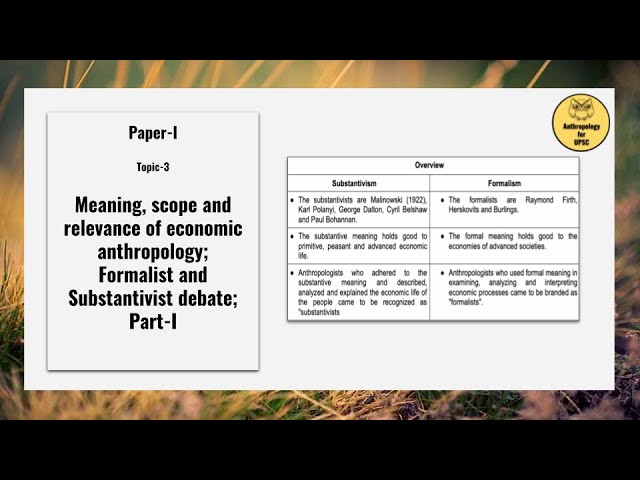
Why this video: This academic lecture provides a rigorous and structured breakdown of the "formalist vs. substantivist" debate. It explains how formalists apply classical Western economic principles (scarcity, maximizing behavior, rational choice) globally, while substantivists argue that economy is an instituted process embedded within specific social, political, and kinship structures.
- Knowledge Checkpoint:
- Explain the core difference between the formalist and substantivist approaches in anthropology.
- Define what it means for an economic activity to be "embedded" within a social structure.
- Describe the primary modes of distribution defined by substantivists (reciprocity, redistribution, market exchange).

Why this video: In this presentation, late anthropologist David Graeber dismantles the standard economic myth that money naturally evolved from barter. Instead, he demonstrates how credit and debt systems preceded coinage by thousands of years, showing how early economic relations were built on social obligations and state-imposed violence.
- Knowledge Checkpoint:
- Articulate why the "myth of barter" is historically inaccurate based on anthropological evidence.
- Explain how early coinages were historically tied to military-market complexes rather than simple organic trade.
- Discuss how debt acts as a moralizing mechanism to make relations of raw force look like voluntary contracts.

Why this video: This video provides an excellent summary of Marcel Mauss’s landmark text, The Gift. It introduces the concept of "total social phenomena" and explains why gifts are never truly free, instead operating under a rigid set of three social obligations that bind societies together.
- Knowledge Checkpoint:
- Define the three core moral obligations of gift exchange: to give, to receive, and to reciprocate.
- Explain the concept of "total social phenomena" (prestations totales).
- Describe how the "spirit of the gift" (hau) establishes a spiritual or social link between the giver and the object given.
Module 2: Gift Economies & Systems of Reciprocity
Building on the foundations of Marcel Mauss, this module investigates the practical application of gift exchange and reciprocity. Through classic anthropological studies, we examine Marshall Sahlins' typology of reciprocity and dive deep into real-world structures: the Pacific Islands' Kula Ring and the Pacific Northwest's Potlatch.
Recommended Videos

Why this video: This concise, conceptual explainer maps out Marshall Sahlins’ highly influential typology of reciprocity, establishing clear boundaries between different intensities of social and physical proximity.
- Knowledge Checkpoint:
- Differentiate between generalized, balanced, and negative reciprocity.
- Provide a real-world example of generalized reciprocity (e.g., household sharing).
- Identify which social circumstances typically trigger negative reciprocity (e.g., trading with complete strangers or competitive bartering).

Why this video: An archival documentary segment that brings to life Bronisław Malinowski’s pioneering work on the Trobriand Islands. It visually illustrates the Kula Ring, a ceremonial exchange network that spans vast oceanic areas, and explains its immense social and political weight.
- Knowledge Checkpoint:
- Detail the physical items traded in the Kula Ring (white shell armbands vs. red shell necklaces) and the directions they travel.
- Explain why these non-utilitarian items carry such massive value (genealogy, ownership history, and prestige).
- Analyze how the Kula Ring serves to maintain peace and trade relations across geographically separated island societies.

Why this video: This video provides crucial environmental, social, and economic context for the Indigenous communities of the Pacific Northwest Coast, highlighting how natural abundance paved the way for complex social stratification and the development of the Potlatch.
- Knowledge Checkpoint:
- Explain how environmental abundance along the Northwest coast enabled resource accumulation without agricultural cultivation.
- Describe the social hierarchy of coast societies and how prestige was tied to resource distribution.
- Connect the geographical and social environment to the necessity of a macro-redistributive system like the Potlatch.

Why this video: A focused exploration of the Potlatch ceremony itself, explaining its purpose as both a wealth-redistribution event and a central legal/social mechanism for Indigenous nations.
- Knowledge Checkpoint:
- Detail how a host chief gains prestige and validates their titles through the lavish giving away or destruction of property.
- Contrast the Potlatch system’s accumulation-for-distribution model with the Western capitalist model of accumulation-for-retention.
- Identify the historical impact of the Potlatch bans imposed by colonial governments.
Module 3: Moral Economies vs. Market Logic
Note on Content Coverage: While the concept of a moral economy is highly respected, academic explainers in mainstream video databases are limited. To fully grasp this module, learners are strongly encouraged to complement this material by searching for specific papers by E.P. Thompson and James C. Scott.
This module investigates how ethical obligations, customary community rights, and the "subsistence ethic" restrict free-market capitalism. We analyze how historical working-class and peasant populations organized to defend their livelihoods against the destabilizing forces of "pure" market mechanics.
Recommended Videos

Why this video: This video functions as the primary theoretical anchor for this module. It explains how economic actions are judged by communities through a moral lens, illustrating how traditional populations prioritize survival, fairness, and reciprocal duties over abstract market laws of supply and demand.
- Knowledge Checkpoint:
- Define the term "moral economy" in an anthropological context.
- Explain how communities assert "moral" expectations over the pricing and distribution of essential goods (like grain or water).
- Describe how violate-and-punish dynamics occur when market actors cross these shared community boundaries.

Why this video: Though extremely short, this ethnographic note specifically ties the concept of the "moral economy" back to its main intellectual standard-bearers: E.P. Thompson and James C. Scott. It highlights how marginal or embattled communities use moral economies to structure alternative survival agreements.
- Knowledge Checkpoint:
- Associate E.P. Thompson's research with 18th-century English food riots and price setting.
- Associate James C. Scott's research with Southeast Asian peasant arrangements and the "subsistence ethic".
- Reflect on how informal moral rules manage resources in contemporary marginal urban settings.
Why this video: This discussion highlights James C. Scott's text Against the Grain. It provides essential context on how agrarian societies view state-imposed agricultural models, demonstrating Scott's broader skepticism of state projects that attempt to simplify and control local, self-sufficient economic ecosystems.
- Knowledge Checkpoint:
- Summarize James C. Scott's argument regarding how early states forced populations into grain-heavy farming.
- Explain how state control disrupts traditional, diversified, and highly resilient community subsistence strategies.
- Describe why communities historically resisted the transition from highly autonomous foraging to heavily taxed state agriculture.
Module 4: Informal Markets & Shadow Economies
When formal systems fail, the state recedes, or regulations choke off access to livelihood, communities organize parallel, informal systems. This module analyzes "System D"—the global informal economy that powers survival and entrepreneurship for billions of people without reliance on formal contracts or banking structures.
Recommended Videos

Why this video: Journalist Robert Neuwirth delivers an eye-opening look at the global reach of the informal sector, coining the term "System D." He presents the scale of this parallel economy, proving that it is not a chaotic aberration, but a highly structured, self-organizing system.
- Knowledge Checkpoint:
- Define "System D" and list its global economic scale relative to formal corporate giants.
- Explain how informal supply chains function globally without formal legal courts or contracts.
- Analyze the positive and negative aspects of working entirely outside state regulation (e.g., agility vs. lack of safety nets).
Why this video: Niti Bhan challenges common misconceptions about informal traders, proving they are often highly organized, systematic managers who keep records, maintain complex local partnerships, and generate massive wealth that is simply invisible to conventional GDP calculations.
- Knowledge Checkpoint:
- Critique the stereotype that informal traders are disorganized, desperate, or unproductive.
- Give examples of the hidden business structures (inventories, records, and supply chains) maintained by informal merchants.
- Explain why formal, Western-style banking or retail products often fail when imposed on these agile, relationship-driven systems.
Why this video: Neuwirth expands his analysis of System D by contrasting top-down, corporate "free markets" with bottom-up, community-governed "flea markets," showing how cooperative and relational structures are built directly into decentralized trading networks.
- Knowledge Checkpoint:
- Contrast top-down corporate structures with the bottom-up, relational structures found in flea markets.
- Explain how decentralized systems establish trust and resolve disputes among competitors without legal intervention.
- Discuss why treating the informal sector as a criminal enterprise harms local community resilience.
Module 5: Mutual Aid & Solidarity Networks
Note on Content Coverage: To bypass low-effort content or memes, our curated selection of video essays focuses on the theoretical roots of Peter Kropotkin, practical mutual aid strategies championed by modern organizers like Dean Spade, and the structure of Solidarity Economy institutions such as Community Land Trusts.
Transitioning from survival strategies within or outside markets, this module explores active, self-organized alternatives designed to build parallel institutions of communal care. We study the evolutionary theory of mutual aid, modern mutual aid frameworks, and concrete structural cooperative tools.
Recommended Videos

Why this video: An exceptional, deep-dive animated essay that defines mutual aid as a structural concept distinct from charity. It traces the history of human cooperation and positions mutual aid as an active political strategy to build non-hierarchical safety nets.
- Knowledge Checkpoint:
- Differentiate between mutual aid (solidarity/horizontalism) and charity (paternalism/verticalism).
- Define the core principle "from each according to their ability, to each according to their need" in a modern mutual aid network.
- Discuss how mutual aid networks actively build dual power, preparing community members to meet their own needs during crises.
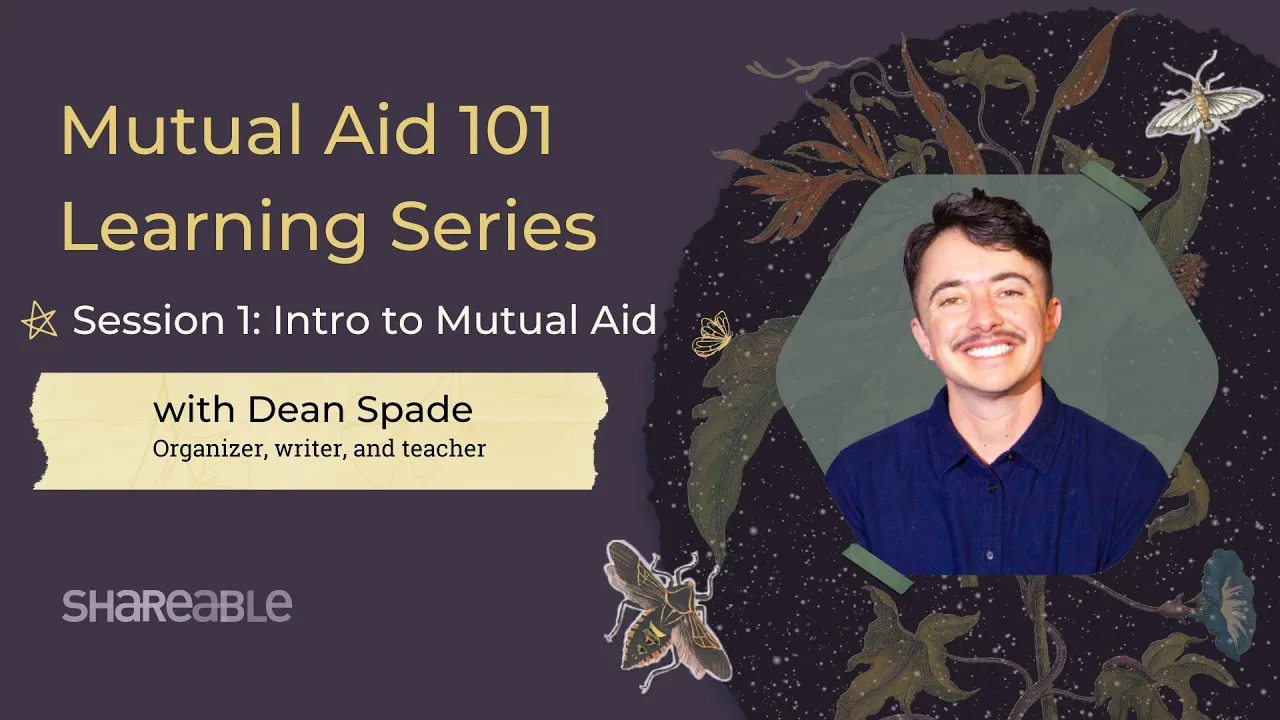
Why this video: A comprehensive workshop hosted by legal scholar and activist Dean Spade. It functions as a masterclass on how to construct, organize, and sustain localized mutual aid networks, highlighting real-world coordination, conflict resolution, and survival mechanics.
- Knowledge Checkpoint:
- List the three central elements of effective mutual aid projects as outlined by Spade (e.g., meeting survival needs, collective mobilization, and non-bureaucratic action).
- Explain how charity models often moralize poverty (sorting people into "deserving" vs. "undeserving" poor), while mutual aid rejects this distinction.
- Design a basic, hypothetical intake and supply-coordination flow for a neighborhood-level crisis.

Why this video: This video focuses on Russian naturalist and political philosopher Peter Kropotkin. It traces his critique of social Darwinism, showing how Kropotkin proved that cooperation (mutual aid) is as much a law of nature and an evolutionary driver as competitive struggle.
- Knowledge Checkpoint:
- Summarize Kropotkin's argument on why cooperation, rather than raw conflict, drives evolutionary intelligence and success in animal and human societies.
- Contrast Kropotkin's view of "survival of the fittest" with vulgar social Darwinist interpretations of human nature.
- Explain how historical guilds, villages, and free cities implemented mutual aid long before state welfare existed.

Why this video: Though very short, this video outlines the core structural practices of the solidarity economy. It demonstrates how modern tools like Community Land Trusts (CLTs) can be used to permanently decommodify land, cultivate regenerative agriculture, and incubate worker-owned cooperatives.
- Knowledge Checkpoint:
- Define a Community Land Trust (CLT) and explain how it separates land ownership from home or building ownership to keep housing permanently affordable.
- Explain the relationship between worker-owned cooperatives and the broader "solidarity economy."
- Discuss why reclaiming land control is a necessary first step for building sustainable community-run alternative economies.
Key People Index
| Person | Context & Contributions | Core Concepts |
|---|---|---|
| Marcel Mauss | French sociologist and author of the seminal 1925 essay The Gift. | Total social phenomena; three obligations (give, receive, reciprocate); the hau (spirit of the gift). |
| David Graeber | Renowned anthropologist, activist, and author of Debt: The First 5,000 Years. | Demolition of the "myth of barter"; credit-preceding-money; debt as social obligation weaponized by states. |
| Marshall Sahlins | Anthropologist famous for his critiques of Western economic rationality. | Three modes of reciprocity: generalized (altruistic), balanced (equivalent), and negative (combative). |
| Bronisław Malinowski | Polish-British anthropologist who pioneered participant observation. | The Kula Ring; intensive ethnographic study of Trobriand island ceremonial exchange systems. |
| E.P. Thompson | British social historian and activist who wrote The Making of the English Working Class. | Historical "moral economy"; popular consensus regarding fair pricing vs. raw free-market forces. |
| James C. Scott | Political scientist and anthropologist who studied subaltern resistance. | Peasant "subsistence ethic"; resistance to state simplification (Against the Grain); Zomia. |
| Peter Kropotkin | Russian evolutionary biologist, geographer, and anarchist philosopher. | Mutual aid as a factor of evolution; scientific critique of social Darwinism; self-organized communal safety nets. |
| Dean Spade | Legal scholar, activist, and author of Mutual Aid: Building Solidarity During This Crisis. | Horizontal, non-bureaucratic organizing; charity vs. mutual aid; community-led disaster relief. |
| Robert Neuwirth | Investigative journalist who embedded in global alternative markets. | System D (the global informal economy); bottom-up flea markets vs. top-down corporatized "free markets." |
Final Self-Assessment
Test your understanding of the entire curriculum by assessing your ability to complete the following tasks:
- I can articulate the fundamental differences between the substantivist and formalist schools of economic anthropology.
- I can explain why the classic textbook narrative of money arising organically from barter is a historical myth.
- I can trace the flow of Marcel Mauss’s three obligations (to give, to receive, to reciprocate) and explain how they construct social bonds.
- I can explain the mechanics of the Kula Ring and identify what type of reciprocity it exemplifies in Marshall Sahlins' typology.
- I can compare and contrast the wealth-accumulation models of a Western capitalist economy with an Indigenous Pacific Northwest Potlatch.
- I can analyze a historical crisis (such as an 18th-century bread riot) through the lens of E.P. Thompson's "Moral Economy".
- I can explain James C. Scott's peasant "subsistence ethic" and describe how it shapes peasant resistance to capitalist agriculture.
- I can define System D and discuss how informal economies establish international supply networks and trust without formal contracts.
- I can clearly define Mutual Aid and defend why it is structurally different from top-down, paternalistic charity.
- I can explain Peter Kropotkin's arguments showing how cooperation operates as a primary mechanism of biological evolution.
- I can outline how a Community Land Trust (CLT) functions to decommodify property and protect local neighborhoods from gentrification.