Game Theory: Pricing, Collusion & Oligopoly
Learning Goal: Apply game theory concepts, such as Nash Equilibrium and sequential moves, to analyze strategic pricing, collusion, and entry deterrence in oligopolistic markets.
- Prerequisites: Basic microeconomics (demand and supply curves, marginal revenue, marginal cost, and perfect competition/monopoly principles).
- Estimated Total Study Time: 10 Hours
Module 1: Introduction to Market Structures & Oligopoly
This module establishes the foundational economic landscape. You will learn what characterizes an oligopoly, how it sits dynamically between the extremes of perfect competition and monopoly, and why strategic interdependence—where one firm's decision directly affects another's payoffs—is its defining feature.
Recommended Videos
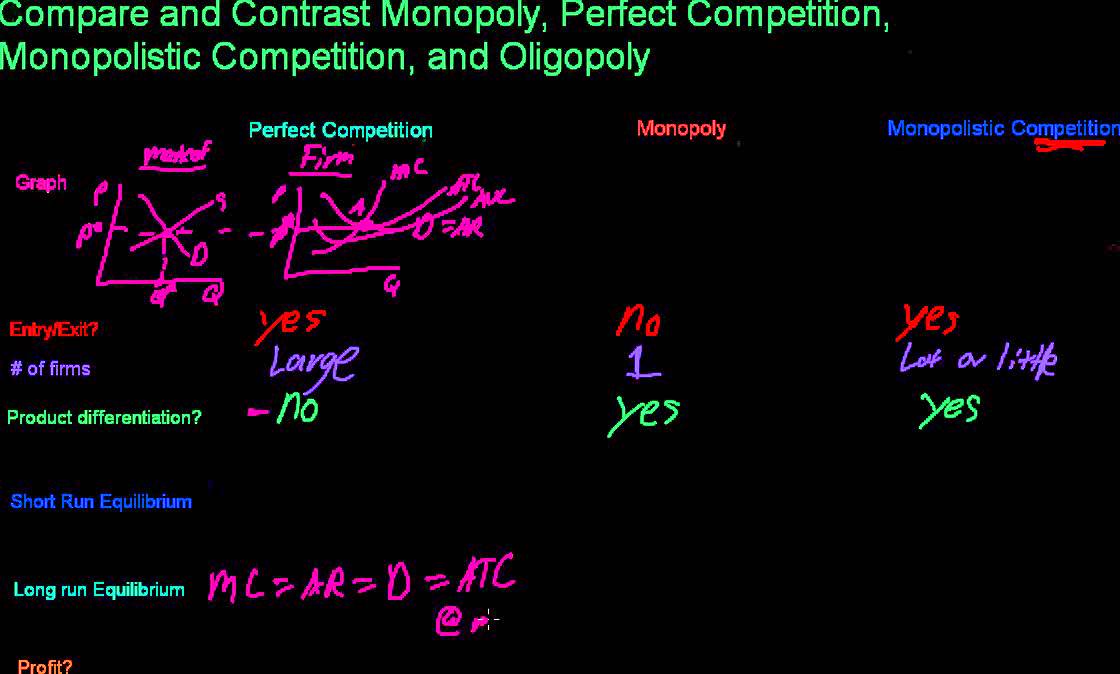
- Why this video: This video offers a comprehensive comparative framework of the four main market structures. It details barriers to entry, pricing power, and profit outcomes, helping you ground your understanding of where oligopolies sit relative to perfect competition and monopolies.
- Describe the four main market structures and identify their key characteristics.
- Explain why oligopolies face high barriers to entry and how they differ from monopolistic competition.
- Understand the concept of mutual interdependence in oligopolistic decisions.

- Why this video: This video focuses on the fundamental traits of an oligopoly (typically 2 to 10 firms dominating a market). It is essential for understanding how the actions of a single competitor force a response from others, laying the groundwork for game theory.
- Define what constitutes a concentrated market structure.
- Explain why strategic planning is necessary in an oligopoly but unnecessary in perfect competition.

- Why this video: This classic video introduces the practical pricing dynamics within an oligopoly, illustrating concepts like the kinked demand curve, price rigidity, and the basic tension between competing and colluding.
- Explain the logic behind the kinked demand curve model.
- Identify why prices in oligopolies tend to remain sticky or rigid even when costs fluctuate slightly.
Module 2: Foundations of Game Theory & Nash Equilibrium
Game theory provides the mathematical toolkit needed to model strategic interdependence. In this module, you will master the components of a game—players, strategies, and payoffs—and learn to find Nash Equilibria and dominant strategies in simultaneous-move games.
Recommended Videos

- Why this video: A concise, high-level introduction from Yale University explaining what strategic thinking is and why game theory is vital when the outcomes of your decisions rely on the decisions of other actors.
- Define a "strategic situation" in economic terms.
- Differentiate between strategic decisions and non-strategic decisions (such as those made by a pure monopolist).
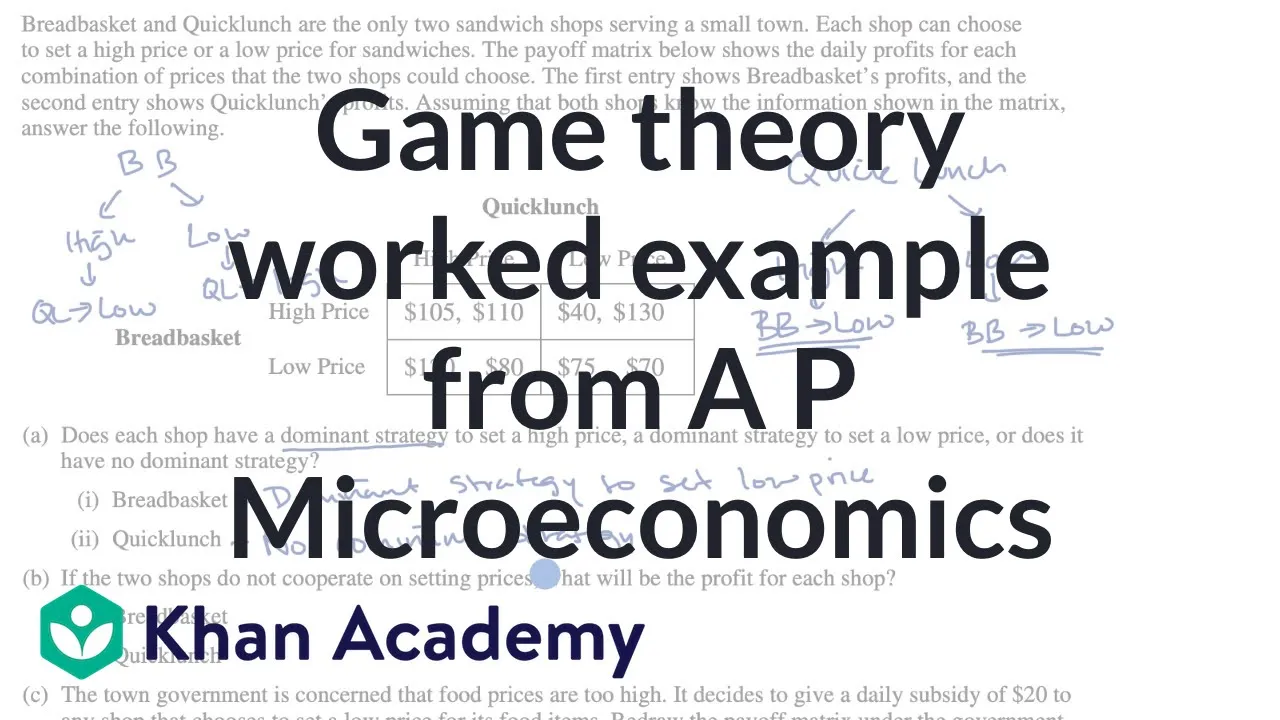
- Why this video: This video uses a practical pricing game between two sandwich shops to teach you how to read a payoff matrix, locate dominant strategies, and identify Nash Equilibria.
- Construct and interpret a simultaneous-move payoff matrix.
- Mathematically define a dominant strategy.
- Find the Nash Equilibrium in a standard simultaneous game.
![[Game Theory Introduction] | Dominant Strategy Equilibrium | Meaning of Nash Equilibrium | 19 |](https://i.ytimg.com/vi/_QCLbdpYU_0/maxresdefault.jpg)
- Why this video: This tutorial teaches you how to systematically find Nash Equilibria using the "best-response analysis" method (underlining the best payoffs). This systematic approach is essential for analyzing more complex, multi-strategy games.
- Apply best-response analysis systematically across any payoff matrix.
- Explain the conceptual difference between a dominant strategy equilibrium and a Nash Equilibrium.
Module 3: Strategic Pricing: Cournot vs. Bertrand Models
This module covers static pricing models in duopolies. You will compare the Cournot model, where firms compete by choosing quantities, with the Bertrand model, where firms compete on price. This section bridges the gap between conceptual game theory and rigorous microeconomic math.
Recommended Videos

- Why this video: This video compares how choosing quantity as a strategic variable yields different market prices and profit margins than choosing price.
- Differentiate between the core assumptions of Cournot and Bertrand competition.
- Explain why Bertrand competition leads to more aggressive market outcomes than Cournot.
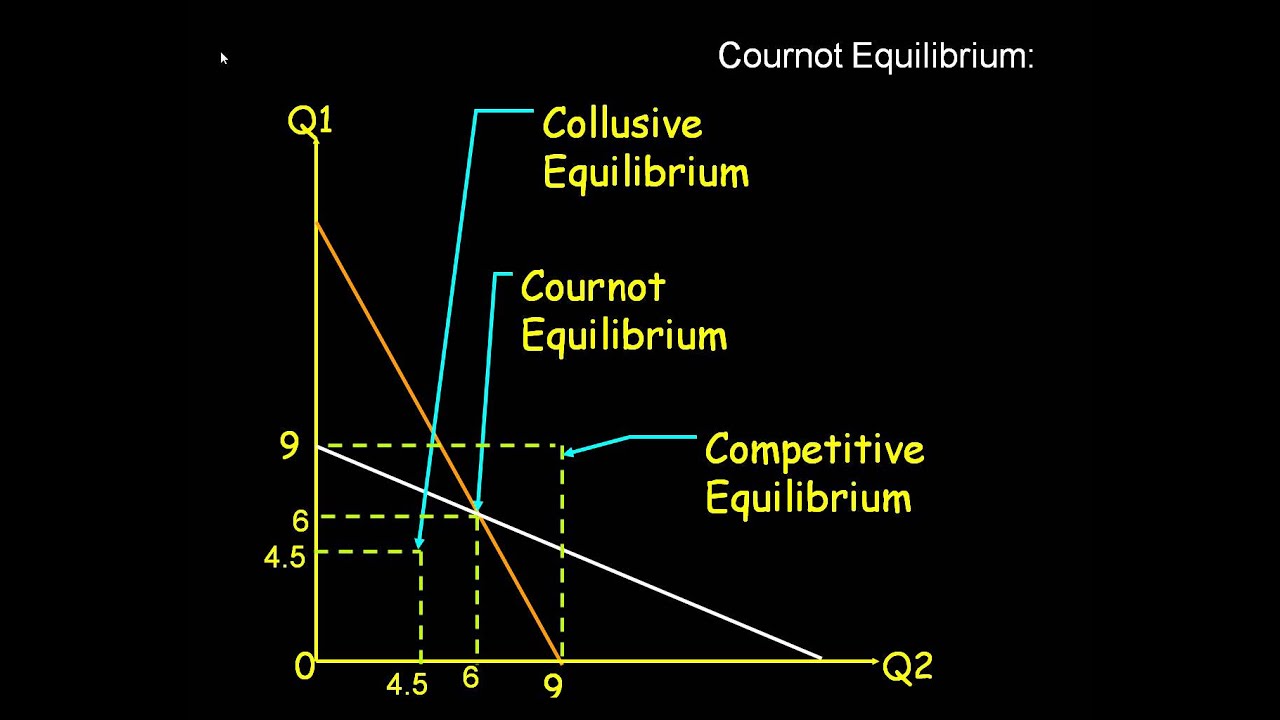
- Why this video: This video provides a step-by-step mathematical demonstration of how to construct a firm's profit function and derive its reaction curve (best-response function) in a Cournot duopoly.
- Set up the profit maximization problem for a Cournot duopolist.
- Mathematically derive a firm’s reaction curve () from its profit function.
- Solve for the Cournot-Nash equilibrium quantities and prices.
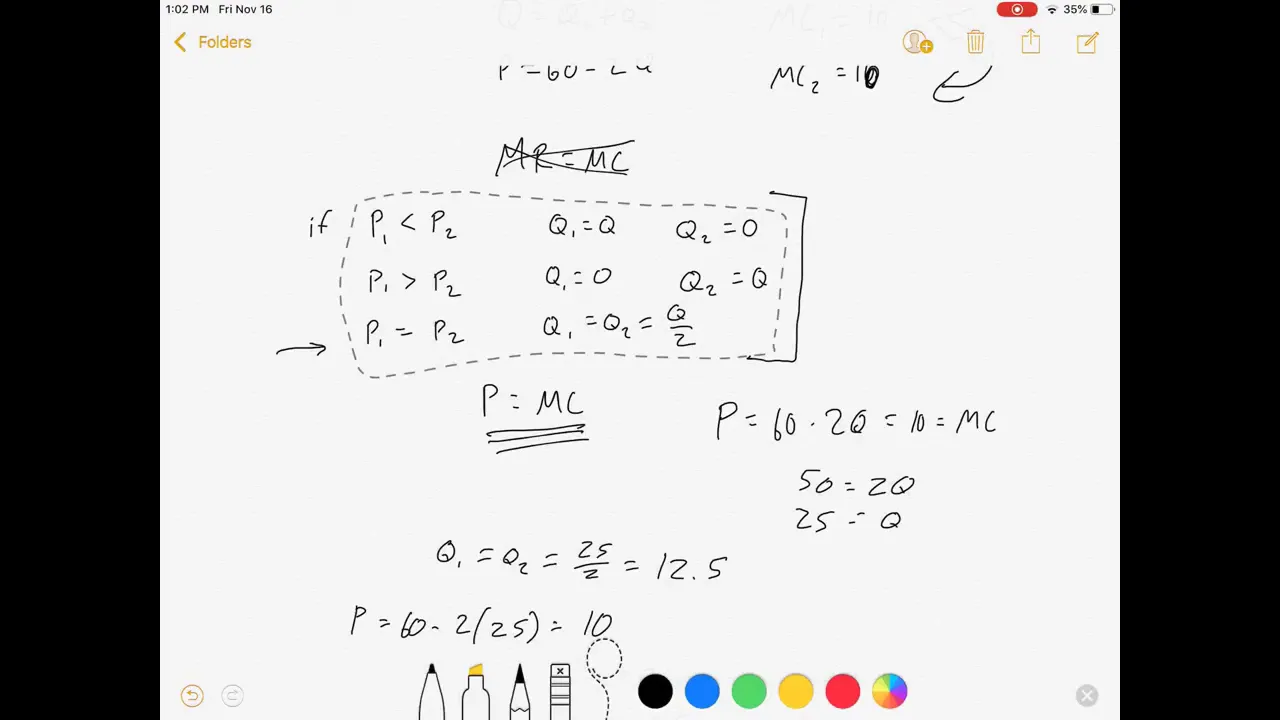
- Why this video: This video covers the Bertrand model under identical marginal costs. It explains how undercutting drives prices down to marginal cost (), resulting in zero economic profit.
- Explain the Bertrand Paradox and why two competing firms can drive prices down to perfectly competitive levels.
- State the critical assumptions (such as homogeneous goods and no capacity constraints) that cause the Bertrand Paradox to hold.
- Why this video: An excellent comparative math session. It uses a single market demand function and cost structure to solve for the pricing and output levels of all major models: Cartel (Collusion), Bertrand, Cournot, and Stackelberg.
- Compare the equilibrium market price across Cartel, Cournot, Stackelberg, and Bertrand structures using the same demand curve.
- Order these four models by total market output and industry profits.
Module 4: Collusion, Cartels, and Repeated Games
While single-stage games predict competition or defection (as in the Prisoner's Dilemma), real-world firms interact repeatedly. This module covers repeated games and shows how dynamic trigger strategies can sustain collusion and Cartels.
Recommended Videos

- Why this video: This video covers the mechanics of the Grim Trigger strategy. It details how the threat of permanent future punishment can sustain cooperation among rational, self-interested players.
- Define the Grim Trigger strategy in repeated games.
- Explain how the "shadow of the future" (discount factor ) determines if cooperation can be sustained.
- Contrast Grim Trigger with other punishment systems, such as Tit-for-Tat.
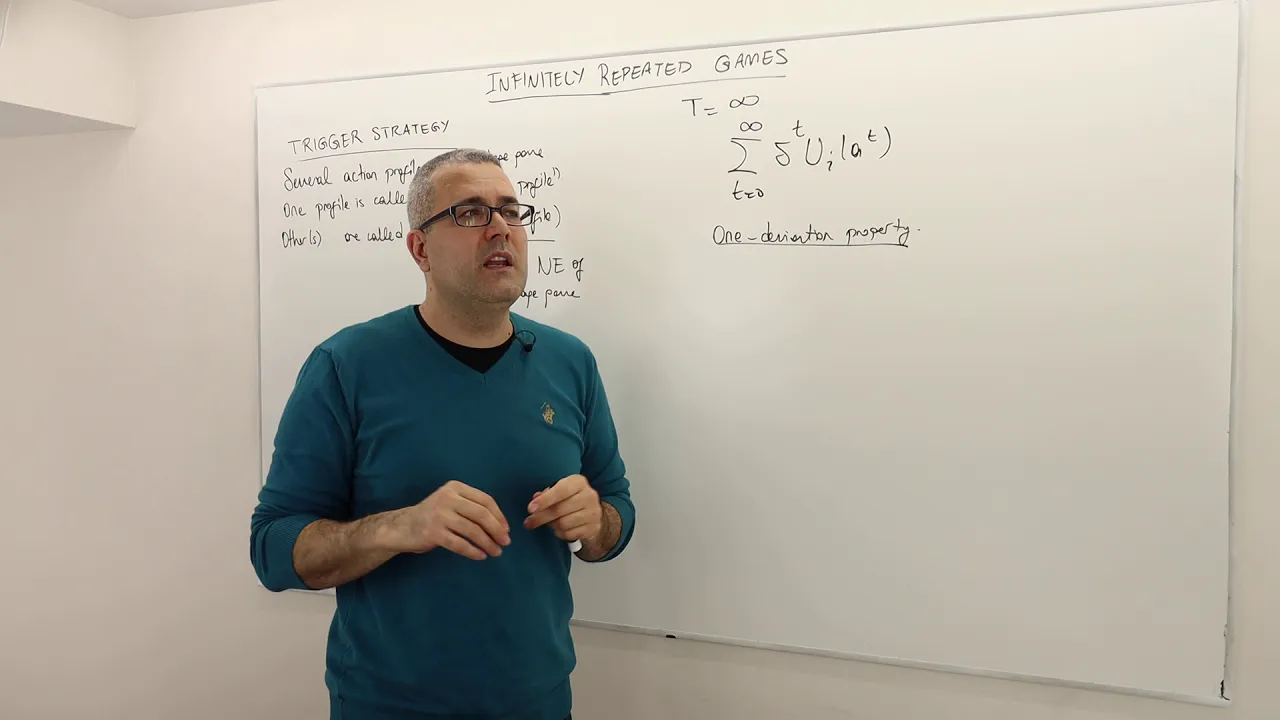
- Why this video: A mathematically rigorous lecture explaining how to prove a Grim Trigger Strategy Profile constitutes a Subgame Perfect Nash Equilibrium (SPNE) in infinitely repeated games.
- Use the One-Period Deviation Property to check if a strategy is an SPNE.
- Calculate the critical value of the discount factor () needed to prevent cheating on a collusive agreement.

- Why this video: This video uses OPEC to show how international cartels coordinate production quotas to keep global prices high, as well as the challenges they face with cheating and changing supply dynamics.
- Describe how real-world cartels manipulate supply to influence prices.
- Identify the main incentives and pressures that lead cartel members to cheat on their production quotas.

- Why this video: This video examines the DRAM price-fixing scandal, showing how tech firms colluded in the real world and how regulatory bodies investigate and prosecute corporate collusion.
- Differentiate between explicit collusion (such as price-fixing agreements) and tacit collusion.
- Explain why collusion is illegal in most major global markets and identify the legal risks involved.
Module 5: Sequential Games & Entry Deterrence
In many industries, firms do not act at the same time. This module covers sequential-move games, game trees, and backward induction. You will study Stackelberg quantity leadership, entry deterrence games, and the difference between credible and non-credible threats.
Recommended Videos
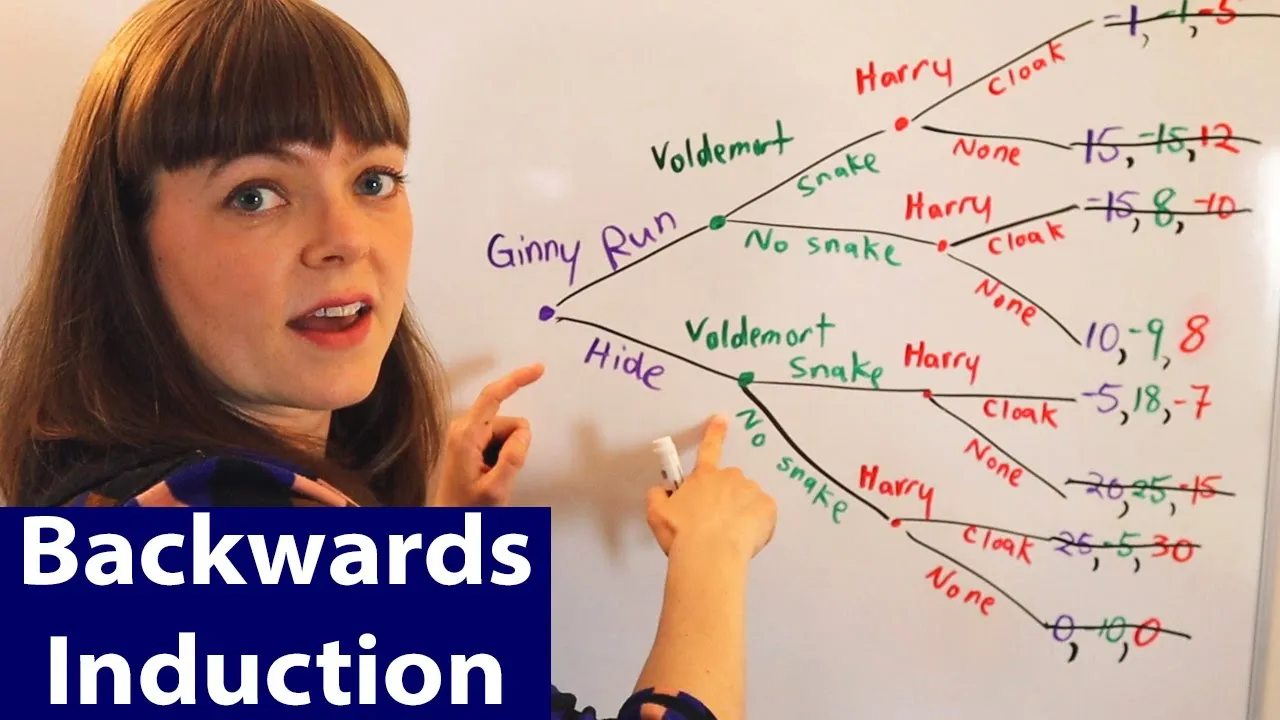
- Why this video: This video shows you how to read a sequential game tree (extensive form game) and use backward induction to find the subgame perfect Nash equilibrium.
- Draw and label an extensive form game tree with decision nodes and payoffs.
- Apply backward induction by working from the terminal nodes back to the initial node.

- Why this video: This video explains quantity leadership under the Stackelberg model. It shows why the first mover (leader) enjoys a strategic advantage over the follower.
- Explain the concept of a first-mover advantage.
- Describe how the follower's reaction function is used by the leader to maximize profits.
![(AGT2E13) [Game Theory] Extensive Form Games: Subgame Perfect (Nash) Equilibrium](https://i.ytimg.com/vi_webp/X2VfMhbSNXU/maxresdefault.webp)
- Why this video: This video uses an entry deterrence game to show how Subgame Perfect Nash Equilibrium (SPNE) eliminates non-credible threats, such as a monopoly threatening to wage a price war if a new competitor enters.
- Define what makes a strategic threat "credible" or "non-credible."
- Explain how backward induction eliminates Nash equilibria that rely on non-credible threats.

- Why this video: This segment covers limit pricing, explaining how dominant firms set prices below the average cost of potential entrants to deter them from entering the market.
- Explain the mechanics of limit pricing and how it deters entry.
- Contrast limit pricing with predatory pricing.
- Describe how strategic capacity expansion serves as a credible commitment to fight entry.
Course Map
This map outlines the recommended progression through the material.
Key People Index
- John Nash (1928–2015): An American mathematician who developed the Nash Equilibrium, a foundational concept in game theory where no player has an incentive to unilaterally deviate from their chosen strategy.
- Antoine Augustin Cournot (1801–1877): A French philosopher and mathematician who formulated the first formal model of oligopoly, where firms compete by choosing production quantities.
- Joseph Louis François Bertrand (1822–1900): A French mathematician who challenged Cournot's model by showing that if firms compete on price instead of quantity, the equilibrium price drops to marginal cost.
- Heinrich Freiherr von Stackelberg (1905–1946): A German economist who expanded oligopoly theory by introducing sequential-move games, where a market leader moves first and a follower moves second.
Final Self-Assessment
Test your understanding of the entire curriculum with this comprehensive checklist:
- Explain why firms in an oligopoly are strategically interdependent and cannot make decisions in isolation.
- Construct a payoff matrix and identify any dominant or dominated strategies for both players.
- Find all pure-strategy Nash Equilibria in a simultaneous-move game matrix using best-response analysis.
- Derive the reaction curves and calculate the equilibrium price, quantities, and profits for a Cournot duopoly.
- Explain why Bertrand price competition leads to perfectly competitive outcomes () and list the assumptions required for this result.
- Define the Grim Trigger strategy and calculate the discount factor () required to sustain a collusive cartel agreement.
- Explain why cartels are inherently unstable and identify the economic incentives that lead members to cheat.
- Solve a sequential game tree using backward induction to find the subgame perfect Nash equilibrium (SPNE).
- Solve the Stackelberg duopoly model and explain why the leader earns higher profits than the follower (first-mover advantage).
- Identify a non-credible threat in an entry deterrence game and explain how SPNE rules it out.
- Explain how limit pricing and capacity expansion can be used as credible commitments to prevent new firms from entering a market.