SWRO Desalination: Brine, Intake & Mitigation
Learning Goal: Evaluate the environmental impacts of seawater reverse osmosis (SWRO) desalination, focusing on brine disposal and marine impingement, and propose mitigation designs like directional diffusers.
- Prerequisites: Basic fluid mechanics, introductory chemistry, and general ecology.
- Estimated Total Study Time: 12 Hours
Module 1: Foundations of Seawater Reverse Osmosis (SWRO)
Module Overview
Seawater Reverse Osmosis (SWRO) is the leading industrial method for producing fresh drinking water from saline oceanic sources. This module establishes the core thermodynamic and physical principles of membrane desalination. You will learn about hydrostatic vs. osmotic pressure, the structural composition of thin-film composite membranes, and the energy demands of scaling up systems to high pressures (up to 1,000 PSI).
Recommended Videos
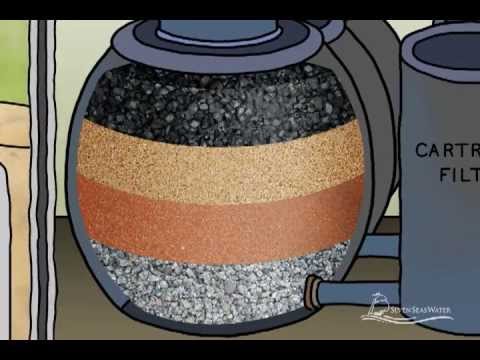
Why this video
This video provides an excellent 3D visual walkthrough of a commercial SWRO facility, breaking down how high-pressure pumps force water molecules through spiral-wound membrane elements while rejecting ionic species.
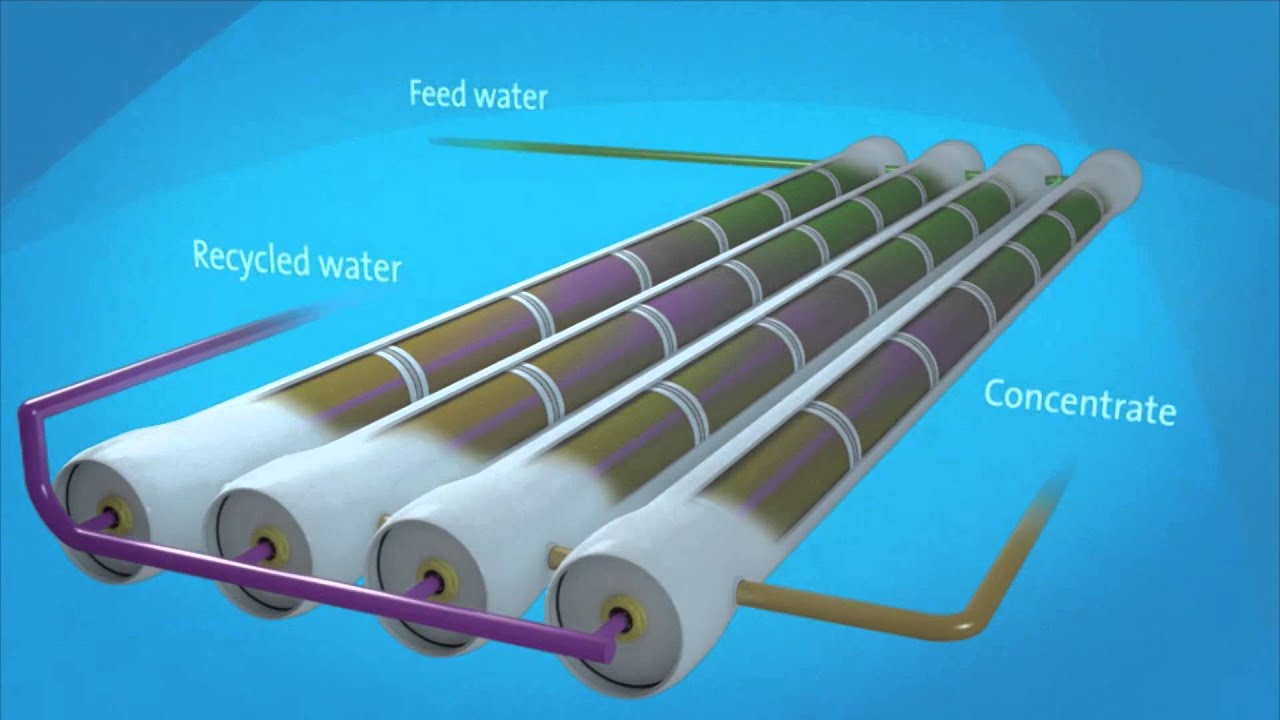
Why this video
Produced by Sydney Water, this animation isolates the atomic-level polymer layers of a modern reverse osmosis membrane (polyester support base, polysulfone mid-layer, and polyamide barrier layer), showing how selectivity works at the molecular scale.
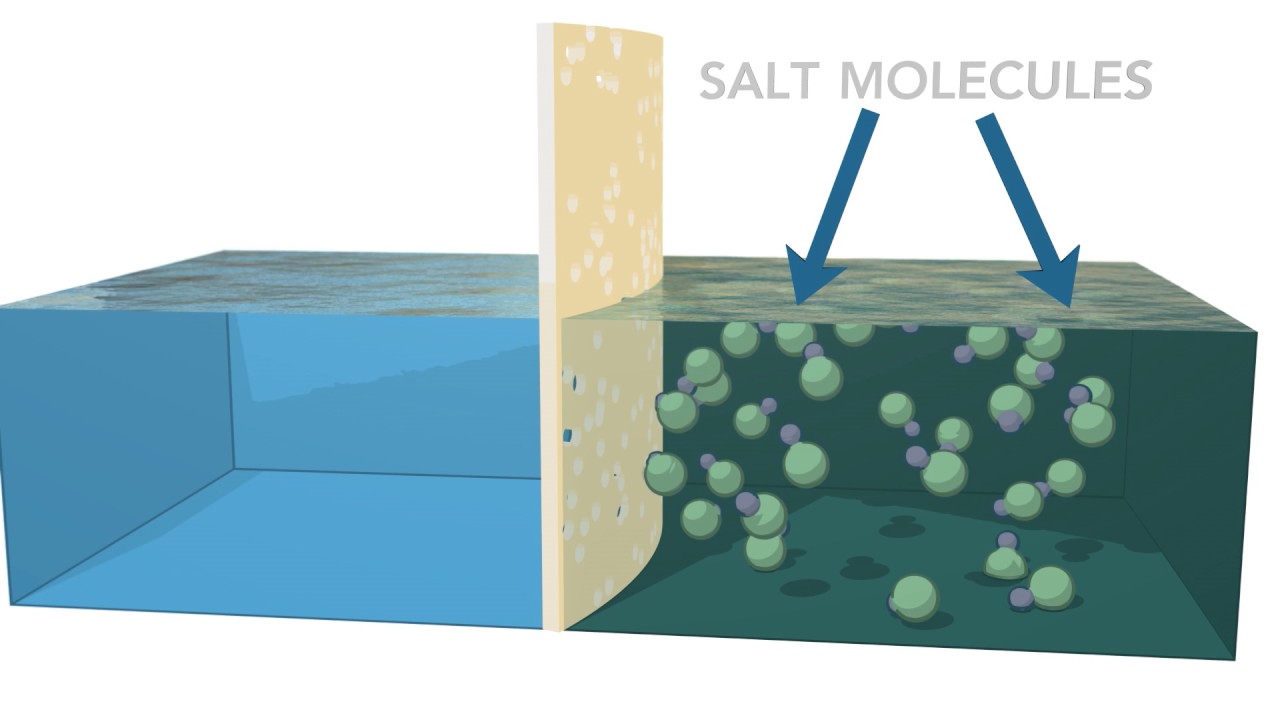
Why this video
A clear, concise, and highly visual representation of the pre-treatment and post-treatment loops wrapped around the central RO membrane core, helping you visualize the overall system architecture.
Knowledge Checkpoint
- Define natural osmotic pressure and write the formula for the Van 't Hoff equation used to estimate it.
- Calculate the minimum net driving pressure (NDP) required to initiate reverse osmosis when feed salinity is 35,000 mg/L.
- Diagram the three layers of a thin-film composite (TFC) membrane and explain the role of the polyamide skin.
- Explain how Energy Recovery Devices (ERDs) transfer pressure from the concentrated brine reject stream back into the incoming feed stream.
Module 2: Marine Intake: Impingement and Entrainment
Module Overview
Drawing millions of gallons of water from the ocean has major ecological impacts. This module focuses on the physical footprint of feedwater collection systems. It contrasts open-ocean intakes with subsurface intakes, highlighting how intake design choices directly affect marine life through impingement (larger organisms trapped on screens) and entrainment (microscopic organisms sucked into the system).
Open-Ocean Intake --> High Velocity --> Screen Impingement (fish/turtles) & Microscopic Entrainment (larvae/eggs) Subsurface Intake --> Low Velocity --> Sand Filtration (zero impingement/entrainment)
Technical Focus: Engineering Specifications for Intake Mitigation
To comply with modern environmental standards (such as the California Ocean Plan), engineering designs must minimize intake mortality:
- Wedge-Wire Screens: Utilizing cylindrical V-shaped wire profiles with slot sizes between and to prevent organism entry.
- Intake Velocity Limits: Designing intake ports so that the through-slot velocity does not exceed (). This low velocity allows fish to swim free from the suction current.
- Subsurface Infiltration Galleries: Drawing seawater through seabed sand filters (seabed filtration) completely avoids impingement and entrainment, but requires specific geological conditions and massive footprints.
Recommended Videos

Why this video
Heather Cooley breaks down the fundamental mechanics of impingement versus entrainment. She highlights how standard open-intake pumps trap medium-to-large fish on screens and pull smaller eggs, plankton, and larval fish into the high-pressure filtration loop.

Why this video
This short news segment illustrates real-world regulatory actions. It details California's mandate pushing plants away from open intakes toward subsurface designs to protect the nearshore coastal ecosystem.

Why this video
Note: This academic lecture provides the core mathematical equations missing in general videos. It walks you through how to calculate screen opening areas based on design entrance velocities to prevent organism entrainment.
Knowledge Checkpoint
- Differentiate between impingement and entrainment, citing typical species and life stages affected by each.
- Calculate the total surface area required for a wedge-wire intake screen operating at a flow rate of with a strict maximum slot velocity limit of .
- List two key geological requirements for installing subsurface Ranney collector wells or seabed infiltration galleries.
- Explain why biological entrainment has a cascading effect on the local marine food web.
Module 3: The Brine Challenge: Salinity and Chemistry
Module Overview
For every liter of pure water produced, SWRO systems discharge roughly 1 to 1.5 liters of highly concentrated brine back into the ocean. Ambient seawater has a salinity of about , while brine discharges usually exceed . This module covers the physical, chemical, and biological impacts of dense, hypersaline plumes sinking to the ocean floor.
Technical Focus: Toxicological Analysis of Brine Chemistry
Brine is not just concentrated salt water; it contains various co-discharged process chemicals:
- Biocides & Disinfection Byproducts: Chlorine/sodium hypochlorite is used to prevent biological fouling on the membranes. This creates halogenated compounds (like trihalomethanes) that are toxic to marine life.
- Antiscalants: Phosphonates and polyacrylic acids are added to prevent mineral scaling (calcium carbonate, calcium sulfate) inside the pressure vessels. When discharged, they can bind trace metal ions, disrupting the natural mineral balance required by marine calcifying organisms.
- Heavy Metals & Acid Cleaners: Regular clean-in-place (CIP) cycles wash membranes with citric acid and sodium hydroxide, occasionally carrying trace copper or nickel from corroding high-pressure pump components into the outfall stream.
Recommended Videos
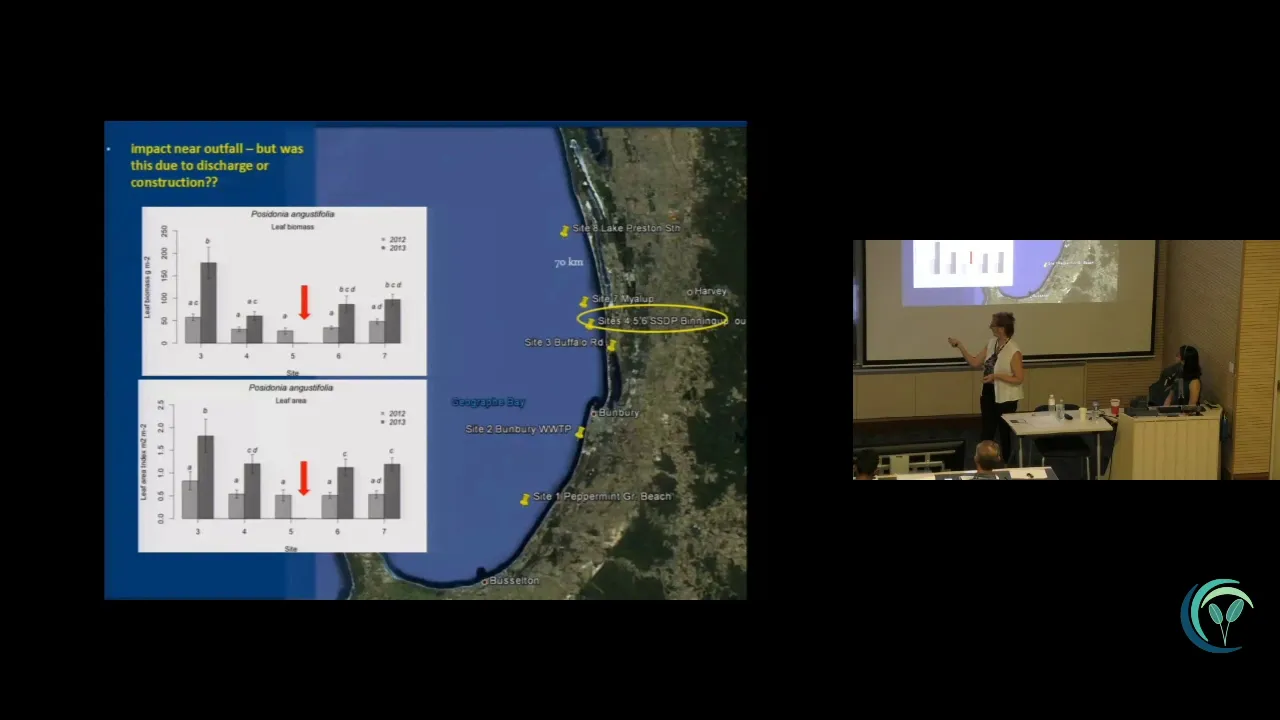
Why this video
Dr. Marion Cambridge shares details from a three-year study on the seagrass Posidonia australis. This video provides crucial, field-tested biological data showing how high salinity impacts benthic marine habitats.

Why this video
This report looks at the Arabian Gulf, where high densities of desalination plants discharge hot, chemically treated brine into a shallow, semi-enclosed sea, illustrating the risks of regional salinity accumulation.

Why this video
This short video shows natural hypersaline deep-sea brine pools. It serves as a visual analog for the toxic, oxygen-depleted zones that can form when industrial brine discharges pool on the ocean floor without proper mixing.
Knowledge Checkpoint
- Explain why SWRO brine has a negative buoyancy profile and how this influences its movement along the seafloor.
- Detail the ecological impact of co-discharged phosphonate-based antiscalants on benthic marine invertebrates.
- Identify two toxic disinfection byproducts (DBPs) generated during the chlorination/dechlorination phase of SWRO pre-treatment.
- Explain how elevated salinity disrupts the osmotic balance of seagrasses like Posidonia australis, leading to tissue damage.
Module 4: Engineering Solutions: Diffusers and Outfalls
Module Overview
To prevent dense brine from pooling on the seafloor, environmental engineers use fluid dynamics to design high-performance outfall systems. This module focuses on the physics of mixing zones and buoyant jets. We will study multiport diffusers and directional diffusers (angled at relative to the seafloor) designed to launch brine upward into the water column, maximizing dilution before the plume reaches the seabed.
              60-degree Angled Jet (High Velocity)
                  ^ . . .
                 /       \   Ambient Water Entrainment
                /         \  (Rapid Dilution)
               /           v . . . .
   ===========o                      \___ Seafloor Salinity Within
   Outfall Pipe                           Ambient Limits (<1-2 ppt above background)
Technical Focus: Outfall Mixing Zone Fluid Dynamics
Plume dilution () is defined as the ratio of the volume of mixed water to the volume of discharged brine. Designers use the densimetric Froude number () to model the mixing efficiency of a jet:
Where:
- is the initial discharge port velocity ()
- is the nozzle diameter ()
- is the reduced gravity:
To optimize mixing, the discharge velocity is set high (typically ), and the jets are angled upward. This increases the plume's travel path and entrains ambient water, preventing the high-salinity core from making direct contact with benthic communities.
Recommended Videos
Why this video
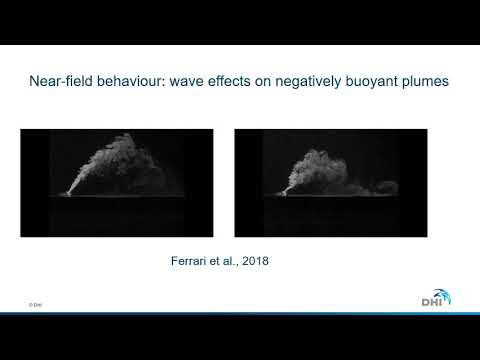
This specialist presentation features laboratory and CFD models of negatively buoyant jets. It explains how ocean wave motion interacts with brine plumes, affecting their dilution rates and landing locations.

Why this video
Note: This video uses an automotive aerodynamic diffuser as a fluid dynamics analog. It explains the boundary layer physics of diffusers, including how maintaining a expansion angle prevents flow detachment and turbulence. The same conservation of momentum and boundary-layer physics apply to underwater outfall nozzles.
Why this video
This practical video shows the plumbing and installation challenges of routing a brine discharge line on a vessel. It illustrates how physical constraints affect the hydraulics of wastewater disposal systems.
Knowledge Checkpoint
- Write the equation for reduced gravity () and calculate its value when brine density is and seawater density is .
- Explain why a nozzle inclination angle of is mathematically optimal for discharging negatively buoyant brine plumes into a stagnant water column.
- Describe "co-flow" and "cross-flow" conditions and explain how ocean currents affect the dilution rate of an outfall plume.
- Detail how regular surface waves affect the trajectory and concentration profile of a submerged brine jet.
Module 5: Alternative Mitigation & Zero Liquid Discharge
Module Overview
The ultimate solution to the brine disposal challenge is eliminating liquid waste entirely. This module covers Zero Liquid Discharge (ZLD) systems and brine mining. We will study the thermal, chemical, and physical separation technologies that recover freshwater and valuable minerals (such as sodium chloride, magnesium, and lithium) from the brine reject stream, turning a hazardous waste into a resource.
                ┌---> Pure Water Distillate (Condensate)
                |
Brine Feed ---> Evaporator ---> Crystallizer ---> Centrifuge Separator | └---> Solid Mineral Salts (NaCl, Li, Mg)
Recommended Videos

Why this video
This detailed mechanical animation shows a ZLD system in action, walking through the integration of a vertical tube falling-film evaporator and a crystallizer loop to convert concentrated brine into pure water and solid crystals.

Why this video
This panel discussion covers the economics and chemistry of modern brine mining. It details how minerals like lithium, magnesium, and sodium compounds are extracted from desalination waste streams.

Why this video
This animation details the downstream mechanical separation steps of a ZLD system. It shows how industrial decanter centrifuges dewater crystallized salts to create a transportable solid cake.
Knowledge Checkpoint
- Explain the thermodynamic difference between mechanical vapor recompression (MVR) and multi-stage flash (MSF) evaporation in ZLD systems.
- Diagram a modern brine mining process flow, showing where calcium carbonate, sodium chloride, and magnesium hydroxide are sequentially precipitated.
- Identify the primary energy and economic barriers preventing widespread industrial adoption of Zero Liquid Discharge technologies.
- Explain the function of a decanter centrifuge in managing the high solids loading generated by crystallization loops.
Course Map
Key People Index
- Dr. Marion Cambridge (University of Western Australia): Lead researcher behind the multi-year study investigating the ecological impacts of elevated salinity and thermal plumes on Posidonia australis seagrass meadows in Western Australia.
- Heather Cooley (Pacific Institute): Prominent environmental policy analyst specializing in water planning and the environmental impacts of desalination facilities.
- Alireza Valizadeh (Fluid Dynamics Researcher): Academic contributor focused on spatial modeling and wave dynamic interactions with underwater negatively buoyant jet plumes.
- Dr. Mike Mickley (Desalination Consultant): Authority on major outfall and intake engineering designs, focusing on the mechanical configurations of subsurface wells and regional brine mitigation structures.
Final Self-Assessment
Test your understanding of the course material with these comprehensive, scenario-based review questions:
- Calculate the osmotic pressure of a seawater source with a temperature of and an ion concentration of using the Van 't Hoff equation.
- Explain why a thin-film polyamide composite membrane rejects small, uncharged boric acid molecules less effectively than sodium and chloride ions.
- Design an open-ocean intake screen array for a facility that meets regulatory limits for slot sizing () and maximum slot velocity ().
- Contrast the ecological impacts of an open-ocean intake with a subsurface horizontal radial collector well system in a sandy coastal aquifer.
- Detail the physical behavior of a dense brine plume (, ) discharged into a shallow, microtidal estuary with an ambient salinity of and a temperature of .
- List three pre-treatment chemical compounds commonly found in SWRO brine outfall streams and describe their toxicological effects on benthic organisms.
- Solve for the densimetric Froude number () of a brine discharge jet where the nozzle diameter is , the jet velocity is , the brine density is , and the ambient sea density is .
- Explain how a multiport diffuser configuration with a nozzle inclination angle reduces benthic salinity impacts compared to a single open-pipe outfall terminating at the seabed.
- Explain how mechanical vapor recompression (MVR) evaporators recover high-purity distillate from SWRO brine while concentrating minerals to their saturation limits.
- Outline the sequential chemical precipitation steps used in a brine mining facility to isolate battery-grade lithium carbonate and magnesium hydroxide from SWRO waste streams.