X-Bar Theory: Syntax, Diagrams & Movement
Learning Goal: Diagram complex sentence structures using the X-bar schema to illustrate hierarchical relationships, head-complement-specifier distinctions, and syntactic movement.
- Prerequisites: Basic knowledge of English parts of speech (nouns, verbs, adjectives, prepositions, etc.) and an introductory understanding of basic word order (Subject-Verb-Object).
- Estimated Total Study Time: 14 hours
Module 1: Introduction to Syntax and Constituency
This module introduces the core scientific approach to syntax. You will learn to move beyond linear word order to understand how words hierarchically group into structural units called constituents. You will master key constituency tests (substitution, movement, and clefting) that provide empirical evidence for these structural groupings.
Recommended Videos
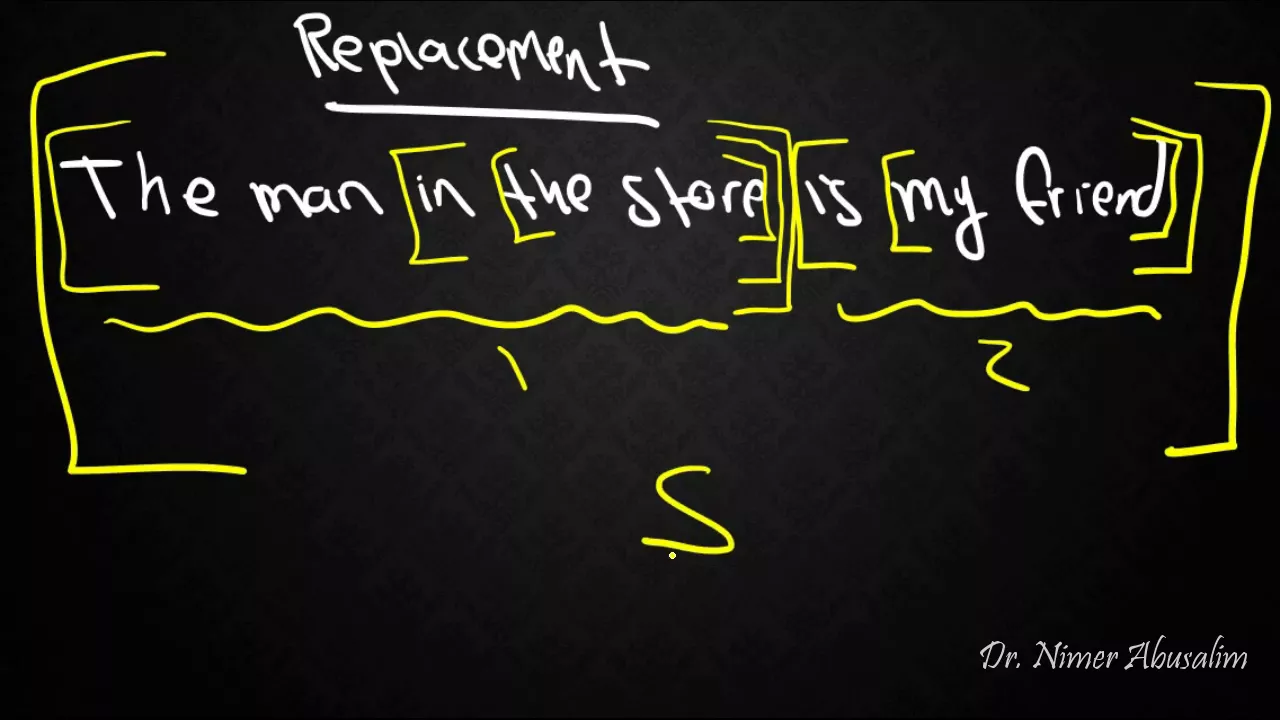
- Why this video: Dr. Abusalim provides an incredibly clear and structured breakdown of the primary empirical diagnostics used by syntacticians to identify constituents. It focuses deeply on practical applications of the replacement/substitution test, making it an essential starting point for active structural analysis.

- Why this video: Part of Andrew Carnie's textbook companion series, this video focuses on structural manipulation tests: movement, clefting, and preposing. It visually illustrates how structural fragments behave as single, cohesive linguistic entities.

- Why this video: This short, high-density animation reinforces the concept of substitution. It quickly proves how multi-word sequences can be replaced by single pro-forms (like pronouns or "do so"), proving they occupy a single node in the mental grammar.
Knowledge Checkpoint
- Can you define what a syntactic "constituent" is in your own words?
- Can you apply the replacement (pro-form substitution) test to isolate a noun phrase (NP) and a verb phrase (VP) in a complex sentence?
- Do you know how to construct an "it-cleft" sentence to verify if a prepositional phrase (PP) forms a valid constituent?
- Can you distinguish between structural grouping and linear sequence when parsing ambiguous sentences?
Module 2: The Core X-Bar Schema
Traditional phrase structure rules (such as ) fail to capture intermediate-level syntactic groupings and are prone to creating overly flat, non-hierarchical structures. This module introduces the universal, three-tiered X-bar schema (XP, X', X), which models human language using a binary-branching, endocentric template.
   XP  (Maximal Projection / Phrase)
  /  \
Spec X' (Intermediate Bar Level)
/
X Complement
(Head)
Recommended Videos
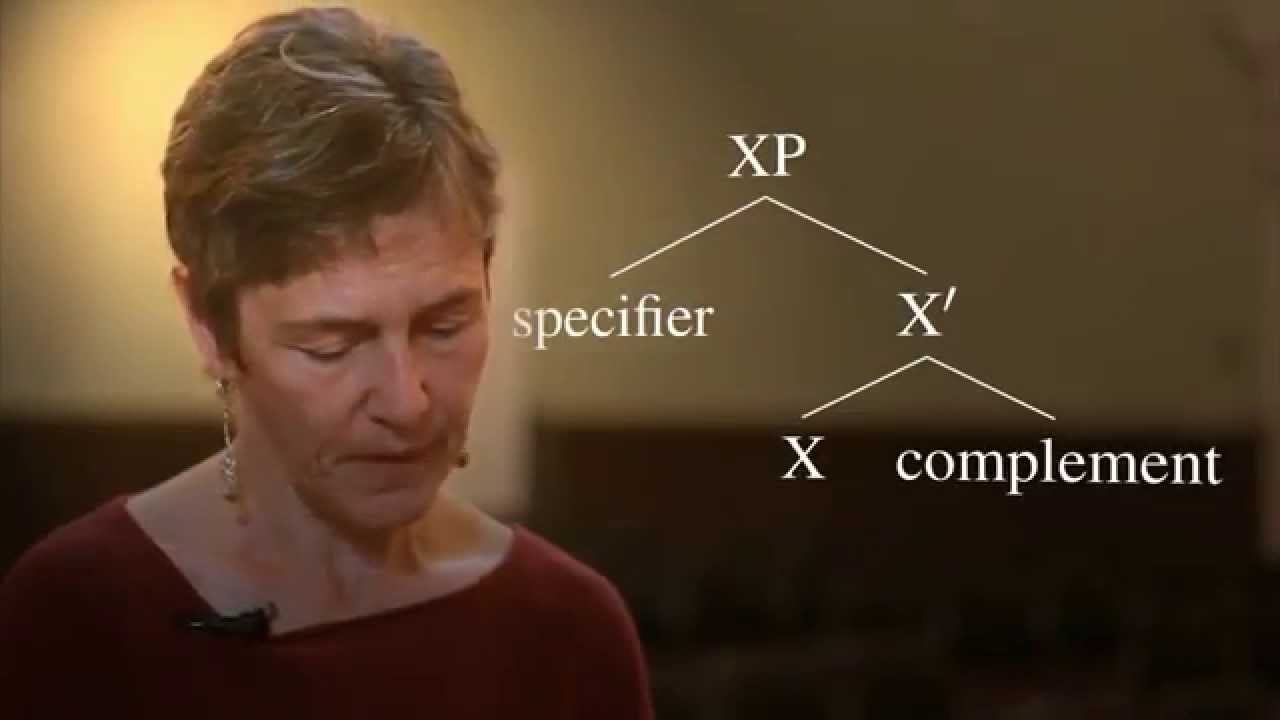
- Why this video: This video offers a clear, animated introduction to the universal three-tiered X-bar template. It explains how lexical items project up to intermediate and maximal projections, providing a solid foundation for structural hierarchy.
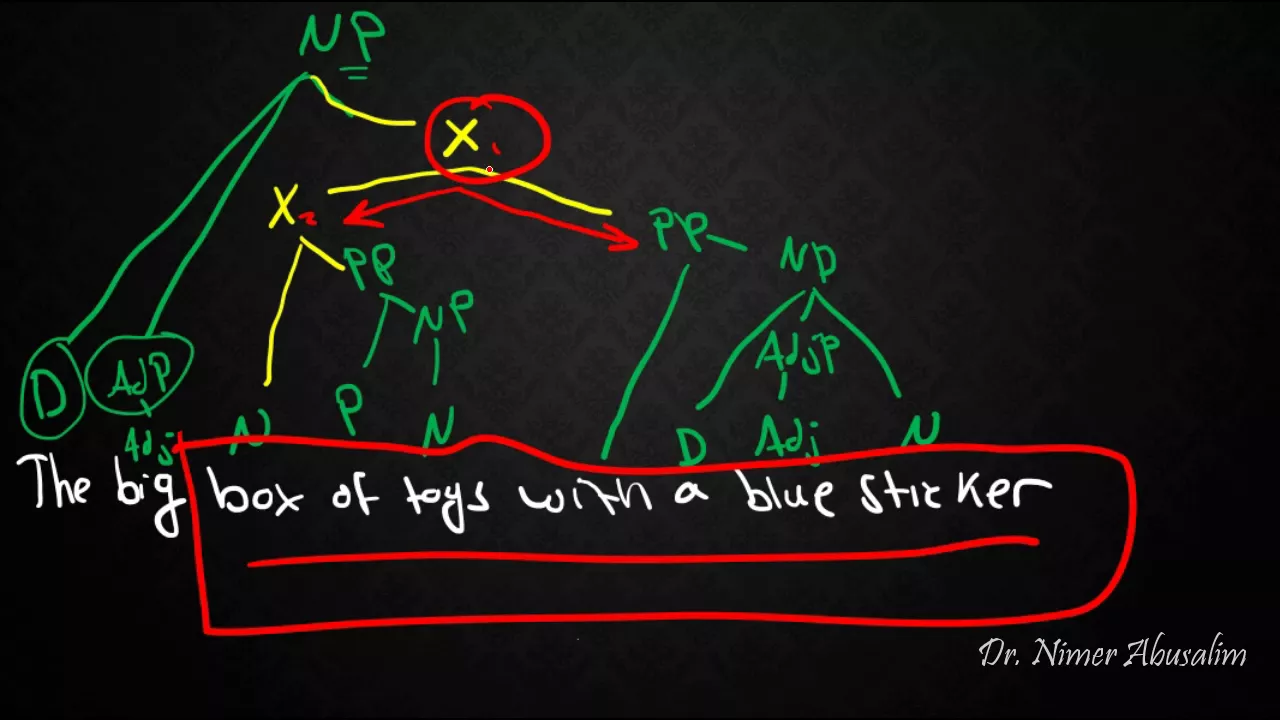
- Why this video: Dr. Abusalim contrasts "flat" syntactic structures with X-bar structures. By showing how flat trees fail to account for pronoun substitution patterns (like "one-substitution" in NPs), he demonstrates the theoretical necessity of the intermediate X-bar () node.
Knowledge Checkpoint
- Why do traditional phrase structure rules fail to represent intermediate syntactic structures?
- What is the structural difference between a head (), an intermediate projection (), and a maximal projection ()?
- How does "one-substitution" act as empirical proof for the existence of the intermediate node in nominal structures?
- Can you write out the generalized, recursive mathematical formulas that define the X-bar template?
Module 3: Heads, Complements, Adjuncts, and Specifiers
Syntactic nodes do not connect arbitrarily. This module details the core syntactic relationships within X-bar theory: the closely bound Complement (sister to the head, daughter of ), the recursively-inserted Adjunct (sister to , daughter of ), and the licensing Specifier (sister to , daughter of ).
            XP (Maximal Projection)
           /  \
[Specifier] YP X'
/
X' ZP [Adjunct] (Recursive)
/
[Head] X WP [Complement]
Recommended Videos
![[Syntax] X-Bar Theory - Specifiers, Adjuncts, and Complements](https://i.ytimg.com/vi_webp/n8TYuq173N0/maxresdefault.webp)
- Why this video: This video is a classic, comprehensive tutorial on distinguishing structural roles. It provides clear linguistic tests to identify which phrases act as modifiers (adjuncts) versus necessary arguments (complements), and how to position them in your diagrams.

- Why this video: Andrew Carnie details the behavioral differences between complements and adjuncts. He explains how complements are highly sensitive to subcategorization restrictions, must appear adjacent to the head, and cannot be recursively iterated—unlike adjuncts.

- Why this video: A focused, practical walkthrough that models how to construct complete Noun Phrases (NPs) step-by-step under the core X-bar model. It shows exactly where specifiers, adjuncts, and complements attach.
Knowledge Checkpoint
- What is the structural distinction between a complement and an adjunct in terms of sister/daughter relationships?
- How does the "adjacency test" help you determine if a PP is a complement or an adjunct to a verb?
- Why are adjuncts allowed to recursively duplicate (e.g., "the book on the shelf in the corner under the dust"), while complements are restricted?
- Where do specifiers (like determiners or possessives in standard NP models) attach in an X-bar tree?
Module 4: Functional Projections: DP, TP, and CP
Linguistics has transitioned from treating sentences as simple lexical phrases to modeling them as functional projections. This module covers the functional layers of syntax: the Determiner Phrase (DP) (where determiners act as heads), the Tense Phrase (TP) (representing tense/inflection and hosting sentential subjects), and the Complementizer Phrase (CP) (representing clause-typing features and hosting moved elements).
Step-by-Step Walkthrough: Drawing a Tense Phrase (TP)
Because high-quality visual walkthroughs of basic TPs can be difficult to find, let's trace how a basic sentence like "The student will read the book" is projected:
-
Construct the Object DP: The noun "book" projects to NP ( to ). It merges with its complement/specifier. Here, the determiner "the" acts as the head of the DP, taking the NP as its complement.
-
Construct the VP: The transitive verb "read" () merges with the DP "the book" (its complement) to form .
-
Establish the TP Core: The modal auxiliary "will" occupies the (Tense) head. The head takes the VP "read the book" as its complement, projecting to .
-
Project the Subject DP: The subject "the student" is constructed as a DP. It merges into the Specifier of TP position (sister to , daughter of TP), completing the sentence.
   TP
  /  \
DP(subj) T' / \ /
D NP T VP The | will /
N' V' DP(obj) | / \ /
N V DP D NP student read| | | the | N' | | D N the book
Recommended Videos
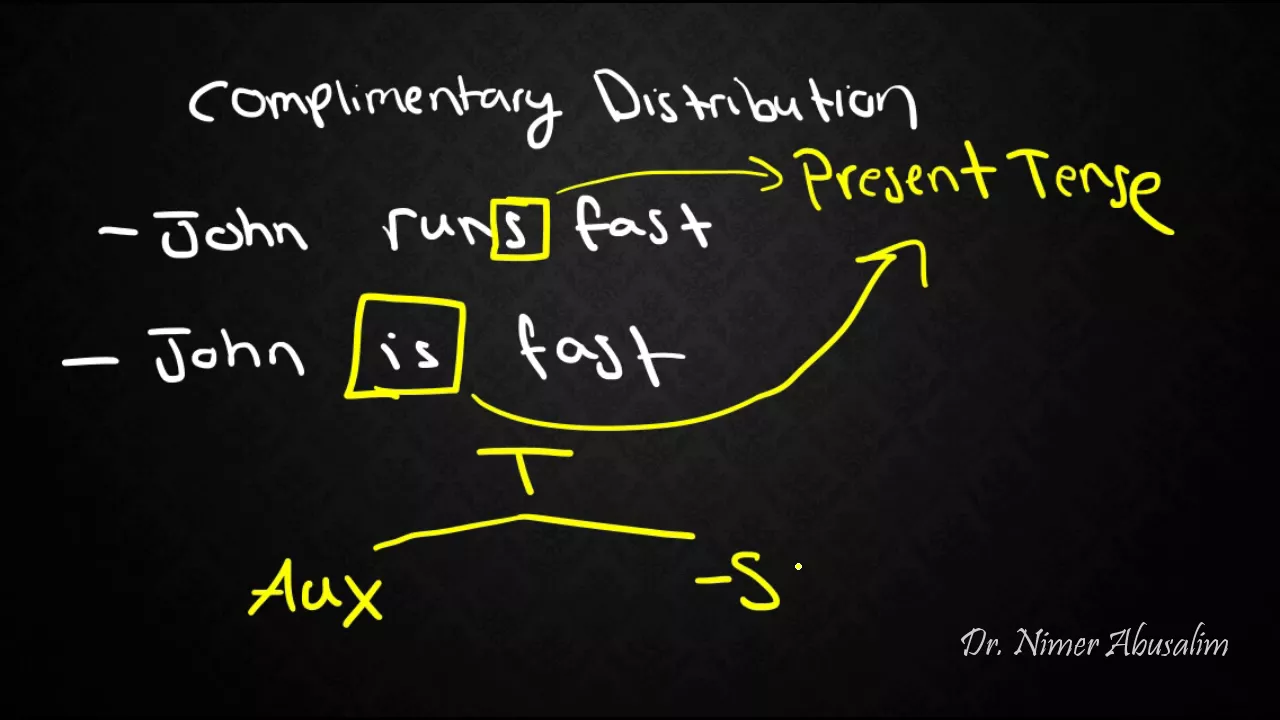
- Why this video: Dr. Abusalim explicitly addresses the structural architecture of the Tense Phrase (TP). He details how the head hosts auxiliaries or abstract tense features, and how the sentential subject resides in the Specifier of TP. This directly resolves the common gap of clear TP diagrams.

- Why this video: This video introduces the DP hypothesis, which places the Determiner as the structural head of nominal phrases rather than the noun. This change is key to keeping our phrase structures consistent across both lexical and functional projections.
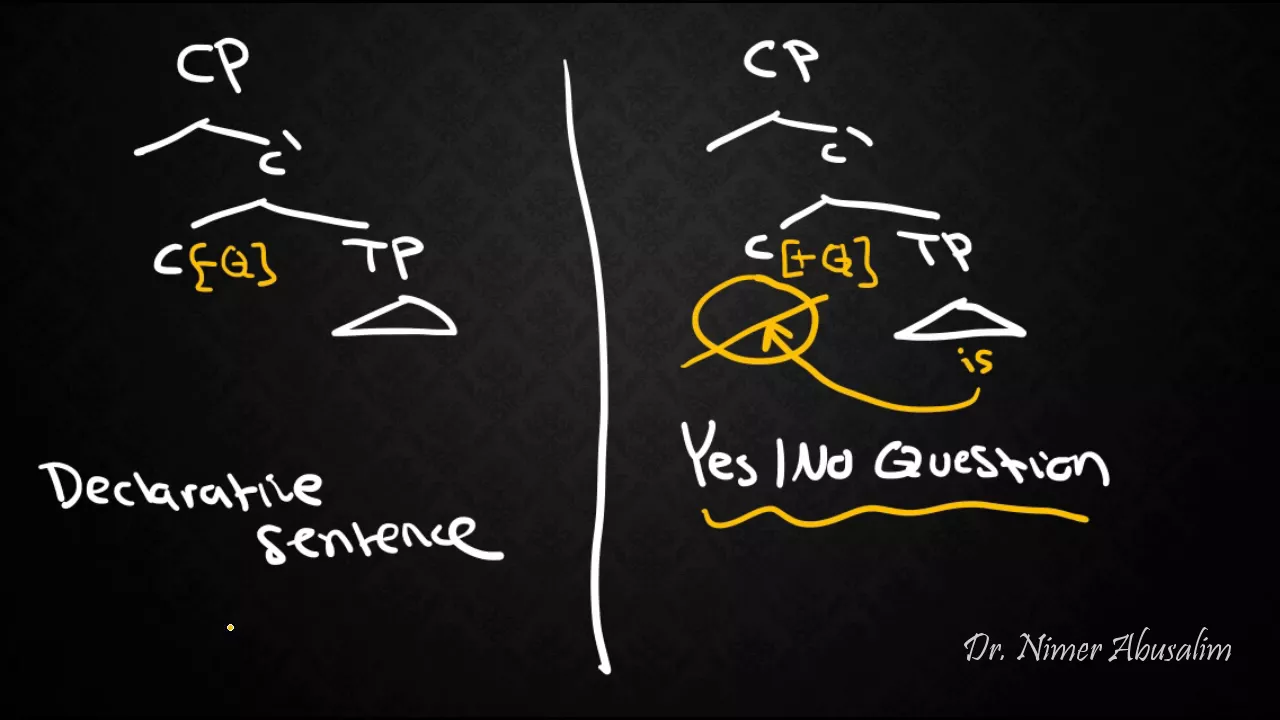
- Why this video: Explores the topmost syntactic layer: the Complementizer Phrase (CP). It shows how subordinate clauses (introduced by complementizers like "that" or "if") and main clauses project a CP layer to establish clause type and host syntactic movement.

- Why this video: This advanced video explains how the functional structure above the VP can expand to include other functional projections, such as aspect (Progressive/Perfect) and voice, within the broader TP domain.
Knowledge Checkpoint
- Why does the DP Hypothesis analyze determiners as heads rather than specifiers?
- What elements occupy the head position in English sentences (both overt and covert)?
- How does a Complementizer Phrase (CP) embed a Tense Phrase (TP) as its complement?
- Can you diagram a complex sentence containing an embedded clause (e.g., "She thinks that he left") using CP, TP, and DP layers?
Module 5: Syntactic Movement and Traces
Sentences are not generated as flat structures; they undergo systematic transformations. This module explores syntactic movement, which is driven by features like Case licensing and clause typing. You will master three primary types of movement: Wh-movement (movement of interrogative operators to Spec, CP), Head-to-Head movement / Aux-to-C (auxiliary inversion in question formation), and DP-movement / Subject Raising.
         CP
        /  \
 DP(wh)    C'
  what_j  /  \
         C    TP
       will_i / \
             DP  T'
            you /  \
               T    VP
              t_i  /  \
                  V    DP
                read  t_j
Recommended Videos
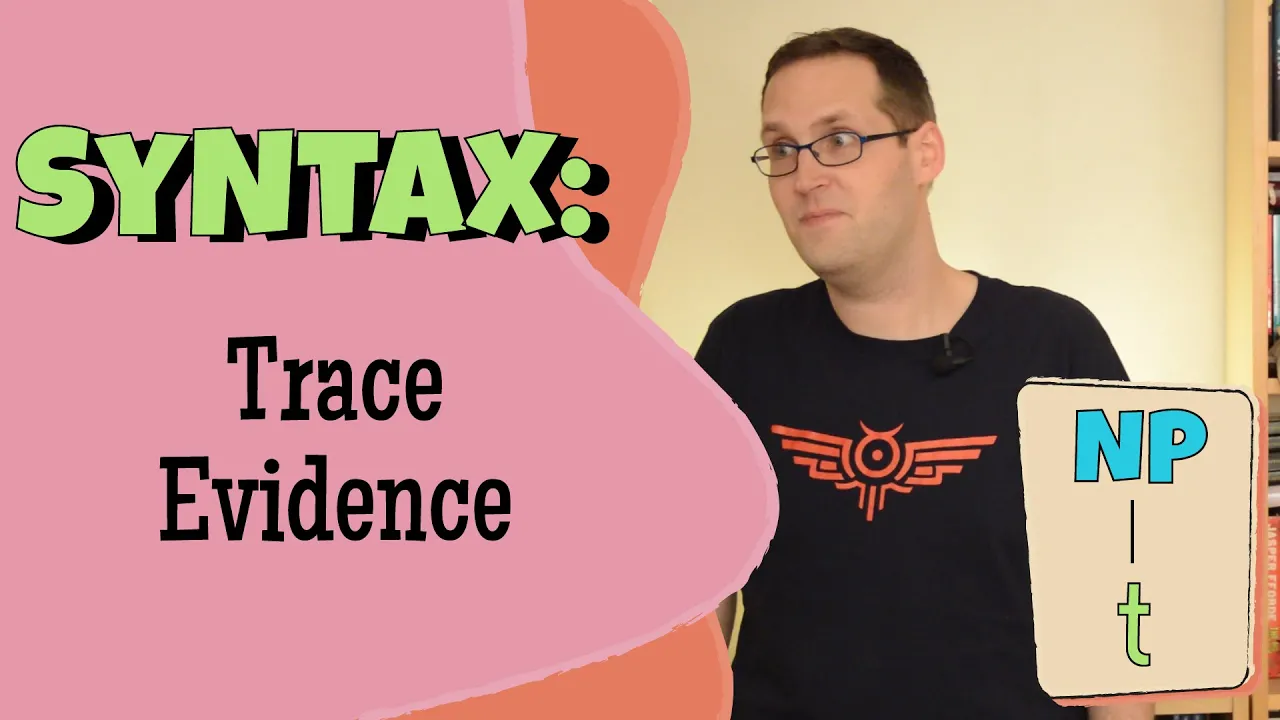
- Why this video: An exceptionally clear, visual introduction to why movement occurs and how it works. It introduces the concepts of "Deep Structure" (where theta roles are assigned) versus "Surface Structure" (where things end up), explaining why silent traces () and co-indexation () are necessary to track moved items.

- Why this video: This video targets Head-to-Head (Aux-to-C / T-to-C) movement, demonstrating how an auxiliary verb moves from the head into the head to form a question (e.g., "Will you..."). It illustrates the step-by-step head adjustments in the tree.
![[Syntax] Wh-Questions and Movement](https://i.ytimg.com/vi_webp/ZZC5L6hU300/maxresdefault.webp)
- Why this video: Trevtutor models Wh-movement in detail. This video shows how Wh-words originate in lower argument or adjunct positions (where they receive theta roles) and move up to the Specifier of CP, leaving behind a trace.

- Why this video: This video focuses on DP-movement (Raising). It explains how a DP moves from an embedded, tenseless clause to the subject position of a higher clause (e.g., "John seems to like apples") because of Case-licensing needs.

- Why this video: Carnie connects DP movement to Case Theory, proving that nominals must move to specific specifier positions (like Spec, TP) to receive morphological or abstract Case (Nominative/Accusative).
Knowledge Checkpoint
- What is the difference between a head-movement operation (like T-to-C) and a phrasal-movement operation (like Wh-movement)?
- Why must we leave a trace () in the original extraction site of a moved constituent?
- How does Case Theory explain why subjects move out of infinitival clauses in Raising constructions (e.g., "She seems to win")?
- Can you diagram a complete question that contains both T-to-C movement and Wh-movement?
Course Map
Below is the recommended pathway through the curriculum. Ensure you master the constituency tests in Module 1 before attempting to map out structural relations in X-bar theory.
Key People Index
- Noam Chomsky: The father of modern generative grammar. He introduced the concepts of Phrase Structure Rules, Transformational Rules, and the basic principles that led to the development of X-bar Theory and modern Minimalism.
- Andrew Carnie: Professor of Linguistics at the University of Arizona and author of the widely used textbook Syntax: A Generative Introduction. His clear structural explanations are featured throughout Modules 3, 4, and 5.
- Dr. Nimer Abusalim: A prominent linguistics educator whose highly analytical videos make abstract syntax trees and functional projections accessible for students.
Final Self-Assessment
Test your understanding of the entire curriculum by verifying your ability to complete the following tasks:
- I can define a constituent and use the substitution and clefting tests to prove its existence.
- I can draw a complete, binary-branching X-bar tree for any basic lexical phrase (NP, VP, PP, AP).
- I can clearly identify and distinguish between specifiers, adjuncts, and complements based on how they branch in a tree.
- I can explain why the "one-substitution" test proves that modifiers are adjuncts, while arguments are complements.
- I can explain the DP Hypothesis and draw nominal trees where the Determiner acts as the head.
- I can construct and diagram a complete Tense Phrase (TP), correctly placing auxiliaries in the head and subjects in the Spec, TP position.
- I can describe how CP and TP work together to organize embedded clauses.
- I can diagram T-to-C movement (Aux-to-C) in yes/no questions, using co-indexation to link the moved auxiliary to its trace.
- I can trace the path of a Wh-word moving from its base object position to the Specifier of CP.
- I can explain how Case licensing drives DP-movement in subject raising and passive constructions.