Mastering Special Relativity: Spacetime, Time Dilation, and the Physics of Near-Light-Speed Travel
Learning Goal: Master the core principles of Special Relativity. Learn how the breakdown of classical physics led to Albert Einstein's revolutionary postulates, discover the mechanics of time dilation and length contraction, master Minkowski diagrams and Lorentz transformations, trace the derivation of mass-energy equivalence (), and resolve famous relativistic paradoxes while visualizing optical effects near the speed of light.
- Prerequisites: High school algebra, basic classical mechanics (velocity, momentum, and kinetic energy concepts). No prior knowledge of quantum mechanics or tensor calculus is required.
- Estimated Study Time: 14 Hours
Module 1: Foundations & The Postulates of Relativity
This module introduces the historical crisis in physics during the late 19th century. You will explore Galilean relativity, learn how the Michelson-Morley experiment failed to find the "luminiferous ether," and discover how Albert Einstein resolved the conflict between Newtonian mechanics and Maxwell's electromagnetism using two elegant postulates.
Recommended Videos
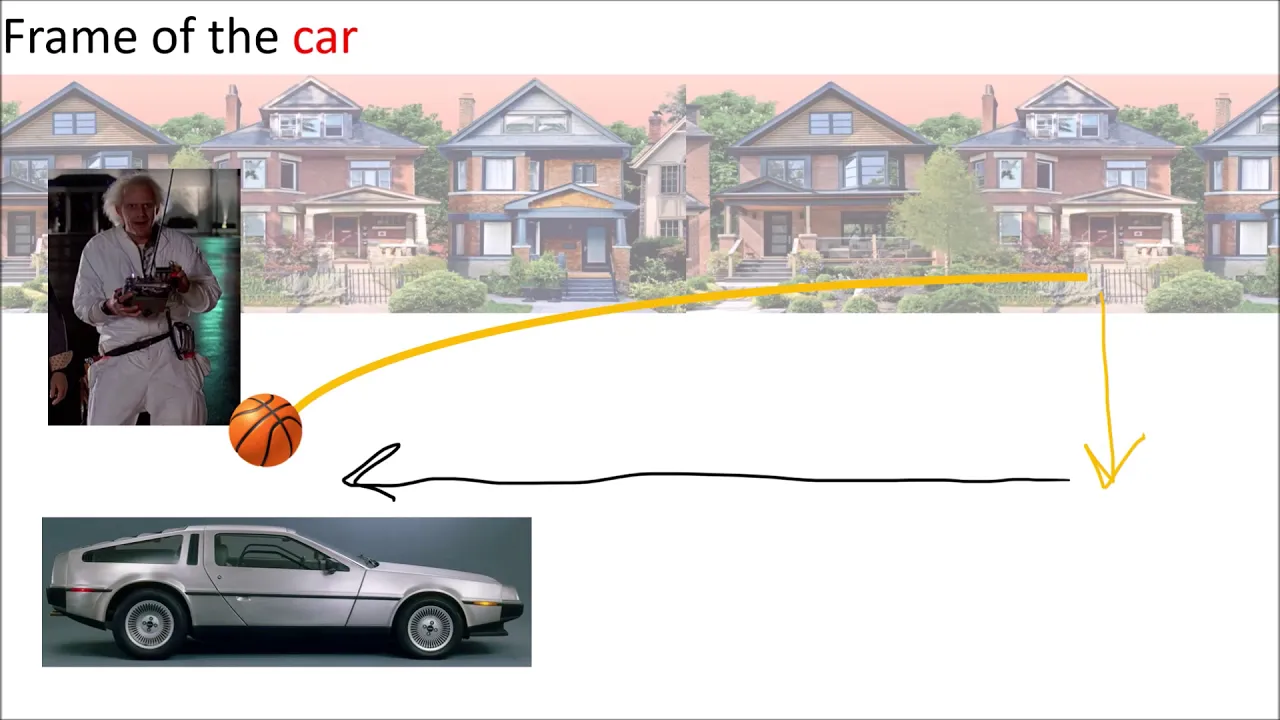
Why this video is valuable: To understand why Einstein's relativity was so revolutionary, you must first master the system it replaced. This video provides a mathematically clean and intuitive introduction to Galilean relativity. It demonstrates how velocities add linearly in classical physics and explains the concept of coordinate transformations under a Galilean framework, setting a critical baseline for comparison with Lorentz transformations later.
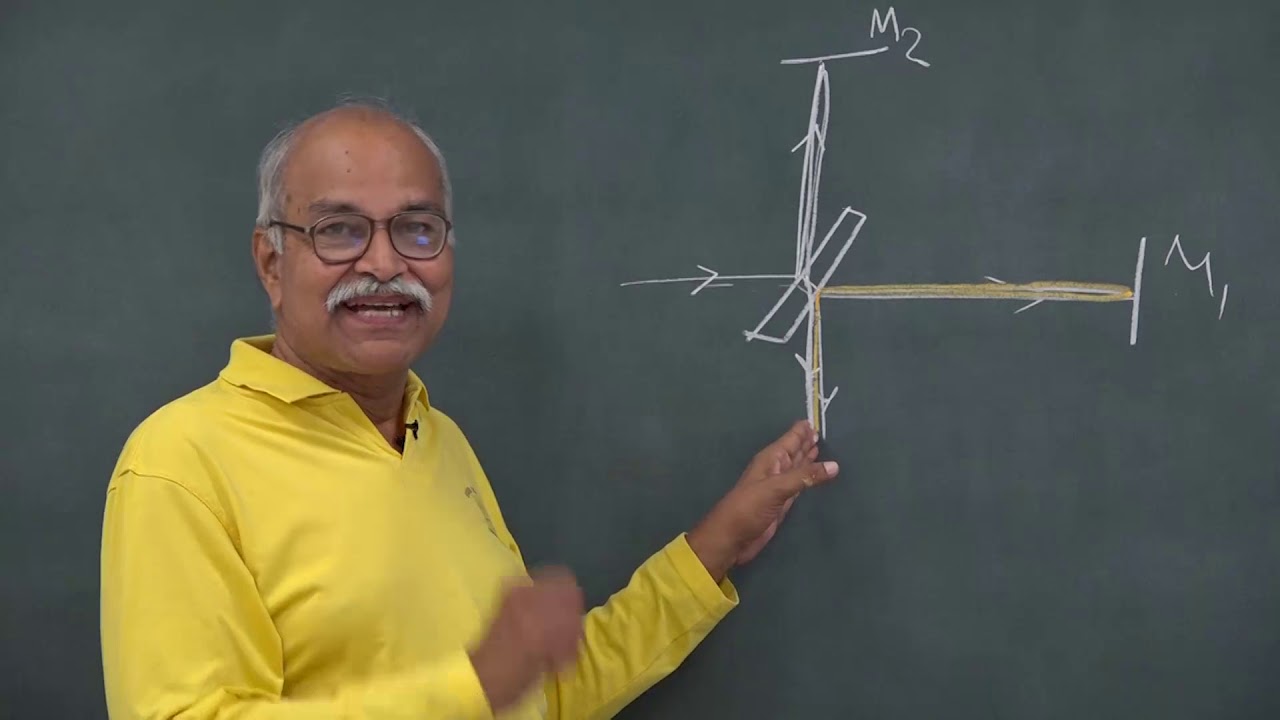
Why this video is valuable: The experimental crisis that catalyzed special relativity was the Michelson-Morley experiment, designed to measure the earth's velocity relative to the "luminiferous ether." Renowned physics educator H.C. Verma breaks down the exact optical physics of the interferometer, explaining how light wave interference patterns (fringes) form and why the experiment's null result proved that the speed of light is constant, regardless of the observer's motion or direction.

Why this video is valuable: This fast-paced video introduces Einstein’s two defining postulates of Special Relativity: (1) the laws of physics are the same in all inertial reference frames, and (2) the speed of light in a vacuum is a universal constant. It brilliantly links these theoretical postulates to physical consequences, preparing you for the kinematics of time dilation.
Module 1 Knowledge Checkpoint
- Explain why Galilean velocity addition fails when applied to Maxwell's equations for the speed of light ().
- Describe the purpose of the Michelson-Morley experiment and explain the physical significance of its "null result."
- State Einstein’s two postulates of Special Relativity in your own words.
- Define an "inertial reference frame" and identify when an observer is NOT in one.
Module 2: Time Dilation and Length Contraction
Having established that the speed of light is constant for all observers, we must abandon absolute space and time. This module covers the physical consequences of the postulates: moving clocks run slow (time dilation) and moving objects shrink along their direction of motion (length contraction). You will step through the classic light clock derivation and analyze concrete experimental evidence.
Recommended Videos

Why this video is valuable: This video guides you step-by-step through the classic "light clock" thought experiment. By tracking a photon bouncing between two mirrors inside a moving rocket, it visually and mathematically derives the time dilation formula using nothing more than the Pythagorean theorem. This is the single most important conceptual derivation in relativistic kinematics.
Why this video is valuable: Length contraction is frequently misunderstood as a physical compressing force acting on matter. Dr. Don Lincoln from Fermilab provides a masterful explanation of what length contraction actually is: a rotation of our slice of spacetime. It explains how different observers slice up space and time differently, making length contraction a real, measurable aspect of relative geometry.
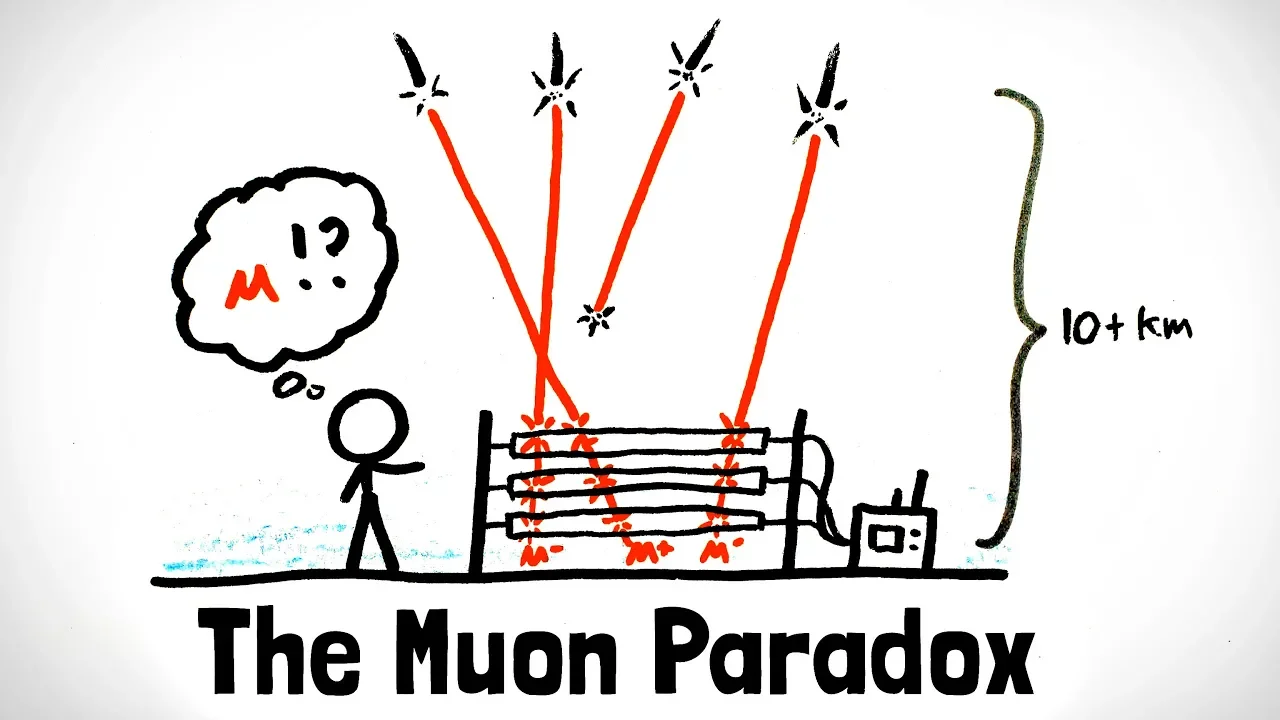
Why this video is valuable: Relativity is not just a math trick; it is verified by experiments daily. This video presents the definitive empirical proof of time dilation: high-altitude atmospheric muons. Because of their short half-life, these particles should decay long before reaching the Earth's surface. However, because they travel at near-light speed, their internal clocks run slow relative to us (and the atmospheric distance is contracted from their frame), allowing them to reach ground detectors.
Module 2 Knowledge Checkpoint
- Derive the Lorentz factor () using the geometry of a moving light clock.
- Distinguish between "proper time" () and "dilated time" (), and identify which observer measures which.
- Explain length contraction conceptually, clarifying why it does not cause physical stress or damage to structural materials.
- Analyze the atmospheric muon experiment from both the Earth's reference frame (time dilation explanation) and the muon's reference frame (length contraction explanation).
Module 3: Lorentz Transformations & Spacetime Diagrams
In this module, you transition from simple thought experiments to a unified mathematical framework. You will swap Galilean coordinate transformations for the Lorentz transformations, learn to plot and interpret Minkowski spacetime diagrams, and resolve the standard thought experiment showing how the concept of "simultaneity" is completely relative.
Recommended Videos
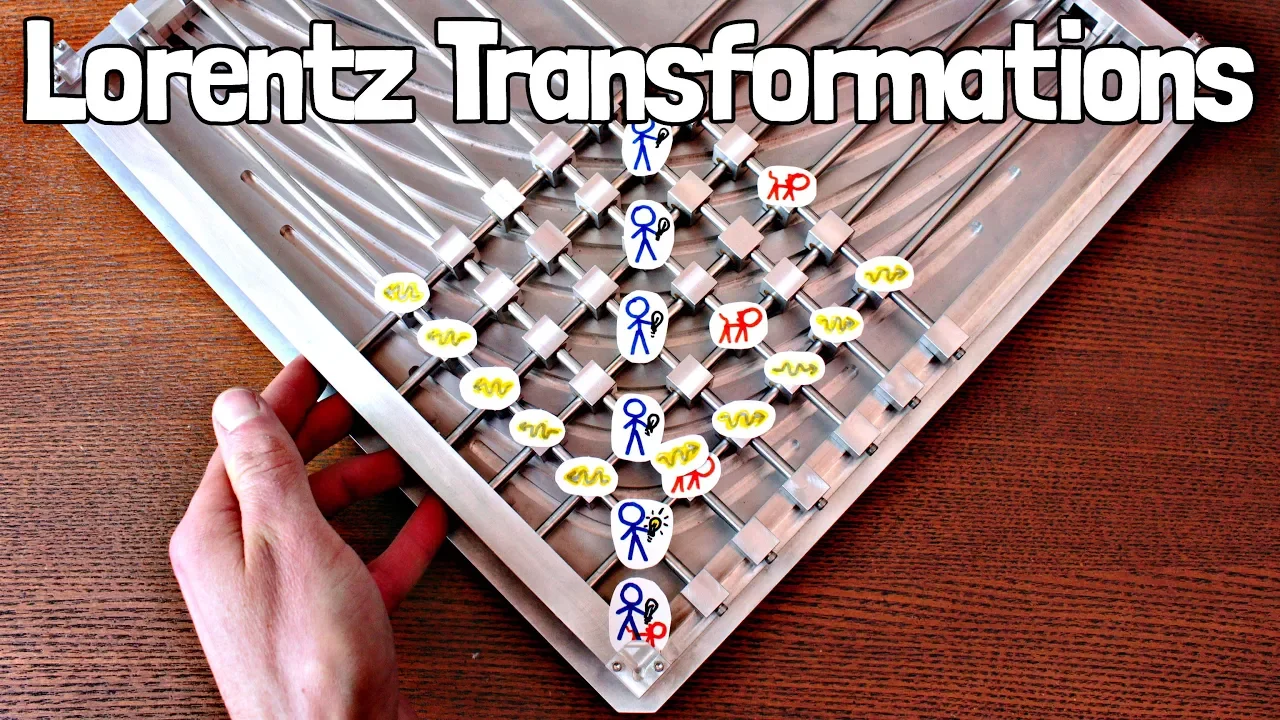
Why this video is valuable: This video provides a brilliant geometric explanation of how Lorentz transformations operate compared to Galilean ones. Rather than treating coordinates as isolated values, it explains how relativity shears and stretches spacetime coordinates along hyperbolic angles, preserving the speed of light for all reference frames.
Why this video is valuable: Spacetime diagrams (Minkowski diagrams) are essential graphical tools for visualizing physics at high speeds. This tutorial walks you through setting up a diagram with space on the horizontal axis and time () on the vertical axis, drawing "worldlines," and plotting the tilted coordinate grids of a moving observer.

Why this video is valuable: This video addresses the historic educational gap highlighted in curriculum reviews. World-renowned physicist Brian Greene walks viewers through a rigorous, clear, and highly professional explanation of the relativity of simultaneity. He uses clean physics animations to show why two events that are simultaneous in a stationary frame are systematically non-simultaneous in a moving frame, and frames this within the geometry of spacetime.
Module 3 Knowledge Checkpoint
- Write down the algebraic equations for the Lorentz transformations for and .
- Draw a Minkowski spacetime diagram, labeling the worldlines of a stationary object, a moving object, and a photon.
- Plot a moving observer's axes ( and ) on a stationary observer's Minkowski diagram, showing why they tilt inward.
- Describe the "relativity of simultaneity" train experiment and calculate the time order of events for both observers.
Module 4: Relativistic Momentum, Energy, and E=mc²
This module bridges kinematics (the study of motion) with dynamics (the study of forces, mass, and energy). You will discover why classical definitions of momentum () and kinetic energy must change as objects approach the speed of light. Finally, you will explore the elegant derivation of , showing that mass is simply condensed, rest-frame energy.
Recommended Videos

Why this video is valuable: Produced by Caltech, this high-production educational classic shows how applying the principle of relativity to collisions forces us to redefine momentum and energy. It traces how relativistic mass conservation works and demonstrates how the classical equations are actually low-velocity approximations of the true relativistic dynamics.

Why this video is valuable: Most popular science videos handwave the origin of . This video reconstructs Einstein's actual 1905 derivation using a thought experiment of an atom emitting two light packets in opposite directions. By viewing this emission from a moving frame and calculating the Doppler shift of light energy, the math naturally reveals that the atom must lose mass to conserve energy. This is a brilliant, clear, and mathematically rigorous walkthrough.
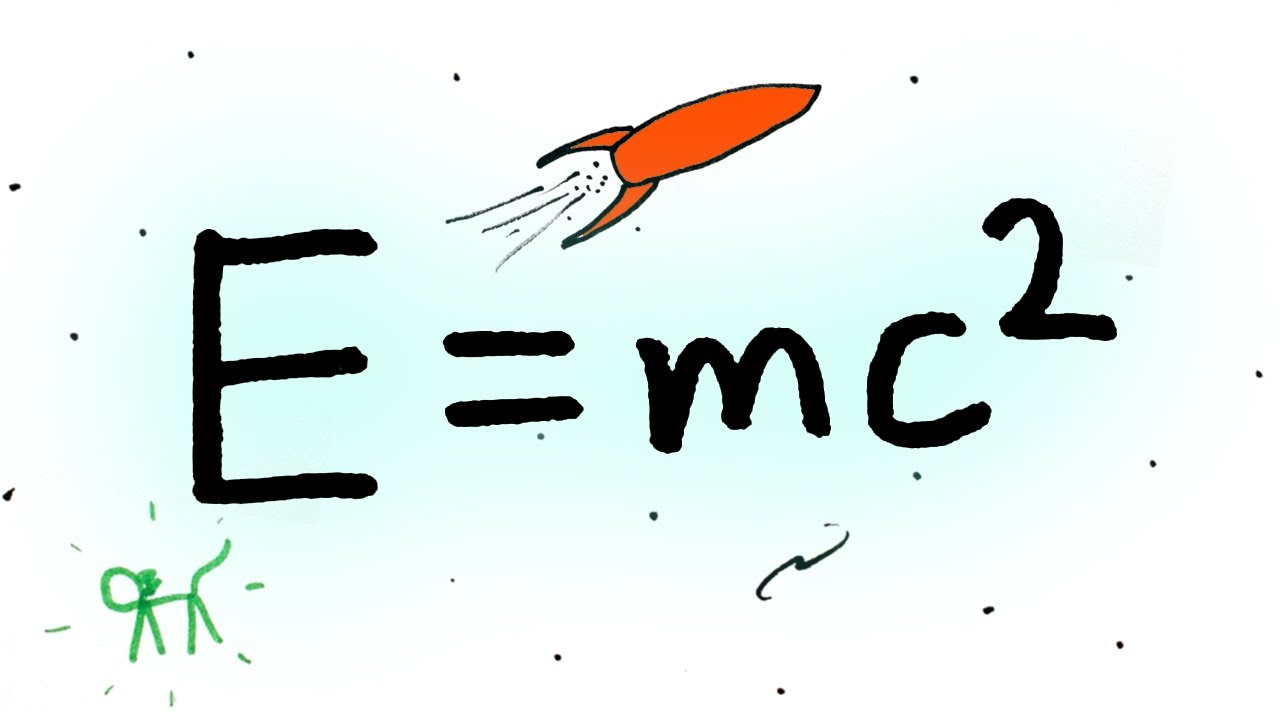
Why this video is valuable: This short animation serves as an excellent, intuitive summary of the derivation presented in the previous video. It details the momentum conservation mechanics of a cat emitting light, explaining the physical reality that inertia (resistance to acceleration) is directly tied to internal energy content.
Module 4 Knowledge Checkpoint
- State the formula for relativistic momentum and explain why the classical momentum formula fails at near-light speeds.
- Define "rest mass" () and explain why an object with non-zero rest mass requires infinite energy to reach the speed of light.
- Walk through the steps of Einstein's 1905 thought experiment demonstrating mass-energy equivalence.
- Calculate the total relativistic energy of an object given its rest mass and momentum using the energy-momentum relation: .
Module 5: Relativistic Paradoxes & Near-Light-Speed Travel
In this final module, you will apply everything you've learned to resolve the classic paradoxes of special relativity. You will also study the optical reality of traveling near the speed of light, learning why things don't just "squish" as length contraction formulas suggest, but instead undergo Terrell rotation and optical aberration.
Recommended Videos
Why this video is valuable: The Twin Paradox asks: if motion is relative, why does the traveling twin return younger? Why doesn't the traveling twin see the Earth twin as younger instead? This video resolves the paradox clearly by showing how the traveling twin must turn around, which breaks the symmetry because acceleration shifts their planes of simultaneity.

Why this video is valuable: The Pole-in-Barn Paradox sets up a contradiction: can a 20-meter pole fit inside a 10-meter barn if it travels fast enough to contract to 10 meters? But from the pole's frame, the barn is contracted to 5 meters! This video demonstrates how the relativity of simultaneity resolves this issue, as the front and back doors of the barn do not close at the same time in the pole's frame.
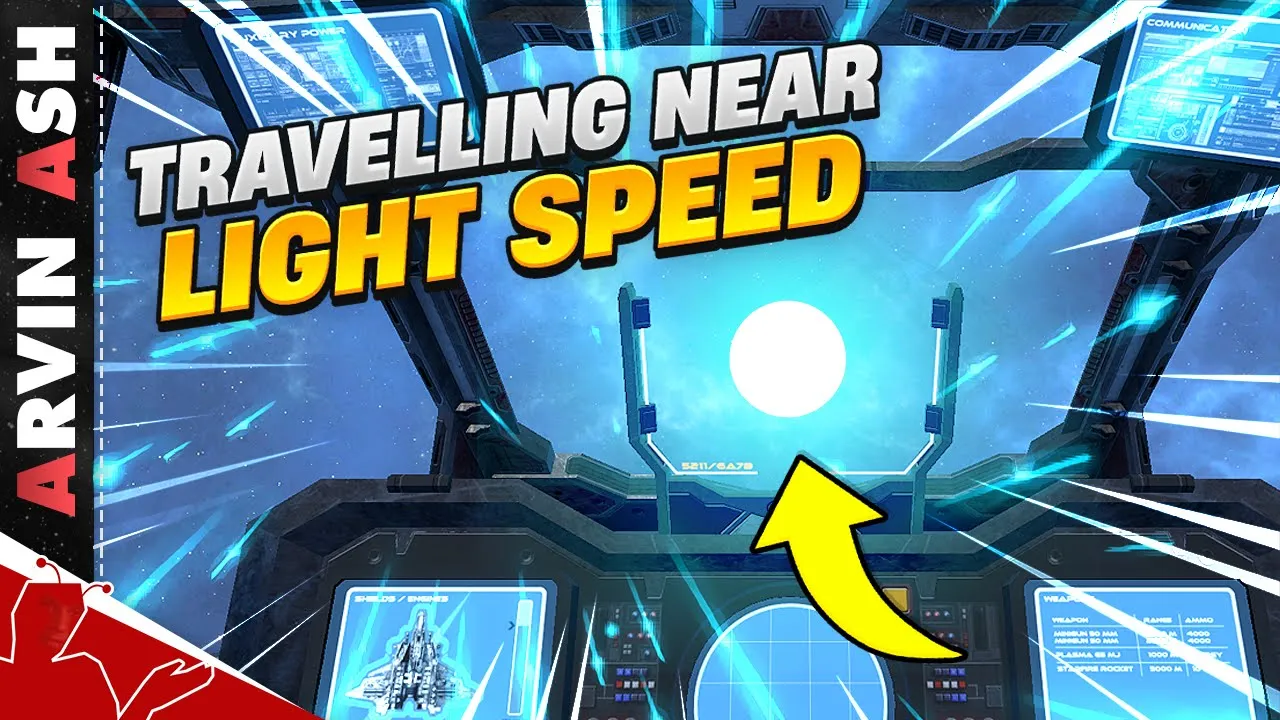
Why this video is valuable: This video addresses the critical curriculum gap on relativistic optical effects. Arvin Ash explains what an observer actually sees when traveling near the speed of light. Because light takes time to travel from the object to your eye, moving forward causes you to intercept photons early. This causes "relativistic aberration" and "Terrell rotation," making objects appear rotated and curved rather than simply shortened.

Why this video is valuable: This highly entertaining experimental simulation shows what everyday life would look like if the speed of light were slowed down to 2 m/s. It visualizes the combined optical effects of time dilation, length contraction, relativistic Doppler shifting (color changes), and searchlight effects (beaming of light to the center of your view) in real-time.
Module 5 Knowledge Checkpoint
- Explain how acceleration during turnaround breaks the symmetry between twins in the Twin Paradox.
- Resolve the Ladder/Barn-Pole Paradox by showing how the order of closing doors changes between reference frames.
- Define "Terrell-Penrose Rotation" and explain why moving at high speed causes the back side of an object to become visible to a forward-facing camera.
- Describe the "searchlight effect" (relativistic beaming) and how it affects the brightness of your field of view during near-light-speed travel.
Course Map
This map outlines your learning path through the curriculum. Completing each module unlocks the concepts needed for the next.
Key People Index
| Person | Context in Special Relativity | Key Contributions Covered |
|---|---|---|
| Albert Einstein | Swiss-American theoretical physicist. | Formulated the two postulates of special relativity and derived mass-energy equivalence () in 1905. |
| Albert Michelson & Edward Morley | American experimental physicists. | Designed and conducted the 1887 interferometer experiment that disproved the luminiferous ether theory. |
| Hendrik Lorentz | Dutch physicist. | Developed the mathematical coordinate transformations that preserve the equations of electromagnetism across moving frames. |
| Hermann Minkowski | German mathematician. | Realized that special relativity is best understood as a four-dimensional geometric space (spacetime) where space and time are unified. |
| James Terrell & Roger Penrose | American/British physicists. | Independently discovered in 1959 that relativistic length contraction is perceived visually as an apparent rotation (Terrell rotation). |
Final Self-Assessment
Review your understanding of the entire curriculum with this comprehensive self-assessment checklist.
- I can state Einstein's two postulates and explain why they force us to abandon the idea of absolute time.
- I can derive the time dilation formula using a Pythagorean setup of a moving light clock.
- I can explain why muons created in the upper atmosphere are able to survive long enough to hit the surface of the Earth.
- I can explain length contraction and clarify why it is a geometric effect rather than a physical squeezing of atoms.
- I can use Lorentz transformations to convert coordinates () of an event in one frame to coordinates () in another.
- I can draw a Minkowski diagram and correctly identify the lines representing constant position and constant time for both resting and moving frames.
- I can show why two events that are simultaneous to a stationary observer are not simultaneous to an observer in motion.
- I can explain why must be modified to to preserve momentum conservation at high speeds.
- I can reconstruct Einstein's thought experiment deriving using an atom emitting light packets.
- I can explain why the twin who travels to space and returns is genuinely younger than the twin who stayed on Earth.
- I can resolve the Pole-in-Barn paradox by showing that door-closing events occur in a different order depending on the frame.
- I can describe the optical distortions (Terrell rotation, aberration, and Doppler shifting) that occur when looking out the window of a ship traveling at .