Deploying Soft Power: Diplomacy, Aid & Media
Learning Goal: Analyze the deployment of soft power in international relations, evaluating how nation-states leverage cultural diplomacy, foreign aid, and global media to project influence.
- Prerequisites: None (Introductory knowledge of political science is helpful but not required).
- Estimated Total Study Time: 12 Hours
Module 1: Foundations of Power in International Relations
This module establishes the foundational theories of power in international relations (IR). You will explore the definitions of hard, soft, and smart power, analyzing how Joseph Nye’s landmark framework disrupted the traditional realist paradigm of statecraft based purely on military and economic coercion.
Core Video Resources
- Why this video: This academic lecture addresses the key gap identified in our syllabus: a deep, rigorous theoretical unpacking of Joseph Nye's classical 1990 framework. It breaks down the shift from structural and behavioral realist theories of power (coercion and inducement) to Nye's tripartite source model of soft power (culture, political values, and foreign policies).
- Knowledge Checkpoint:
- Explain the original definition of soft power as formulated by Joseph Nye in 1990.
- Compare the behavioral differences between "co-opting" vs. "coercing" in international diplomacy.
- Identify the three primary resources of soft power according to academic IR theory.

- Why this video: Renowned diplomat Shashi Tharoor provides a modern global perspective on how soft power operates on the ground, emphasizing why states must prioritize cultural attraction and pluralism over brute military force to build long-term international leadership.
- Knowledge Checkpoint:
- Contrast Tharoor’s practical depiction of soft power with standard hard power dynamics.
- Explain how a nation's internal narrative, diversity, and cultural reputation organically bolster its external foreign policy goals.

- Why this video: A concise theoretical explainer on the synthesis of hard and soft power—colloquially termed "smart power." It explains how modern states integrate coercive military posture with persuasive diplomatic maneuvers to execute complex geopolitical strategies.
- Knowledge Checkpoint:
- Define "smart power" and identify its primary objectives in modern statecraft.
- Provide an example of how military force (hard) can be integrated with cultural diplomacy (soft) to achieve a unified foreign policy outcome.
Module 2: Cultural Diplomacy and Nation Branding
This module examines how states leverage cultural exports, language programs, tourism, and educational exchanges to curate "nation brands." We will look closely at historical and contemporary case studies—including East Asian pop culture and Western royalty—to understand how cultural alignment fosters geopolitical compliance.
Core Video Resources
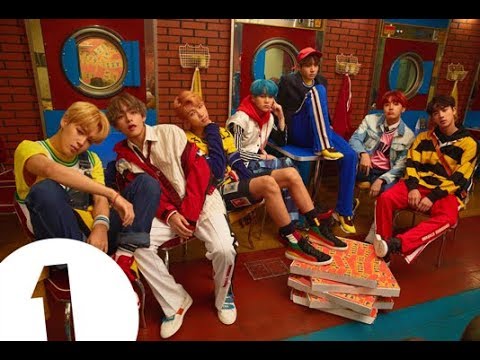
- Why this video: This documentary acts as a premier case study of highly successful, state-supported cultural diplomacy: South Korea's Hallyu (Korean Wave). It reveals how the South Korean government systematically co-funded, cultivated, and exported K-Pop as a deliberate political instrument to build global affinity and economic prestige.
- Knowledge Checkpoint:
- Describe the historical motivations behind the South Korean government's decision to heavily invest in its cultural and entertainment sectors in the 1990s.
- Analyze how rigorous entertainment training academies and global digital fandoms serve the geopolitical interests of the Korean state.
- Differentiate between organic cultural emergence and state-manufactured cultural diplomacy.
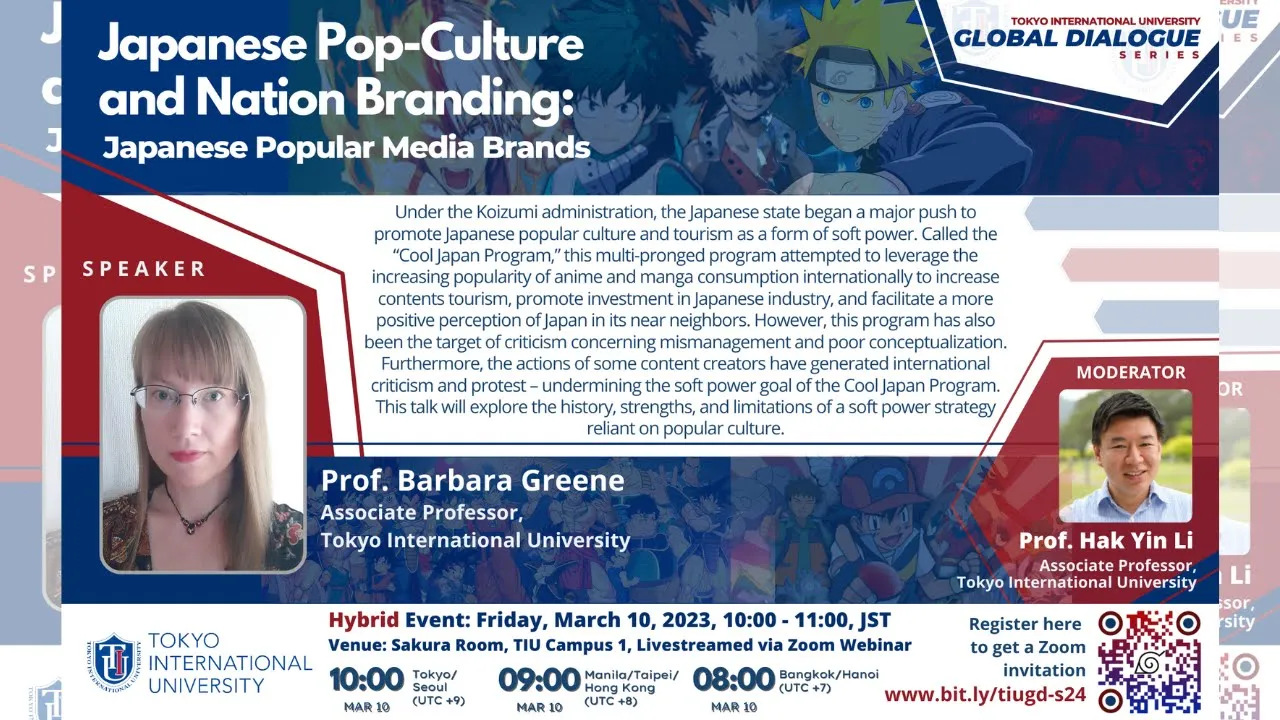
- Why this video: This video links the concept of "nation branding" with corporate marketing structures, focusing on Japan's strategic use of pop culture (anime, gaming, and manga) to pivot its post-war global image from an imperial aggressor to a peaceful, innovative cultural superpower.
- Knowledge Checkpoint:
- Define "nation branding" and list the corporate marketing principles applied to sovereign countries.
- Explain how Japan's "Cool Japan" campaign altered global perceptions and attracted tourism.

- Why this video: A brief but insightful look into British soft power. It explains how non-political institutions, such as the UK Royal Family, are deployed on high-level state visits to ease diplomatic tensions and lay the groundwork for bilateral negotiations where formal political channels might falter.
- Knowledge Checkpoint:
- Explain how non-governmental or constitutional monarchic figures act as diplomatic lubricants.
- Distinguish between formal bilateral treaties (hard diplomacy) and relational soft diplomacy.
Module 3: Foreign Aid and Economic Influence
This module explores the mechanics of economic soft power. You will study historical precedents like the Marshall Plan, contrast democratic humanitarian aid programs (such as USAID) with non-Western statecraft models, and analyze critical perspectives on how development assistance can morph into modern strategic leverage.
Core Video Resources
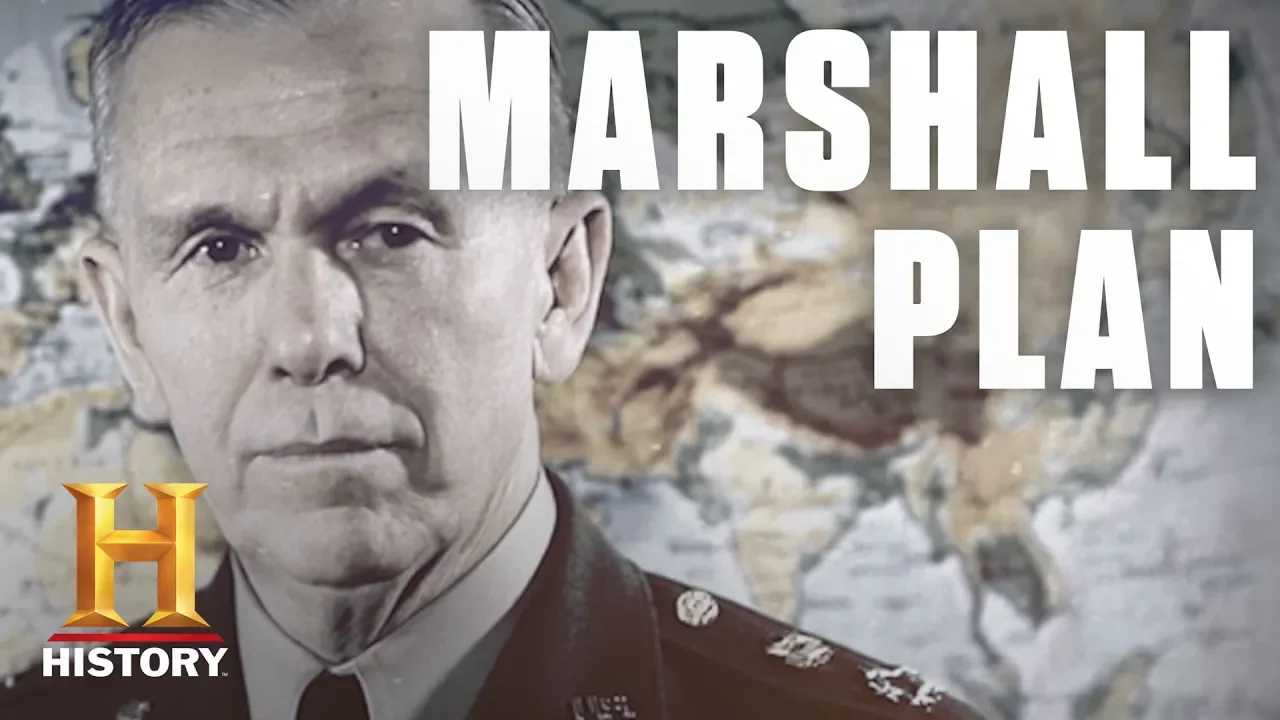
- Why this video: This video details the benchmark historical case of economic soft power: the post-WWII Marshall Plan. It demonstrates how a multi-billion dollar aid package reconstructed European markets, neutralized Soviet ideology, and locked Western European nations into the American sphere of influence.
- Knowledge Checkpoint:
- State the primary geopolitical objective of the Marshall Plan beyond humanitarian reconstruction.
- Analyze how rebuilding European economies directly benefited the long-term trade security of the United States.

- Why this video: This seminar unpacks the modern usage of international developmental aid. Using the United States Agency for International Development (USAID) as a model, it details how humanitarian programs generate long-term structural dependencies, projecting soft influence directly into the domestic policy networks of developing states.
- Knowledge Checkpoint:
- Describe how USAID programs establish structural dependencies in target nations.
- Explain the foreign policy concept of using developmental assistance to buy political compliance.
- Why this video: To address the curriculum feedback calling for non-Western economic models, this video analyzes China's Belt and Road Initiative (BRI). It illustrates how Beijing projects economic influence using commercial infrastructure debt rather than traditional, altruistic developmental aid.
- Knowledge Checkpoint:
- Differentiate between Western grant-based aid models and China's infrastructure debt-finance model.
- Define the term "debt trap diplomacy" and evaluate its accuracy in describing the China-Pakistan Economic Corridor (CPEC) dynamics.
Module 4: Global Media and Information Warfare
This module investigates how nation-states systematically project national narratives to global audiences. You will evaluate how international state-run broadcasters (such as RT, CGTN, and Al Jazeera) operate as soft power apparatuses, and examine the rising role of social media platforms in digital diplomacy.
Core Video Resources

- Why this video: This video directly bridges a curriculum coverage gap on Middle Eastern state media. Focusing on Qatar-backed Al Jazeera, it analyzes how the network curates progressive, liberal-leaning coverage for Western audiences while broadcasting highly conservative regional narratives to advance Qatari state influence.
- Knowledge Checkpoint:
- Analyze how a state-run network can tailor different narratives for Eastern vs. Western audiences to secure geopolitical goals.
- Explain why a state would fund an international news outlet that operates with high editorial polish.

- Why this video: This segment offers a deep dive into China's global media network: CGTN (formerly CCTV9). It exposes how the Chinese government rebranded its international state television and systematically hires Western influencers to project a positive image of China.
- Knowledge Checkpoint:
- What was the geopolitical objective behind the 2016 rebranding of CCTV9 to CGTN under President Xi Jinping?
- Explain the practice of hiring Western media figures ("white monkey propagandists") to bypass domestic censorship and build global trust.

-
Why this video: This panel introduces "Diplomacy 2.0" (digital diplomacy). It covers how embassies and world leaders bypass traditional press offices to directly shape foreign public opinion via digital networks.
-
Knowledge Checkpoint:
- Explain how social media has changed the timeline and communication style of modern public diplomacy.
- Define the risks and opportunities for foreign ministries attempting direct-to-citizen digital campaigns.
-
Independent Study Tip for Module 4: To further build your knowledge, independently search for academic resources on the US Smith-Mundt Act and research the legal challenges RT (Russia Today) faced regarding foreign agent registration in Western jurisdictions.
Module 5: Measuring and Critiquing Soft Power
This module centers on the quantitative measurement frameworks of soft power and the fundamental critiques of statecraft. We will study the pillars of global indexes, compare the relative effectiveness of US and Chinese soft power models, and investigate why artificially engineered soft power frequently encounters severe limitations.
Core Video Resources

- Why this video: This interview explains how soft power is measured, addressing the core gap in index evaluation identified in the curriculum review. Richard Haigh introduces the Global Soft Power Index survey methodology, which collects responses from over 88,000 individuals across 100 countries.
- Knowledge Checkpoint:
- Detail how Brand Finance quantifies soft power using nationwide surveys.
- Name the seven core pillars of soft power defined by Brand Finance's index methodology.
- Why this video: This news analysis unpacks the application of global index metrics, using specific nation placements to show how elements like trade, governance, people, and values translate directly into numerical rankings.
- Knowledge Checkpoint:
- Identify how national "governance behaviors" impact a country's rank on the index.
- Discuss the limits of reducing complex cultural attraction down to a numerical score.
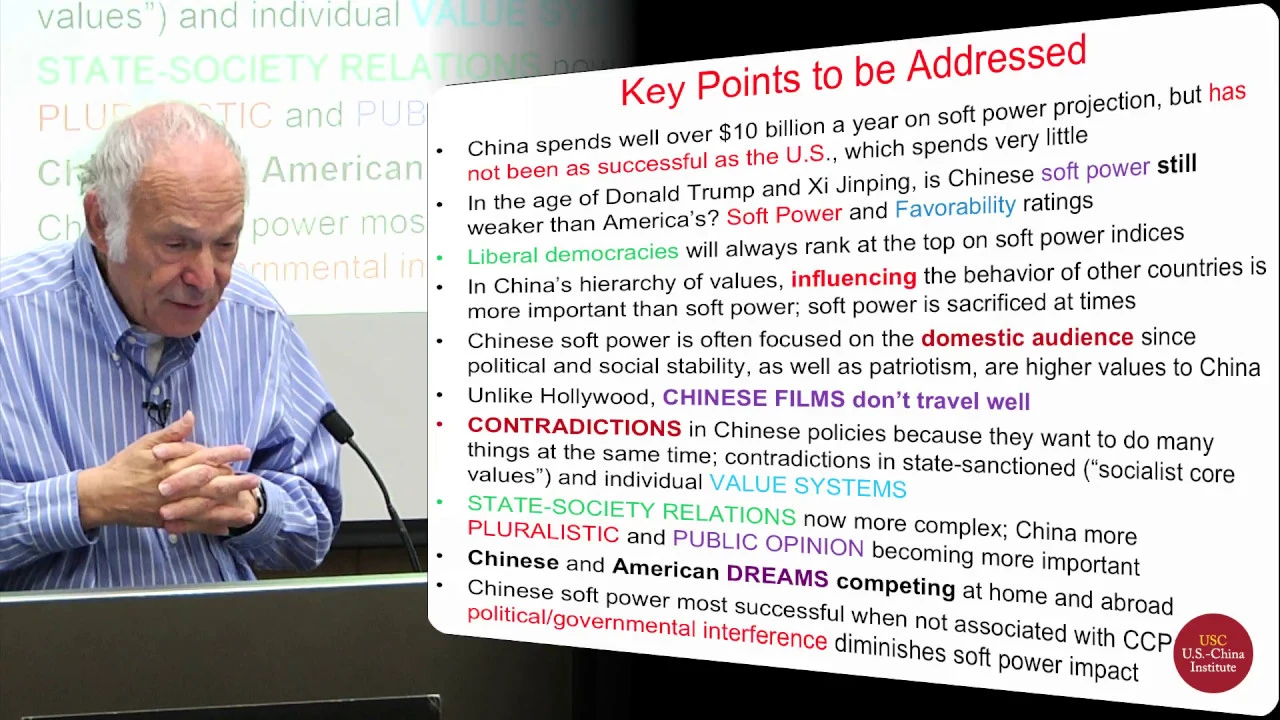
- Why this video: A comprehensive academic analysis of the structural limitations of top-down soft power campaigns. Stan Rosen evaluates why China's massive $10+ billion annual soft power investments struggle to match the return of American cultural exports, illustrating how government over-control can choke out authentic cultural attraction.
- Knowledge Checkpoint:
- Contrast the US model of decentralized, organic soft power with China's top-down, state-directed model.
- Explain why prioritizing domestic political stability often undermines a nation's international appeal.

- Why this video: This video offers a strong critical perspective on the decline of American soft power. It traces how policy decisions, hyper-polarization, and systemic domestic issues can erode the values of democratic moral leadership that undergirded US influence for decades.
- Knowledge Checkpoint:
- Explain the concept of "credibility gap" in international relations as it relates to soft power.
- Identify domestic political factors that can quickly damage a nation’s global prestige.
Course Map
Below is the recommended sequence of modules. Note how Module 1 lays the theoretical foundation required for the three pillar modules, which then converge into Module 5's measurement and critique.
Key People Index
- Joseph Nye: Harvard Kennedy School Professor who coined the term "soft power" in his 1990 book Bound to Lead: The Changing Nature of American Power, and subsequently developed the concept of "smart power."
- George C. Marshall: General and US Secretary of State who drafted and advocated for the European Recovery Program (The Marshall Plan) in 1947, defining modern economic diplomacy.
- Shashi Tharoor: Indian politician, diplomat, and former Under-Secretary-General of the United Nations; widely known for his advocacy of pluralistic cultural soft power models.
- Richard Haigh: Managing Director at Brand Finance, responsible for deploying the methodologies behind the Global Soft Power Index tracking international power assets.
Final Self-Assessment
Complete this comprehensive self-assessment to verify your mastery of the curriculum:
- I can articulate the core differences between hard power (coercion), soft power (attraction), and smart power (strategic integration).
- I can trace the origin of the term "soft power" back to Joseph Nye’s 1990 critique of the realist paradigm of international relations.
- I can explain the mechanics of "nation branding" and list three ways states utilize cultural exports (such as Hallyu or Cool Japan) to achieve geopolitical aims.
- I can analyze the Marshall Plan as an early example of economic soft power and compare it to modern development aid models (e.g., USAID).
- I can contrast Western grant-based aid models with China's loan-based Belt and Road Initiative (BRI) infrastructure strategy.
- I can explain how international state-run broadcasting networks (such as CGTN, Al Jazeera, or RT) function as diplomatic or propagandist institutions for their home nations.
- I can define "Diplomacy 2.0" (digital diplomacy) and discuss how social media affects diplomatic communications.
- I can identify the 7 key pillars evaluated in the Global Soft Power Index by Brand Finance.
- I can discuss why state-controlled, top-down cultural campaigns often fail to produce genuine soft power compared to organic, decentralized cultural emergence.
- I can analyze how domestic policy inconsistencies or political polarization can diminish a nation's soft power credibility on the global stage.