Electrochemistry (Cell Design & Battery Tech)
Learning Goal: Mastering Applied Electrochemistry: Principles, Cell Design, and the Mechanics of Modern Battery Technologies. This curriculum bridges fundamental chemical transfer reactions with thermodynamic principles, kinetic limitations, and advanced commercial engineering implementations of state-of-the-art battery chemistries.
Prerequisites
- Basic high school algebra (for calculating cell potentials and solving logarithmic equations).
- Introductory physics concepts (basic understanding of voltage, current, and resistance).
Estimated Study Time
- Total: ~22 Hours (including videos, self-guided mathematical practice, and supplementary reading).
Module 1: Chemistry Foundations: Redox & Ions
This module establishes the chemical foundation necessary to master electrochemistry. You will learn the mechanics of electron transfer, how to determine oxidation numbers, how to balance complex oxidation-reduction (redox) reactions, and the physics of how ions migrate through electrolytic solutions to carry electrical currents.
Recommended Videos

- Why this video: This video provides a rigorous, step-by-step primer on tracking electron movement within molecules. It covers how to assign oxidation numbers and systematically breaks down the periodic trends that govern which elements act as strong oxidizing or reducing agents.
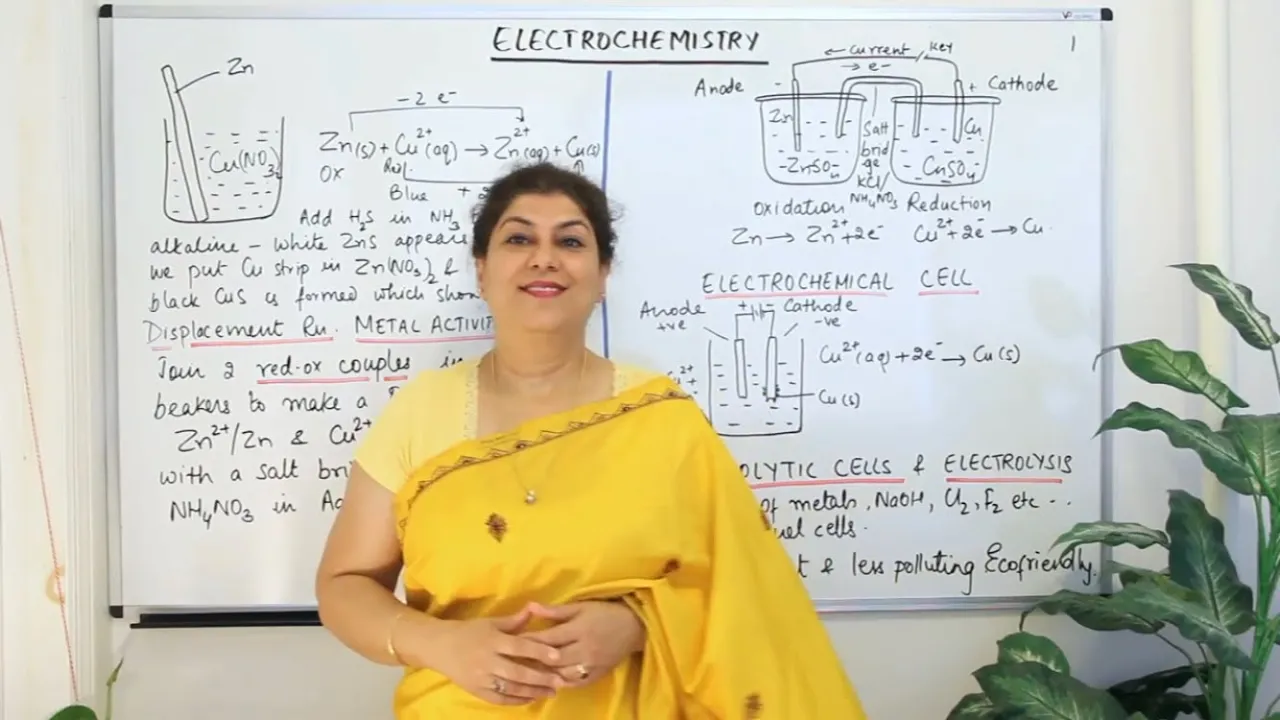
- Why this video: This lecture serves as the bridge between basic chemical reactions and physical electrochemical systems. It introduces how chemical change directly generates electricity (and vice versa) and details how basic redox reactions are physically partitioned to create charge flow.

- Why this video: A short, essential concept-builder that defines electrolytes. It explains why solid ionic salts are non-conductive, whereas their aqueous or molten counterparts conduct electricity through the physical migration of free-moving anions and cations.
Knowledge Checkpoint
- Can you determine the oxidation state of transition metals in complex oxides (e.g., Manganese in )?
- Do you understand the difference between electronic conduction (electrons in metals) and ionic conduction (ions in electrolytes)?
- Can you split a complete chemical reaction into its respective oxidation and reduction half-reactions?
Module 2: Electrochemical Cells & Thermodynamics
In this module, you will learn to apply thermodynamic principles to calculate standard cell potentials. You will contrast galvanic (spontaneous) and electrolytic (non-spontaneous) cells, understand how standard reference electrodes function, and learn to apply the Nernst equation to predict cell behavior under non-standard, real-world concentrations.
Recommended Videos
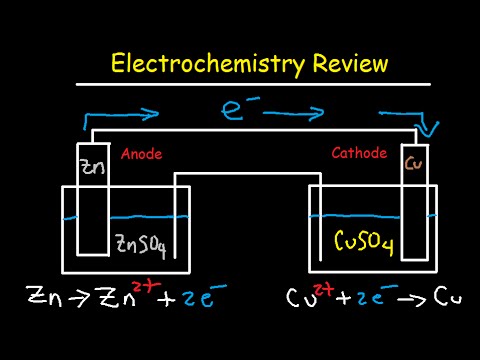
- Why this video: A masterclass in thermodynamic electrochemistry. This comprehensive review explains the construction of galvanic cells, standard cell notation rules (Anode on left, Cathode on right), the calculation of standard potentials (), and how they relate to free energy change ().

- Why this video: This video focuses heavily on the application of the Nernst equation to non-standard conditions. It demonstrates how changes in concentration shift the equilibrium of an active electrochemical system, changing its real-time voltage.

- Why this video: This highly visual animation clarifies the concept of standard reduction potentials. It shows exactly how the Standard Hydrogen Electrode (SHE) serves as the universal reference point () by facilitating a reversible reaction on a catalytic platinum surface.
Knowledge Checkpoint
- Can you calculate the cell potential of an electrochemical cell operating at non-standard concentrations using the Nernst Equation?
- Do you know how to write cell notation using correct phase boundary () and salt bridge () symbols?
- Can you explain why the anode in a galvanic cell is negative, while in an electrolytic cell it is positive?
Module 3: Electrode Kinetics, Mass Transport & Characterization
Note: Due to a historical scarcity of highly visual, engaging video explanations of advanced kinetic topics on YouTube, the videos below focus heavily on the mathematical frameworks of kinetics and state-of-the-art diagnostic methods. Learners are highly encouraged to supplement this module with textbook diagrams of the electrical double layer and mass-transport profiles.
In this module, you will transition from thermodynamic equilibrium to kinetic rates. You will analyze interfacial charge transfer using the Butler-Volmer equation, learn how activation overpotentials limit real cell voltage, examine mass-transport limitations, and master modern analytical techniques such as Cyclic Voltammetry (CV) and Electrochemical Impedance Spectroscopy (EIS).
Recommended Videos

- Why this video: An academic lecture explaining electrode reaction kinetics. It details how the Butler-Volmer equation describes the relationship between current density and overpotential (), and derives the Tafel equations used under high overpotential regimes.
- Why this video: An incredibly thorough theoretical overview of EIS. This video teaches you how applying a small, alternating voltage signal across different frequencies allows researchers to separate and measure distinct resistance sources inside a battery (e.g., electrolyte resistance vs. charge transfer resistance).
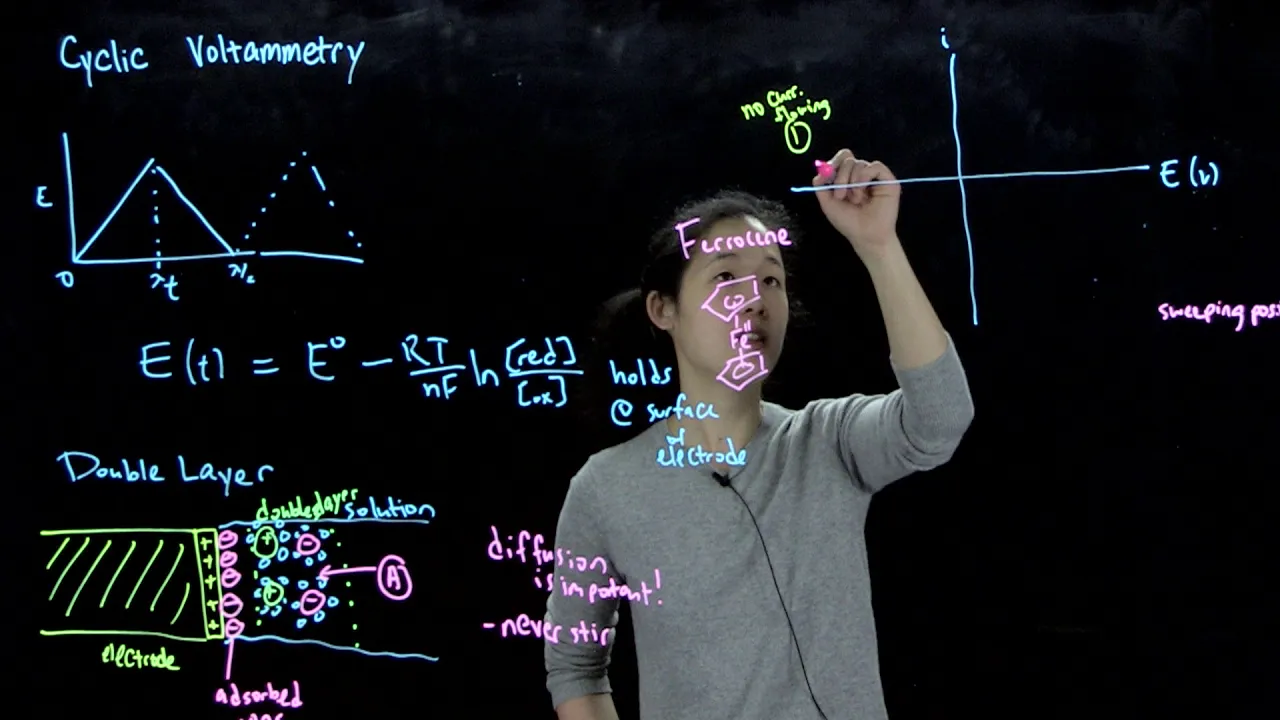
- Why this video: This video introduces Cyclic Voltammetry (CV)—the "electrochemical camera." It breaks down how sweeping the potential of an electrode linearly back and forth generates characteristic peak currents, revealing the thermodynamic and kinetic properties of active redox species.
Critical Independent Study Recommendation
Since video material on physical mass transport is highly mathematical, self-study the following concepts in an electrochemistry textbook:
- Diffusion: Movement of ions down a concentration gradient (governed by Fick's Laws).
- Migration: Movement of charged ions due to an electric field gradient.
- Convection: Bulk physical movement of the fluid electrolyte (e.g., stirred cells).
Knowledge Checkpoint
- What is "exchange current density" (), and how does it reflect the intrinsic catalytic activity of an electrode?
- Can you identify key regions of an EIS Nyquist plot, such as the high-frequency intercept (bulk electrolyte resistance) and the mid-frequency semi-circle (charge-transfer impedance)?
- How does cyclic voltammetry distinguish between a fully reversible, quasi-reversible, and irreversible electrochemical reaction based on peak spacing?
Module 4: Modern Battery Chemistry & Intercalation
This module dives into the active materials of modern battery technologies. We will analyze the molecular mechanics of Lithium-ion cells, the process of intercalation (where ions slide into host crystal structures), anode/cathode options (such as LFP, NMC, Graphite), and alternative systems like solid-state batteries.
Recommended Videos

- Why this video: This highly acclaimed video uses photorealistic 3D animations to bridge the macro-scale battery with atomic-scale physics. It clearly shows lithium atoms ionizing, passing through organic electrolytes, and intercalating within the graphite and metal-oxide crystal lattices.
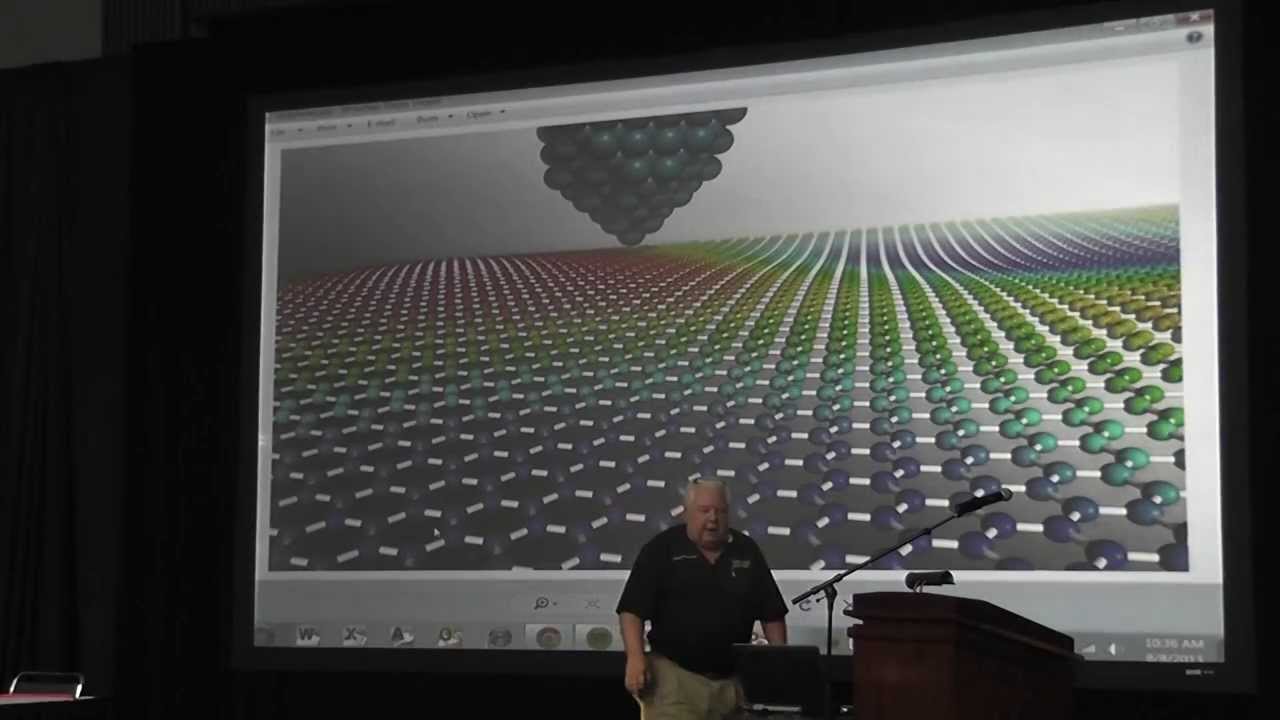
- Why this video: A practical explanation of active battery materials. This segment highlights Lithium Iron Phosphate ( or LFP) olivine crystal structures, explaining how materials selection dictates the voltage, thermal stability, and overall longevity of a battery cell.

- Why this video: An objective look at the transition from liquid electrolytes to solid-state designs. This short explainer highlights the engineering benefits (energy density, fire safety) and manufacturing challenges of replacement solid ceramic or polymer separators.
Knowledge Checkpoint
- What is "intercalation," and how does it differ from a conversion or alloying reaction mechanism?
- Why is graphite used as an anode material instead of pure, metallic lithium in standard consumer batteries?
- What are the primary trade-offs (energy density, thermal runaway temperature, cost) between LFP and nickel-rich (NMC/NCA) cathode chemistries?
Module 5: Cell Architecture & Battery Pack Engineering
Batteries must be scaled from individual chemical cells into safe, robust, high-voltage battery packs. In this module, you will analyze the physical manufacturing process, compare mechanical cell formats (cylindrical, pouch, prismatic), evaluate thermal management, and master the functions of the Battery Management System (BMS).
Recommended Videos
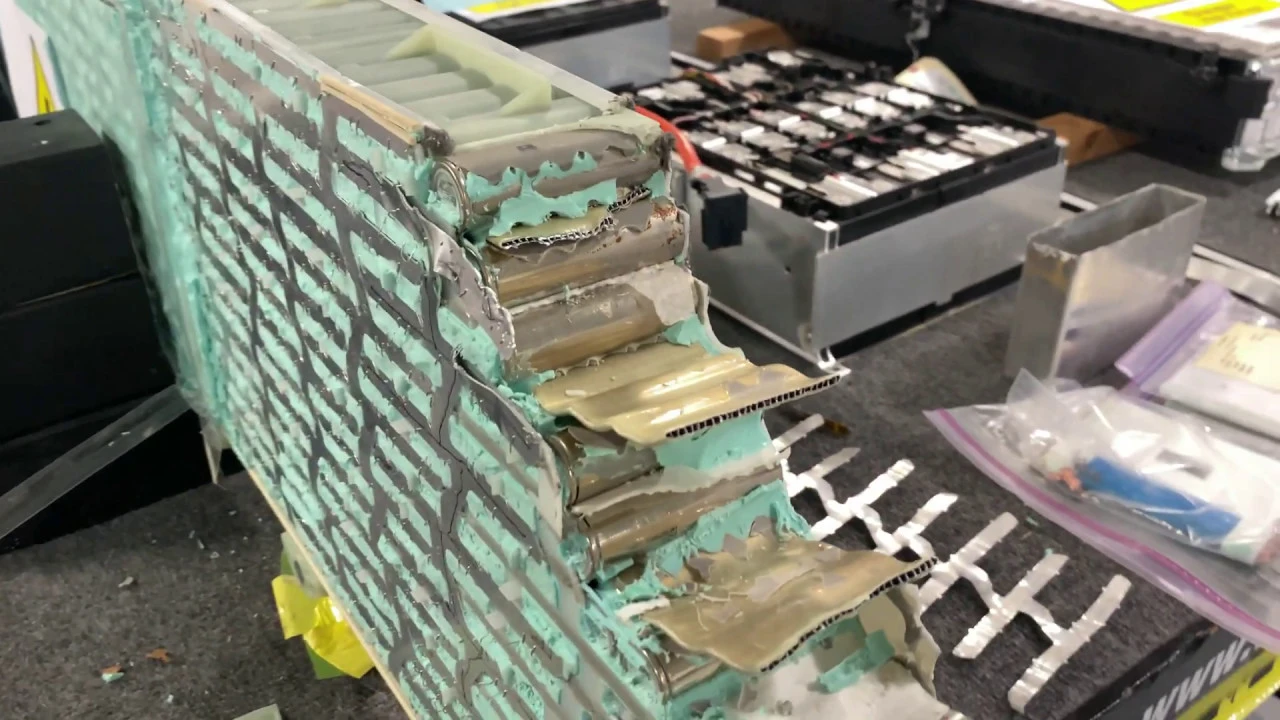
- Why this video: Led by automotive teardown expert Sandy Munro, this video evaluates the physical form factors used in electric vehicles. It analyzes cylindrical (e.g., 2170), prismatic, and pouch cells, highlighting the volumetric packaging, structural support, and cooling trade-offs of each.

- Why this video: A comprehensive, engineering-oriented breakdown of BMS architecture. This lecture covers the critical tasks of a BMS: sensing cell voltages, tracking State-of-Charge (SoC), active/passive cell balancing, and preventing overcurrent or overtemperature events.
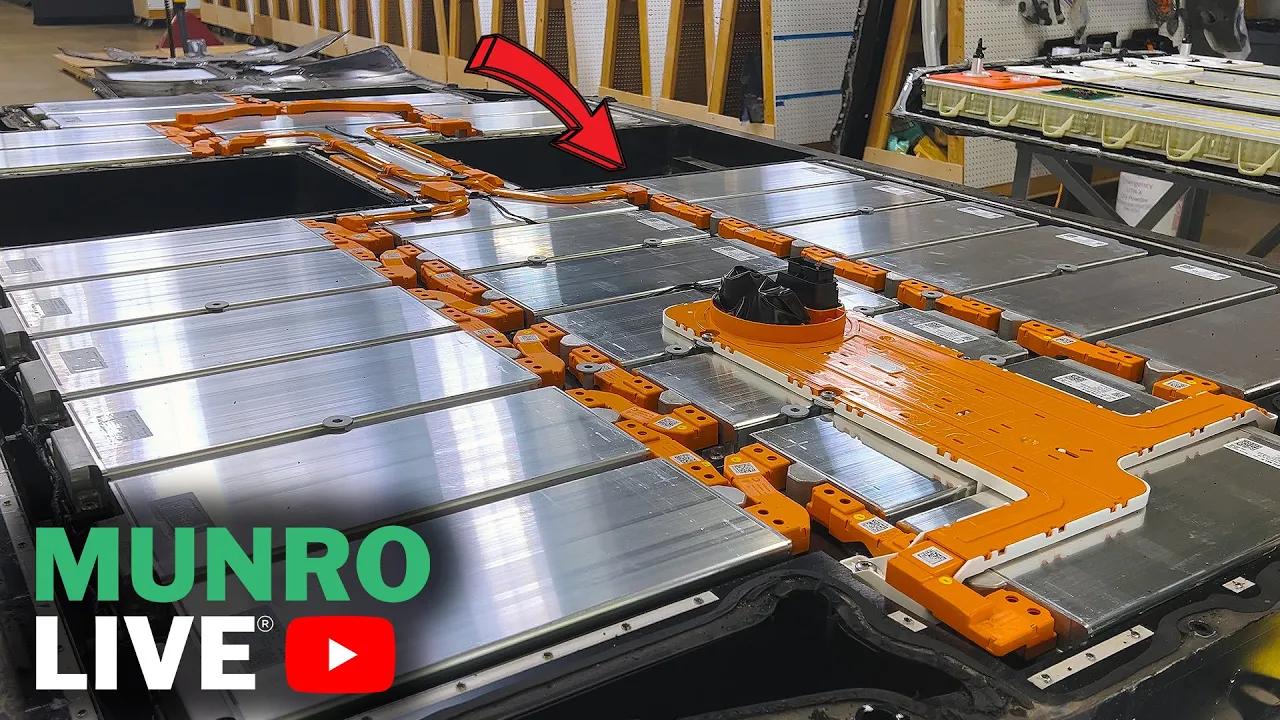
- Why this video: This teardown reveals the advanced liquid cooling plates, thermal interface materials (TIMs), and micro-extruded aluminum cooling channels required to manage the high thermal loads of ultra-fast charging architectures (like the Taycan's 800V pack).
Knowledge Checkpoint
- How do passive and active balancing in a BMS differ, and why are they necessary for multi-cell series battery packs?
- What mechanical advantages do cylindrical metal cans provide over pouch cells during internal cell outgassing?
- Why is keeping a battery pack in the to temperature window critical for slow aging and prevent solid-electrolyte interphase (SEI) layer breakdown?
Course Map
Key People Index
- Dr. Hector Abruña (Video 9 context): Director of the Center for Alkaline Based Energy Solutions (CABES) at Cornell University; pioneer in operando methods and fundamental interfacial charge transfer kinetics.
- Dr. Jeff Dahn (Video 71 context): Pioneer in lithium-ion battery research at Dalhousie University; key researcher on modern battery degradation, cathode design, and Tesla's long-cycle battery development.
- Dr. Shirley Meng (Video 71 context): Prominent battery researcher at the University of Chicago / Argonne National Lab; developer of atomic-resolution imaging techniques to study energy storage materials and solid-state battery interfaces.
- Sandy Munro (Videos 37, 62): Automotive engineer and founder of Munro & Associates; widely respected for physical teardown analyses of modern EV battery architectures.
Final Self-Assessment
Test your comprehensive understanding of the materials covered in this curriculum:
- Redox Balancing: Can you balance a complex redox reaction in an acidic or basic aqueous solution using the half-reaction method?
- Ionic Transport: Can you explain how the ionic conductivity of an organic electrolyte impacts a battery’s high-rate discharge capabilities?
- Nernst Application: Can you calculate the open-circuit voltage (OCV) of a lithium-ion battery at state-of-charge versus state-of-charge using active component activities?
- Interfacial Kinetics: Can you write out the Butler-Volmer equation and explain what parameters dictate the slope of the activation polarization curve?
- Mass Transport: Do you know how to calculate the "limiting current density" from Fick's first law of diffusion in a concentration-polarized cell?
- EIS Interpretation: Given an EIS Nyquist plot, can you estimate the high-frequency ohmic resistance and assign physical battery elements to equivalent electrical circuit models?
- Intercalation Mechanics: Can you describe the structural changes and volumetric expansion that occur in a graphite anode when it goes from a fully discharged state to a fully intercalated stage-1 () state?
- Cathode Metallurgy: Can you detail why LFP cathodes have superior cycle life and thermal stability compared to NMC cathodes?
- Cell Formats: Can you list at least two manufacturing benefits and two heat dissipation challenges associated with switching from cylindrical 2170 to 4680 formats?
- BMS & Safety: Can you explain the role of a BMS in preventing thermal runaway by monitoring individual cell voltages during a fast-charging cycle?