Solid-State Chemistry: Crystals & Bragg's Law
Learning Goal: Master the core principles of solid-state chemistry and X-ray crystallography. By the end of this curriculum, you will understand the atomic arrangement of crystalline solids, index crystal planes, derive and apply Bragg's Law, calculate structure factors, account for systematic absences, and manually index powder X-ray diffraction (XRD) patterns to determine crystal systems.
- Prerequisites: High school-level general chemistry and physics (specifically wave interference, basic trigonometry, and algebra).
- Estimated Total Study Time: 15 Hours
Module 1: Introduction to Crystalline Solids
This module establishes the foundational distinction between crystalline and amorphous solids. You will explore how atomic arrangements form repeating patterns in three dimensions, defining concepts like space lattices, lattice points, and unit cells.
Recommended Videos
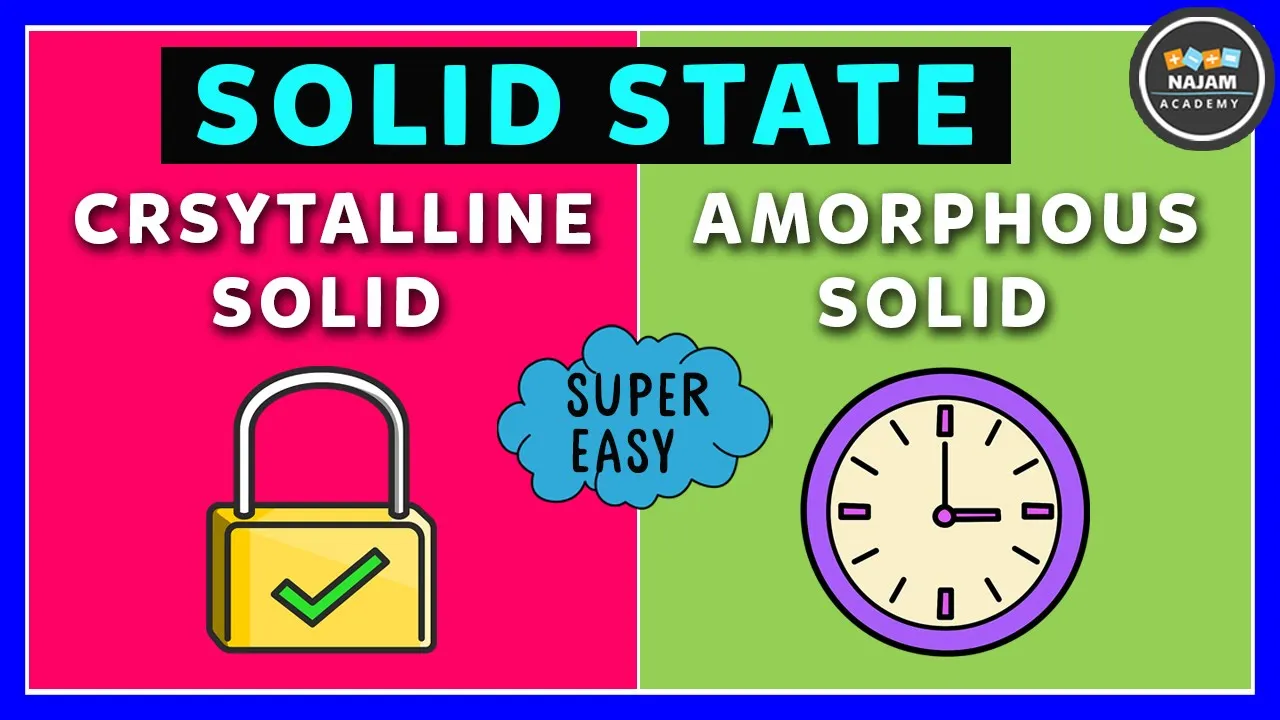
Why this video
This animated introductory video offers an intuitive visual comparison between crystalline and amorphous solids. It highlights critical thermodynamic and physical differences, such as the sharp melting points and anisotropic properties of true crystals compared to the isotropic, supercooled behavior of amorphous glasses.
Knowledge Checkpoint
- Differentiate between crystalline and amorphous materials based on atomic order and heat of fusion.
- Define "anisotropy" and explain why crystalline solids exhibit physical properties that vary with direction.
- Identify everyday examples of both crystalline and amorphous solids.
Why this video
This lecture cleanly bridges the macro-properties of crystals with their microstructural definitions. It defines a space lattice as an abstract geometric framework of infinite repeating points and establishes the unit cell as the smallest representative volume that generates the entire crystal through simple translational symmetry.
Knowledge Checkpoint
- Define a "lattice point" and explain what it represents in physical space.
- Describe how translating a unit cell along its three primary axes recreates the macroscopic crystal structure.
- Identify the geometric parameters (lattice parameters and interaxial angles ) that define a unit cell.

Why this video
Presented by MIT, this full-length lecture places solid-state chemistry in a broader scientific context. It demonstrates how electronic structure directly dictates atomic arrangement, which ultimately governs the physical and mechanical properties of engineered materials.
Knowledge Checkpoint
- Explain the relationship between electronic configuration and chemical bonding in solid networks.
- Understand why solid-state chemistry is considered an essential gateway discipline for materials engineering and design.
Module 2: Crystal Systems and Miller Indices
This module transitions from basic structures to formal crystallographic notations. You will learn about the 7 crystal systems and 14 Bravais lattices, and master the coordinate system used to label directions and planes in a unit cell (Miller Indices).
Recommended Videos
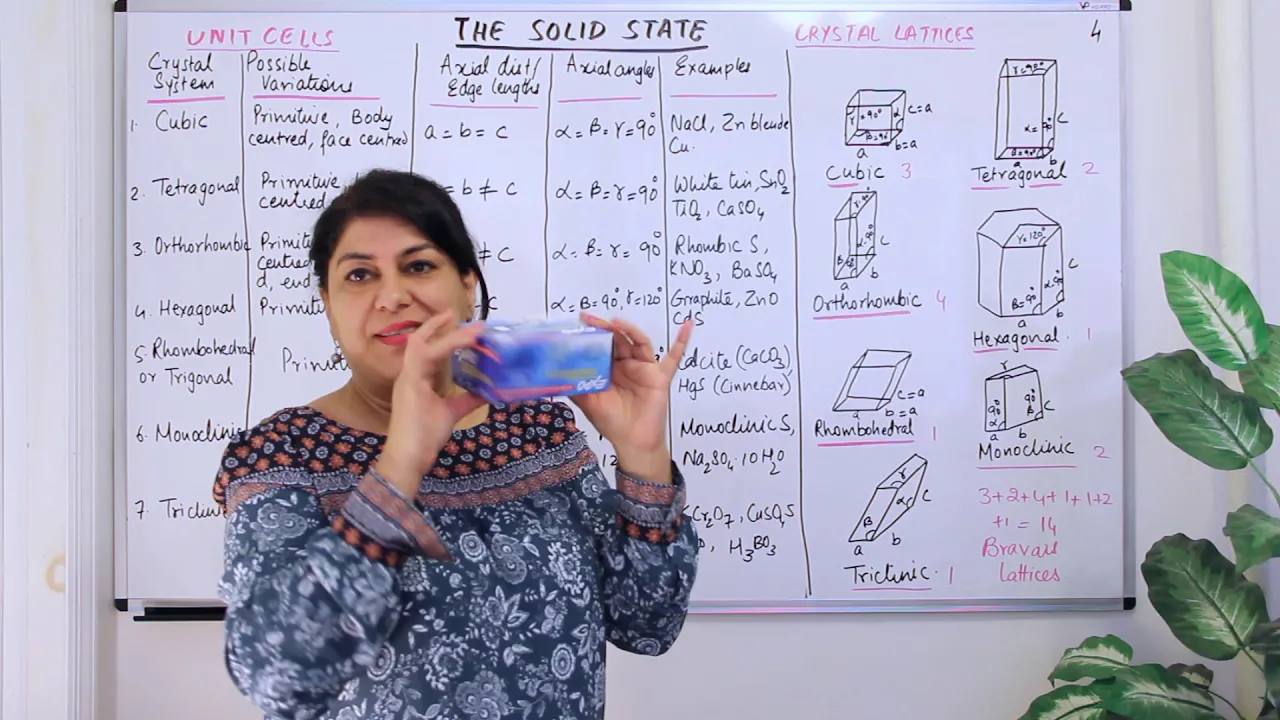
Why this video
This video breaks down how unit cells are classified mathematically into the 7 distinct crystal systems (Cubic, Tetragonal, Orthorhombic, Hexagonal, Monoclinic, Triclinic, and Trigonal/Rhombohedral) and the 14 space-filling Bravais lattices. It provides direct, step-by-step visual breakdowns of axial relationships and angles.
Knowledge Checkpoint
- List the 7 crystal systems and state their defining axial lengths () and angles ().
- Understand how combining the 7 crystal systems with lattice centerings (primitive, body-centered, face-centered, base-centered) yields exactly 14 Bravais lattices.
- Identify which crystal system possesses the highest symmetry and which possesses the lowest.
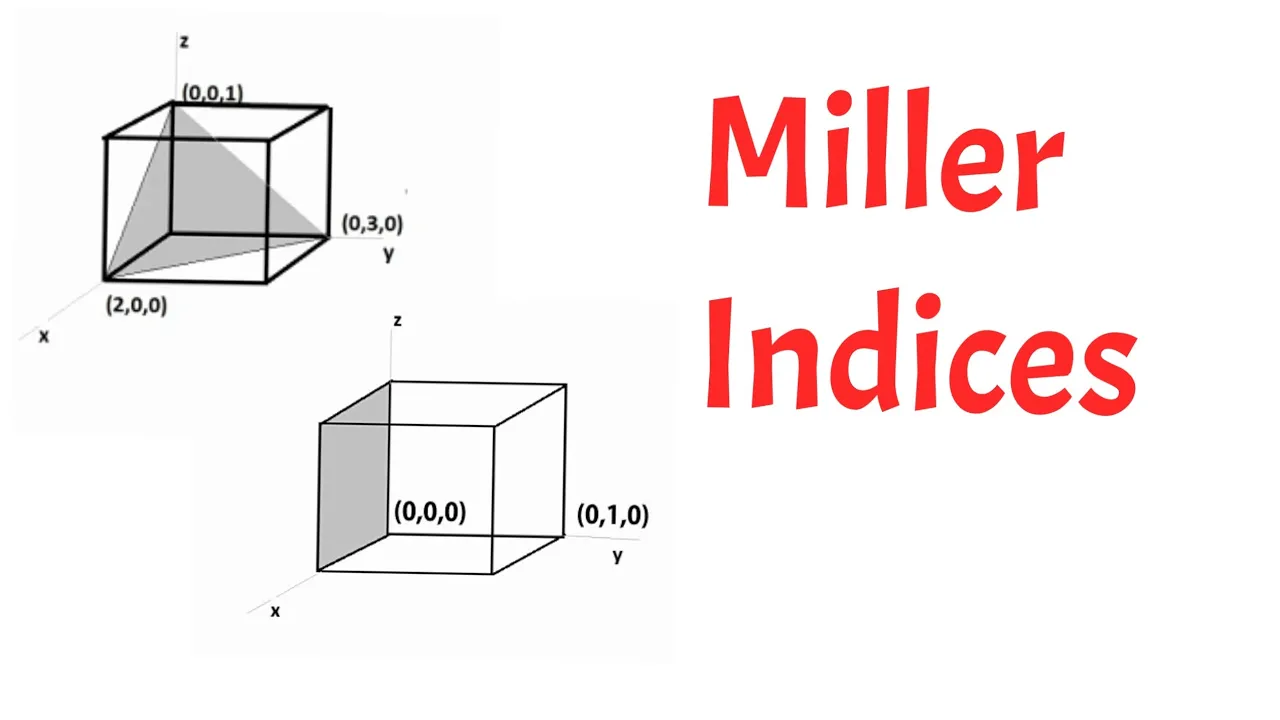
Why this video
This short, animated tutorial provides an incredibly clean, three-dimensional visualization of crystallographic planes. It details the reciprocal relationship between coordinate intercepts and Miller indices , simplifying the mathematical definition for beginners.
Knowledge Checkpoint
- Explain why crystallographic planes are defined by taking the reciprocals of axis intercepts rather than the direct values.
- Convert plane intercepts (e.g., , , ) to standard Miller Indices .
- Recognize that a plane parallel to an axis has a Miller index of for that dimension.
Why this video
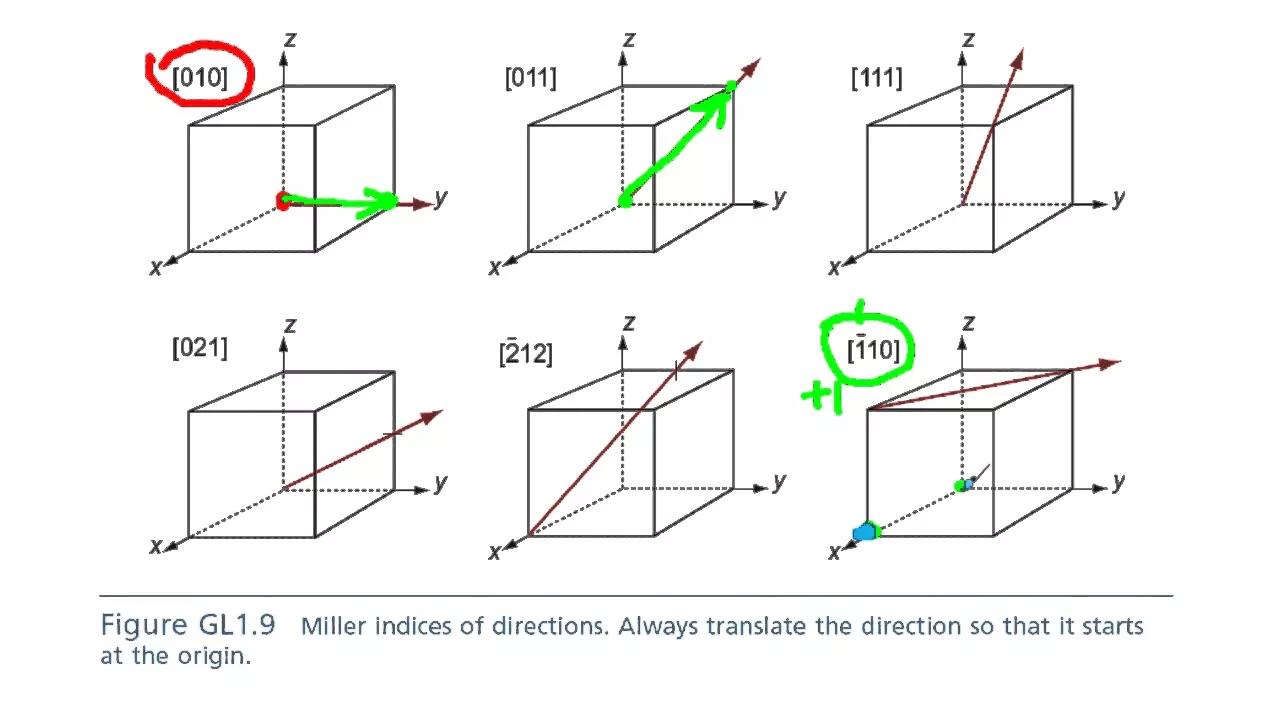
This tutorial focuses specifically on crystallographic directions rather than planes, explaining how vectors are plotted and defined using indices written in square brackets . It teaches the coordinate shift required to index directions with negative components.
Knowledge Checkpoint
- Differentiate between the notation for a specific crystal direction and a specific crystal plane .
- Determine the Miller indices of a direction vector by positioning its tail at the origin and determining its projection coordinates.
- Write negative coordinates using the standard bar notation (e.g., ).

Why this video
This MSEN course lecture from Texas A&M walks you through more complex crystal plane scenarios, focusing on shifting the origin to avoid intercepting coordinate zero, and converting fractional numbers to smallest-integer indices.
Knowledge Checkpoint
- Relocate the origin of your coordinate system when a crystallographic plane passes directly through the absolute origin.
- Apply clearance factors (multiplication) to reduce fractional reciprocals to standard integer values.
Module 3: Wave Interference and X-ray Generation
Diffraction relies on the wave properties of light. In this module, you will learn the physics of wave interference and understand how high-energy X-rays—with wavelengths comparable to interatomic distances—are generated in the laboratory.
Recommended Videos

Why this video
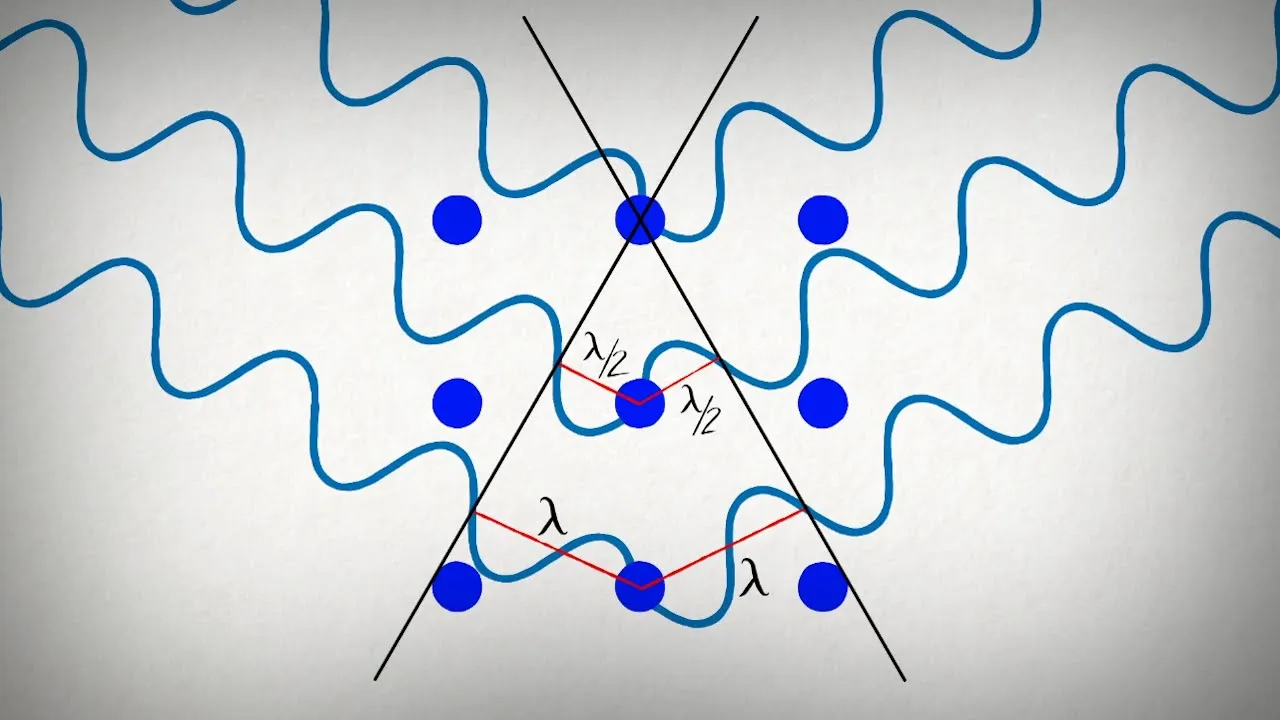
A fundamental mastery of wave optics is essential for understanding diffraction. Khan Academy provides an exceptional conceptual and mathematical derivation of wave interference, demonstrating how path differences determine whether waves constructively reinforce or destructively cancel each other.
Knowledge Checkpoint
- Define the terms "phase," "path difference," and "phase difference."
- State the mathematical criteria for constructive interference (path difference equal to ) and destructive interference (path difference equal to ).
- Explain how two waves of the same frequency can completely cancel each other out.

Why this video
This concise educational video explains how experimental X-rays are produced using vacuum tubes. It visualizes electron acceleration and distinguishes between the continuous Bremstrahlung ("braking") radiation and the sharp characteristic spectral peaks (such as ) used for XRD experiments.
Knowledge Checkpoint
- Explain how laboratory X-ray tubes generate radiation from a metal target (e.g., Copper or Tungsten).
- Compare the physical origin of Bremsstrahlung radiation with that of characteristic radiation.
- Identify which type of radiation is filtered to obtain the monochromatic X-rays needed for diffraction experiments.

Why this video
This SciShow feature delivers the historical context of X-ray diffraction. It highlights Max von Laue's 1912 discovery, illustrating how passing X-rays through a copper sulfate crystal proved both that X-rays behave as waves and that crystals are composed of highly ordered atomic lattices.
Knowledge Checkpoint
- Describe the significance of the first X-ray diffraction patterns recorded on photographic plates.
- Explain why visible light cannot resolve atomic-scale arrangements, whereas X-rays can.
Module 4: Bragg's Law and Diffraction Basics
This module introduces the mathematical foundation of X-ray crystallography: Bragg's Law (). You will derive this equation step-by-step and understand how interplanar spacing () maps to diffraction angles ().
Recommended Videos
Why this video
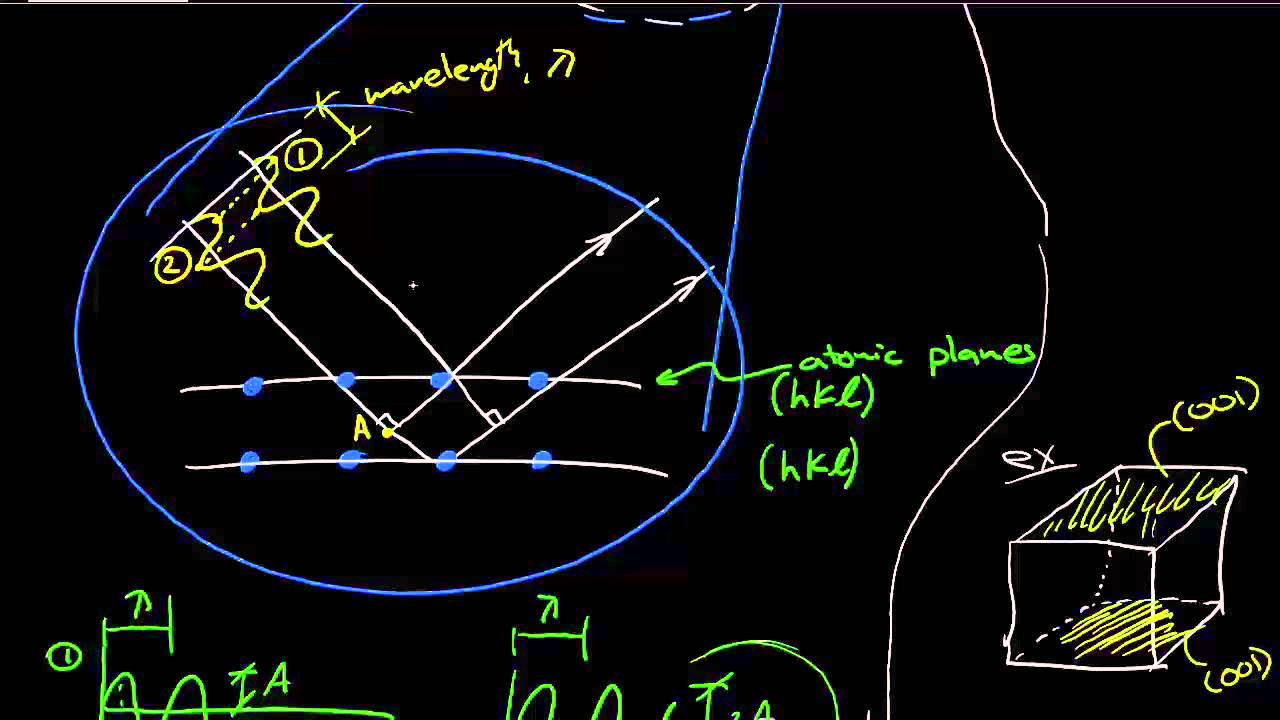
This video is a premier guide to deriving Bragg's Law. It utilizes clean geometry and trigonometry to explain why the extra distance traveled by the deeper wave reflecting off parallel atomic planes is equal to , showing exactly how this geometry yields constructive interference.
Knowledge Checkpoint
- Draw the geometric diagram of waves reflecting off two parallel planes separated by distance .
- Mathematically derive Bragg's equation using basic right-triangle trigonometry.
- Identify all variables in Bragg's equation and state their physical units.

Why this video
This advanced lecture expands Bragg's Law from simple "specular reflection" models to real three-dimensional atomic scattering. It introduces the transition from pure geometrical path differences to the complex mathematical representation of the Structure Factor, bridging the gap between simple diffraction physics and advanced crystallography.
Knowledge Checkpoint
- Explain the physical concept of atomic scattering power and how it differs from simple specular reflection.
- Understand why Bragg's Law represents a necessary—but not sufficient—condition for observing diffraction peaks in non-primitive unit cells.
Module 5: Structure Determination via XRD
This module bridges theory and laboratory application. You will learn to manually index powder diffraction patterns using the ratio method, identify selection rules caused by structure factors/systematic absences, and explore structural analysis using laboratory software.
Recommended Videos

Why this video
This tutorial resolves a critical learning gap: how to manually index a powder diffraction pattern step-by-step. It demonstrates how to combine Bragg's Law with the cubic interplanar spacing equation () to form a list of values, identify their common ratios, and determine whether a crystal is Simple Cubic, BCC, or FCC.
Knowledge Checkpoint
- State the mathematical formula for the interplanar spacing of a cubic unit cell.
- Write out the combined Bragg-Cubic equation: .
- Construct a manual indexing table from a list of peak positions () to find the common multiplier and the integer sums ().

Why this video
This video explains Structure Factors () and Systematic Absences. Using the mathematical equation , it derives why certain planes yield zero diffracted intensity in body-centered (BCC) and face-centered (FCC) crystal lattices, producing key "selection rules" used to identify lattice type.
Knowledge Checkpoint
- State the Selection Rules for diffraction in cubic crystal structures:
- Simple Cubic: All planes can diffract ()
- Body-Centered Cubic (BCC): must be even ()
- Face-Centered Cubic (FCC): must be unmixed (all odd or all even) ()
- Explain why the reflection is systematically absent in a BCC lattice (like metallic iron) even though it satisfies Bragg's Law.
Why this video
This MIT segment reinforces the calculations involved in indexing cubic phases. It demonstrates how to normalize experimental values by dividing by the smallest value in the array, and how to identify the correct integer multiplier to extract the true lattice parameter .
Knowledge Checkpoint
- Perform calculation steps to normalize a sequence of experimental diffraction peaks.
- Determine the lattice constant () of a cubic crystal from the slope of indexed peak positions.
Why this video
While powder XRD targets random polycrystalline arrays, single-crystal XRD isolates a single domain rotated through three-dimensional space. This Bruker animation shows how single-crystal diffractometers record full reciprocal space datasets to map electron densities and solve complex molecular structures.
Knowledge Checkpoint
- Contrast powder XRD (polycrystalline averages as cones of diffraction) with single-crystal XRD (discrete reciprocal space spots).
- Explain how a crystal acts as a 3D diffraction grating to scatter X-rays.
Course Map
Key People Index
- Wilhelm Röntgen (1845–1923): Discovered X-rays in 1895. He observed that high-voltage electrical discharges produced unknown rays that could pass through solid objects and capture skeletal images. This discovery earned him the first Nobel Prize in Physics in 1901.
- Max von Laue (1879–1960): Discovered X-ray diffraction in crystals in 1912. He realized that if crystal lattices are periodic, their interatomic spacings should match X-ray wavelengths, causing crystals to act as 3D diffraction gratings. He won the 1914 Nobel Prize in Physics.
- William Henry Bragg (1862–1942) & William Lawrence Bragg (1890–1971): The father-and-son team who developed X-ray crystallography as a practical tool for molecular structure determination. In 1913, Lawrence Bragg derived the famous Bragg's Law (). They shared the 1915 Nobel Prize in Physics; Lawrence remains the youngest-ever physics laureate.
- Auguste Bravais (1811–1863): A French physicist and mineralogist who proved mathematically in 1850 that there are exactly 14 unique ways to distribute repeating points periodically in 3D space with translational symmetry—known today as the 14 Bravais Lattices.
Final Self-Assessment
Test your mastery of solid-state chemistry and crystallography with the following checklist. You should be able to solve these problems confidently before declaring this curriculum completed:
- Structural Classifications: I can explain the structural and thermodynamic differences between crystalline and amorphous solids, using properties like melting points and anisotropy.
- Symmetry Operations: I can identify the 7 crystal systems and explain how combining them with Bravais centerings produces exactly 14 Bravais lattices in three dimensions.
- Crystallographic Coordinates: Given a graphic representation of a cubic unit cell, I can write the correct Miller Indices for crystallographic directions and planes , including handling negative values with bar notation.
- Wave Physics: I can explain why phase difference and path length difference dictate whether two overlapping electromagnetic waves will exhibit constructive or destructive interference.
- Laboratory Generation: I can explain how characteristic and X-rays are produced via electronic transitions when high-energy cathode electrons strike a metal target.
- Bragg's Derivation: I can derive Bragg's Law () from scratch using a geometric path-difference diagram and trigonometry.
- Systematic Absences: I can write out the structural factor selection rules for Simple Cubic, Body-Centered Cubic (BCC), and Face-Centered Cubic (FCC) structures, and explain why certain planes do not yield diffraction peaks.
- Analytical Indexing: Given a list of peak positions () from a powder XRD experiment using a known wavelength (), I can construct a table of , calculate their ratios, determine the cubic lattice type, and compute the lattice parameter ().
- Method Contrast: I can explain the physical difference between powder XRD and single-crystal XRD techniques, explaining why one yields concentric cones of diffraction and the other produces individual reciprocal space spots.