Macroeconomics: Keynes, Monetarism & Austrian
Learning Goal: Compare the core theoretical frameworks of major schools of macroeconomic thought—specifically Keynesian, Classical, Monetarist, and Austrian economics—regarding business cycles and stabilization policy.
- Prerequisites: Basic understanding of high-school-level economic concepts (e.g., supply, demand, and markets).
- Estimated Total Study Time: 12 hours
Module 1: Foundations of Macroeconomics & The Business Cycle
This foundational module introduces the primary indicators used to measure the health of a national economy—Gross Domestic Product (GDP), inflation, and unemployment. It also introduces the basic mechanics of how an economy naturally fluctuates through the phases of expansion and recession using the Aggregate Demand and Aggregate Supply (AD-AS) framework.
Why this video: This video provides an exceptionally clear, highly produced overview of the big three macroeconomic indicators: GDP, unemployment, and inflation. It establishes the common vocabulary that all macroeconomic schools of thought use to debate policy.
Why this video: This segment offers a clean, foundational breakdown of the classic business cycle. It explains the typical phases an economy transitions through: peak, contraction (recession), trough, and expansion, showing how these fluctuations are defined.

Why this video: Before comparing how different economic schools view market corrections, you must understand the basic Aggregate Demand (AD) and Aggregate Supply (AS) model. This video walks through the curves and their determinants, setting up the standard framework for the upcoming policy debates.
Knowledge Checkpoint
- Define the three major macroeconomic indicators: GDP, inflation, and unemployment.
- List and describe the four distinct phases of the business cycle.
- Explain why the Aggregate Demand curve slopes downward and what factors can cause it to shift.
Module 2: Classical Economics & The Self-Correcting Market
The Classical school of economics, emerging from Adam Smith and formalizing in the 19th century, holds that free markets are inherently stable and self-correcting. This module explores how Classical thinkers view recessions as temporary imbalances and why they argue that wages, prices, and interest rates will naturally adjust to restore full employment without government intervention.

Why this video: This video explains Say’s Law of Markets ("supply creates its own demand"), a foundational pillar of Classical macroeconomics. Understanding Say's Law is crucial because it leads to the Classical conclusion that general overproduction or prolonged involuntary unemployment is theoretically impossible in a free market.
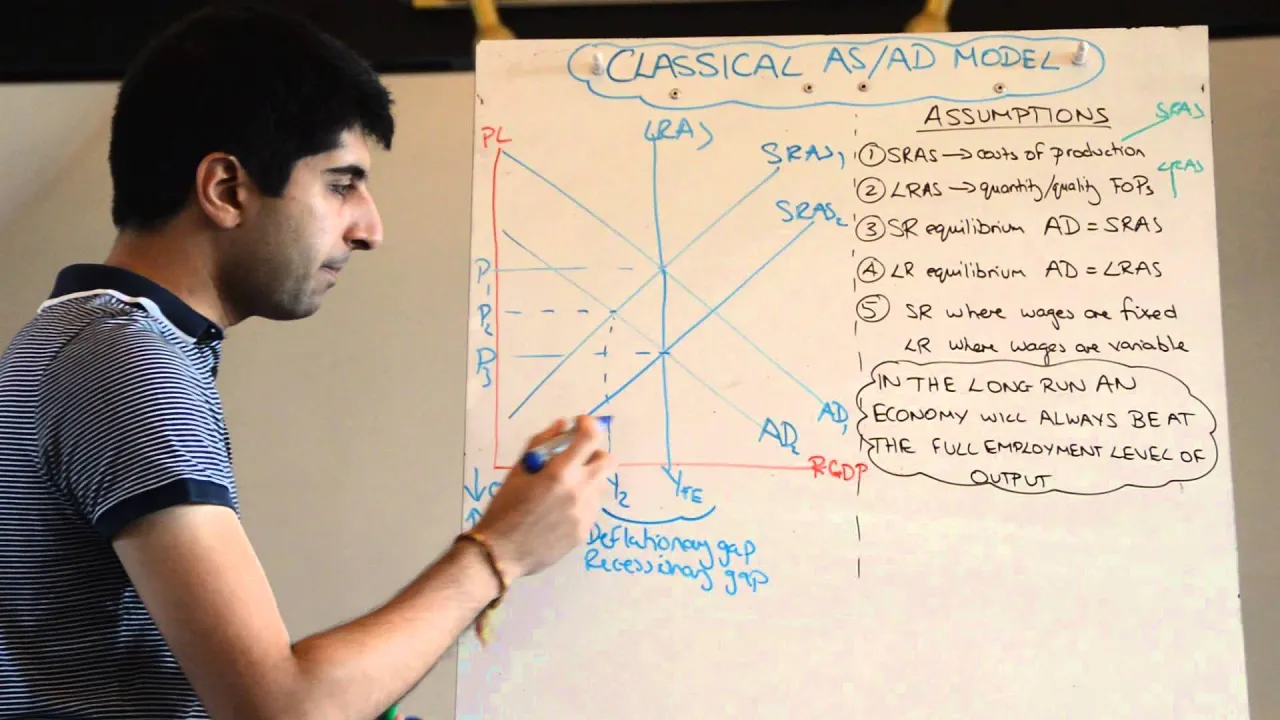
Why this video: This video visually demonstrates the self-correction mechanism using the AS/AD model. It shows how, in the Classical view, a drop in demand triggers price and wage drops, naturally shifting the short-run aggregate supply (SRAS) curve to the right and returning the economy to its long-run full employment equilibrium.
Why this video: This video contrasts Classical assumptions with Keynesian ideas, clarifying the key Classical beliefs: flexible wages and prices, laissez-faire policy, and the neutrality of money in the long run.
Knowledge Checkpoint
- Explain J.B. Say's core assertion that "supply creates its own demand" and its implications for recessions.
- Describe the automatic adjustment process that occurs when Aggregate Demand falls in a Classical model.
- Why do Classical economists advocate for a laissez-faire policy stance during economic downturns?
Module 3: Keynesian Economics & Fiscal Stabilization Policy
Formulated by John Maynard Keynes during the Great Depression, Keynesian economics challenged the Classical self-correction model. This module covers why Keynes believed wages and prices are "sticky" (resistant to falling), how "animal spirits" drive aggregate demand volatility, and why government must step in during recessions with expansionary fiscal policy.

Why this video: To understand Keynes, one must understand the economic devastation of the Great Depression. This video tracks how the prolonged 25% unemployment rate challenged Classical assumptions, creating the historical opening for Keynes’s theory of demand-side management.
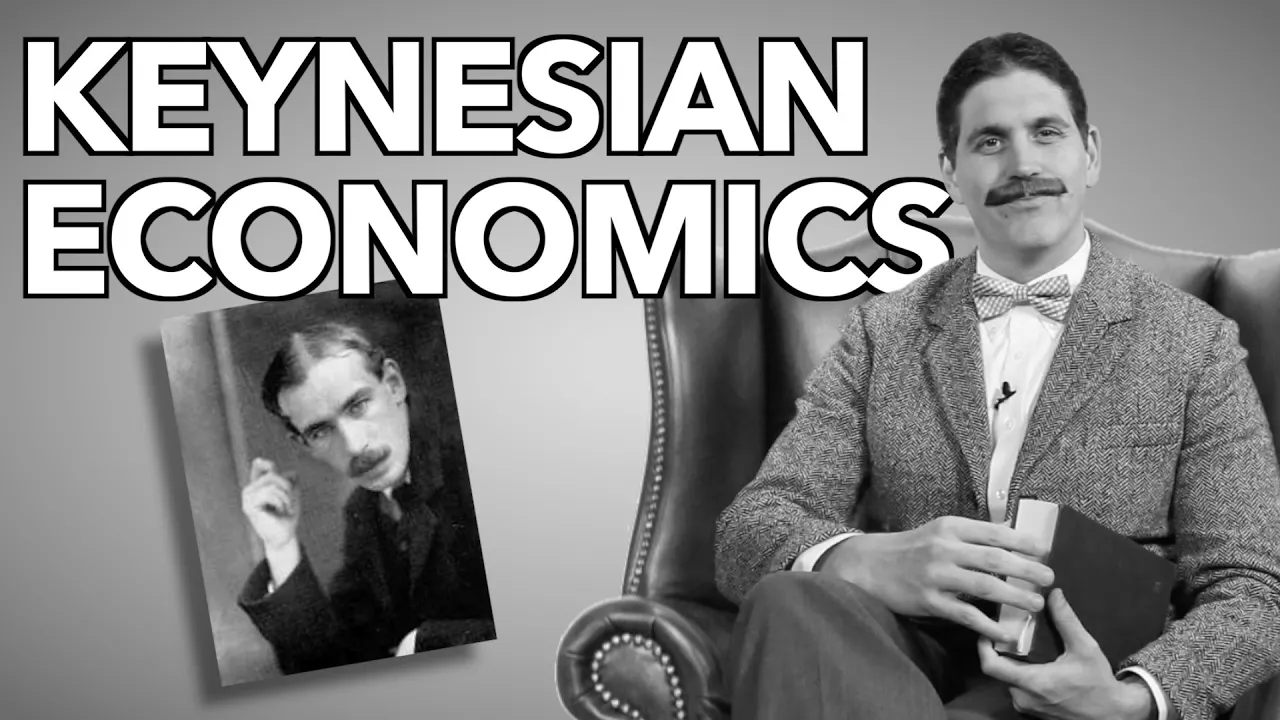
Why this video: Jacob Clifford delivers a clear breakdown of the Keynesian policy playbook. He explains why Keynesians believe the government should run budget deficits to stimulate the economy, demonstrating how government spending offsets drops in private consumption and investment.
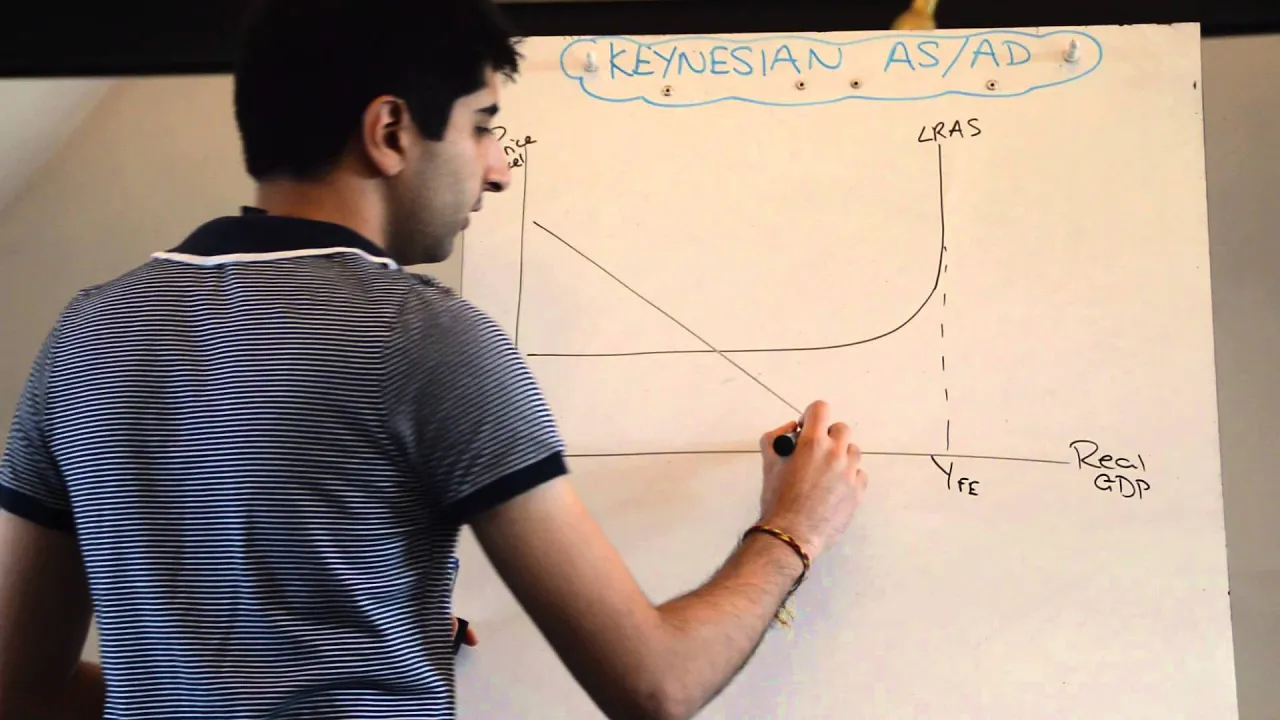
Why this video: This video introduces the Keynesian Aggregate Supply curve. Unlike the vertical Classical supply curve, the Keynesian supply curve has a flat, horizontal section, illustrating why demand shocks can lead to persistent recessions without causing price deflation.
Knowledge Checkpoint
- Define "sticky wages and prices" and explain why they prevent the Classical self-correction mechanism from operating in the short run.
- Explain how the Keynesian multiplier amplifies an initial injection of government spending.
- Outline the discretionary fiscal policy tools a Keynesian would recommend to resolve a recessionary gap.
Module 4: Monetarism & The Critical Role of Money Supply
Led by Milton Friedman, Monetarism arose in the mid-20th century as a critique of Keynesian discretionary fiscal policy. This school focuses on the money supply as the primary driver of both inflation and economic cycles. This module breaks down the Quantity Theory of Money, the causes of 1970s stagflation, and why Monetarists prefer predictable monetary rules over active policy intervention.
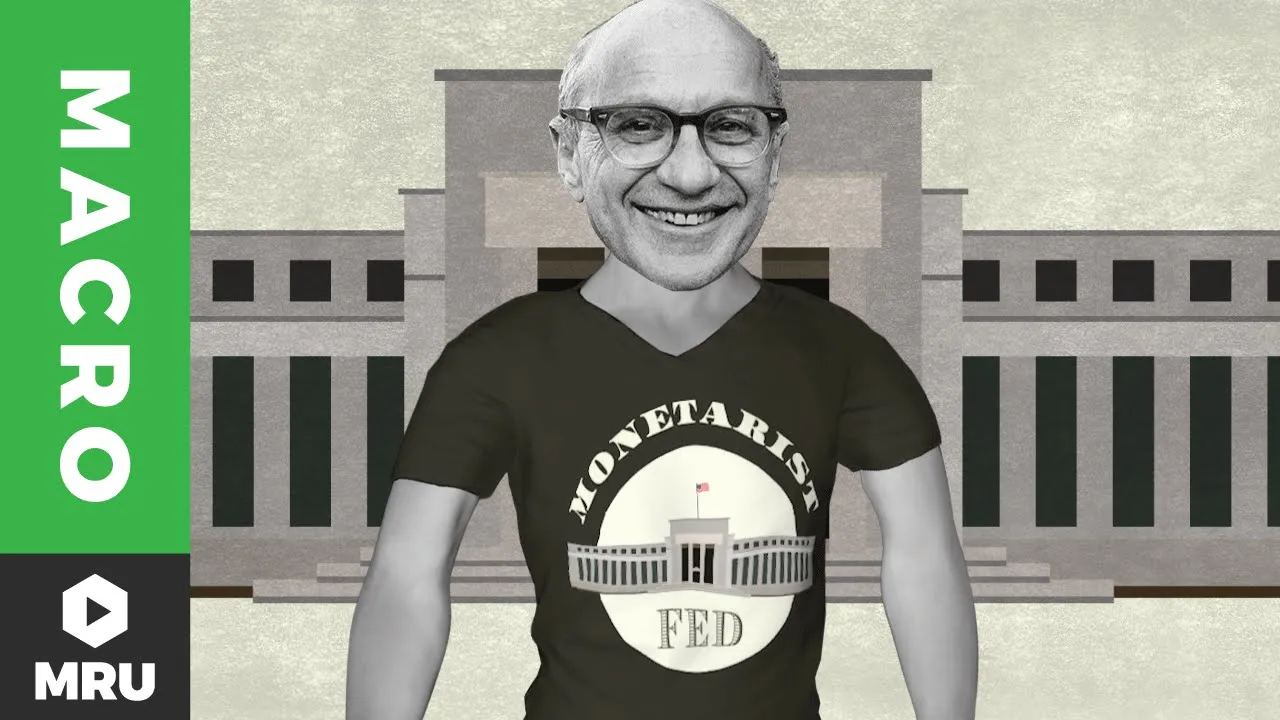
Why this video: Part of MRU's "Game of Theories" series, this video provides a highly engaging explanation of Milton Friedman’s ideas. It explains how central bank missteps in managing the money supply—rather than inherent market instability—can turn mild downturns into depressions.

Why this video: This video breaks down the mathematical foundation of Monetarism: the Quantity Equation (). It uses clear animations to show how changes in the money supply () directly influence the price level () under the assumption of stable velocity () and long-run real output ().

Why this video: This video directly addresses a key historical critique of Keynesianism: Milton Friedman's challenge to the Phillips Curve. It explains why the trade-off between inflation and unemployment exists only in the short run (due to worker "money illusion"), and why the long-run Phillips Curve is vertical at the Natural Rate of Unemployment.
Knowledge Checkpoint
- State the Quantity Theory of Money formula () and explain what each variable represents.
- Explain why Milton Friedman argued that "inflation is always and everywhere a monetary phenomenon."
- Define the Natural Rate of Unemployment (NAIRU) and explain why expansionary monetary policy cannot keep unemployment artificially low in the long run.
Module 5: Austrian Economics & Austrian Business Cycle Theory
The Austrian School, featuring Ludwig von Mises and F.A. Hayek, offers a unique microeconomic perspective on macroeconomic cycles. Rejecting aggregate mathematical models, Austrians focus on individual action, the price system as a coordinator of knowledge, and how central bank interest rate manipulation distorts investment, causing unsustainable booms and inevitable busts.
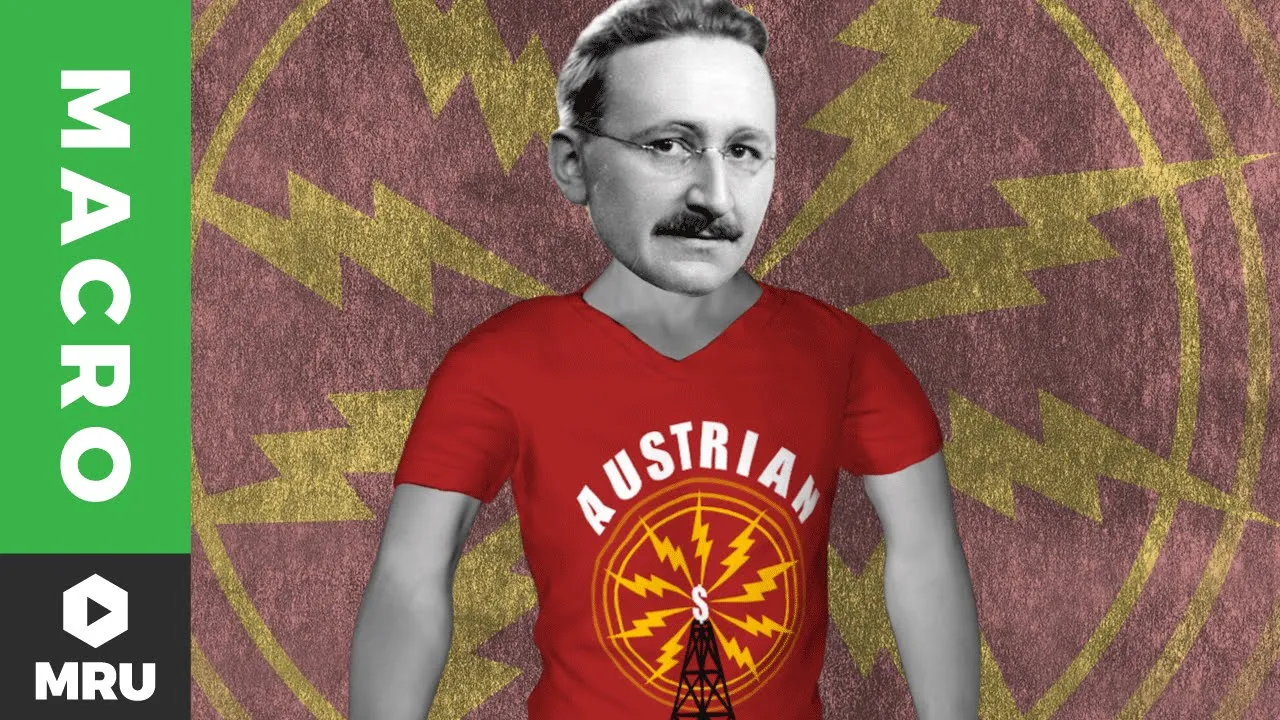
Why this video: This video introduces the Austrian School's distinct view on economic cycles. It explains how central bank decisions to keep interest rates artificially low mislead businesses, resulting in "malinvestment" (investing in projects that are not actually viable in the long run).

Why this video: This short video provides a concise explanation of how artificial interest rate manipulation leads to asset bubbles. It shows how lowering interest rates distorts price signals, leading to over-investment in specific sectors (like real estate) that inevitably crashes when rates normalize.

Why this video: This video explains F.A. Hayek's concept of the price system as a coordination network. It explains why prices are critical for communicating localized knowledge about resource scarcity, and how manipulating interest rates (which are simply the "price" of loanable funds) destabilizes this communication network.
Knowledge Checkpoint
- Define "malinvestment" and explain how it differs from simple over-investment.
- Describe the step-by-step mechanism of the Austrian Business Cycle Theory (ABCT), starting from central bank credit expansion to the eventual crash.
- Explain F.A. Hayek's "knowledge problem" and why it makes centralized interest rate setting inefficient.
Module 6: Comparative Analysis & Policy Debates
This synthesis module brings all four schools of thought together. By reviewing historical and creative debates, you will contrast how Classical, Keynesian, Monetarist, and Austrian economists diagnose the causes of recessions and prescribe stabilization or non-intervention strategies.
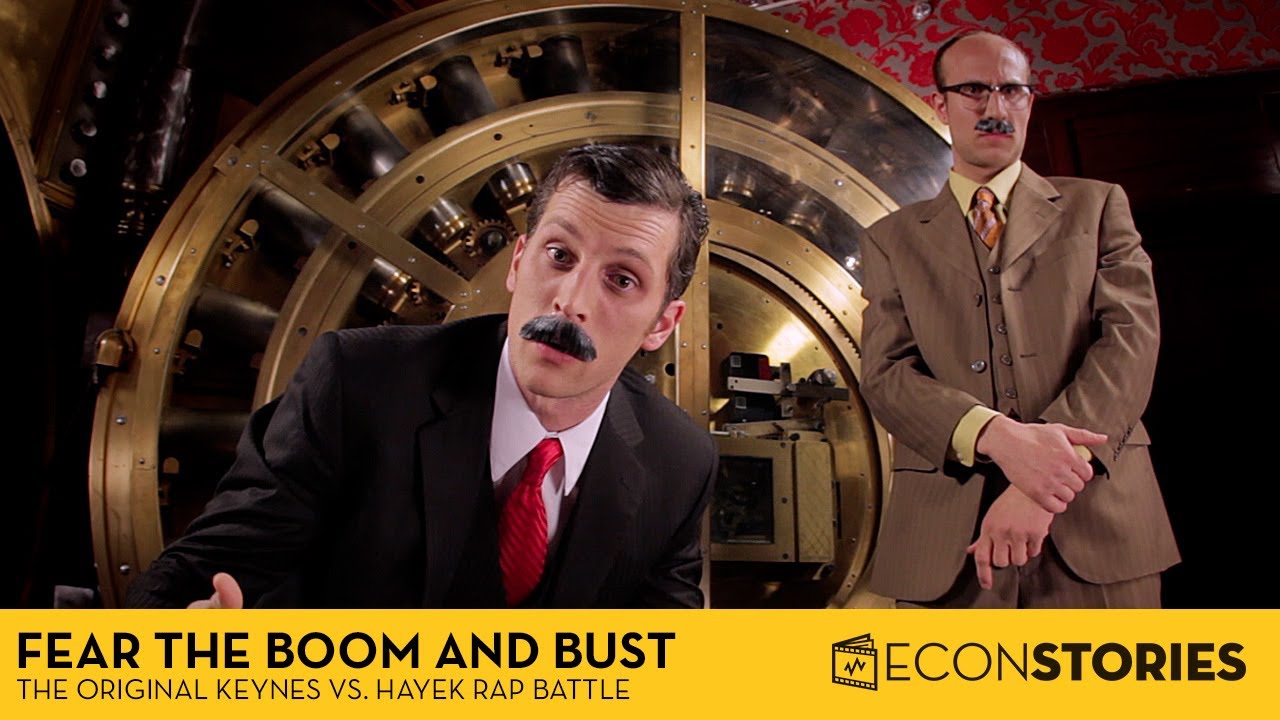
Why this video: This famous rap battle is more than entertainment; it is an incredibly accurate, academic summary of the core disagreements between John Maynard Keynes and F.A. Hayek. It contrasts the Keynesian focus on circular flow and demand-side stimulus with the Austrian focus on credit expansion and structural capital alignment.

Why this video: The sequel to the original rap battle shifts focus to the recovery process. It addresses whether a government should implement stimulus packages to alleviate short-term pain (Keynes) or step aside to let structural malinvestments liquidate (Hayek).

Why this video: This video provides a structured academic summary of the major schools of economics. It serves as an excellent final synthesis, laying out the core differences in methodology, core models, and policy positions of each group.
Knowledge Checkpoint
- Create a matrix comparing Classical, Keynesian, Monetarist, and Austrian schools across four dimensions: Cause of Recessions, Role of Government, Preferred Policy Tool, and View on Inflation.
- Explain the fundamental debate between Keynesians and Austrians regarding whether a government should prevent the liquidation of failing firms during a recession.
- Contrast the Monetarist "monetary rule" (growing the money supply at a fixed rate) with the Keynesian preference for discretionary interest rate adjustments.
Course Map
This map outlines the recommended progression through the modules. While Modules 3, 4, and 5 can theoretically be studied in any order once Module 1 and 2 are mastered, the sequence below mirrors the historical development of macroeconomic theory.
Key People Index
- Adam Smith (1723–1790): The pioneer of political economy. Smith formulated the "invisible hand" concept, establishing the foundation of Classical economics. He argued that rational self-interest in free markets leads to economic prosperity.
- Jean-Baptiste Say (1767–1832): A Classical French economist famous for Say's Law ("supply creates its own demand"). He argued that aggregate production naturally creates an equivalent amount of purchasing power.
- John Maynard Keynes (1883–1946): A British economist whose book The General Theory of Employment, Interest, and Money revolutionized macroeconomics. Keynes advocated for government intervention and discretionary fiscal policy to manage demand and stabilize cycles.
- Milton Friedman (1912–2006): An American economist and leader of the Chicago School of Economics. Friedman revitalized Monetarism, arguing that changes in the money supply are the primary driver of inflation and short-run economic fluctuations.
- Friedrich A. Hayek (1899–1992): An Austrian-British economist and co-recipient of the Nobel Prize. Hayek was Keynes's primary intellectual opponent. He defended the price system and developed the Austrian Business Cycle Theory based on capital structure and credit expansion.
- Ludwig von Mises (1881–1973): A key figure in the Austrian School who formalized "praxeology" (the study of human action) and argued that credit expansion by central banks is the fundamental root of boom-and-bust cycles.
Final Self-Assessment
Complete this comprehensive self-assessment to verify your mastery of the curriculum's learning goals.
- I can define the core macroeconomic indicators (GDP, CPI inflation, and unemployment) and explain how they behave during expansions and recessions.
- I can explain Say's Law and describe how Classical economists use flexible wages and prices to prove the economy is self-correcting in the long run.
- I can describe the Keynesian concept of "sticky wages and prices" and explain how they can trap an economy in a persistent recessionary gap.
- I can calculate the theoretical impact of expansionary fiscal policy using the Keynesian multiplier formula.
- I can write the Quantity Theory of Money equation () and explain the Monetarist view on how money supply growth leads directly to price inflation.
- I can explain why the short-run Phillips Curve trade-off between inflation and unemployment breaks down in the long run according to the natural rate hypothesis.
- I can outline the mechanism of the Austrian Business Cycle Theory, explaining how artificial credit expansion leads to malinvestment and a subsequent crash.
- I can explain Friedrich Hayek's "knowledge problem" and why Austrian economists reject central bank manipulation of interest rates.
- I can compare and contrast the stabilization policies of all four schools: Keynesian (discretionary fiscal policy), Monetarist (strict monetary rule-following), Classical (laissez-faire), and Austrian (allowing market liquidations and abolishing central banking).