Testing Sapir-Whorf: Color, Space & Gender
Learning Goal: Evaluate the empirical evidence for the Sapir-Whorf hypothesis by analyzing cross-linguistic studies on color categorization, spatial orientation, grammatical gender, and numerical cognition.
- Estimated Total Study Time: 12 hours
- Prerequisites: None (Introductory linguistics or cognitive science is helpful but not required).
Module 1: Foundations of Language and Thought
This module introduces the historical roots of linguistic relativity—the Sapir-Whorf hypothesis. You will learn to clearly distinguish between linguistic determinism (the "strong" version, which claims language restricts or dictates thought) and linguistic relativity (the "weak" version, which proposes that language shapes cognitive habits and attention).
Recommended Videos

- Why this video: This introductory video provides an exceptionally clear distinction between the strong (deterministic) and weak (relativistic) versions of the Sapir-Whorf hypothesis. It uses visual storytelling to ground complex theoretical claims in real-world examples, offering a baseline for evaluating empirical work in later modules.

- Why this video: Understanding linguistic relativity requires comparing it with opposing cognitive theories. This video situates Whorfianism alongside other prominent models of language and thought, such as Piaget's cognitive development theory, Chomsky's universalist/innatist perspective, and Vygotsky's social development theory.

- Why this video: This high-production BBC explainer bridges historical theory and initial contemporary studies. It reviews how different languages compartmentalize universal physical concepts and prompts you to consider the active debate over cognitive limits.
Knowledge Checkpoint
- Define the core difference between the strong (determinism) and weak (relativity) versions of the Sapir-Whorf hypothesis.
- Identify which cognitive model argues that thought completely determines language (e.g., Piaget's perspective) versus the model that claims language determines thought.
- Explain why early absolute claims (like the popular misconception that Hopi speakers have no concept of time) were later debunked or refined.
Module 2: Color Categorization and Perception
One of the most heavily researched arenas of linguistic relativity is color perception. Human eyes share identical physiological structures, yet different languages segment the color spectrum in radically different ways. This module contrasts universalist theories (specifically Berlin and Kay's evolutionary stages of basic color terms) with relativist findings (such as the Russian "blues" experiment and the Himba tribe's green/blue color boundaries).
Recommended Videos

- Why this video: This video introduces Brent Berlin and Paul Kay's seminal 1969 study on basic color terms. It explains how color vocabulary evolves across cultures in a highly predictable, universalist sequence of seven stages (e.g., starting with dark/light, then adding red, followed by green or yellow).
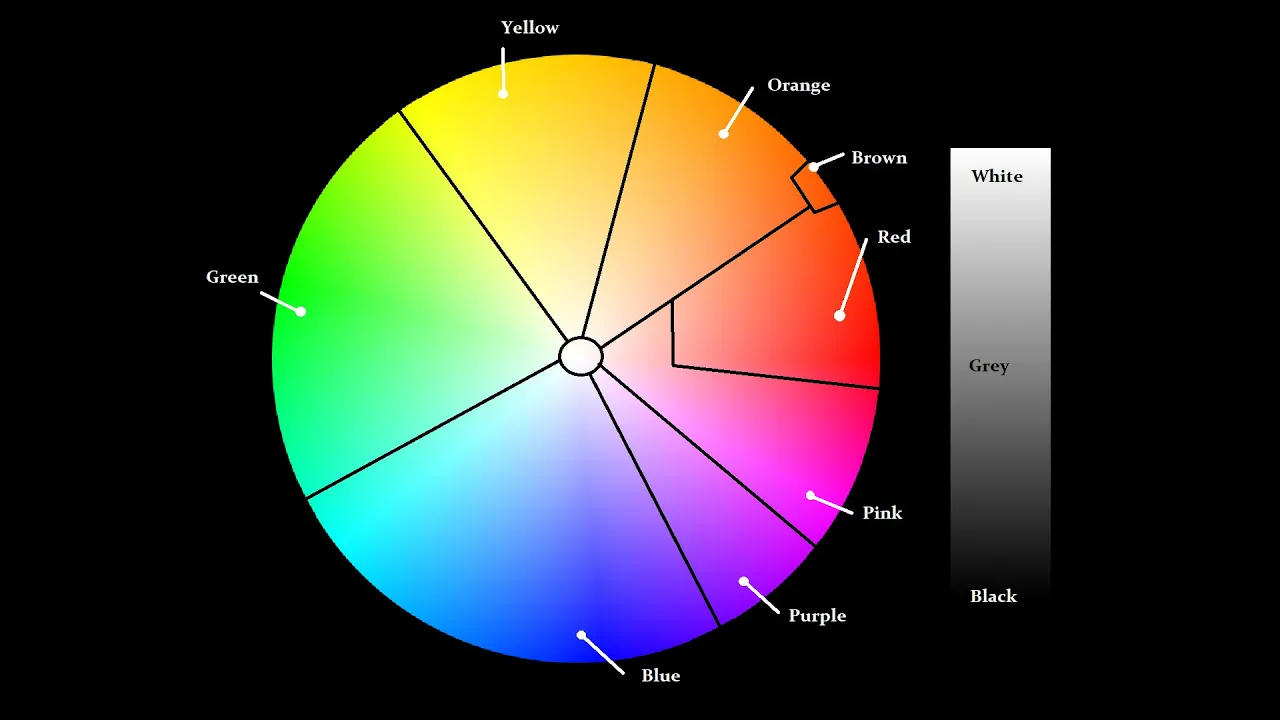
- Why this video: This concise guide offers a quick structural reference for Berlin and Kay's developmental hierarchy of colors, serving as an excellent visual cheat sheet for understanding how terms progress from basic light/dark boundaries up to eleventh-stage colors.

- Why this video: This brief but high-impact video highlights the landmark 2006 "Russian Blues" experiment. It demonstrates that Russian speakers, who use separate lexical categories for light blue (goluboy) and dark blue (siniy), display faster reaction times when discriminating colors across this linguistic boundary compared to English speakers who group them under a single term ("blue").

- Why this video: This segment details Jules Davidoff's famous experiment with the Himba tribe of Namibia. Because the Himba language categorizes colors differently—using single terms to cover shades of green and blue that English speakers distinguish—the video visualizes how their speed in detecting color anomalies changes based on their native vocabulary boundaries.
Knowledge Checkpoint
- List the first three universal stages of basic color term evolution according to Berlin and Kay's 1969 theory.
- Describe the methodology and cognitive outcomes of the 2006 Russian Blues categorization experiment.
- Explain how different color boundaries (like those of the Himba or Berinmo) affect discrimination speeds in visual search tasks.
Module 3: Spatial Cognition and Numerical Estimation
Do languages shape our physical orientation in the world? This module looks at spatial reference systems, contrasting egocentric (relative: left, right, front) and allocentric (absolute: north, south, east) linguistic frameworks. We will study how speaker groups like the Guugu Yimithirr navigate using constant cardinal orientation. Additionally, we expand our view of linguistic constraints by analyzing how a lack of exact number terms (as in the Pirahã tribe) impacts mathematical estimation and memory.
Recommended Videos

- Why this video: This student-led talk provides an incredibly accessible introduction to how absolute spatial reference frames function in real-world contexts, focusing on the Kuuk Thaayorre community. It details how speaking a language without "left" or "right" results in an extraordinary cognitive capacity for dead reckoning.

- Why this video: This video offers a visual explanation of spatial cognition research comparing Dutch children (who use relative spatial frames) with children from indigenous Namibian tribes. It details the exact experiments used to test how physical orientation tasks are processed based on spatial language structures.

- Why this video: Cognitive scientist Lera Boroditsky outlines how the Australian Aboriginal language Guugu Yimithirr relies completely on absolute coordinates. This presentation connects linguistic requirements (always knowing where magnetic north is to speak grammatically) directly to enhanced spatial reasoning.

- Why this video: To expand on non-linguistic domains, this video examines the Pirahã tribe of the Amazon. Lacking precise numerals (having words only for "few," "some," or "many"), their system illustrates how language affects the ability to track, recall, and match exact mathematical quantities.
Knowledge Checkpoint
- Differentiate between an egocentric (relative) reference frame and an allocentric (absolute) reference frame.
- Explain how a speaker of Guugu Yimithirr or Kuuk Thaayorre would describe an object sitting on a table relative to their body.
- Outline the cognitive performance differences in exact quantity-matching tasks between speakers of languages with infinite counting terms and speakers of "one-two-many" languages (like the Pirahã).
Module 4: Grammatical Gender and Object Association
Does treating a table as masculine or a key as feminine alter how speakers perceive those inanimate objects? This module looks at the cognitive consequences of grammatical gender assignments. We will review Lera Boroditsky’s classic "key and bridge" association studies, while critically evaluating replication challenges and alternative linguistic explanations.
Recommended Videos

- Why this video: This TEDx talk reviews the classic gender association studies (e.g., German speakers describing a "key" as hard, heavy, and metallic, versus Spanish speakers describing it as golden, lovely, and little). It introduces how grammatical systems may skew everyday perception.

- Why this video: This video provides crucial scholarly balance by critiquing Boroditsky, Schmidt, and Phillips’ famous grammatical gender study. It reveals that the key and bridge experiment was not published in peer-reviewed journals in the format often cited, prompting a rigorous evaluation of the methodology.

- Why this video: This international segment outlines the cognitive shifts bilinguals experience when switching between a gendered language (like Spanish or German) and a non-gendered language (like English), illustrating how shifting linguistic contexts can alter object descriptions in real time.
Knowledge Checkpoint
- Explain how grammatical gender systems differ from biological gender categorizations in linguistics.
- Recall the adjectives typically associated with keys and bridges by German versus Spanish speakers in classic relativity experiments.
- Formulate at least two key methodological critiques of early grammatical gender/object association studies.
Module 5: The Modern Scientific Consensus
This module synthesizes the theoretical extremes to establish where modern cognitive science stands on neo-Whorfianism. You will study Dan Slobin's "thinking-for-speaking" hypothesis and analyze why modern consensus favors a middle ground: language does not trap our thoughts, but it serves as an active lens that biases our attention, memory retrieval, and reaction times.
Recommended Videos

- Why this video: This video introduces a multi-dimensional approach to neo-Whorfianism, breaking down how researchers study effect strength, cognitive domains, and task difficulty. It also reframes Whorf's original work within its historical, anti-racist linguistic framework.

- Why this video: This clip introduces Dan Slobin’s influential "thinking-for-speaking" hypothesis. Slobin proposes that language's real cognitive footprint occurs at the moment of communication, forcing us to quickly categorize reality into schemas required by our grammar.

- Why this video: This brief podcast overview summarizes the modern scientific consensus: language is not a prison that limits our thoughts, but a set of cognitive habits and biases that shape attention and prioritization.

- Why this video: Renowned linguist John McWhorter presents the counter-argument to neo-Whorfianism, explaining that minor differences in perception tasks (like those of Russian blue speakers) do not point to fundamentally different internal worlds.
Knowledge Checkpoint
- Explain Dan Slobin’s "thinking-for-speaking" hypothesis and how it differs from strong linguistic determinism.
- State the current consensus in modern cognitive science regarding the strength and limits of language's effect on non-linguistic thought.
- Summarize John McWhorter's primary arguments against treating linguistic variation as evidence of different mental realities.
Course Map
Key People Index
- Edward Sapir & Benjamin Lee Whorf: Formulated the foundational hypothesis that language structure influences or determines human thought patterns and worldviews.
- Brent Berlin & Paul Kay: Proposed the universalist evolutionary sequence of basic color terms (1969), showing that color lexicons develop through structured, cross-linguistic stages.
- Lera Boroditsky: A prominent contemporary cognitive scientist whose research on grammatical gender, absolute spatial systems, and temporal frameworks supports the weak version of linguistic relativity (neo-Whorfianism).
- Dan Slobin: Created the "thinking-for-speaking" hypothesis, proposing that language forces speakers to attend to specific details during linguistic encoding rather than permanently limiting general thought.
- John McWhorter: A leading linguist and public intellectual who argues against strong neo-Whorfianism, emphasizing that human cognitive worlds remain fundamentally shared regardless of grammar.
Final Self-Assessment
Perform a self-evaluation of your understanding of linguistic relativity by checking off your mastery of these core learning targets:
- I can clearly explain the difference between linguistic determinism (strong) and linguistic relativity (weak).
- I can detail Berlin and Kay's evolutionary color sequence stages and describe how a stage-one language differs from a stage-seven language.
- I can describe the cognitive mechanisms that allow Russian speakers to solve light-blue/dark-blue discrimination tasks faster than English speakers.
- I can explain the experimental differences between egocentric and allocentric spatial reference frames using a physical layout task.
- I can explain how the grammatical gender of nouns (e.g., die Brücke in German vs. el puente in Spanish) can influence the descriptive adjectives chosen by bilingual speakers.
- I can outline the methodological flaws and replication difficulties associated with early gender-association experiments.
- I can explain how the Pirahã's numerical system limits or shapes exact mathematical estimation tasks without indicating any structural brain deficits.
- I can define Slobin's "thinking-for-speaking" hypothesis and explain why it represents a middle ground in cognitive science.
- I can defend a balanced, modern scientific stance on how language actively directs attention, memory, and cognitive habits without acting as an absolute limit on thought.