Existentialism: Meaning, Absurdity & Ethics
Learning Goal: Analyze the existentialist response to the crisis of meaning, focusing on Kierkegaard’s leap of faith, Sartre’s concept of bad faith, Camus’s philosophy of the absurd, and Simone de Beauvoir’s ethics of ambiguity.
- Prerequisites: None (A general familiarity with modern European history is helpful but not required).
- Estimated Total Study Time: 12 Hours
Module 1: Introduction to Existentialism & The Crisis of Meaning
This module establishes the historical and philosophical origins of existentialism. It traces the disintegration of traditional religious and rationalist frameworks during the 19th and 20th centuries, exploring how the collapse of absolute truths led to the "crisis of meaning" and the rise of nihilism.

- Why this video: Dr. Wes Cecil provides a comprehensive historical and structural look at how nihilism emerged as a response to the breakdown of traditional Western cultural assumptions. He bridges the gap between historical developments (the Renaissance, Enlightenment, and industrialization) and the profound existential dread that followed, setting up the perfect backdrop for understanding the necessity of existentialist philosophy.

- Why this video: This academic lecture details the formal transition from systematic, highly abstract Enlightenment rationalism to the concrete, lived-experience-focused rebellion that defined existentialism. It helps students understand why existentialists rejected armchair philosophy in favor of passionate individual involvement in life.

- Why this video: A rigorous academic lecture from the Indian Institute of Technology (IIT) outlining the core coordinates of existential philosophy. It introduces foundational themes such as the primacy of concrete human existence over abstract universal concepts, laying the groundwork for the modules on Sartre, Camus, and Beauvoir.
Module 1 Knowledge Checkpoint
- Understand the historical shift from the search for objective cosmic meaning to the recognition of subjective human existence.
- Explain the relationship between the decline of traditional religious frameworks ("the death of God") and the rise of nihilism.
- Define the core premise of existentialism: prioritizing the "lived experience" of the thinking, feeling, and acting individual over abstract systematic theories.
Module 2: Kierkegaard’s Leap of Faith
This module investigates Søren Kierkegaard’s religious response to the existential crisis. We will explore his critique of objective certainty, his analysis of anxiety (dread) as the "dizziness of freedom," and how his concept of the "leap of faith" and the "Knight of Faith" addresses the fundamental limitations of rational thought.
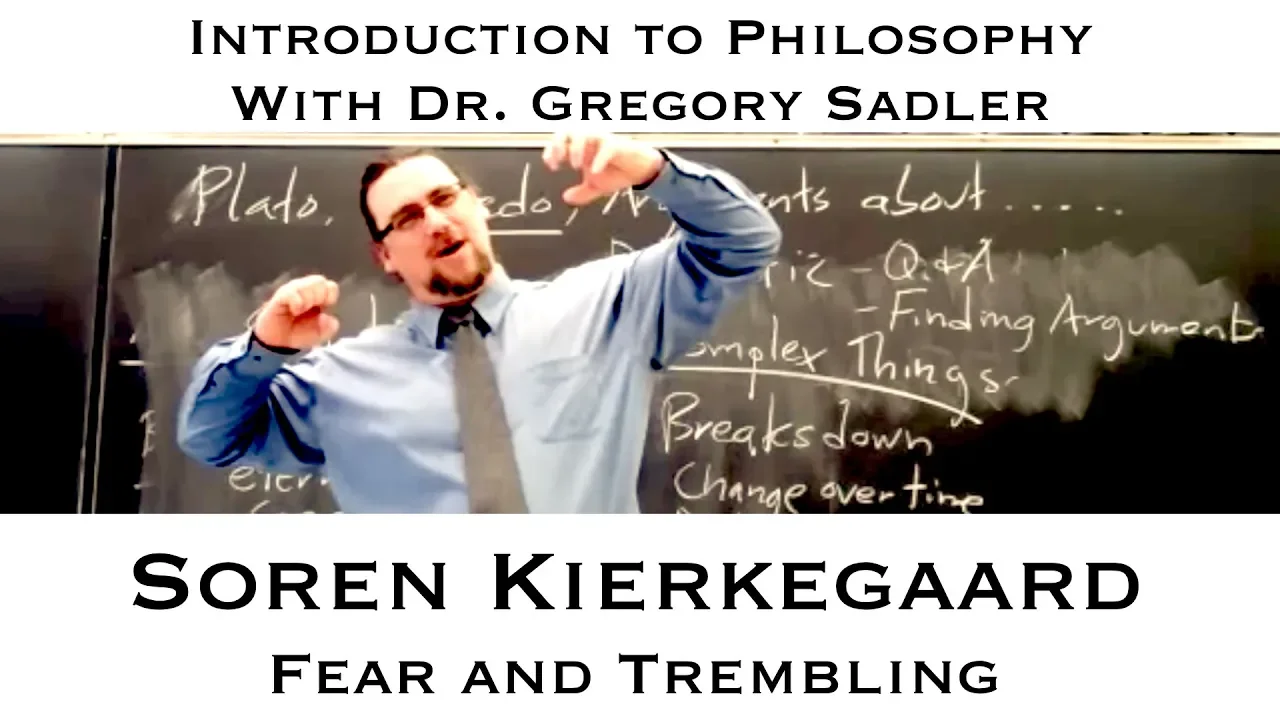
- Why this video: Dr. Sadler delivers an exceptional, long-form academic introduction to Kierkegaard’s masterpiece, Fear and Trembling. He masterfully explains why Kierkegaard argues that authentic faith requires a movement through "infinite resignation"—accepting our human limitations and suffering—to arrive at something completely beyond rational calculation.

- Why this video: This video offers a lucid, highly engaging analysis of Kierkegaard's radical perspective on faith. It details faith not as a set of logical dogmas or dry objective truths, but as a passionate, paradox-embracing "leap" that operates completely outside the boundaries of institutional knowledge and rational proof.

- Why this video: A targeted, highly visual conceptual analysis that defines Kierkegaard's archetypal figure: the "Knight of Faith." It contrasts this figure with the "tragic hero" (who sacrifices for the universal ethical community) to clarify why the Knight of Faith must stand in a unique, unmediated, and highly paradox-driven relationship with the infinite.
Module 2 Knowledge Checkpoint
- Articulate why Kierkegaard claims that "truth is subjectivity" and why objective proofs for the existence of God destroy the genuine nature of faith.
- Differentiate between the "tragic hero" (who conforms to ethical rules of society) and the "Knight of Faith" (who embraces absolute paradox).
- Explain how Kierkegaard’s "leap of faith" is a movement through infinite resignation rather than a simple, thoughtless escape from reason.
Module 3: Sartre’s Radical Freedom and Bad Faith
This module shifts the focus to 20th-century secular existentialism, centering on Jean-Paul Sartre. Students will analyze his famous maxim that "existence precedes essence," the deep anxiety of radical freedom, and the mechanics of "bad faith" (mauvaise foi) — the process of self-deception through which humans deny their responsibility.
![Jean-Paul Sartre - Existentialism is a Humanism [Philosophy Audioboook] Full Lecture](https://i.ytimg.com/vi_webp/TiD_hMGJPi8/maxresdefault.webp)
- Why this video: This is the complete audio text of Sartre’s most famous public lecture, Existentialism is a Humanism. It serves as the primary text for understanding how secular existentialism operates. Sartre defends his system against charges of quietism and pessimism, systematically laying out his argument that humans are entirely self-defining.

- Why this video: An incredibly clear, mid-length explainer that addresses a critical curriculum gap. The hosts analyze the dual nature of bad faith: denying one’s transcendent freedom (treating oneself as a static object like a jar of water) versus denying one’s facticity (ignoring real-world historical constraints).

- Why this video: This video offers a deeper academic lecture investigating the psychological "horror" of radical freedom. Dr. Dodson explores how the realization of absolute freedom causes vertigo, driving individuals to use self-deception as a protective mechanism to shield themselves from existential responsibility.
- Why this video: A short, highly accessible classic that uses Sartre's famous "waiter in the café" example to illustrate bad faith in daily life. It details how we adopt predetermined societal roles to escape the anxiety of realizing we can always change our actions.
Module 3 Knowledge Checkpoint
- Define "existence precedes essence" and explain its implications for human nature, destiny, and morality.
- Distinguish between facticity (our unchangeable historical, physical, and biological constraints) and transcendence (our freedom to choose how to interpret and act on those constraints).
- Explain how Sartre’s concept of bad faith (mauvaise foi) operates as a form of self-deception, using the example of the café waiter.
Module 4: Camus’s Philosophy of the Absurd
This module focuses on Albert Camus and his exploration of "the absurd"—the permanent, unresolvable tension between the human drive for order and meaning, and the silent, indifferent universe. We will dissect The Myth of Sisyphus and study his theory of revolt.
- Why this video: A premier introductory explainer that outlines Camus's worldview. It clearly frames "the absurd" not as a feature of the world alone, but as a relational friction that arises when human consciousness collides with cosmic indifference. It also introduces Camus's three potential responses to the absurd: physical suicide, philosophical suicide (leaps of faith), and defiant acceptance (revolt).

- Why this video: A highly polished analysis focusing on Camus’s treatment of the ancient Greek myth of Sisyphus. It details how the condemnation to roll a boulder up a hill for eternity serves as an allegory for everyday human routines, and why we "must imagine Sisyphus happy" as he walks back down the mountain.

- Why this video: This video offers a deeper dive into Camus’s subsequent work, The Rebel. It explains why Camus rejected both total nihilistic withdrawal and dogmatic commitments to external structures (like political ideologies or religious institutions), proposing instead that the only authentic path is perpetual, measured revolt.
Module 4 Knowledge Checkpoint
- Define "the absurd" in Camus’s terms, demonstrating why it requires both human consciousness and cosmic indifference to exist.
- Critique Camus's rejection of "philosophical suicide" (making a leap of faith to solve absurdity) and physical suicide.
- Explain why Sisyphus’s endless, purposeless task is seen as a victory rather than a defeat when met with defiant conscious awareness.
Module 5: Simone de Beauvoir’s Ethics of Ambiguity
This module introduces Simone de Beauvoir's ethical framework. We will examine her argument that existentialism does not lead to moral anarchy, but instead creates a powerful ethics of ambiguity. Students will discover how our freedom is fundamentally co-dependent on the freedom of others.

- Why this video: An in-depth academic lecture exploring the structural components of The Ethics of Ambiguity. Professor Travis outlines Beauvoir's fundamental argument: humans are permanently caught in a dual, ambiguous condition (we are simultaneously free subjects who make choices, yet determined physical objects subject to external situations and history).

- Why this video: This episode explains how individual freedom can avoid descending into selfishness or solipsism. Beauvoir’s relational ethics are illuminated: because my freedom requires an open future with options, and those options are structured by other free human beings, I must actively work to liberate others in order to truly be free myself.

- Why this video: This video offers a clear, accessible overview of Beauvoir’s core concepts. It helps students distinguish her philosophy from Sartre's earlier, hyper-individualistic assertions of radical freedom, introducing the ideas of situation, social oppression, and shared historical agency.

- Why this video: A targeted, shorter analysis of one of Beauvoir's classic archetypes from The Ethics of Ambiguity: the "sub-man" (or subhuman). This video explores her critique of the passive human agent who surrenders their critical agency and choices to external circumstances, running away from the ambiguity of freedom.
Module 5 Knowledge Checkpoint
- Explain how Simone de Beauvoir defines "ambiguity" and why she argues that trying to eliminate this ambiguity leads to tyranny or self-deception.
- Outline why Beauvoir believes that "to will oneself free is also to will others free," explaining how this forms an ethical response to oppression.
- Describe the traits of the "sub-man" and how this archetype illustrates a failure to live up to our existential freedom.
Course Map
This flowchart outlines the recommended sequence of modules and major conceptual developments in this curriculum.
Key People Index
| Thinker | Core Contribution in Existentialism | Contextual Background |
|---|---|---|
| Søren Kierkegaard <br>(1813–1855) | Father of Christian Existentialism. Developed concepts of objective uncertainty, the leap of faith, stages of life, and anxiety as the dizziness of freedom. | Danish philosopher and theologian who wrote under various pseudonyms to prompt self-reflection in his readers. |
| Jean-Paul Sartre <br>(1905–1980) | Father of Atheistic Existentialism. Coined "existence precedes essence." Formulated theories of bad faith, facticity vs. transcendence, and absolute human responsibility. | French philosopher, playwright, and political activist who declined the 1964 Nobel Prize in Literature. |
| Albert Camus <br>(1913–1960) | Developer of Absurdism. Explored the absurdity of human struggle against cosmic indifference, and defined "revolt" as the ultimate response. | French-Algerian novelist, essayist, and journalist who won the 1957 Nobel Prize in Literature. |
| Simone de Beauvoir <br>(1908–1986) | Architect of the Ethics of Ambiguity. Linked existentialist freedom directly with political liberation and interpersonal ethical responsibility. | French philosopher, feminist theorist, and social activist who wrote The Ethics of Ambiguity and The Second Sex. |
Final Self-Assessment
Use this checklist to measure your mastery of the material across all five modules:
- I can explain the historical transition from systematic rationalism to existentialism.
- I can articulate Kierkegaard's critique of objective certainty and defend his argument for the "leap of faith."
- I can identify a "Knight of Faith" and explain how they differ from a "tragic hero."
- I can define Sartre's concept of "existence precedes essence" and analyze its moral implications.
- I can spot "bad faith" in real-world scenarios and explain how it differs from a simple, conscious lie.
- I can distinguish between facticity and transcendence using concrete examples.
- I can define Camus's concept of "the absurd" and state why physical or philosophical suicide are inadequate responses to it.
- I can explain what Camus means by "revolt" and how it relates to the figure of Sisyphus.
- I can describe the fundamental human "ambiguity" outlined by Simone de Beauvoir.
- I can defend why Beauvoir's ethics require us to actively struggle against the oppression of others to secure our own freedom.