Quantum Mechanics (Duality & Entanglement)
Learning Goal: To develop a deep, conceptually rigorous, and mathematically grounded understanding of the foundational principles of quantum mechanics. By the end of this curriculum, you will understand the historical failure of classical physics, master the dual wave-particle nature of matter and light, navigate the mathematics of the Schrödinger wavefunction, analyze the quantum mechanical barrier penetration (tunneling) that drives modern technology, and dissect the non-local realities of quantum entanglement and Bell's Theorem.
- Prerequisites: High School Physics (basic wave mechanics and classical kinematics) and Introductory Calculus (basic derivatives and integration concepts).
- Estimated Total Study Time: 12 Hours
Module 1: The Crisis of Classical Physics
This module establishes the historical and physical background that necessitated the quantum revolution. You will explore why classical thermodynamics and mechanics failed to explain phenomena at atomic scales, culminating in the "ultraviolet catastrophe." You will see how Max Planck introduced quantization as a mathematical necessity, and how Albert Einstein formalized this to explain the photoelectric effect, fundamentally altering our understanding of light.
Recommended Videos
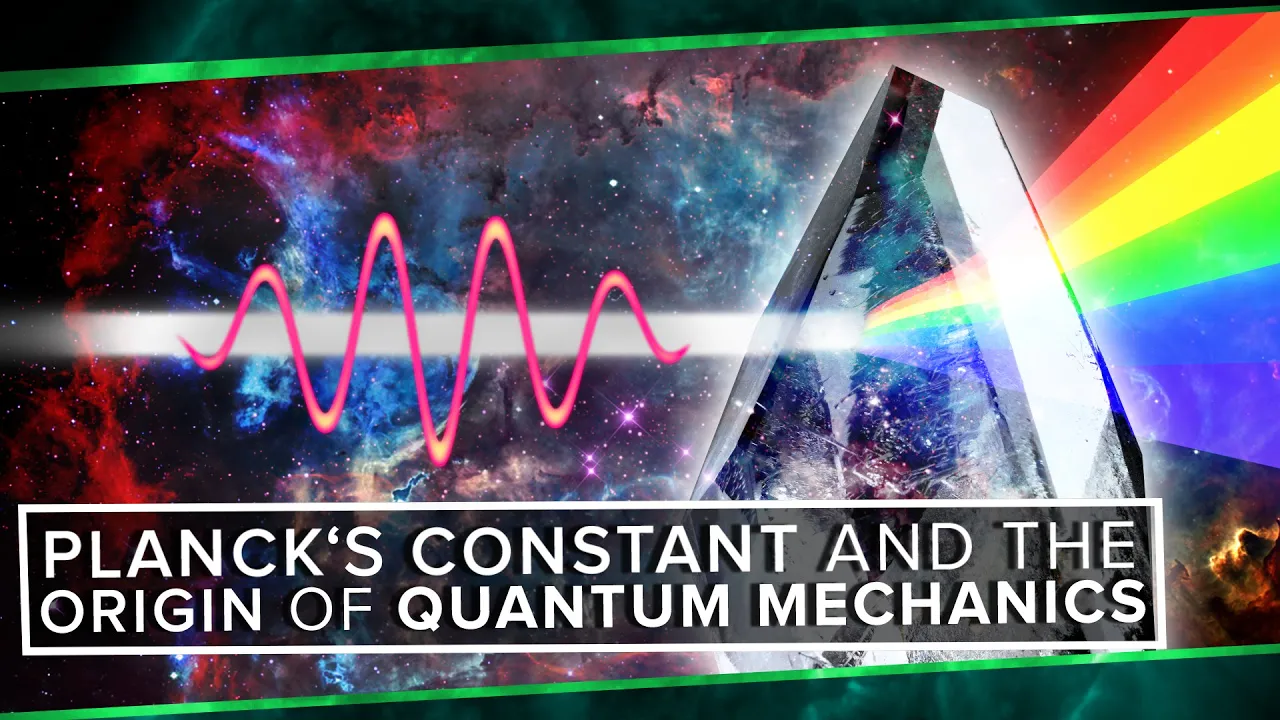
- Why this video: This video provides an unmatched historical and conceptual deep-dive into how the ultraviolet catastrophe forced Max Planck to introduce his famous constant (). It masterfully bridges classical thermodynamic wave equations with the radical birth of quantized energy states.
- Knowledge Checkpoint:
- Understand why classical Rayleigh-Jeans law predicted infinite energy emission at high frequencies (the ultraviolet catastrophe).
- Explain Planck's physical assumption: that energy in standing waves can only take discrete values proportional to frequency ().
- Identify the value and dimensional units of Planck's constant.
- Why this video: A deeper, highly visual mathematical explanation of the statistical mechanics behind blackbody radiation. It explains the transition from continuous Maxwell-Boltzmann distribution to Planck's discrete distribution, framing it as the "mathematical trick" that changed everything.
- Knowledge Checkpoint:
- Contrast continuous energy distributions with discrete quantized states using probability curves.
- Describe how mathematical discrete summation replaces integration in Planck's blackbody radiation formula.

- Why this video: An incredibly clear, intuitive, and visually descriptive guide to thermal radiation. It focuses on how vibrating charged particles produce electromagnetic waves, setting up a solid foundation for physical intuition.
- Knowledge Checkpoint:
- Define what an ideal "blackbody" is and why it serves as the perfect model for studying thermal emission.
- Explain how thermal agitation of atomic-scale charges creates a spectrum of electromagnetic emissions.
Module 2: Wave-Particle Duality & The Double Slit
Here, you will investigate the strange reality that energy and matter exhibit both wave-like propagation and particle-like localized interactions. You will analyze Thomas Young's classic double-slit experiment, trace how Louis de Broglie extended wave-particle duality to physical matter (electrons), and examine experimental proofs where solid particles produce wave interference.
Recommended Videos

- Why this video: This is a comprehensive, masterclass-level breakdown of wave-particle duality. It traces light's dual behaviors from Newton's corpuscular theory and Young's double-slit experiment up to Einstein's photoelectric effect and de Broglie's physical matter-wave hypothesis.
- Knowledge Checkpoint:
- Describe the differences between how localized particles and self-interfering waves behave classically.
- Explain how the photoelectric effect demonstrates the localized, particle-like nature of light photons.
- Define the de Broglie wavelength relation () and calculate wavelength given momentum.
- Why this video: Uses high-fidelity, elegant 3D animations to illustrate how single particles (such as electrons) fired sequentially through two narrow slits still construct a classic wave interference pattern over time.
- Knowledge Checkpoint:
- Explain what happens when a stream of particles is sent through a double slit one-by-one.
- Distinguish between the mathematical expectation of classical particle distribution (two bands) and quantum reality (an interference pattern).
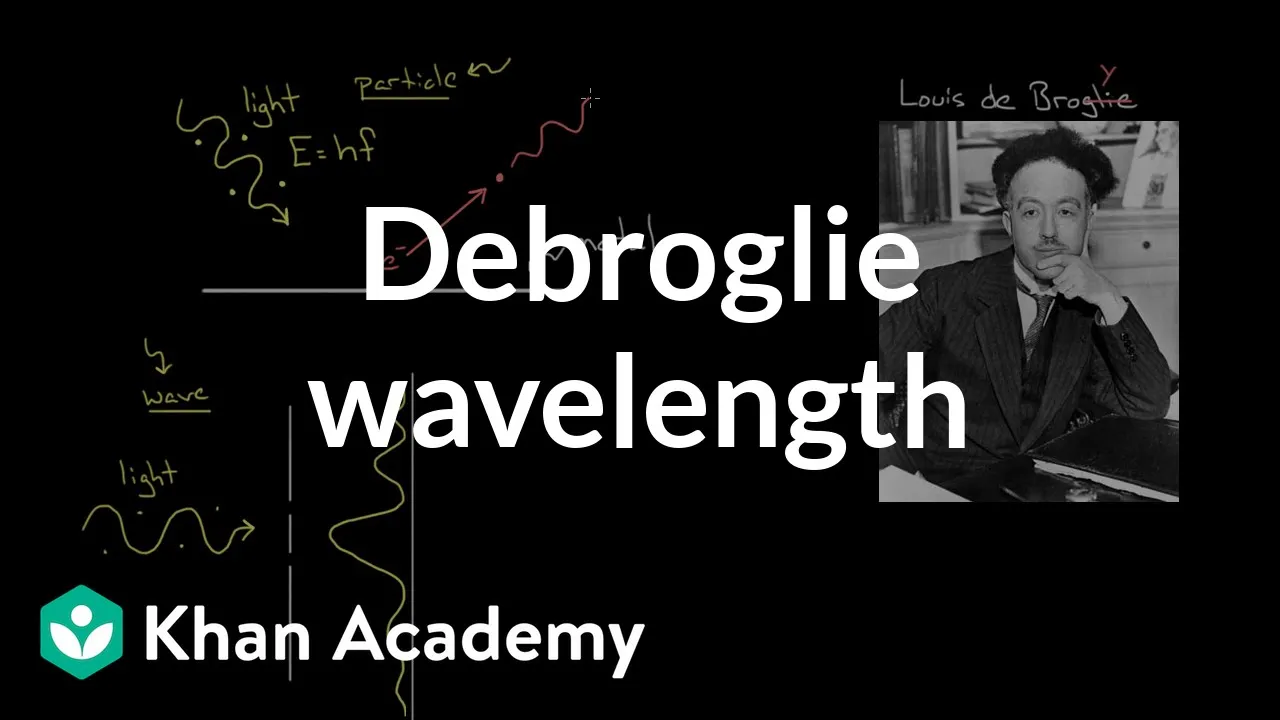
- Why this video: An excellent pedagogical resource illustrating the mathematical calculations of matter waves. It demonstrates why macroscopic objects do not display wave-like properties in daily life, while subatomic particles do.
- Knowledge Checkpoint:
- Calculate the de Broglie wavelength of both an electron and a macroscopic object (e.g., a baseball) to show scale differences.
- Explain why macroscopic wave behaviors are entirely suppressed by high classical momentum.
Module 3: The Wavefunction, Superposition & The Measurement Problem
In this module, you will master the fundamental mathematics of the quantum state. You will discover the physical meaning of Schrödinger's wave equation, explore how a particle exists in a mathematical superposition, and grapple with the "measurement problem"—the mysterious process of wavefunction collapse. You will also review the core physical differences between competing quantum interpretations.
Recommended Videos
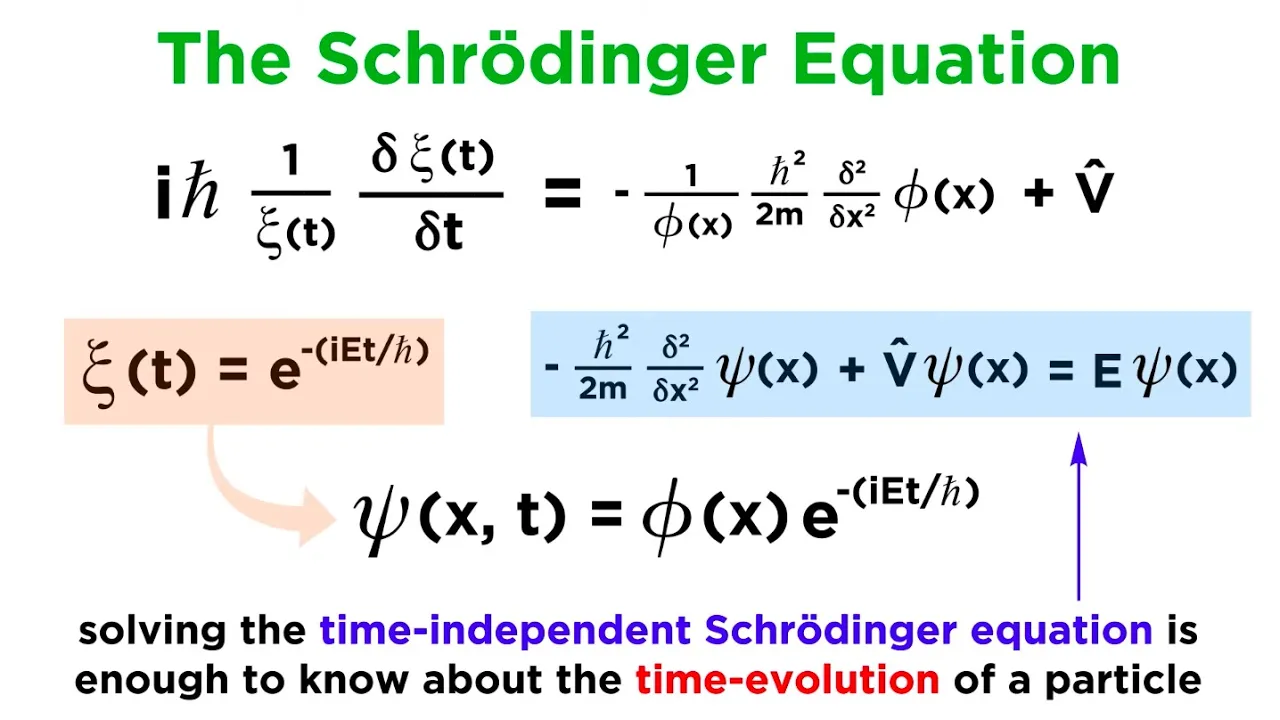
- Why this video: A mathematically rich, step-by-step unpacking of the Schrödinger Equation. It clearly isolates and explains each operator (the Hamiltonian, potential energy, kinetic energy, and imaginary wave evolution).
- Knowledge Checkpoint:
- Identify the components of the time-dependent Schrödinger equation: .
- Describe the physical meaning of the Hamiltonian operator () as the sum of kinetic and potential energy operators.
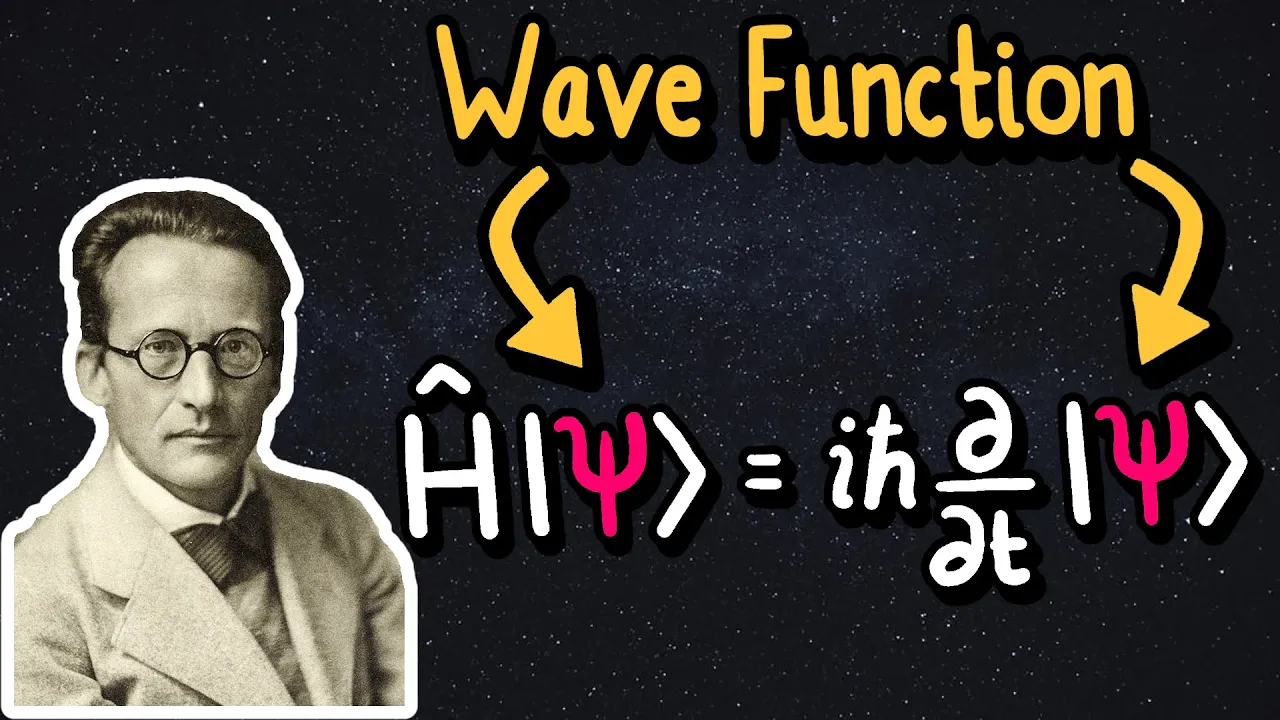
- Why this video: Offers a clear, visual explanation of the physical interpretation of the wavefunction (). It clarifies Max Born's rule: why the complex wavefunction amplitude itself is not observable, but its squared absolute value () describes actual probability density.
- Knowledge Checkpoint:
- State Born's Rule and mathematically relate to the probability density of finding a particle at position .
- Explain why a wavefunction must be "normalized" such that the total probability over all space equals 1 ().

- Why this video: This video strips away mystical misconceptions about quantum superposition. It demonstrates how superposition is a natural consequence of linear wave mechanics, framing quantum states as vectors in abstract vector spaces (Hilbert space).
- Knowledge Checkpoint:
- Define the principle of superposition and explain why linear combinations of valid wave solutions are also valid solutions.
- Explain why observation/measurement forces a multi-state vector into a single eigenstate.
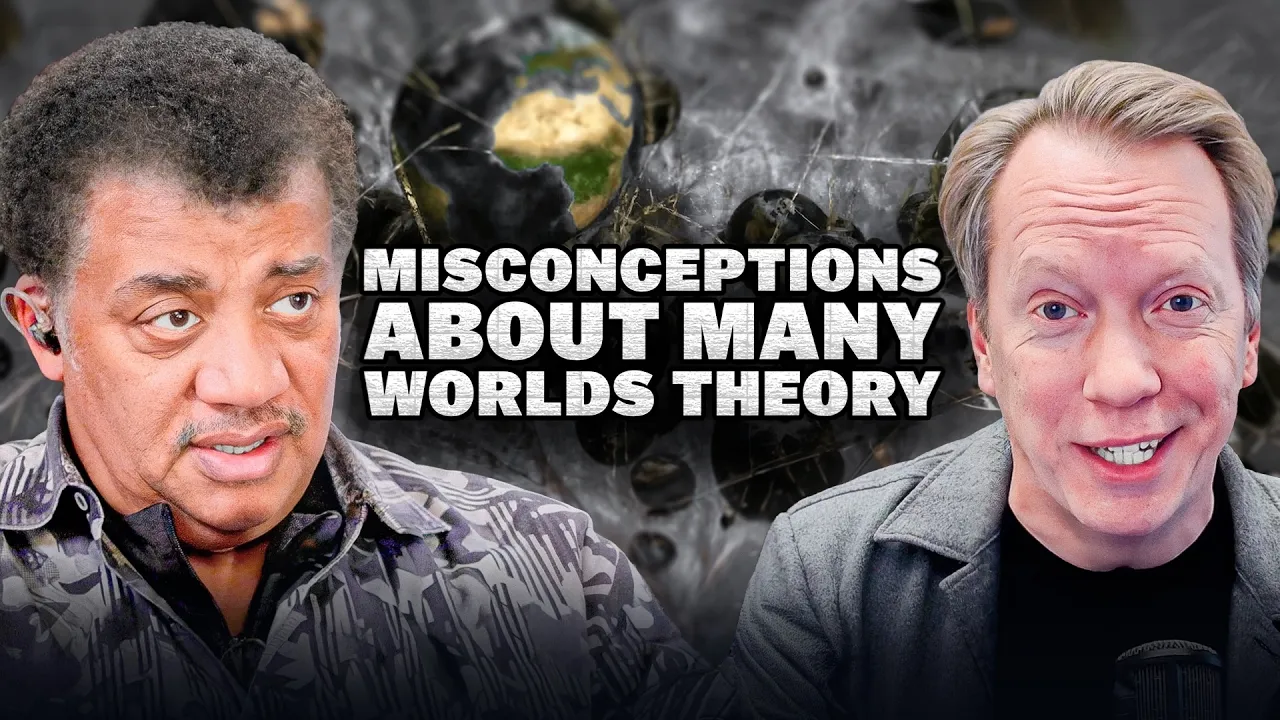
- Why this video: A brief, highly dense conceptual summary comparing interpretations of quantum mechanics. It contrasts the classic Copenhagen interpretation (wavefunction collapse) with the Many-Worlds interpretation (universal wavefunction branching).
- Knowledge Checkpoint:
- Contrast the Copenhagen interpretation's random wavefunction collapse with the Many-Worlds interpretation's deterministic branching.
- Define what a "measurement" means under both dominant interpretations.
Module 4: Quantum Tunneling
This module explores the counterintuitive phenomenon of quantum tunneling, where particles pass through energy barriers they do not classically have the energy to scale. You will examine the physics governing wavefunction penetration through finite potential barriers, see how this phenomenon powers the nuclear fusion in our Sun, and analyze its applications in modern technology (Scanning Tunneling Microscopes and solid-state SSD memory).
Recommended Videos
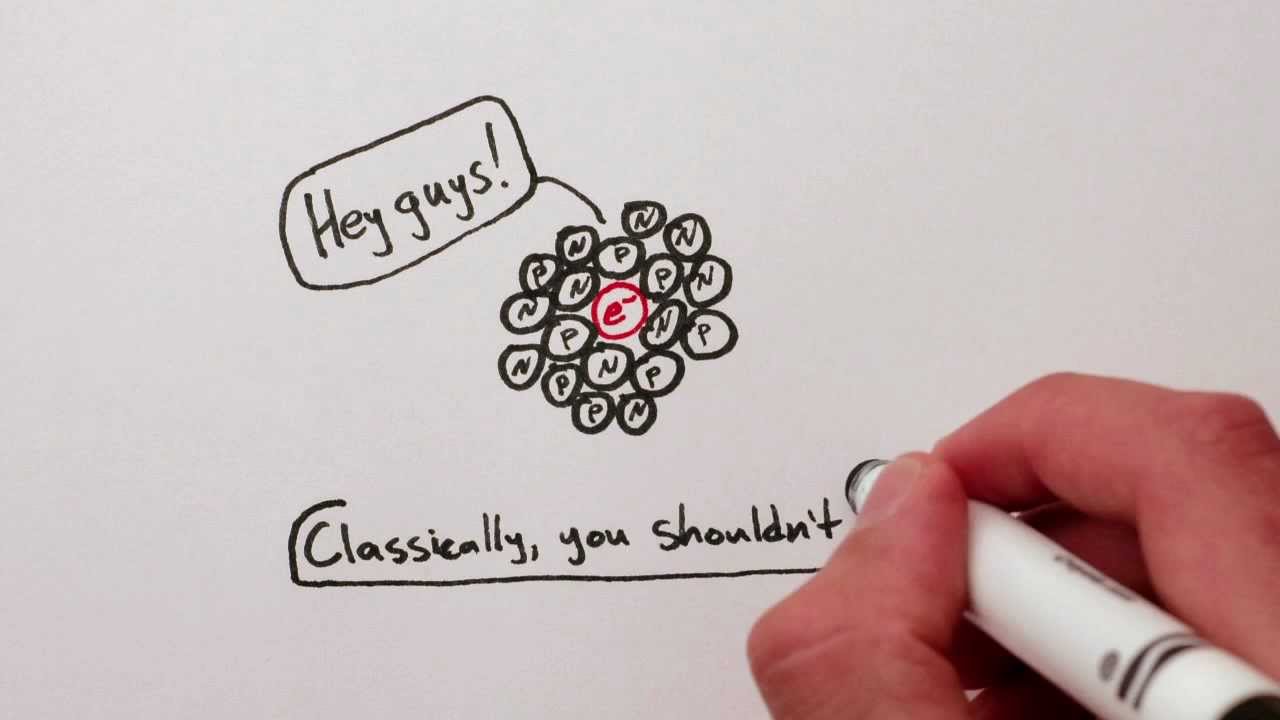
- Why this video: A rapid, highly conceptual animated overview. It contrasts throwing a macroscopic ball against a physical wall with a quantum probability wave bleeding through a thin barrier.
- Knowledge Checkpoint:
- Describe how a wavefunction behaves inside a potential energy barrier higher than the particle's total energy (exponential decay).
- Explain how a non-zero wavefunction amplitude on the far side of a barrier translates to a real probability of transmission.

- Why this video: Addresses a common learning gap by showcasing the industrial application of quantum tunneling. It details how solid-state drives (SSDs) and flash memory use quantum tunneling (Fowler-Nordheim tunneling) to push electrons through insulating barriers to program floating gate transistors.
- Knowledge Checkpoint:
- Explain how electrons are trapped and released inside a floating gate transistor using quantum tunneling.
- Describe the role of high voltage in narrowing the potential barrier to allow tunneling to occur during SSD write cycles.
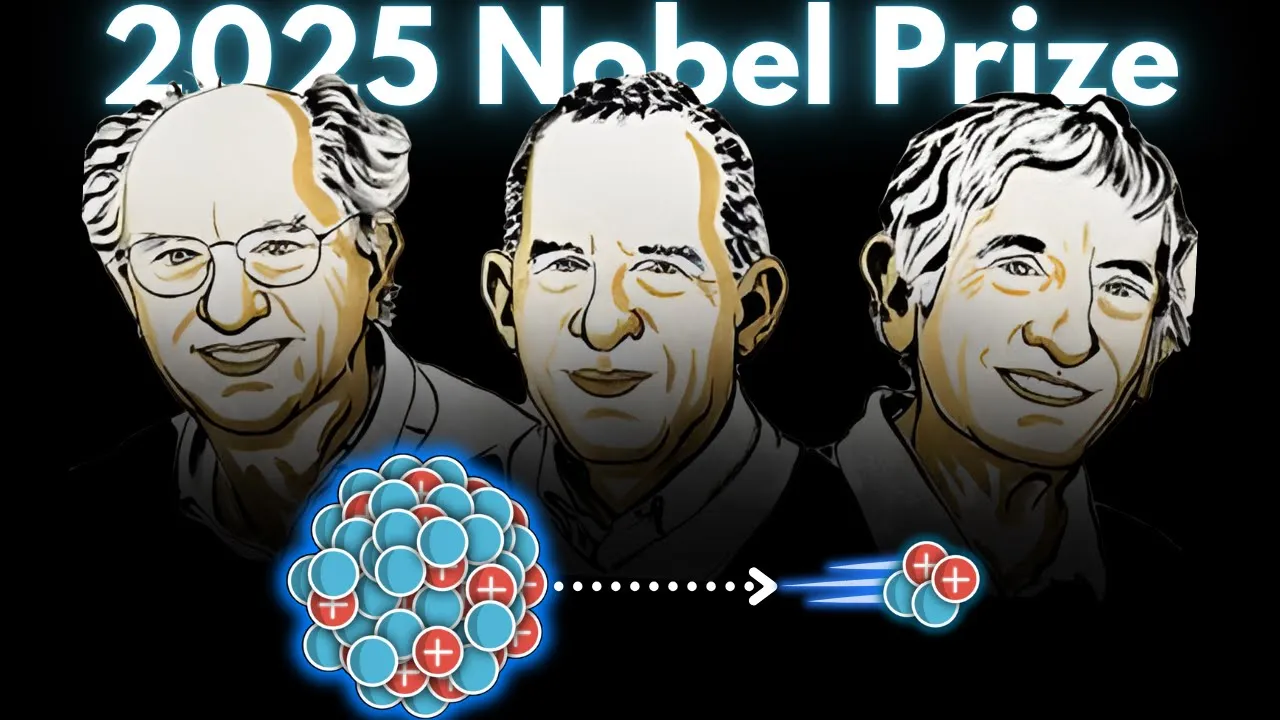
- Why this video: Explains the physical engineering of the Scanning Tunneling Microscope (STM). It shows how a sub-nanometer tip positioned near a conductive surface measures atomic-scale tunneling currents to image individual atoms.
- Knowledge Checkpoint:
- Explain why the tunneling current in an STM is incredibly sensitive to the distance between the tip and the sample surface.
- Describe how keeping tunneling current constant allows the tip to map topography at the single-atom scale.

- Why this video: Clarifies the astrophysical role of quantum tunneling. Without it, the electrostatic repulsion (Coulomb barrier) between positively charged protons would prevent stellar nucleosynthesis, meaning the Sun would not shine.
- Knowledge Checkpoint:
- Explain why the Sun's core temperature is classically insufficient to cause hydrogen fusion.
- Describe how proton wavefunctions overlap, allowing them to tunnel through the Coulomb barrier.
Module 5: Quantum Entanglement & Bell's Theorem
This final module covers the profound implications of quantum non-locality. You will explore the historic Bohr-Einstein debates, analyze the Einstein-Podolsky-Rosen (EPR) paradox, and step through the mathematical and experimental proof of Bell's Theorem. You will see how modern physics conclusively demonstrated that our universe is fundamentally non-local, ruling out local hidden variable theories.
Recommended Videos
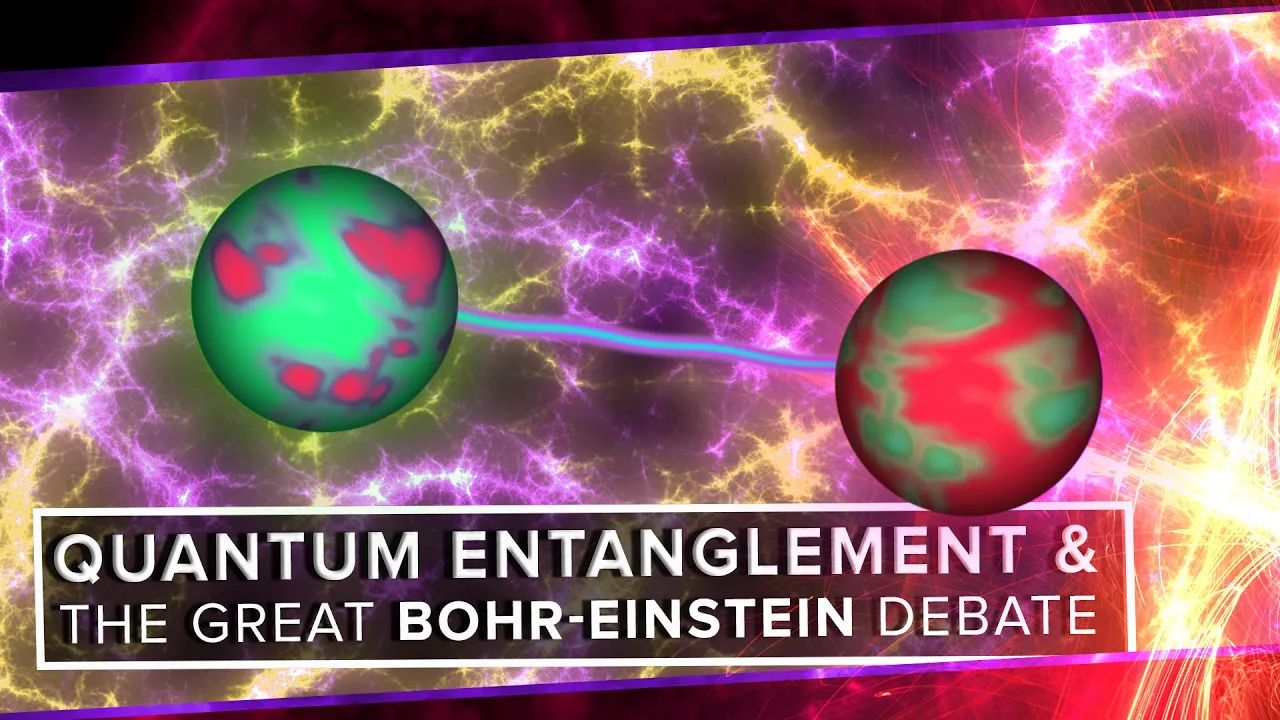
- Why this video: An exceptionally clear, deep overview of quantum entanglement and the historical clash between Albert Einstein and Niels Bohr. It frames Einstein's defense of "local realism" and how the EPR paradox attempted to prove quantum mechanics incomplete.
- Knowledge Checkpoint:
- Define quantum entanglement in terms of a joint, inseparable multi-particle wavefunction.
- Contrast Einstein's "local hidden variable" hypothesis (local realism) with Bohr's view that properties are undefined until measured.
- Explain why measuring one entangled particle instantly determines the state of the other, regardless of spatial distance.

- Why this video: This video addresses a major learning gap by walking viewers through the logic of John Stewart Bell's inequality. It uses clear visual sets to show how any local realism model imposes strict mathematical limits on correlations, limits that quantum mechanics violates.
- Knowledge Checkpoint:
- State Bell's Theorem: any theory based on local realism cannot reproduce all predictions of quantum mechanics.
- Walk through the basic logic of a Bell test, showing how correlation coefficients exceed classical limits.

- Why this video: Explains the real-world validation of Bell's Theorem. This footage from the 2022 Nobel Prize ceremony highlights the work of Aspect, Clauser, and Zeilinger, who experimentally proved the violation of Bell's inequalities using entangled photons.
- Knowledge Checkpoint:
- Describe how real-world experiments measure entangled photon polarization correlations at different detector angles.
- Explain the scientific impact of the 2022 Physics Nobel Prize: ruling out local hidden variables and launching quantum information science.
Course Map
Key People Index
- Max Planck (1858–1947): Initiated the quantum era by introducing the energy quantum () in 1900 to resolve the blackbody ultraviolet catastrophe.
- Albert Einstein (1879–1955): Extended quantization to light (photons) to explain the photoelectric effect. Later became a key critic of quantum indeterminacy, co-authoring the EPR paradox paper.
- Louis de Broglie (1892–1987): Proposed that all moving matter possesses an associated wave nature, introducing the formula .
- Erwin Schrödinger (1887–1961): Developed wave mechanics and the fundamental wave equation () describing quantum state evolution.
- Max Born (1882–1970): Proposed the statistical interpretation of the wavefunction, establishing that represents probability density.
- Niels Bohr (1885–1962): Primary architect of the Copenhagen interpretation; championed the concepts of complementarity and the necessity of the measurement process to define quantum realities.
- John Stewart Bell (1928–1990): Formulated Bell's Theorem and the Bell inequalities, establishing a mathematically testable boundary to distinguish local realism from quantum mechanics.
Final Self-Assessment
Test your mastery of the curriculum by verifying that you can complete and explain the following tasks:
- Explain how Max Planck solved the ultraviolet catastrophe by swapping continuous integrals for discrete sums.
- Calculate the de Broglie wavelength of an electron traveling at and explain how this relates to electron microscopy.
- Write down the time-independent Schrödinger equation and label what each term represents physically.
- Explain Born's probability interpretation of the wavefunction and perform a simple conceptual normalization check.
- Draw a diagram of a wavepacket encountering a finite potential energy barrier, depicting the difference in amplitude, wavelength, and decay inside vs. outside the barrier.
- Explain the engineering principles behind how a Scanning Tunneling Microscope maps surfaces at atomic resolution.
- Detail how flash memory (SSDs) exploits quantum tunneling to write data to floating gate transistors.
- Describe the Einstein-Podolsky-Rosen (EPR) paradox and explain what "local hidden variables" are.
- Sketch out a basic Bell test setup using polarized photons and explain how violating Bell's inequality proves the universe is non-local.
- Contrast the Copenhagen and Many-Worlds interpretations of quantum mechanics, detailing how each explains the apparent collapse of a wavefunction.