Superconductivity: Meissner & Josephson
Learning Goal: Mastering Superconductivity: Cooper Pairs, the Meissner Effect, and Josephson Junctions. Discover the microscopic quantum transitions that allow materials to carry currents with zero loss, explore how magnetic fields interact with superconductors, derive the foundational math of quantum tunneling junctions, and trace their applications to SQUIDs and modern qubits.
- Prerequisites: Familiarity with high-school level physics (Ohm's Law, basic electric circuits) and high-school level algebra.
- Estimated Study Time: 20 hours
Module 1: Foundational Physics: Conductivity & Quantum Basics
Module Overview
To understand why superconductivity is such a radical departure from ordinary material physics, we must first establish the baseline of classical electrical conduction and contrast it with fundamental quantum mechanical tools. This module covers the classical origin of electrical resistance (collisional transport in lattices) and introduces the concept of the quantum wave function (which replaces definite trajectories with probability waves) and the quantum categorization of indistinguishable particles into bosons and fermions. This distinction is the exact stepping stone required to understand how electrons—normally fermions—can pair up to behave like bosons and form a single macroscopic quantum state.
Recommended Videos

Why this video
This video provides a highly intuitive and solid practical review of Ohm's Law () and the concept of resistance. It frames resistance as a persistent opposition to electrical current, setting up the classical standard that materials naturally impede electron flow—a baseline that superconductors will completely break.
Knowledge Checkpoint
- Define Ohm's Law and express the relationship between voltage, current, and resistance.
- Describe how physical obstacles inside a conducting medium impede the drift velocity of charge carriers.

Why this video
In order to master macroscopic quantum phenomena, one must first demystify the wave function (). This video provides a conceptual and physical overview of how the wave function acts as a mathematical probability density map. It replaces classical particle certainty, which is essential to understanding the phase-coherent states of superconductors.
Knowledge Checkpoint
- Explain what information is encapsulated within a quantum system's wave function ().
- Explain how a probability distribution is derived from the wave function (i.e., the physical interpretation of ).
- Contrast how a particle's position is treated in classical mechanics versus quantum mechanics.
Why this video
Superconductivity relies on the transition of electrons into a state where they can share a single ground-state level. This brief academic segment establishes the critical quantum division: fermions (which have half-integer spin and must obey the Pauli Exclusion Principle) and bosons (which have integer spin, symmetrical wave functions, and can condense into the same low-energy quantum state).
Knowledge Checkpoint
- Define the fundamental difference in spin characteristics between bosons and fermions.
- Distinguish how wave function symmetry (symmetrical vs. asymmetrical) applies to systems of indistinguishable particles.
- Explain why the Pauli Exclusion Principle prevents ordinary fermions from occupying the exact same energy state simultaneously.
Module 2: Introduction to Superconductivity & Meissner Effect
Module Overview
With classical resistance and wave mechanics established, this module introduces the fundamental transition of materials into superconductors. We explore the historical discovery of zero electrical resistance below a critical temperature () and dive deep into the Meissner effect—the complete expulsion of magnetic fields from the interior of a superconductor. You will learn why a superconductor is mathematically distinct from a hypothetical "perfect conductor" and contrast the abrupt transitions of Type I superconductors with the complex mixed-state properties of Type II superconductors.
Recommended Videos

Why this video
This video details the thermodynamic transition of materials below their critical temperatures, demonstrating the complete loss of electrical resistance. It provides the core qualitative framework of the Meissner effect, explaining how screening currents form on the surface to cancel internal magnetic fields.
Knowledge Checkpoint
- Describe the dramatic transition that occurs at the critical temperature ().
- Explain why the expulsion of magnetic fields in the Meissner effect cannot be explained simply by classical perfect conductivity (Lenz's Law).
- Illustrate how surface eddy currents are generated to resist and expel external magnetic flux.

Why this video
This lecture adds essential analytical depth, offering formal definitions and clear board-work detailing the magnetic behavior of superconductors. It explains magnetic induction inside the materials () and proves why the internal magnetic flux density leads to a state of perfect diamagnetism ().
Knowledge Checkpoint
- Write the equation relating magnetic flux density (), magnetic field strength (), and magnetization ().
- Mathematically prove why the Meissner effect corresponds to a magnetic susceptibility () value of .
- Differentiate between a material cooled in a magnetic field (field cooling) vs. a material placed in a magnetic field after being cooled (zero-field cooling) to show how a superconductor behaves in both.

Why this video
Superconductors are categorized by how they respond to intense magnetic fields. This video highlights the structural and behavioral differences between Type I ("soft" pure metal superconductors with a single threshold ) and Type II ("hard" alloy/ceramic superconductors that possess lower and upper critical fields and ).
Knowledge Checkpoint
- Compare Type I and Type II superconductors based on their critical magnetic fields ( vs. and ).
- Define the "vortex state" (mixed state) in Type II superconductors and explain how quantized magnetic flux lines penetrate the material.
- Identify which category of superconductors is suited for high-power magnet applications (like MRI or particle accelerators) and explain why.
Module 3: BCS Theory and Cooper Pairs
Module Overview
How do negatively charged electrons overcome their natural Coulomb repulsion to flow in unison without scattering? This module provides a step-by-step physical breakdown of the Nobel Prize-winning Bardeen-Cooper-Schrieffer (BCS) theory. You will study how moving electrons deform the surrounding positive ion lattice to generate an attractive force mediated by quantized lattice vibrations (phonons). This phonon-mediated attraction binds electrons into "Cooper pairs" that behave as composite bosons, allowing them to condense into a single, highly stable, phase-coherent macroscopic quantum state.
Recommended Videos

Why this video
This animated presentation breaks down the core concepts of BCS theory visually. It is highly effective at showing how the microscopic lattice distortion creates an attractive channel, why thermal fluctuations eventually destroy this channel, and how the paired state leads to zero electrical resistance.
Knowledge Checkpoint
- Explain how an electron traveling through a metal lattice alters the local density of positive ions.
- Describe how this positive charge density perturbation attracts a second, trailing electron.
- Detail how thermal energy (phonons at higher temperatures) disrupts the formation and stability of Cooper pairs.
Why this video
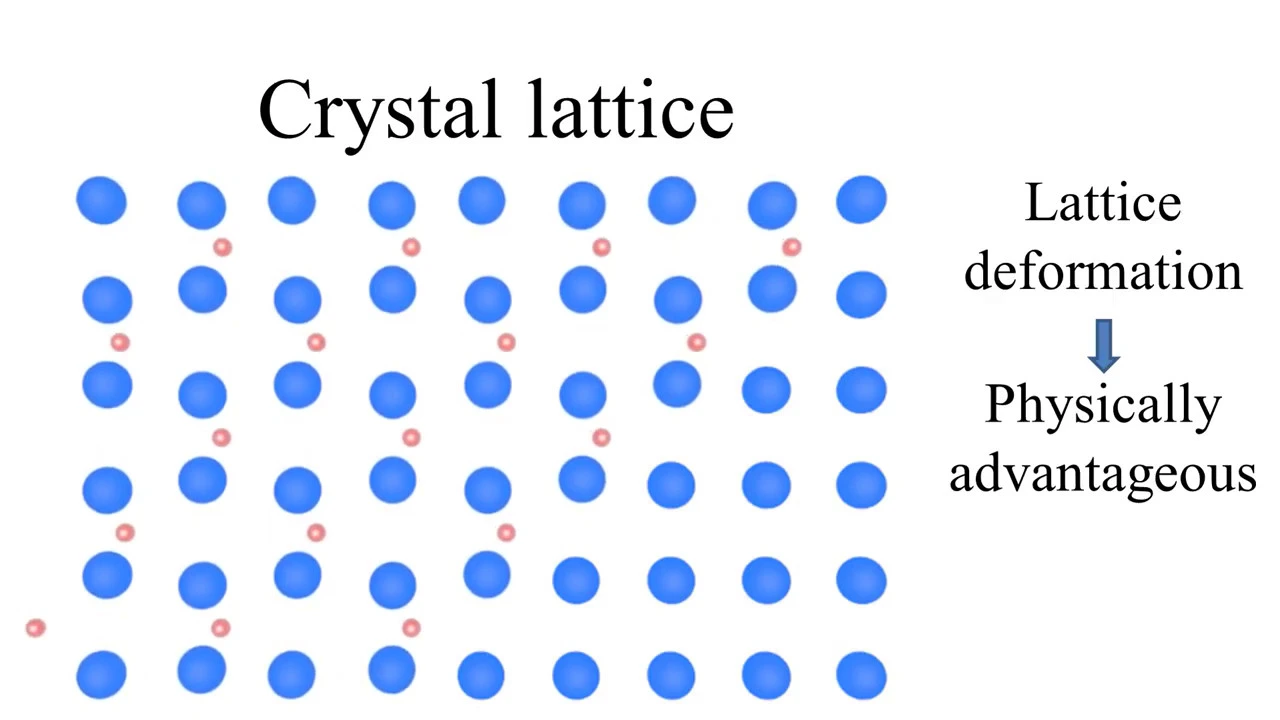
Focusing specifically on the mechanics of the electron-phonon-electron interaction, this video clarifies how the attractive interaction can overcome the formidable Coulomb repulsion barrier. It helps you visualize the localized positive charge cloud that acts as the "glue" binding two identical negative charges.
Knowledge Checkpoint
- Explain how the time scales of lattice relaxation allow the screening effect to overcome Coulomb repulsion.
- Define a "phonon" and state its role as the mediating boson in BCS theory.
- Contrast the behavior of a single uncoupled conduction electron with a bound Cooper pair.

Why this video
This video offers a rigorous, syllabus-aligned academic breakdown of the BCS model. It integrates the microscopic electron-phonon behaviors with macro-scale variables, showing how millions of overlapping Cooper pairs condense into a unified quantum state that flows around lattice defects without transferring momentum.
Knowledge Checkpoint
- Explain why the overlapping of millions of Cooper pairs creates a collective "superfluid" state.
- Describe why Cooper pairs do not scatter off lattice imperfections like single electrons do (the concept of the energy gap, ).
- Identify the physicists behind the "BCS" acronym and state the historical significance of their 1957 model.
Module 4: Josephson Junctions & Quantum Tunneling
Module Overview
This module addresses the core quantum mechanics and mathematical derivations of the Josephson effects. By placing a weak insulating barrier between two superconductors, Cooper pairs are able to tunnel across the barrier. This system exhibits extraordinary properties that can be derived directly from Schrödinger's equation. We will derive and analyze the DC Josephson relation (linking current to phase difference) and the AC Josephson relation (linking phase evolution to voltage), which reveals that an applied DC voltage across a junction produces an AC current.
Recommended Videos
Why this video
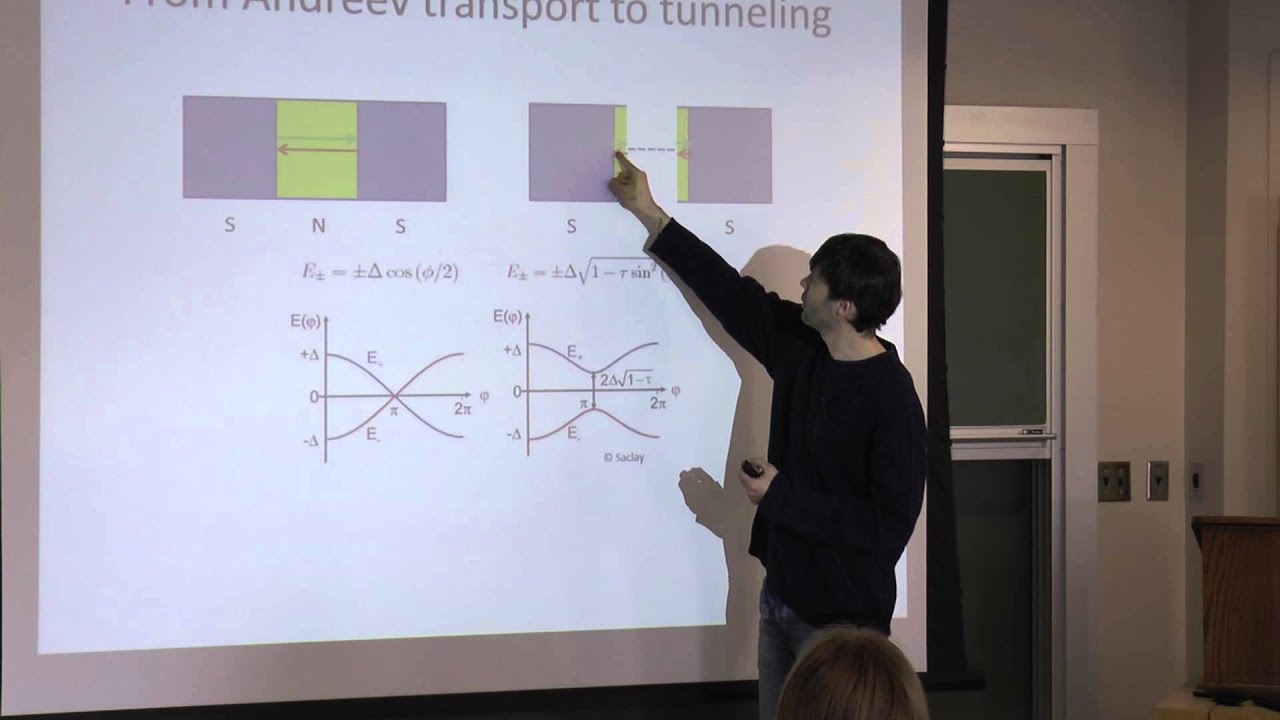
This university-level lecture provides the mathematical foundation of the Josephson effect. It models the weak link separating two superconductors using coupled macroscopic wave functions. This video is crucial for mastering the quantum transport mechanics and phase transitions occurring across the junction.
Knowledge Checkpoint
- Define a Josephson Junction and describe its three physical components (Superconductor - Weak Link - Superconductor).
- Derive the time-dependent phase relationship across the barrier using the coupled Schrödinger equations.
- Define the critical current () and explain what physical factors determine its magnitude.

Why this video
This video provides a step-by-step whiteboard derivation of the DC and AC Josephson equations, using the wave function . This is an invaluable resource for resolving the mathematical gaps in standard textbooks.
Knowledge Checkpoint
- Write down the DC Josephson relation: , and define as the phase difference ().
- Derive the AC Josephson relation: (or ).
- Prove mathematically why applying a constant DC voltage () across a Josephson Junction produces an alternating current (AC) with frequency .

Why this video
Presented by a leading quantum physicist, this segment links the mathematical derivations of AC/DC Josephson relations directly to physical circuit components. It frames the Josephson junction as a non-linear, dissipationless inductor, setting up the fundamental physics of superconducting qubits.
Knowledge Checkpoint
- State how the Josephson junction acts as a non-linear inductor whose inductance depends on the current passing through it.
- Explain how this non-linearity is utilized to construct quantum circuits.
Module 5: Superconducting Applications: SQUIDs & Qubits
Module Overview
In this final module, we bridge the gap between microscopic quantum tunneling and revolutionary modern technology. We examine how Josephson junctions are integrated into loop geometries to create SQUIDs (Superconducting Quantum Interference Devices), which are capable of measuring magnetic fields smaller than a single magnetic flux quantum (). We will then trace how these same junctions are engineered as artificial two-level atoms (Transmons) to serve as the building blocks for quantum computers, operating in dilution refrigerators at millikelvin temperatures.
Recommended Videos

Why this video
This concise guide illustrates how a SQUID combines Josephson junctions with macroscopic quantum interference. It shows how magnetic fields passing through a superconducting loop change the phase of tunneling Cooper pairs, altering the total critical current and enabling ultra-sensitive magnetometry.
Knowledge Checkpoint
- Draw a basic schematic of a SQUID loop containing two parallel Josephson junctions.
- Define the magnetic flux quantum () and state its numerical significance.
- Explain how changes in external magnetic flux are converted into a measurable electrical voltage across the SQUID.
Why this video
Produced by the Google Quantum AI team, this video provides an inside look at how Josephson junctions act as non-linear elements to form qubits. It explains why a standard LC resonator creates a ladder of equally spaced energy states (which cannot be isolated), while a Josephson junction creates an anharmonic, non-linear system where we can isolate the and states.
Knowledge Checkpoint
- Explain why a simple linear LC circuit (inductor-capacitor) is unsuitable for isolating a two-level qubit system.
- Define "anharmonicity" and explain how the Josephson junction introduces it into a superconducting circuit.
- Describe the physical layout of a transmon qubit and how it minimizes charge noise.
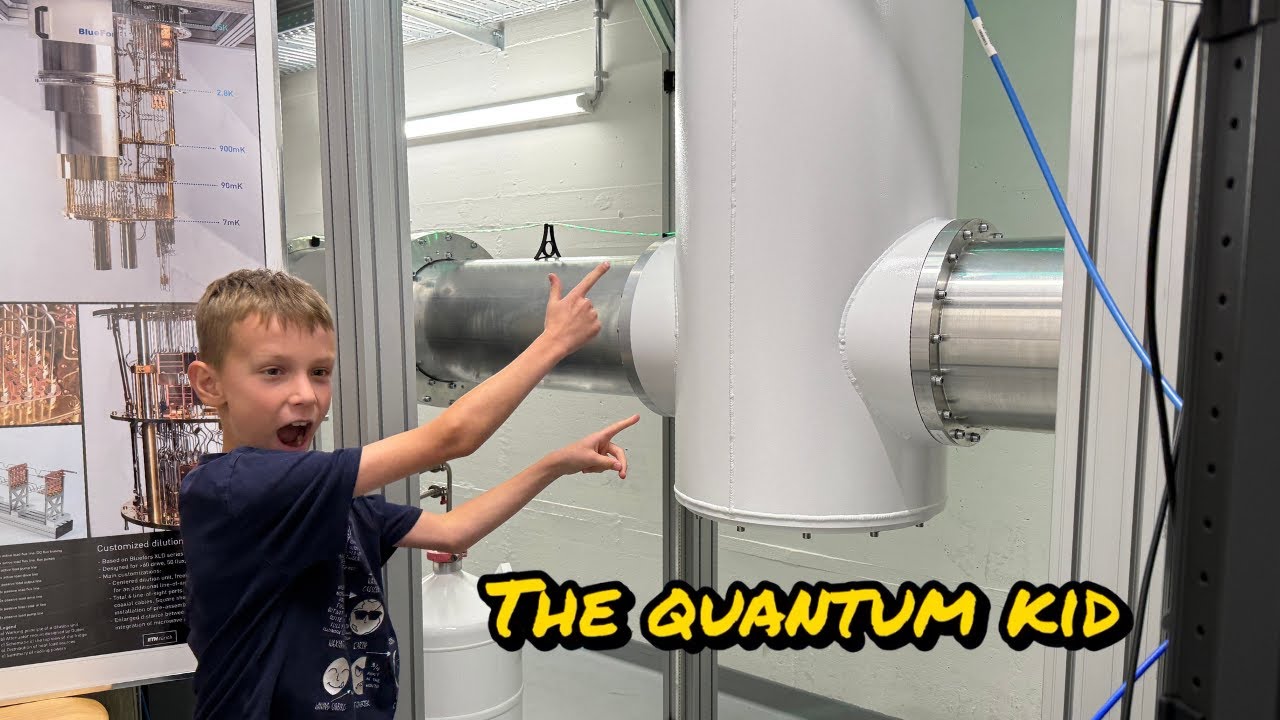
Why this video
This tour of ETH Zurich's Quantum Lab provides an immersive look at the physical hardware used to operate superconducting qubits. It shows the cryogenic systems, microwave control electronics, and physical shielding required to protect qubits from thermal noise and maintain quantum coherence.
Knowledge Checkpoint
- State the temperature range (typically 7 to 15 millikelvin) required inside a dilution refrigerator to run superconducting qubits.
- Describe why magnetic and radiation shielding are necessary to preserve quantum superposition and entanglement.
- Identify how microwave pulses are used to manipulate the state of transmon qubits.
Course Map
Key People Index
| Scientist / Researcher | Context within Superconductivity | Primary Achievement |
|---|---|---|
| Heike Kamerlingh Onnes | Discovered the phenomenon of superconductivity in 1911 by cooling mercury to 4.2 K. | First to observe zero resistance; awarded the 1913 Nobel Prize in Physics. |
| Walther Meissner | Co-discovered the active expulsion of magnetic fields from superconductors in 1933. | Established that superconductors are perfect diamagnets, not just perfect conductors. |
| John Bardeen | Co-developed the microscopic BCS theory of superconductivity in 1957. | First person to win two Nobel Prizes in Physics (one for the transistor, one for BCS theory). |
| Leon Cooper | Proved that a weak attractive interaction in a Fermi sea can bind electrons into pairs. | Named the "Cooper pair" concept, forming the basis of the BCS theory. |
| John Robert Schrieffer | Co-developed the BCS theory, constructing the wave function that describes the paired state. | Shareholder in the 1972 Nobel Prize in Physics for BCS theory. |
| Brian Josephson | Predicted the quantum tunneling of Cooper pairs through a weak insulating barrier in 1962. | Derived the DC/AC Josephson equations at age 22; awarded the 1973 Nobel Prize. |
Final Self-Assessment
Test your mastery of superconductivity by verifying that you can confidently check off each of the following statements:
- I can explain the physical origin of classical resistance as lattice collision scattering.
- I can explain why two electrons, which naturally repel via the Coulomb force, can form an attractive Cooper pair through lattice-polarization (phonon mediation).
- I can explain how Cooper pairs act as composite bosons, allowing them to condense into a single macroscopic quantum state.
- I can explain the difference between a hypothetical "perfect conductor" (which traps existing magnetic fields) and a "superconductor" (which expels magnetic fields via the Meissner effect).
- I can mathematically relate magnetization (), magnetic susceptibility (), and magnetic field () to show that a superconductor behaves as a perfect diamagnet ().
- I can describe the structural and phase differences between Type I (abrupt transition) and Type II (mixed-vortex state with flux pinning) superconductors.
- I can write and physically interpret the DC Josephson equation .
- I can derive and physically interpret the AC Josephson equation , proving why a constant DC voltage generates an alternating current.
- I can describe how a SQUID uses quantum interference in a dual-junction loop to detect magnetic fields on the scale of a single flux quantum ().
- I can explain why an anharmonic oscillator (like a Josephson junction transmon) is required to build a physical two-level qubit, whereas a standard linear LC resonator cannot isolate a single qubit transition.