Nuclear Deterrence: MAD & Global Security
Learning Goal: Evaluate the strategic logic of nuclear deterrence in international relations, analyzing how mutually assured destruction, missile defense systems, and proliferation dynamics shape global security architectures.
- Prerequisites: Basic understanding of 20th-century world history and international relations theory.
- Estimated Study Time: 15 Hours
Module 1: Origins of the Nuclear Age and the Cold War Arms Race
This module covers the scientific foundations of the atomic bomb, the history of the Manhattan Project, early espionage, and the Cold War arms race that followed. You will explore how the shift from a US nuclear monopoly to a bipolar arms race altered the geopolitical landscape and laid the groundwork for modern strategic deterrence.
Recommended Videos

- Why this video: Understanding the physics of nuclear weapons is essential to understanding their geopolitical impact. This video provides a detailed breakdown of how nuclear fission works using unstable isotopes like uranium-235 or plutonium-239, transitioning from basic atomic physics to the mechanics of weapon deployment. This technical understanding helps clarify why producing and securing these materials is the primary bottleneck in nuclear proliferation.
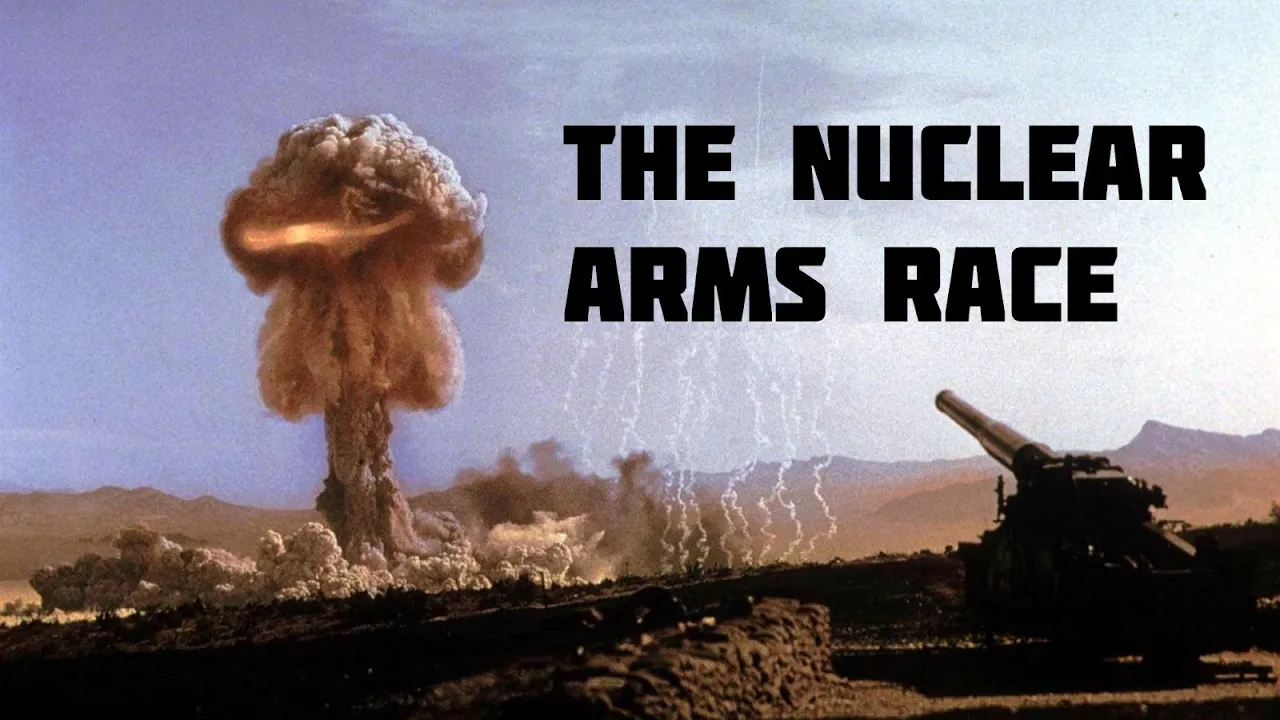
- Why this video: This documentary provides a concise historical overview of the nuclear arms race between the US and the USSR from 1945 to 1991. It traces the rapid scale-up from the initial Trinity test in 1945 to arsenals of tens of thousands of warheads, helping you understand how strategic dynamics shifted from atomic weapons to thermonuclear weapons.

- Why this video: This segment focuses on early nuclear espionage at Los Alamos, specifically the roles of Klaus Fuchs and Ted Hall. It illustrates how early intelligence leaks accelerated the Soviet nuclear program, turning a US monopoly into a bipolar rivalry far faster than American intelligence anticipated.
Knowledge Checkpoint
- Understand the difference between nuclear fission (fissioning of heavy atoms like U-235/Pu-239) and thermonuclear fusion.
- Explain how Soviet espionage at Los Alamos (e.g., Klaus Fuchs) impacted the timeline of the Cold War arms race.
- Detail the scale of nuclear stockpile accumulation during the height of the Cold War between the United States and the Soviet Union.
Module 2: The Strategic Logic of Mutually Assured Destruction (MAD)
This module examines the game-theoretic foundations of nuclear deterrence. You will learn about first-strike vs. second-strike capabilities, credible commitments, and how the threat of mutually assured destruction creates a stable—yet precarious—equilibrium.
Recommended Videos

- Why this video: Professor Sachs applies game theory models, such as the hawk-dove game (chicken), to analyze nuclear crisis decision-making. This clip bridges formal strategic theory and international relations, showing why a pursuit of dominant security strategies can lead to dangerous, non-cooperative equilibria where both sides face catastrophic outcomes.
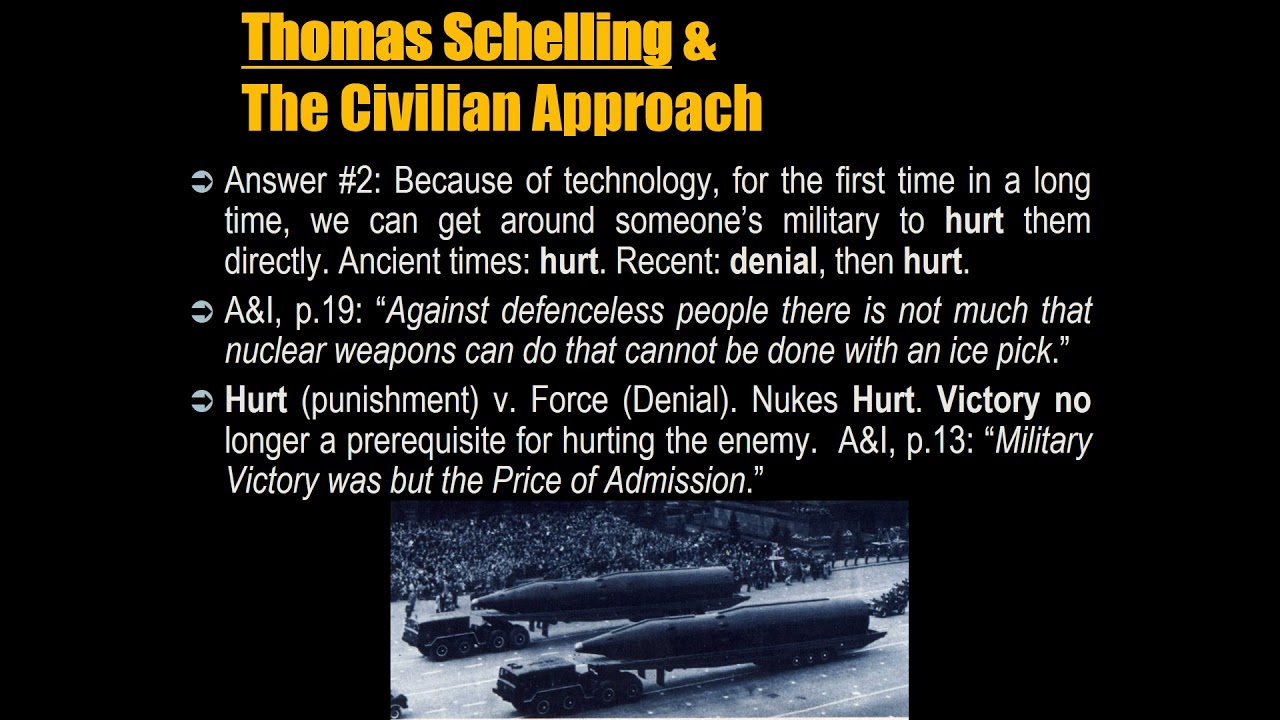
- Why this video: This academic lecture reviews Thomas Schelling's bargaining theory in nuclear strategy. It explores the logic of using brinkmanship and slow escalation to establish credible commitments, illustrating how nuclear weapons are used for coercion and diplomatic leverage rather than immediate military defeat.

- Why this video: This video introduces John von Neumann's mathematical formulations of game theory and their early application to Cold War nuclear planning. It covers the transition of strategic thought from traditional warfare to mathematical models of deterrence, showing how calculations of mutual vulnerability became institutionalized in defense policy.

- Why this video: This explainer video details how MAD operates as a nuclear deterrence strategy. It walks through the requirement of a survivable second-strike capability (primarily secured via the nuclear triad) to make retaliation credible, explaining why this balance of terror has historically prevented direct conflict between major nuclear powers.
Knowledge Checkpoint
- Define a Nash equilibrium in the context of a classic "Hawk-Dove" (or Chicken) nuclear crisis model.
- Explain Thomas Schelling's concept of a "threat that leaves something to chance" (brinkmanship).
- Describe why second-strike capability (via nuclear submarines or hardened silos) is necessary to maintain a credible deterrent under MAD.
Module 3: Missile Defense Systems and Strategic Stability
This module explores how national missile defense (NMD) technologies alter the balance of power. While defensive in intent, interceptor networks can paradoxically destabilize nuclear deterrence by threatening an adversary’s second-strike capability and incentivizing pre-emptive strikes.
Recommended Videos

- Why this video: This lecture evaluates the technical feasibility and economic limits of national missile defense systems. Using the US "Golden Dome" concept as a case study, Perun explains how defense costs scale relative to offense, and how defensive systems alter calculations of strategic stability and crisis escalation.

- Why this video: Produced by the Center for Strategic and International Studies (CSIS), this panel discussion defines the three pillars of strategic stability: survivable second-strike capability, arms race stability, and crisis stability. The experts analyze how deploying advanced interceptors can inadvertently undermine these pillars and spark defensive arms races.

- Why this video: This archival video provides historical context by reviewing the Nike Zeus program, America’s first attempt at an anti-ballistic missile (ABM) system. Understanding early ABM efforts helps illustrate the long-standing technological and strategic competition between offensive missile development and defensive interceptors.
Knowledge Checkpoint
- Explain the security dilemma in the context of missile defense: why does a purely defensive system make an adversary feel insecure?
- Differentiate between the three dimensions of strategic stability: first-strike stability, crisis stability, and arms race stability.
- What is the "cost-exchange ratio" in missile defense, and why does it typically favor the offensive side?
Module 4: Nuclear Proliferation, Treaties, and Global Governance
This module examines how the international community attempts to limit the spread of nuclear weapons. You will study the three pillars of the Non-Proliferation Treaty (NPT), the role of the International Atomic Energy Agency (IAEA) in monitoring nuclear facilities, and the strategic debates surrounding proliferation.
Recommended Videos

- Why this video: This clip outlines the structural design of the 1968 Nuclear Non-Proliferation Treaty (NPT). It details the three core, interdependent pillars: non-proliferation (non-nuclear states commit not to acquire weapons), disarmament (nuclear states commit to reducing arsenals), and the peaceful use of nuclear technology (all states retain the right to civil nuclear energy).

- Why this video: This investigative segment focuses on the International Atomic Energy Agency (IAEA) headquartered in Vienna. It demonstrates the technical procedures used by IAEA inspectors to safeguard enriched uranium stocks, track dual-use materials, and verify that peaceful civilian nuclear programs are not being diverted for military weaponization.
- Why this video: This diplomatic exchange illustrates real-world challenges in proliferation governance. It highlights the political debates over compliance, the limits of state sovereignty, and how states balance NPT commitments against perceived national security threats in regions with high security competition.
Curriculum Gap Alert: The video pool lacks a comprehensive tutorial on the step-by-step legal processes of IAEA safeguards agreements (such as the Additional Protocol). To supplement this module, search independently for: "IAEA Comprehensive Safeguards Agreements and Additional Protocol explained."
Knowledge Checkpoint
- Identify and describe the three fundamental pillars of the Non-Proliferation Treaty (NPT).
- Explain the institutional mandate of the IAEA and the mechanism of "safeguards inspections."
- What is the "Waltz-Sagan debate" concerning proliferation? Contrast the argument that "more nuclear states may be better" (Kenneth Waltz) with the argument that organizational limits make proliferation dangerous (Scott Sagan).
Module 5: Modern Security Architectures and Multipolar Deterrence
This module explores the shift from a bipolar Cold War model to a complex multipolar dynamic involving the US, Russia, and China. We will analyze contemporary nuclear challenges, including the rise of hypersonic delivery systems, cyber threats to nuclear command structures, and the decline of strategic arms control treaties.
Recommended Videos

- Why this video: This lecture from Stanford's Center for International Security and Cooperation (CISAC) analyzes how cyber warfare complicates nuclear deterrence. It breaks down cyber threats into three categories: confidentiality (espionage), integrity (spoofing sensor data), and availability (disrupting communications), illustrating how cyber vulnerabilities can trigger accidental escalations.

- Why this video: This report examines how hypersonic glide vehicles (HGVs) and hypersonic cruise missiles challenge modern strategic architectures. Traveling faster than Mach 5 with highly maneuverable trajectories, these systems bypass early-warning radars and traditional interceptors, compressing decision-making timelines for command structures.

- Why this video: This video offers a balanced, technical counter-perspective on hypersonic weapons. It reviews their engineering limitations—such as extreme thermal friction, high unit costs, and the plasma blackout effect—helping you separate actual military capabilities from political rhetoric in the new arms race.
Knowledge Checkpoint
- Explain how a multipolar deterrence structure (US, Russia, China) differs dynamically from the bipolar balance of the Cold War.
- How do hypersonic glide vehicles (HGVs) bypass traditional ballistic missile early-warning systems?
- Describe how a cyber attack targeting the "integrity" of nuclear early-warning networks could inadvertently trigger a nuclear launch.
Course Map
This flowchart illustrates how the modules build on each other. You should master the historical and strategic foundations in Modules 1 and 2 before moving on to technical disrupters (Module 3) or treaty structures (Module 4). Both paths converge in Module 5, which addresses the complex reality of today's multipolar, high-tech security landscape.
Key People Index
- Julius Robert Oppenheimer: Leading theoretical physicist and scientific director of the Manhattan Project at Los Alamos, often referred to as the "father of the atomic bomb."
- Klaus Fuchs & Ted Hall: Physicists inside the Manhattan Project who passed design secrets to the Soviet Union, illustrating the role of espionage in early proliferation.
- John von Neumann: Mathematician and pioneer of game theory who helped formulate early Cold War deterrence strategies and calculations of preemptive vulnerability.
- Thomas Schelling: Nobel Prize-winning economist whose work on bargaining theory, credible threats, and brinkmanship shaped modern strategic deterrence doctrine.
- Jeffrey Sachs: Academic and policy analyst who uses classic game theory models (e.g., the Hawk-Dove game) to explain modern diplomatic standoffs and non-cooperative international states.
Final Self-Assessment
Review your understanding of the curriculum by completing this comprehensive self-assessment checklist.
- I can explain the physics of nuclear fission and identify the primary isotopes required to construct a nuclear weapon (U-235 and Pu-239).
- I can describe the strategic role of espionage in transforming the early postwar US nuclear monopoly into a bipolar rivalry.
- I can define "second-strike capability" and explain why the nuclear triad (ICBMs, SLBMs, bombers) is essential to maintaining it.
- I can outline a Hawk-Dove matrix and explain how the search for strategic dominance can trap rational actors in a mutually destructive equilibrium.
- I can explain Thomas Schelling's strategic concept of "brinkmanship" and why it relies on a "threat that leaves something to chance."
- I can explain why national missile defense systems can destabilize deterrence by incentivizing adversaries to build more offensive weapons or plan preemptive strikes.
- I can list and define the three core pillars of the 1968 Treaty on the Non-Proliferation of Nuclear Weapons (NPT).
- I can describe how the IAEA monitors civilian nuclear programs to ensure compliance with international non-proliferation obligations.
- I can summarize the core debate between Kenneth Waltz and Scott Sagan regarding the strategic consequences of nuclear proliferation.
- I can analyze how cyber threats targeting command, control, and communication (C3) systems complicate modern deterrence strategies.
- I can explain how hypersonic glide vehicles challenge existing missile defense systems and compress geopolitical decision-making windows during a crisis.