Mastering Chemical Kinetics and Catalysis: From Reaction Mechanisms to Industrial Catalytic Systems
Learning Goal: Master the physical, mathematical, and engineering principles of chemical kinetics. By the end of this course, you will be able to formulate and solve empirical and integrated rate laws, model complex reaction mechanisms (using steady-state and pre-equilibrium approximations), analyze enzyme-catalyzed pathways (Michaelis-Menten kinetics), design catalytic systems (homogeneous/heterogeneous), and derive foundational design equations for industrial batch and continuous flow reactors.
Prerequisites
- General Chemistry: Basic stoichiometry, chemical equilibrium, and thermodynamic state functions (, ).
- Calculus I & II: Differential equations, separation of variables, integration of basic functions, and concepts of rates of change (derivatives).
Course Metrics
- Estimated Study Time: ~24 hours (including video lectures, derivations, and recommended practice problems)
- Modules: 6 Core Modules
Module 1: Foundations of Reaction Rates and Collision Theory
This module establishes the physical foundation of chemical kinetics. You will learn to differentiate between average and instantaneous reaction rates, mathematically express reaction rates in terms of stoichiometric changes, and explore Collision Theory to understand how kinetic energy, collision frequency, and molecular orientation govern whether a molecular encounter leads to a reaction.
Recommended Videos

Why this video is valuable: This high-energy introduction provides an intuitive molecular-level visualization of chemical kinetics. Hank Green uses clear analogies to illustrate how reactant concentration, temperature, and physical states influence collision rates. This video is the perfect conceptual launchpad, illustrating why thermodynamics alone cannot predict how fast a reaction will occur.

Why this video is valuable: This short, targeted animation breaks down Collision Theory into its three strict fundamental rules: physical collision, sufficient kinetic energy to overcome the activation barrier (), and correct spatial orientation. It is essential for transitioning from intuitive macro-observations to rigorous micro-level kinetic concepts.
Why this video is valuable: This video provides a solid mathematical bridge. It teaches you how to construct rate expressions for any generic stoichiometric equation (such as ). You will learn how to transition from average rate expressions () to exact instantaneous rates () using calculus and graphical slope analysis.
Module 1 Knowledge Checkpoint
- Write the relative rate of reaction expression for using derivatives.
- Explain why not every collision between reactant molecules yields a product, identifying the specific thermodynamic and steric requirements.
- Determine the average rate of a reaction given a dataset of concentrations at specified times, and explain how to graphically estimate the instantaneous rate at .
Module 2: Rate Laws, Reaction Orders, and Integrated Kinetics
In this module, you will learn to express reaction rates mathematically using rate laws. You will master the Method of Initial Rates to deduce empirical reaction orders and rate constants from experimental data, and use integral calculus to derive and apply the integrated rate laws for zero, first, and second-order reactions.
Recommended Videos
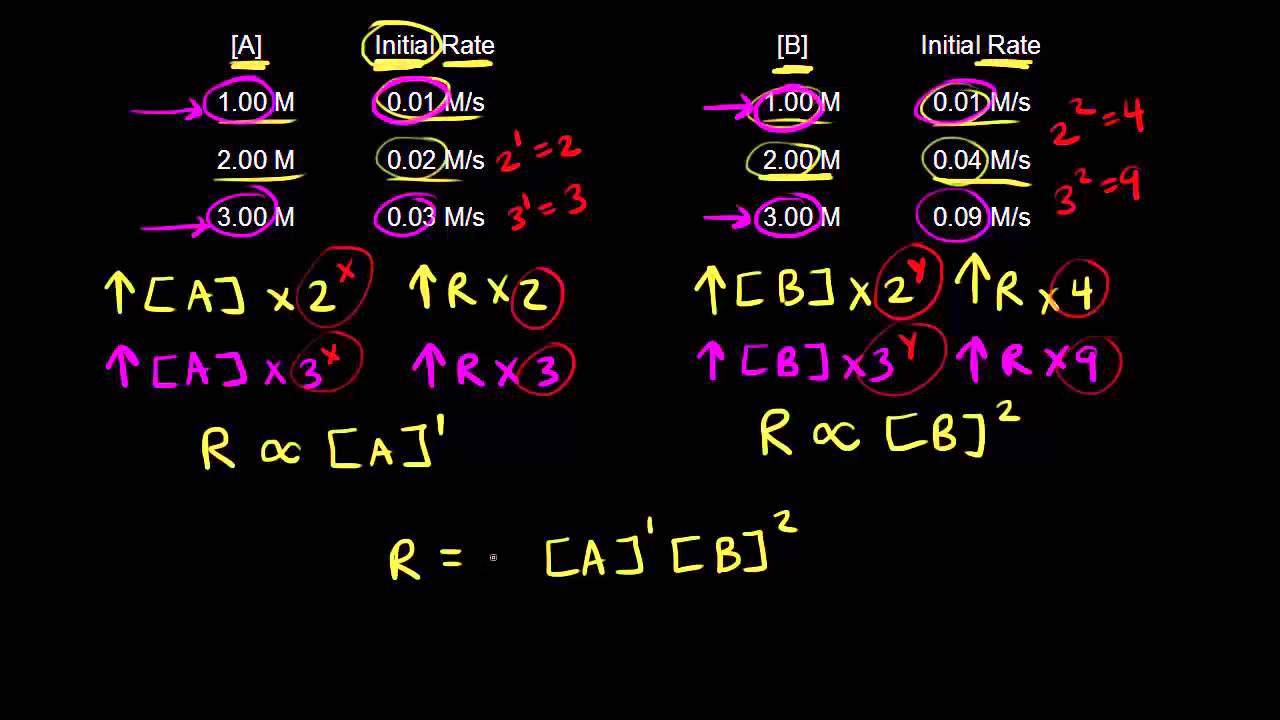
Why this video is valuable: This video introduces the empirical rate law (). It explains why the exponents ( and ) cannot be deduced from stoichiometry and must be determined experimentally. It walks you step-by-step through comparing experimental trials to isolate and solve for individual reaction orders.

Why this video is valuable: An outstanding, comprehensive deep-dive into integrated rate laws. This video shows how to integrate the differential rate equations for zero-order (), first-order (), and second-order () systems. It explains half-life formulas and how to identify reaction orders using linear plots.
Why this video is valuable: This video provides structured practice for determining overall reaction orders, rate constant units, and integrated rate law calculations. Chad’s methodical teaching style clarifies common algebraic pitfalls and helps you quickly solve initial rate problems during exams.
Module 2 Knowledge Checkpoint
- Determine the units of the rate constant for zero, first, second, and third-order reactions.
- Given experimental trials with varying initial reactant concentrations and initial rates, calculate the order with respect to each reactant, the overall order, and the value of .
- State which graphical plot (, , or ) yields a straight line for zero, first, and second-order reactions.
- Derive the half-life () equations for first and second-order reactions starting from their integrated rate laws.
Module 3: Temperature Dependence and Activation Energy
Temperature has a profound effect on reaction rates. This module covers the mathematical framework of this relationship, focusing on the Arrhenius equation, the Maxwell-Boltzmann energy distribution, and Transition State Theory. You will learn to calculate activation energy () and frequency factors () using both graphical and algebraic two-point methods.
Recommended Videos

Why this video is valuable: This video addresses a key visual gap in kinetics education: the Maxwell-Boltzmann distribution curve. It shows how the distribution of molecular kinetic energies shifts as temperature changes. It illustrates that even a modest temperature rise dramatically increases the fraction of molecules with kinetic energy exceeding the activation energy ().
Why this video is valuable: A clear tutorial on the mathematical mechanics of the Arrhenius equation: . It demonstrates how to linearize this non-linear equation into a straight-line form () to calculate from the slope of an Arrhenius plot.
Why this video is valuable: This video covers the practical algebraic application of the Arrhenius equation using its two-point form: . It walks you through calculating the activation energy directly from rate constants measured at two different temperatures without needing a full graph.
Module 3 Knowledge Checkpoint
- Draw a Maxwell-Boltzmann distribution curve for a gas sample at a low temperature and a high temperature . Shade the region representing molecules that can react.
- Identify all variables, constants, and units in the linear form of the Arrhenius equation, and specify what the slope and y-intercept represent on a plot of versus .
- A reaction rate triples when the temperature is raised from to . Calculate the activation energy () of the reaction using the two-point Arrhenius equation.
- Describe the physical nature of an activated complex (transition state) and locate it on a reaction coordinate diagram.
Module 4: Reaction Mechanisms and Elementary Steps
Most chemical reactions do not occur in a single step. This module focuses on reaction mechanisms, elementary steps, molecularity, and reaction intermediates. You will learn how to deduce overall rate laws from proposed mechanisms using both the rate-determining step method and the pre-equilibrium approximation.
Recommended Videos
Why this video is valuable: This video provides a thorough introduction to elementary steps (unimolecular, bimolecular) and reaction coordinate diagrams for multi-step mechanisms. It shows how to identify reaction intermediates versus catalysts and explains why the slowest elementary step acts as the rate-determining step.

Why this video is valuable: This video addresses a key advanced topic in chemical kinetics: writing rate laws when the slow step is preceded by a fast reversible step. It explains why intermediate concentrations cannot appear in a final rate law and demonstrates how to use the pre-equilibrium approximation to substitute them with reactant concentrations.
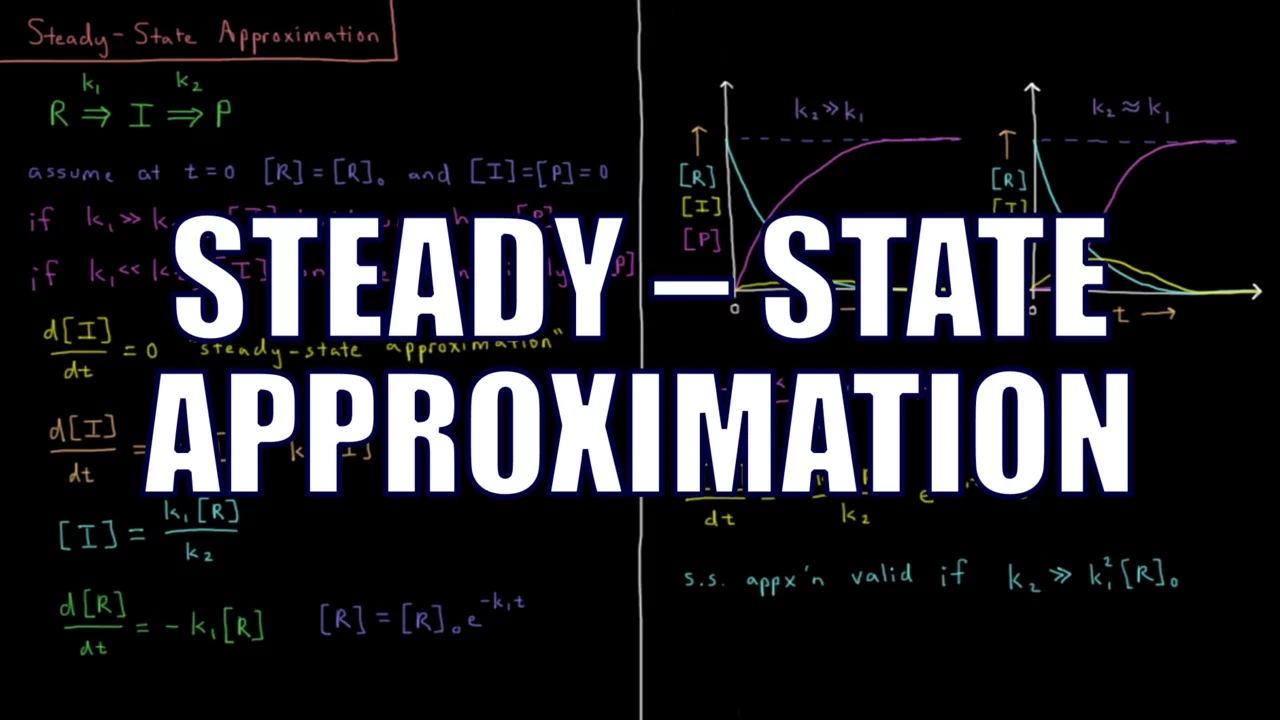
Why this video is valuable: This video introduces the steady-state approximation, a more general approach than pre-equilibrium. It shows how setting the net rate of change of an intermediate concentration to zero () allows you to derive rate laws for complex, multi-step mechanisms.
Module 4 Knowledge Checkpoint
- Define "molecularity" and explain how it differs from the overall empirical reaction order.
- Differentiate between a reaction intermediate and a catalyst based on how they appear in a reaction mechanism and a reaction coordinate diagram.
- For the proposed mechanism: Derive the rate law for the formation of using the pre-equilibrium approximation.
- Write down the mathematical assumption that defines the Steady-State Approximation for a highly reactive intermediate .
Module 5: Principles of Catalysis and Enzyme Kinetics
This module bridges chemistry and biochemistry by examining how catalysts accelerate reaction rates. You will study homogeneous versus heterogeneous catalysis, analyze how catalysts alter transition states on activation energy diagrams, and master the Michaelis-Menten kinetic model for enzyme-catalyzed reactions.
Recommended Videos
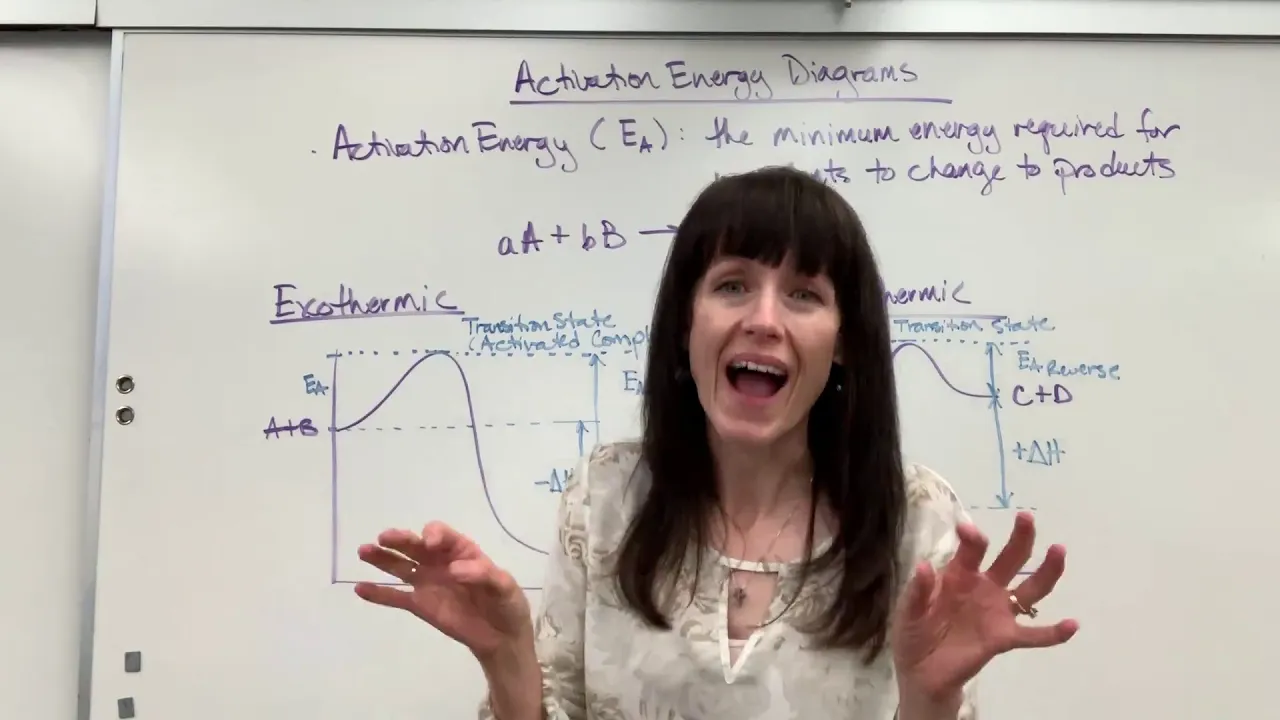
Why this video is valuable: This quick visual guide contrasts catalyzed and uncatalyzed pathways on an activation energy diagram. It reinforces that a catalyst provides an alternative reaction pathway with a lower activation energy, without changing the net thermodynamic free energy ( or ) of the reaction.

Why this video is valuable: This video provides an excellent introduction to enzyme kinetics. It explains the hyperbolic relationship between reaction velocity () and substrate concentration (), defines and , and shows how the Michaelis-Menten equation is constructed.
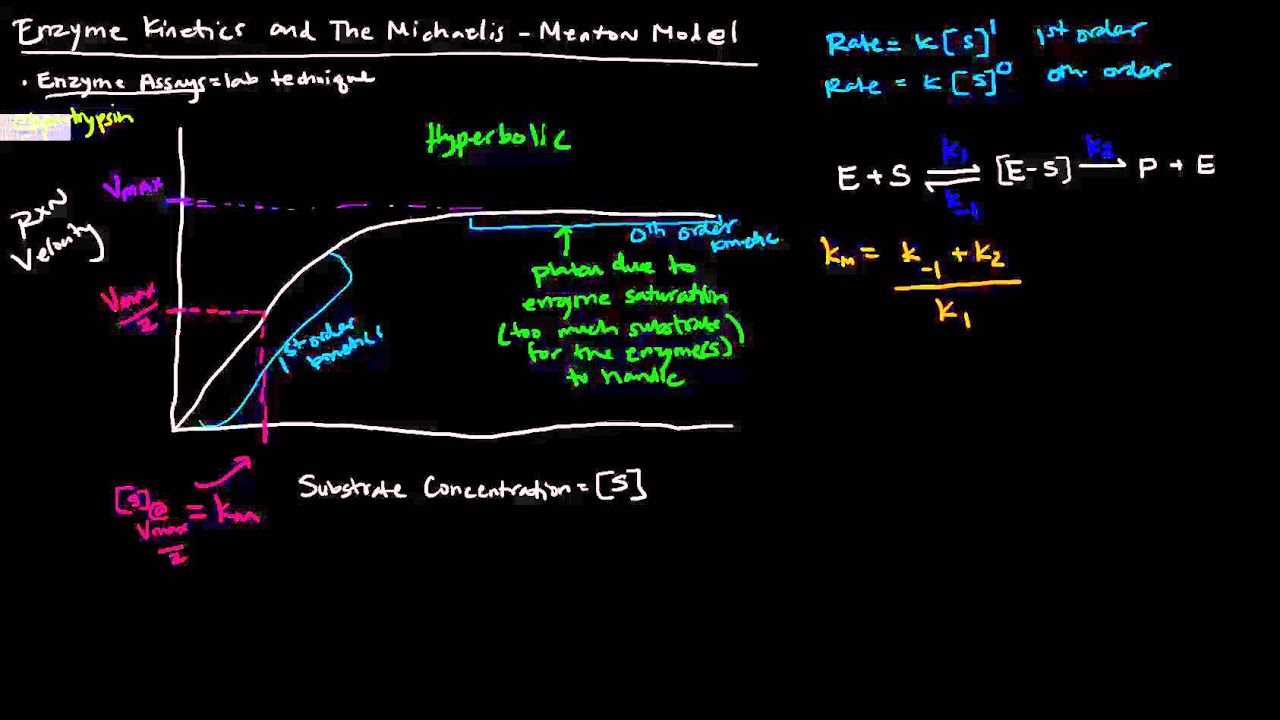
Why this video is valuable: This lecture derives the Michaelis-Menten equation using the steady-state assumption for the enzyme-substrate complex (). It walks you through the algebra step-by-step and explains the physical meaning of the Michaelis constant () as an indicator of enzyme-substrate affinity.
Module 5 Knowledge Checkpoint
- Draw an energy coordinate diagram comparing an uncatalyzed reaction to a catalyzed reaction, labeling the reactants, products, transition states, and activation energies.
- State the Michaelis-Menten equation and define each of its terms (, , , and ) with their standard units.
- Explain the physical significance of . What does a high value indicate about the affinity between an enzyme and its substrate?
- Differentiate between homogeneous and heterogeneous catalysis, providing a chemical example of each.
Module 6: Industrial Catalysis and Reactor Engineering
This module applies chemical kinetics to large-scale chemical processes. You will study gas-solid heterogeneous catalysis via the Langmuir-Hinshelwood mechanism, explore historic processes like the Haber-Bosch process, and learn how chemical kinetics governs the design of three industrial reactor types: Batch, Continuous Stirred-Tank (CSTR), and Plug Flow Reactors (PFR).
Recommended Videos

Why this video is valuable: This video introduces the Langmuir-Hinshelwood mechanism, the standard model for surface-catalyzed gas reactions. It explains the sequential steps of reactant adsorption onto active surface sites, surface reaction between adjacent adsorbed species, and product desorption.

Why this video is valuable: This video addresses the reactor engineering gap. It derives the fundamental material balances and design equations for three key industrial reactor configurations: Batch reactors, CSTRs (Continuous Stirred-Tank), and PFRs (Plug Flow). It shows how to link reaction rates () directly to reactor volume or residence time.
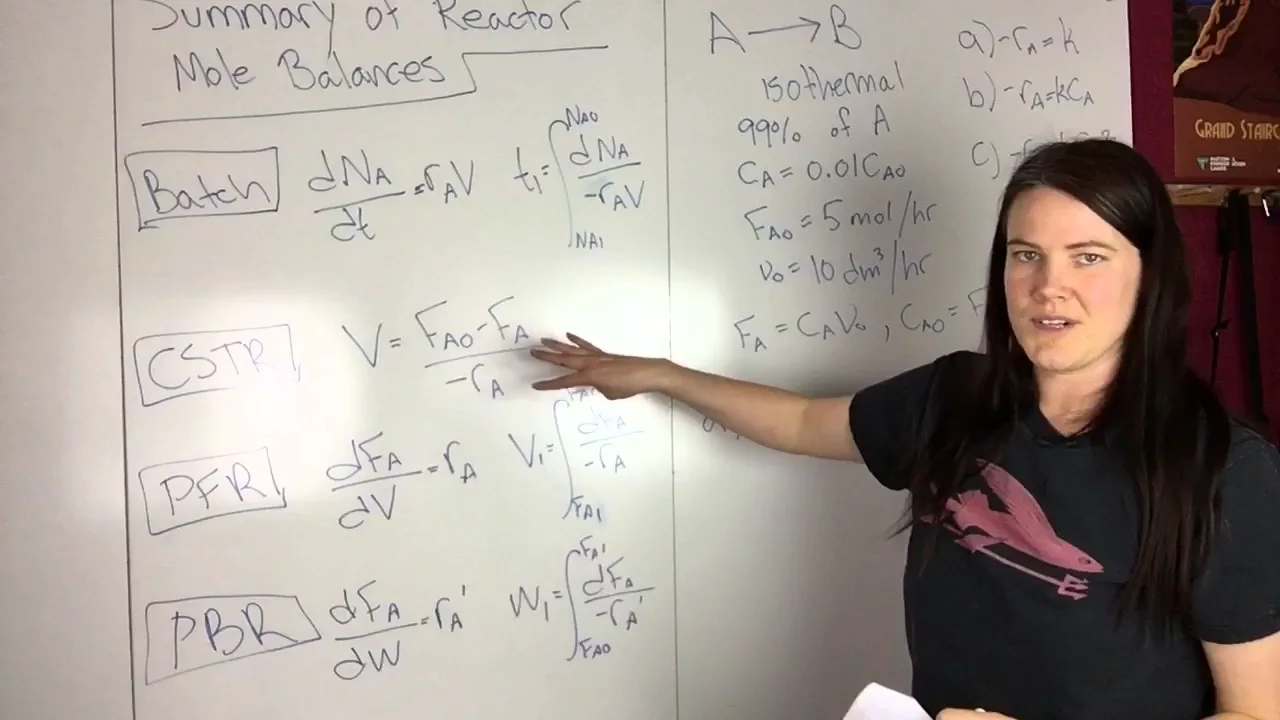
Why this video is valuable: A highly practical numerical problem-solving video. It walks you through calculations to determine the required reactor volume for a CSTR and PFR, as well as the processing time for a Batch reactor, given a target conversion level and a specific kinetic rate law.

Why this video is valuable: This video provides historical and physical context for the Haber-Bosch process. It explains how high-pressure engineering and iron-based catalysts overcame the high activation energy of breaking atmospheric nitrogen's triple bond () to synthesize ammonia on an industrial scale.
Module 6 Knowledge Checkpoint
- Outline the five key steps of a heterogeneous catalytic reaction on a solid surface.
- Derive the design equation for a Continuous Stirred-Tank Reactor (CSTR) starting from a general molar balance: .
- Explain how a Plug Flow Reactor (PFR) differs from a CSTR in terms of concentration profile along its length, and write its integral design equation: .
- Explain why the Haber-Bosch process requires high pressures () and moderate temperatures () to balance reaction kinetics with thermodynamic equilibrium.
Course Map
This flowchart shows the recommended study progression and the dependencies between modules:
Key People Index
- Svante Arrhenius (1859–1927): Swedish scientist who developed the Arrhenius equation, quantifying the relationship between temperature, activation energy, and reaction rate constants.
- Leonor Michaelis (1875–1949) & Maud Menten (1879–1960): Developed the Michaelis-Menten kinetic model, which remains the mathematical foundation for understanding enzyme catalysis and substrate binding.
- Fritz Haber (1868–1934) & Carl Bosch (1874–1940): German chemists who designed the high-pressure heterogeneous catalytic process for ammonia synthesis, which revolutionized modern agriculture and industrial chemical engineering.
- Irving Langmuir (1881–1957) & Cyril Hinshelwood (1897–1967): Developed the Langmuir-Hinshelwood kinetics model, establishing how gas molecules adsorb, react, and desorb on solid catalyst surfaces.
Final Self-Assessment
Test your understanding of the entire curriculum with this comprehensive self-assessment checklist:
- Stoichiometric Relative Rates: Given the reaction , can you express the instantaneous rate of consumption of relative to the rate of formation of ?
- Deducing Rate Laws: Can you use the Method of Initial Rates to determine reaction orders from experimental concentration and rate data?
- Linear Integrated Equations: Can you select the correct graphical plot to identify zero, first, and second-order kinetics, and use the slope to determine the rate constant ?
- Arrhenius Calculations: Can you calculate a reaction's activation energy () using the rate constants at two different temperatures?
- Transition State Theory: Can you sketch a reaction coordinate diagram and identify the difference in free energy () versus activation energy ()?
- Pre-Equilibrium Approximation: Can you derive a rate law for a multi-step reaction where a fast reversible step precedes the rate-limiting step?
- Steady-State Approximation: Can you apply the steady-state assumption () to find the rate equation for a mechanism with a highly reactive intermediate?
- Michaelis-Menten Parameters: Can you define and from a hyperbolic reaction velocity plot and describe enzyme saturation?
- Catalytic Surface Mechanisms: Can you explain the difference between the Langmuir-Hinshelwood and Eley-Rideal heterogeneous catalytic pathways?
- Reactor Design Comparison: Can you write the design equations for Batch, CSTR, and PFR reactors, and explain how the spatial concentration profile differs between a CSTR and a PFR?