Acid Mine Drainage: Passive Bioreactor Design
Learning Goal: Investigate the chemical pathways of acid mine drainage (AMD) in abandoned coal mines and design a passive bioreactor treatment system to neutralize pH and precipitate toxic heavy metals.
This video-based, comprehensive curriculum guides students from basic chemical engineering principles to field-level environmental remediation design. By combining rigorous physical chemistry, microbiology, and civil engineering, you will learn to tackle one of the mining sector's most persistent ecological disasters.
- Prerequisites: High school chemistry (balancing equations, basic stoichiometry).
- Estimated Study Time: 25 Hours (including video lessons, core reading, and design calculations).
Module 1: General Chemistry Foundations: pH, Redox & Solubility
To remediate Acid Mine Drainage (AMD), we must first understand the fundamental aqueous chemistry that governs it. This module covers pH/pOH logarithmic scales, oxidation-reduction (redox) reactions, and the solubility product constant (), which defines the thermodynamic limit of metal dissolution.
Recommended Videos

- Why this video is valuable: It establishes the core logarithmic math behind hydronium () and hydroxide () ion concentrations, defining the relationship which is critical for measuring mine water acidity.
- Why this video is valuable: AMD is fundamentally driven by the transfer of electrons. This tutorial provides a quick, clear refresher on identifying which elements gain and lose electrons in redox reactions—a prerequisite for understanding pyrite oxidation.
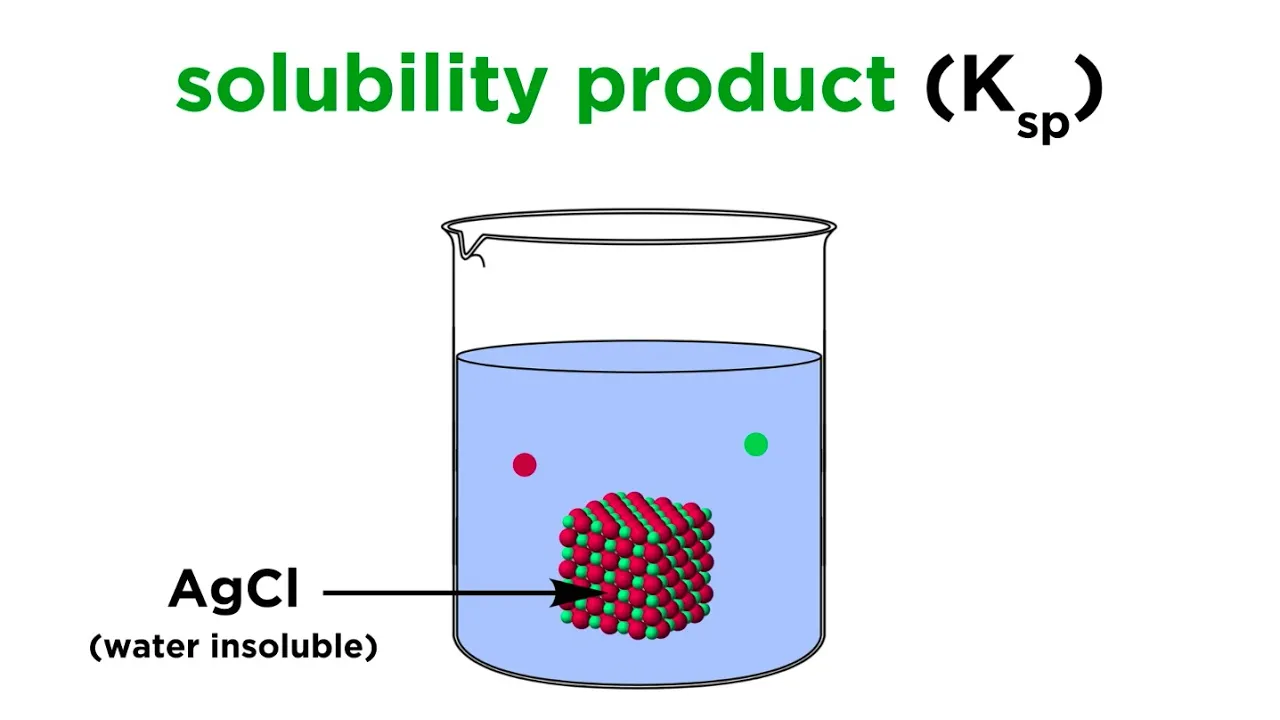
- Why this video is valuable: It explains the equilibrium of sparingly soluble salts. In bioreactors, we force dissolved heavy metals back into solid forms; calculating tells us the exact concentration of ions that remain dissolved at chemical equilibrium.
Gap-Filling Academic Notes: and Common Ion Effect
The solubility product constant () represents the mathematical limit of a solid compound's dissolution in aqueous solution:
If the ion product (Reaction Quotient, ) exceeds , precipitation occurs (). Under the Common Ion Effect, adding an excess of an anion (such as sulfide, , or hydroxide, ) drastically decreases the solubility of the target metal cation (), forcing it out of solution.
Module 1 Knowledge Checkpoint
- Calculate the pH of a mine effluent sample given a hydronium ion concentration of .
- Identify which chemical species is oxidized and which is reduced in a basic iron-oxygen system.
- Set up the equilibrium expression for Iron(III) Hydroxide: .
Module 2: Chemical Pathways of Acid Mine Drainage
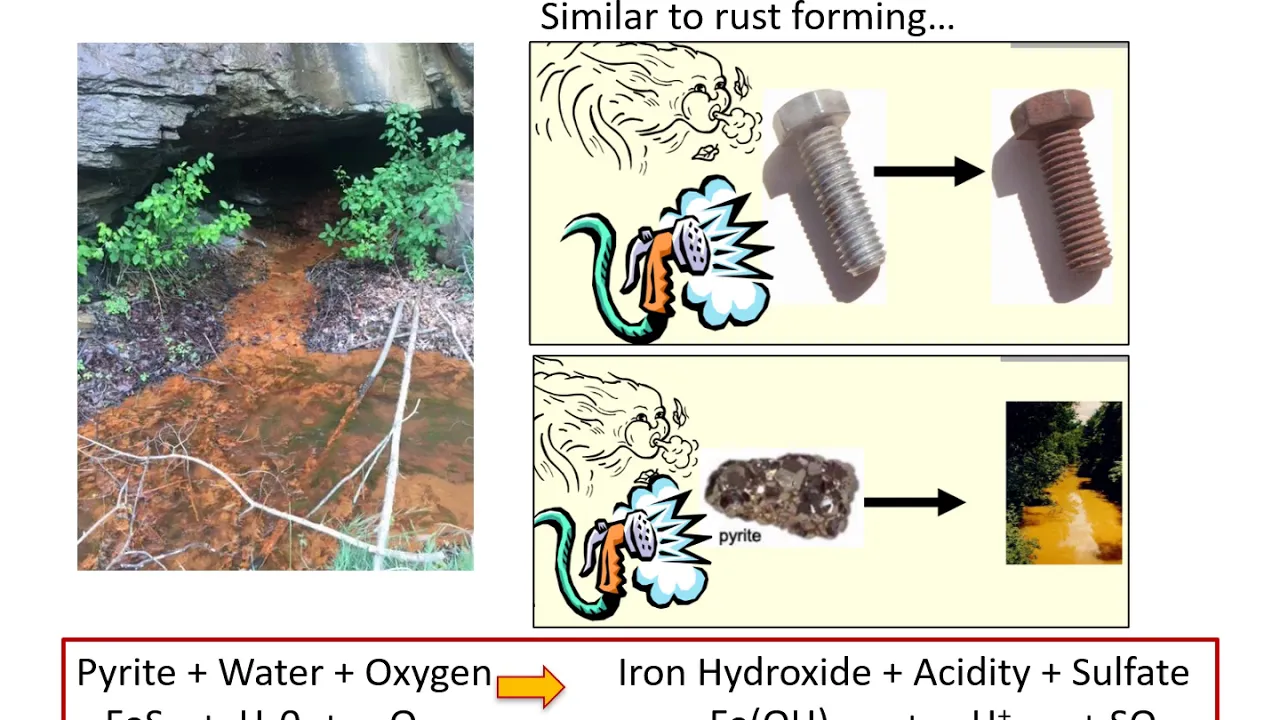
When underground coal seams are mined, previously stable pyrite () is exposed to oxygen and water. This module investigates the abiotic and biotic oxidation pathways of pyrite, the generation of sulfuric acid, and the catalyzing role of acidophilic extremophiles like Acidithiobacillus ferrooxidans.
Recommended Videos
- Why this video is valuable: This video offers a clear visual and conceptual overview of the physical impact of AMD, showing how pyrite oxidation leads to the thick, orange-colored ferric hydroxide deposits known as "yellow boy."

- Why this video is valuable: A quick but highly technical USGS presentation mapping out the specific iron-to-sulfur stoichiometric ratio in pyrite and detailing how sulfur's oxidation state generates excess acidity.

- Why this video is valuable: This lecture segment provides an academic breakdown contrasting the abiotic (slow) and biotic (biologically accelerated) pathways of pyrite breakdown.

- Why this video is valuable: It focuses specifically on the biology of Acidithiobacillus ferrooxidans, showing how these acidophilic bacteria utilize ferrous iron () as an electron donor, accelerating the cycle of AMD generation.
Step-by-Step Pyrite Dissolution Pathways
The chemical pathways of AMD occur via four distinct steps:
-
Abiotic Oxidation of Pyrite (Initial Step): Pyrite is oxidized by dissolved oxygen, releasing ferrous iron (), sulfate, and acidity.
-
Oxidation of Ferrous to Ferric Iron (Rate-Limiting Step): At low pH (pH < 4.0), this abiotic oxidation is extremely slow. However, Acidithiobacillus ferrooxidans catalyzes this step, increasing the reaction rate by up to 100,000 times to capture metabolic energy.
-
Hydrolysis and Precipitation of Ferric Iron: Ferric iron hydrolyzes to form solid ferric hydroxide ("yellow boy"), generating three moles of for every mole of precipitated.
-
Autocatalytic Propagation (Ferric Iron as Oxidant): In the absence of oxygen, dissolved ferric iron () acts as a highly potent oxidant, directly attacking remaining pyrite and accelerating the acid-generation loop.
          [ Pyrite (FeS2) ]
            /           \
  (O2 + H2O)             (14 Fe3+)  <-- Autocatalytic loop
          /               \
         v                 v
    [ Fe2+ ] ---------> [ Fe3+ ] ---> [ Fe(OH)3 (s) ] (Yellow Boy)
              (Bacteria)                + Generates more H+
Module 2 Knowledge Checkpoint
- Write balanced chemical equations for both the abiotic oxygen-based and ferric-iron-driven oxidation of pyrite.
- Explain how Acidithiobacillus ferrooxidans benefits metabolically from low pH conditions and the oxidation of .
- Identify the solid mineral name and appearance of the precipitate formed in Step 3 of the pathway.
Module 3: Environmental Chemistry of Heavy Metals in AMD
Acidic mine water dissolves toxic metals from surrounding geological formations. Remediation requires adjusting the pH to shift the equilibrium from dissolved ions to solid metal hydroxides. This module details the specific precipitation pH thresholds for iron, aluminum, and manganese.
Recommended Videos

- Why this video is valuable: It demonstrates the direct impact of pH on solubility equilibria using ICE tables. This quantitative foundation is key to understanding how changing pH can alter the solubility of dissolved metals.

- Why this video is valuable: It demonstrates how raising the pH using hydroxide sources causes the immediate precipitation of transition metals (specifically, hydrated ferric oxide) as highly insoluble gelatinous solids.
Metal Hydroxide Solubility pH Thresholds
In a passive or active neutralization system, the pH must be elevated to specific thresholds to remove dissolved metals. Metals precipitate as hydroxides:
Because the values of these metal hydroxides vary by orders of magnitude, they precipitate at distinct, sequential pH values:
| Metal Ion | Target Precipitate | Optimal Precipitation pH | Engineering/Environmental Significance |
|---|---|---|---|
| Ferric Iron () | 2.5 – 3.5 | Precipitates first; can coat and clog downstream limestone systems. | |
| Aluminum () | 4.5 – 5.5 | Forms a white, gelatinous floc; highly toxic to aquatic life (clogs gills). | |
| Ferrous Iron () | 8.0 – 9.0 | Requires significant pH elevation unless oxidized to first. | |
| Manganese () | 9.0 – 10.0 | Extremely difficult to remove passively; requires high pH or specialized bacteria. |
Metal Precipitation Sequence as pH Increases: [pH 2.0] ----------> [pH 4.5] ----------> [pH 8.0] ----------> [pH 9.5] | | | | Fe(III) Al(III) Fe(II) Mn(II) precipitates precipitates precipitates precipitates
Module 3 Knowledge Checkpoint
- Rank the following metals in order of their precipitation threshold from most acidic to most basic: , , , .
- Explain why is much easier to precipitate at lower pH than .
- Calculate the concentration of hydroxide ions required to begin precipitation of from a solution, given .
Module 4: Passive Treatment Technologies Overview
Passive systems utilize natural energy sources, gravity-fed hydraulics, and local geochemical/biological reactions to treat AMD without requiring continuous chemical dosing. This module contrasts Anoxic Limestone Drains (ALDs), Successive Alkalinity Producing Systems (SAPS), and constructed wetlands.
Recommended Videos

- Why this video is valuable: It introduces the practical limitations of simple limestone treatment, illustrating how ALDs fail when mine water has high oxygen and metal concentrations due to precipitate armor.
- Why this video is valuable: This video reviews passive design methods, detailing aerobic wetlands and passive limestone channels used to remediate long-term environmental hazards.

- Why this video is valuable: It provides a comprehensive engineering layout of constructed wetlands, showing the mechanics of gravel-bed filtration, plant root interfaces, and microbial biofilms.
Core Comparison of Passive Technologies
To design an effective treatment train, an engineer must select the correct technology based on water chemistry:
- Anoxic Limestone Drains (ALDs):
- Mechanism: Buried, sealed beds of limestone () gravel. The absence of oxygen prevents from oxidizing to , preventing the precipitation of solid within the bed, which would otherwise armor the limestone and clog flow channels.
- Limitation: Requires dissolved oxygen (DO) and low aluminum/ferric iron.
- Successive Alkalinity Producing Systems (SAPS):
- Mechanism: Combines anaerobic biological treatment with limestone dissolution. Water ponds over an organic substrate layer (which consumes oxygen and reduces to ), then flows downward through a limestone bed to pick up alkalinity before discharging to an aerobic settling basin.
- Constructed Aerobic Wetlands:
- Mechanism: Shallow, surface-flow systems planted with emergent vegetation (e.g., Typha latifolia). Designed to aerate water, allowing to oxidize to and settle out naturally as ferric hydroxide over a large surface area.
Module 4 Knowledge Checkpoint
- Explain why oxygen must be kept out of an Anoxic Limestone Drain (ALD).
- Draw a cross-sectional diagram of a SAPS, detailing the water level, organic substrate layer, limestone layer, and drainage pipes.
- Determine which technology is most suitable for mine water with , , and high concentrations.
Module 5: Bioreactor Design: Sulfate-Reducing Bacteria
For highly acidic, metal-rich AMD that cannot be treated with simple limestone drains, Sulfate-Reducing Bioreactors (SRBs) offer an elegant biochemical alternative. This module details how anaerobic heterotrophic bacteria utilize organic carbon to reduce sulfate to sulfide, generating carbonate alkalinity and precipitating metals as highly stable sulfides.
Recommended Videos

- Why this video is valuable: Explains the physical construction of an upflow sulfate-reducing bioreactor using limestone, mushroom compost, and gravel to maximize hydraulic conductivity and biological surface area.

- Why this video is valuable: A brief high-level overview from a leading researcher on utilizing biogenic hydrogen sulfide () produced by anaerobic reactors to selectively precipitate and recover valuable metals from waste streams.

- Why this video is valuable: Provides a simple visual demonstration of how biogenic hydrogen sulfide gas reacts instantly with dissolved transition metals to produce dark, insoluble metal sulfides.
Biochemical Pathways of Sulfate-Reducing Bacteria (SRB)
Sulfate-reducing bioreactors host anaerobic bacteria (such as Desulfovibrio or Desulfotomaculum) that use sulfate as a terminal electron acceptor and organic matter as an electron donor.
Step 1: Organic Oxidation and Sulfate Reduction
Using a simplified organic carbohydrate formula (), the metabolic process is:
- Carbonate Alkalinity Generation: Every mole of sulfate reduced generates two moles of bicarbonate (), which directly neutralizes acidic ions in the incoming AMD, elevating the pH:
- Hydrogen Sulfide Production: The reaction produces biogenic hydrogen sulfide ( / ).
Step 2: Metal Sulfide Precipitation
The generated reacts with dissolved divalent metals (, e.g., , , , ) in the system:
- Extreme insolubility: Metal sulfides () have exceptionally low solubility product constants ( values are orders of magnitude lower than those of metal hydroxides). They remain highly stable and insoluble even if the pH drops slightly, preventing the remobilization of heavy metals into the environment.
Module 5 Knowledge Checkpoint
- Write out the balanced biochemical reaction showing how lactate () oxidation drives sulfate reduction by SRBs.
- Compare the stability of metal sulfides versus metal hydroxides in fluctuating pH environments.
- Explain how biogenic carbonate alkalinity is generated in an anaerobic bioreactor.
Module 6: Engineering and Sizing Passive Bioreactors
Moving from chemistry to mechanical and civil engineering, this module focuses on calculating hydraulic retention times, designing organic substrate recipes, sizing bioreactor beds, and planning for long-term maintenance issues like preferential flow and clogging.
Recommended Videos

- Why this video is valuable: It highlights a successful field-scale mine reclamation project, demonstrating how engineers layered multiple organic media to naturally treat acidic water.

- Why this video is valuable: Analyzes structural aeration and substrate permeability in compost systems, translating directly to selecting media that prevents clogging in anaerobic bioreactor beds.
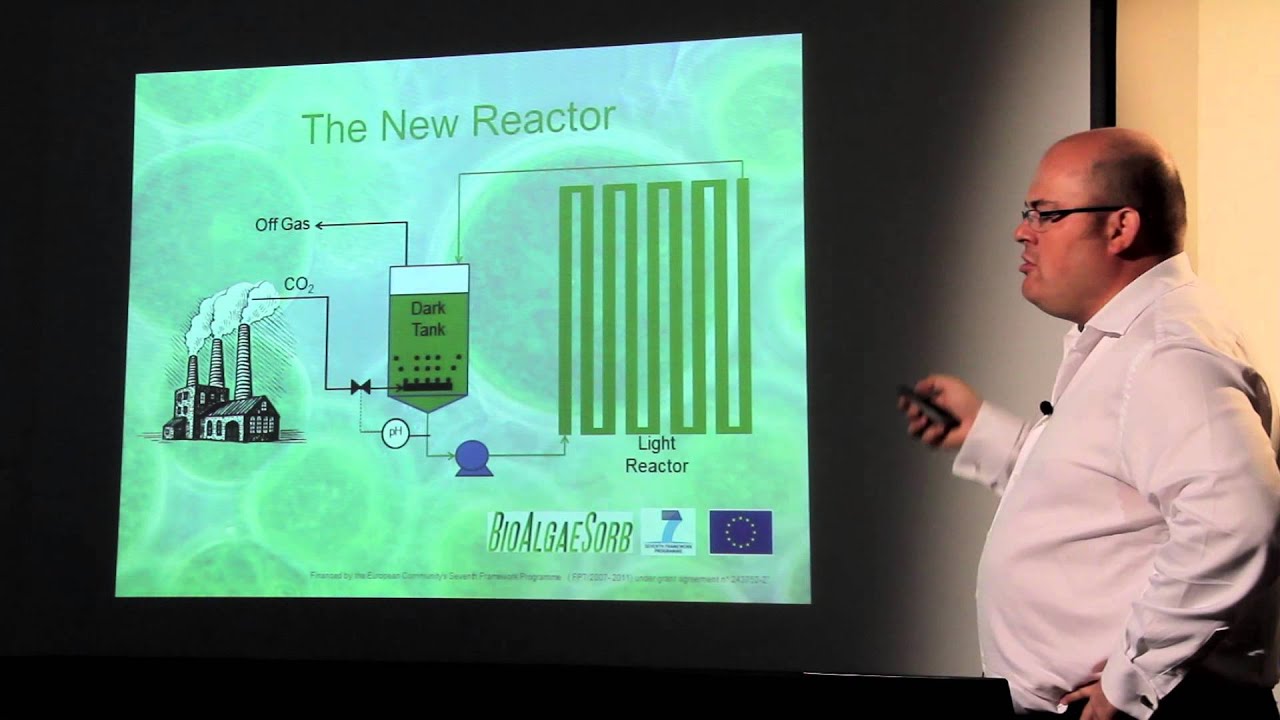
- Why this video is valuable: Focuses on industrial bioreactor design constraints, detailing safety requirements for handling toxic hydrogen sulfide gas () and managing biological scaling.
Quantitative Engineering Sizing Calculations
1. Volumetric Acidity Loading Rate ()
Engineers size passive bioreactors using an empirical volumetric acidity loading rate to prevent overloading the microbial community. The standard maximum design limit is .
Step A: Calculate Acid Load ( in g/day) Where:
- = Flow rate of AMD ()
- = Influent acidity concentration ( as equivalent)
Step B: Calculate Required Substrate Volume ( in )
2. Hydraulic Retention Time (HRT)
To ensure sufficient contact time for sulfate reduction, a minimum HRT of is typically targeted:
Where:
- = Effective porosity of the substrate mixture (typically to ).
3. Standard Organic Substrate Recipe
The bioreactor substrate must provide a balance between mechanical support, hydraulic permeability, short-term carbon availability, and long-term structural carbon:
- Spent Mushroom Compost or Aged Manure (): Provides high initial nutrient availability and inoculates the system with native SRBs.
- Wood Chips or Sawdust (): Slow-release, complex cellulose carbon source to sustain microbial activity over a year operational life.
- Limestone Sand/Gravel (): Adds supplemental alkalinity and structural stability to prevent compaction.
- Pea Gravel or Sand (): Maintains hydraulic conductivity and prevents preferential flow paths (channeling).
Module 6 Knowledge Checkpoint
- Calculate the required substrate volume () and the resulting HRT for an AMD stream flowing at with an acidity of , assuming an of and a substrate porosity () of .
- Explain how a high concentration of wood chips provides long-term operational viability for the bioreactor.
- Identify two key causes of engineering failure in field passive bioreactors and suggest maintenance designs to mitigate them.
Course Map
Below is the conceptual flow of the curriculum. Each module serves as a mandatory prerequisite for the next, moving from fundamental physical chemistry to biological mechanics, and finally to applied field-scale civil engineering.
Key People Index
- Dr. Piet Lens (Professor of Environmental Biotechnology)
- Context: Featured in Module 5 (Video 19). A global authority on the sulfur cycle and the engineering of anaerobic systems for selective metal recovery and wastewater treatment.
- Dr. Ana Santos (Researcher in Bioremediation)
- Context: Featured in Video 9. Expert in utilizing acidophilic and sulfate-reducing biological systems for the extraction and recovery of heavy metals from industrial mine tailings.
- Dr. Darren Oatley (Biochemical Engineer)
- Context: Featured in Module 6 (Video 87). Specialist in industrial scale-up constraints, gas transfer safety, and fluid dynamics in complex biological reactors.
Final Self-Assessment
Test your mastery of the complete "Acid Mine Drainage: Passive Bioreactor Design" curriculum. You should be able to check off every item before proceeding to field work or advanced research:
- Fundamentals: Can you calculate the pH, pOH, and expected solubility of transition metal complexes given raw values?
- Pyrite Pathway: Can you write out the four chemical steps of pyrite oxidation and explain why ferric iron acts as an autocatalytic driver?
- Biological Catalysis: Can you describe how Acidithiobacillus ferrooxidans accelerates AMD formation under highly acidic conditions?
- Solubility Curves: Do you know the specific pH values where , , , and precipitate as solid hydroxides?
- SAPS vs. ALD: Can you explain the structural and chemical differences between Anoxic Limestone Drains and Successive Alkalinity Producing Systems?
- Sulfate Reduction: Can you write the stoichiometry of biological sulfate reduction, proving that it generates twice the carbonate alkalinity per mole of sulfate reduced?
- Sulfide Stability: Can you explain why metal sulfide precipitates () are thermodynamically more stable than metal hydroxides ()?
- Bioreactor Sizing: Can you size a passive bioreactor bed () based on influent acidity loading rates and calculate hydraulic retention time (HRT)?
- Substrate Mix: Can you design a field-ready, multi-layered compost-limestone-woodchip substrate recipe that mitigates preferential flow and compaction?