Quantum Mechanics: Waves, States & Spin
Learning Goal: Understanding Quantum Mechanics: Wave-particle duality, superposition, quantum entanglement, and subatomic mechanics.
This curriculum is designed to take you from a classical understanding of the universe into the weird, counterintuitive world of the quantum. You will learn why classical mechanics fails at the subatomic level, how particles behave as waves (and vice versa), the mathematical formulation of quantum states, the limits of physical measurement, and the foundational elements of particle physics.
- Prerequisites: High school-level algebra and basic classical physics (forces, waves, and electromagnetism).
- Estimated Study Time: 16 hours.
Module 1: The Dawn of Quantum Physics
This module covers the historical transition from classical physics to quantum theory. You will understand how phenomena like blackbody radiation and the ultraviolet catastrophe forced physicists to discard continuous energy models in favor of quantized energy states.
Recommended Videos
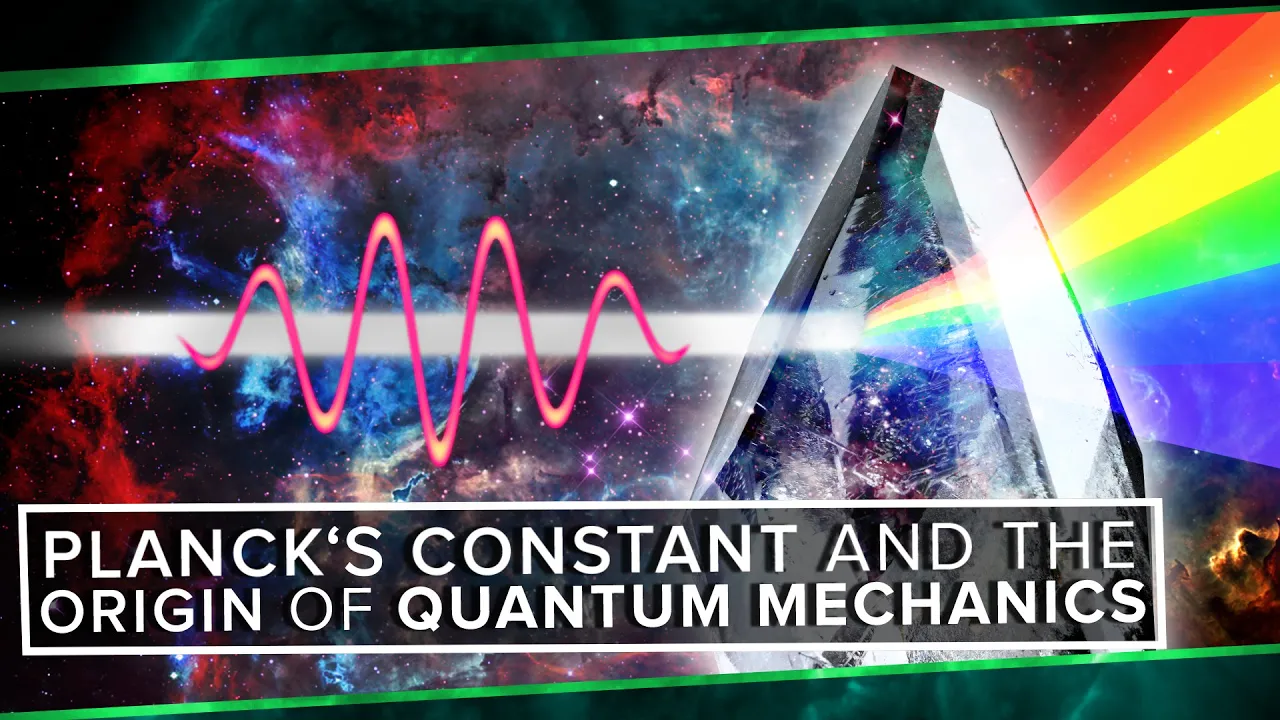
- Why this video: It bridges classical thermodynamics with quantum theory by showing how thermal radiation spectrums could not be mathematically resolved without quantized energy packets, introducing Max Planck's foundational constant ().

- Why this video: It offers a concise breakdown of the "ultraviolet catastrophe"—the catastrophic classical prediction that an ideal blackbody would radiate infinite energy at high frequencies. It explains how Planck resolved this by limiting atomic oscillators to discrete energy levels.
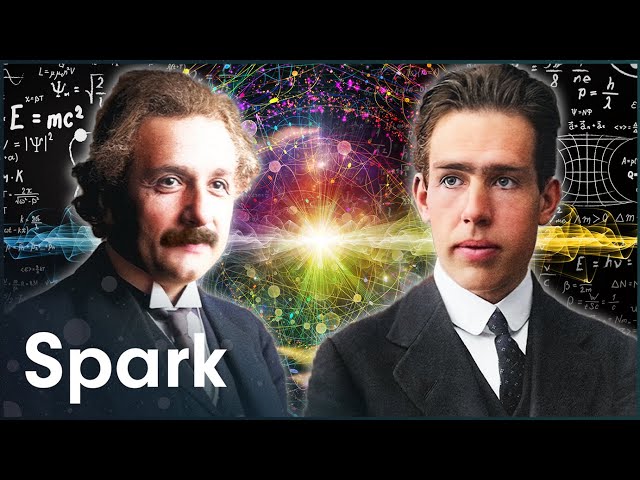
- Why this video: It outlines the historical clash between Albert Einstein and Niels Bohr regarding the nature of reality. It sets the stage for understanding the philosophical divide between determinism and quantum probability.
Knowledge Checkpoint
- Explain why classical physics predicted infinite energy emissions at ultraviolet wavelengths (the Ultraviolet Catastrophe).
- Define Planck's constant () and explain what it means for energy to be "quantized."
- Describe the core difference between Einstein's and Bohr's views on physical reality prior to observation.
Module 2: Wave-Particle Duality
Here, you will explore the experimental evidence showing that light behaves as a stream of particles (photons) and that massive particles (like electrons) behave like waves. This module introduces the photoelectric effect, the de Broglie wavelength, and the famous double-slit experiment.
Recommended Videos
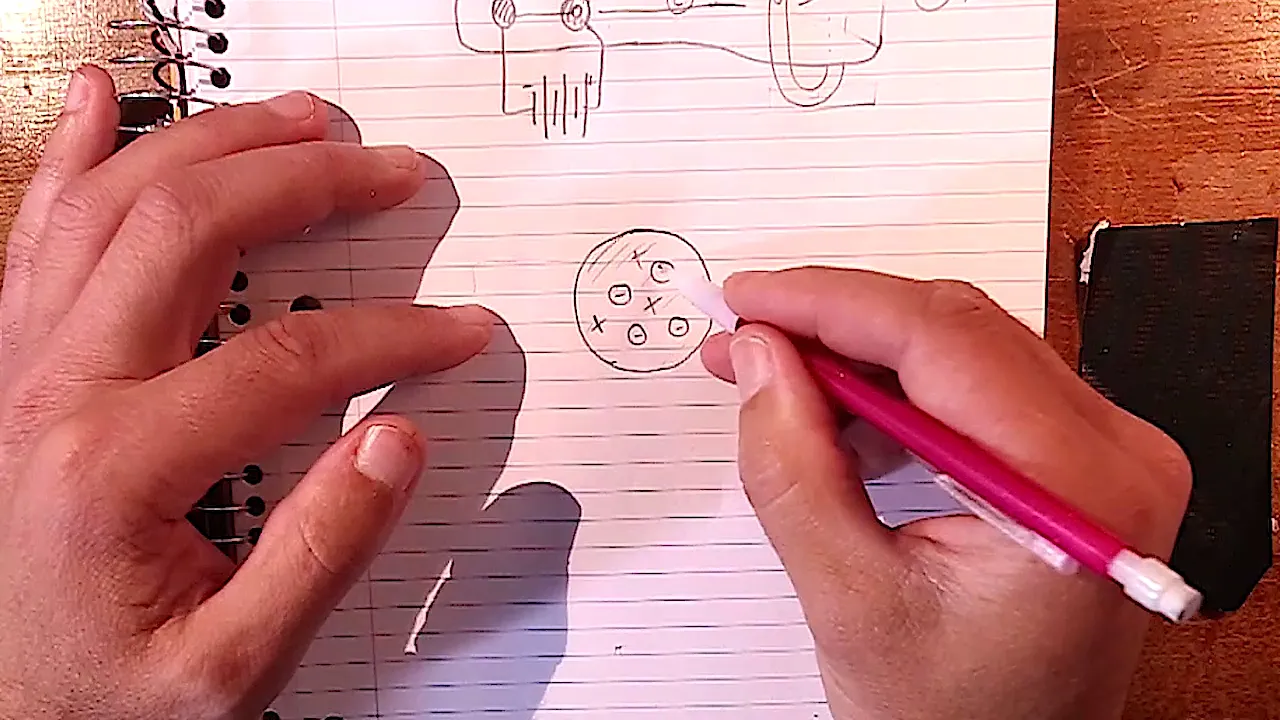
- Why this video: It provides a direct, conceptual analysis of how Einstein resolved the photoelectric effect. By proving light is made of discrete packets (photons) with energy proportional to frequency (), it demonstrates the particle nature of light.
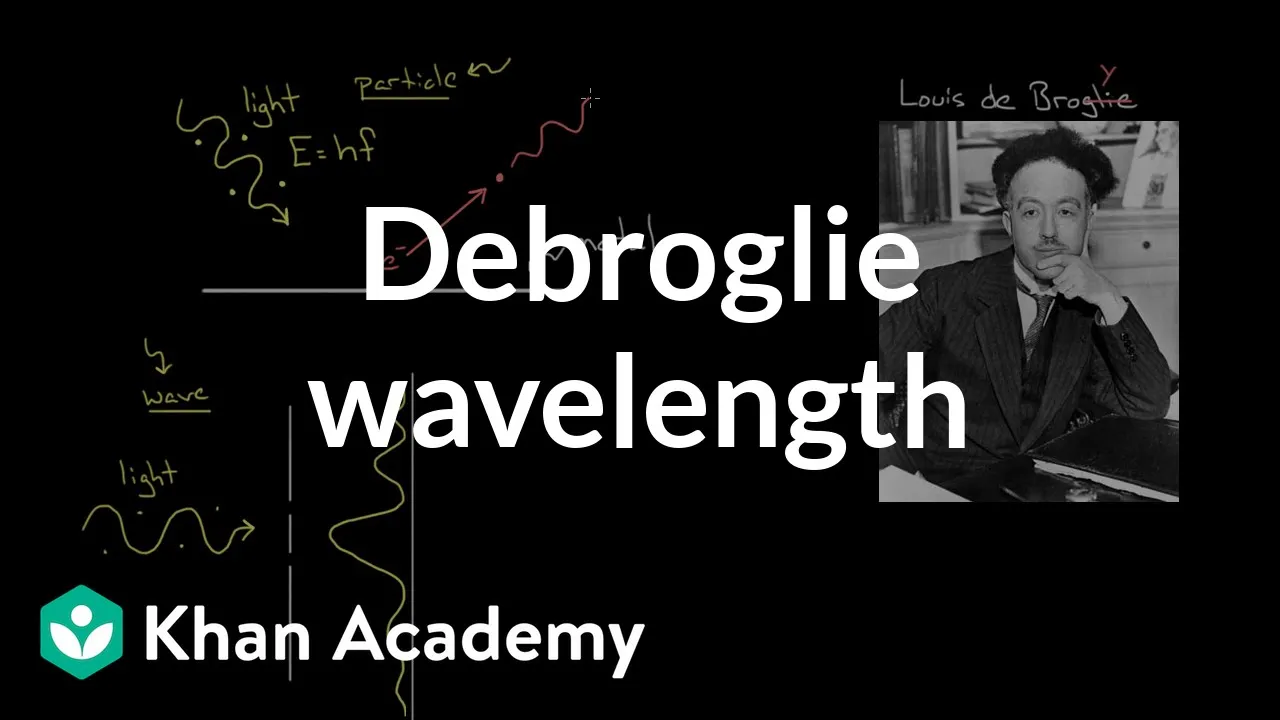
- Why this video: It explains de Broglie's mathematical hypothesis that if light waves have particle properties, matter particles must have wave properties. It walks through calculating the de Broglie wavelength ().
- Why this video: A comprehensive look at the double-slit experiment. It illustrates how firing single electrons through two slits still produces an interference pattern, proving that matter travels as a probability wave.
Knowledge Checkpoint
- Explain why the photoelectric effect cannot be explained using classical wave theory of light.
- Calculate the de Broglie wavelength of an electron given its momentum, using the formula .
- Describe the resulting pattern on a detector screen when individual electrons are shot through a double slit without being observed.
Module 3: The Wave Function and Superposition
This module transitions into the mathematics of quantum states. You will study Schrödinger’s wave function (), learn about probability densities, and explore the paradox of superposition through Schrödinger’s Cat.
Recommended Videos

- Why this video: This video addresses the feedback gap. It focuses on the actual physical and mathematical meaning of Erwin Schrödinger's wave function, highlighting why it is a mathematical tool to describe probabilities rather than a physical wave of matter.
- Why this video: This video addresses the feedback gap. It explains how to transition from the wave function value () to actual probability density () using Born's Rule, visualizing where a particle is most likely to be found.

- Why this video: It moves past the pop-science surface of Schrödinger’s Cat to explain the thought experiment's actual objective: criticizing the Copenhagen interpretation's transition from microscopic superposition to macroscopic realities.
Knowledge Checkpoint
- Distinguish between the wave function amplitude and the probability density .
- Define "superposition" in terms of linear combinations of quantum states.
- Explain why Erwin Schrödinger initially proposed the "cat in the box" thought experiment (hint: it was a critique, not a literal belief).
Module 4: Measurement and the Uncertainty Principle
In this module, you will learn about the physical limitations of measurement. You will cover Werner Heisenberg's Uncertainty Principle and analyze the "measurement problem," comparing competing philosophical interpretations of what happens during wavefunction collapse.
Recommended Videos
- Why this video: It offers a highly visual explanation of the physical reality behind the Uncertainty Principle, illustrating that uncertainty is not a limitation of our experimental instruments, but an inherent, wave-like property of nature itself.
- Why this video: A rapid but precise conceptual framing of the quantum measurement problem, highlighting the paradox of how a deterministic wave equation collapses into a single probabilistic value upon observation.
- Why this video: It compares different interpretations of the quantum measurement problem, contrasting the classic Copenhagen collapse theory with deterministic alternatives like Pilot Wave (Bohmian) mechanics.
Knowledge Checkpoint
- State the Heisenberg Uncertainty formula for position and momentum () and explain why it is an intrinsic physical limit.
- Describe the "Measurement Problem" in your own words.
- Contrast how the Copenhagen Interpretation and Pilot Wave Theory handle the concept of determinism.
Module 5: Quantum Spin and Entanglement
This module covers "spooky action at a distance." You will learn about quantum spin (an intrinsic form of angular momentum), see how the Stern-Gerlach experiment proved spin quantization, and explore quantum entanglement and Bell's Theorem.
Recommended Videos

- Why this video: It explains why spin is not physical rotation, but rather an intrinsic magnetic moment. It outlines the Stern-Gerlach experiment, which showed electrons deflecting into discrete paths rather than a continuous spread.
- Why this video: It clarifies quantum entanglement and explains the EPR paradox. Crucially, it breaks down Bell’s Theorem in an intuitive way, showing why local hidden variables cannot explain quantum correlations.
- Why this video: It details a real-world, modern physical test of quantum entanglement. Using 600-year-old starlight to establish random settings, this cosmic test closes loopholes to prove that nature is truly non-local.
Knowledge Checkpoint
- Explain how the Stern-Gerlach experiment proved that quantum spin is quantized.
- Define quantum entanglement and explain why it does not allow for faster-than-light communication.
- What is the significance of Bell's Inequality violations in proving local realism is false?
Module 6: Subatomic Mechanics & Particle Physics
In this final module, you will apply your quantum knowledge to the fundamental building blocks of our universe. You will explore the Standard Model (quarks, leptons, and bosons) and touch on Quantum Field Theory (QFT).
Recommended Videos

- Why this video: This video offers a highly visual, conceptual, and accessible walkthrough of standard model particles. It bridges the microscopic quantum state concepts you've learned to physical particles like quarks, leptons, and bosons.

- Why this video: A clear academic presentation detailing how quarks combine to form composite particles (hadrons) and how leptons exist independently, alongside their relative fractional electrical charges.
- Why this video: Introduces the core concept of Quantum Field Theory (QFT) — explaining that particles are not solid points, but rather localized vibrations or excitations in continuous, space-permeating fields.
Curriculum Gap Notice: While these videos provide an excellent conceptual foundation, intermediate-level particle physics involves complex gauge symmetries. If you want to dive deeper into QFT math, search YouTube independently for: “Quantum Field Theory conceptual introduction PBS Space Time” or “Standard Model of particle physics quarks leptons bosons explained”.
Knowledge Checkpoint
- List the three main categories of particles in the Standard Model and identify which are force-carriers and which are matter-carriers.
- Explain how protons and neutrons are constructed from quarks (up/down).
- Describe how Quantum Field Theory defines a "particle" compared to classical mechanics.
Course Map
This map outlines the recommended linear progression through the curriculum. Ensure you complete the checkpoints of each module before proceeding.
Key People Index
- Max Planck (1858–1947): Explored blackbody radiation and derived Planck's constant (), establishing that energy is radiated in discrete, quantized units (quanta).
- Albert Einstein (1879–1955): Utilized quantization to explain the photoelectric effect, showing light acts as packets of energy (photons). Remained historically skeptical of quantum non-determinism.
- Louis de Broglie (1892–1987): Proposed wave-particle duality for matter, postulating that all material objects possess an associated probability wavelength.
- Erwin Schrödinger (1887–1961): Formulated the wave equation () that dictates the probability state and evolution of quantum systems. Developed the Schrödinger's Cat paradox.
- Werner Heisenberg (1901–1976): Developed matrix mechanics and formulated the Uncertainty Principle, which defines the mathematical limits of measuring conjugate variables.
- John Stewart Bell (1928–1990): Formulated Bell’s Theorem, establishing a mathematical test to determine whether quantum mechanics can be explained by local hidden variable theories.
Final Self-Assessment
To verify your comprehension of the complete curriculum, you should be able to confidently check off all of the following items:
- I can explain why classical mechanics failed to predict blackbody radiation spectra and how energy quantization solved this.
- I can write and use the photoelectric equation to find photon energy.
- I can describe the setup, execution, and implications of the double-slit experiment using single particles.
- I can calculate the de Broglie wavelength of an object when given its mass and velocity.
- I understand that the absolute square of the wave function () represents a probability density map of a particle's position.
- I can explain what a quantum superposition is and how measurement forces a state collapse under the Copenhagen interpretation.
- I can explain why the Heisenberg Uncertainty Principle is not an issue of imperfect human tools, but a fundamental wave constraint.
- I can describe the difference between spin up/down and physical macroscopic rotation.
- I can explain how the Stern-Gerlach experiment proved that quantum angular momentum is quantized.
- I can explain quantum entanglement, the EPR Paradox, and why Bell's Inequality violations prove local realism cannot exist.
- I can identify the difference between fermions (quarks and leptons) and bosons (gauge force-carriers) in the Standard Model.