AGN: Accretion, Jets & Black Holes
Learning Goal: This curriculum provides an in-depth analytical pathway into the mechanics of Active Galactic Nuclei (AGN). Learners will examine the physics of black hole accretion disks, explore the magnetohydrodynamics of relativistic jet formation, and evaluate the observational evidence and spectroscopy methodologies used to confirm and weigh supermassive black holes (SMBHs).
Prerequisites
- Physics: Classical Mechanics (Keplerian orbits, angular momentum conservation), basic thermodynamics, and an introduction to electromagnetism.
- Astronomy: General understanding of stellar evolution and coordinate systems.
- Mathematics: Basic calculus and vector algebra (useful for relativistic calculations).
Course Parameters
- Estimated Total Study Time: 12 Hours
- Target Audience: Upper-undergraduate physics/astrophysics students or advanced amateur astronomers seeking a quantitative and physical understanding of AGN.
Module 1: Supermassive Black Holes: The Engines of AGN
This module establishes the physical framework of Supermassive Black Holes (SMBHs) as the gravitational powerhouses behind AGN. You will explore S-star stellar dynamics around Sagittarius A* and delve into radio interferometry techniques used by the Event Horizon Telescope (EHT) to image event horizons.
Video Resources

Why this video
This video explains the observational history of tracking the S-star orbits around Sagittarius A*. It provides a clean, conceptual baseline of how Kepler’s Third Law is applied to calculate the central mass of Sgr A*, proving that millions of solar masses are packed into an incredibly compact volume.

Why this video
This short segment summarizes the orbital physics of the ~100 stars surrounding our local supermassive black hole. It provides a visual map showing how the Keplerian velocity profiles of these stars constrain the volume and mass of Sagittarius A* to 4.3 million solar masses.
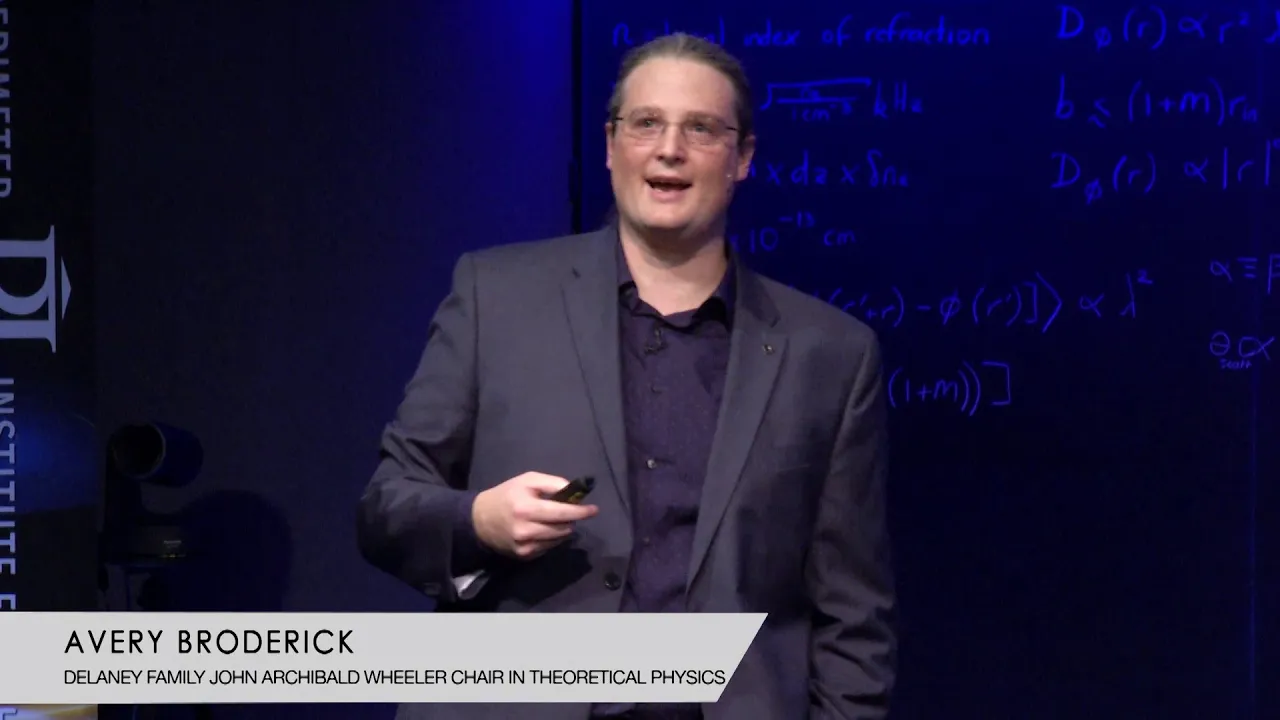
Why this video
For a graduate-level understand of SMBH imaging, this public lecture by Avery Broderick details the mathematics and physics of Very Long Baseline Interferometry (VLBI). You will learn how radio dish arrays across the globe synchronize using atomic clocks to act as an Earth-sized telescope, resolving the shadow of M87* and Sgr A*.
Knowledge Checkpoint
- Understand how to calculate the mass of an SMBH using Kepler's Third Law () given the semi-major axis () and period () of an orbiting star (e.g., S2).
- Define Very Long Baseline Interferometry (VLBI) and explain how telescope baseline distance dictates angular resolution ().
- Explain why the Event Horizon Telescope captures a bright asymmetrical ring around a dark shadow (gravitational lensing and relativistic Doppler beaming).
Module 2: Introduction to Active Galactic Nuclei (AGN)
This module shifts focus from quiet supermassive black holes to active systems. You will learn the historical development of AGN astronomy, the classification scheme of active galaxies, and the geometric Unified Model that explains Seyfert 1/2 galaxies, Quasars, and Blazars.
Video Resources
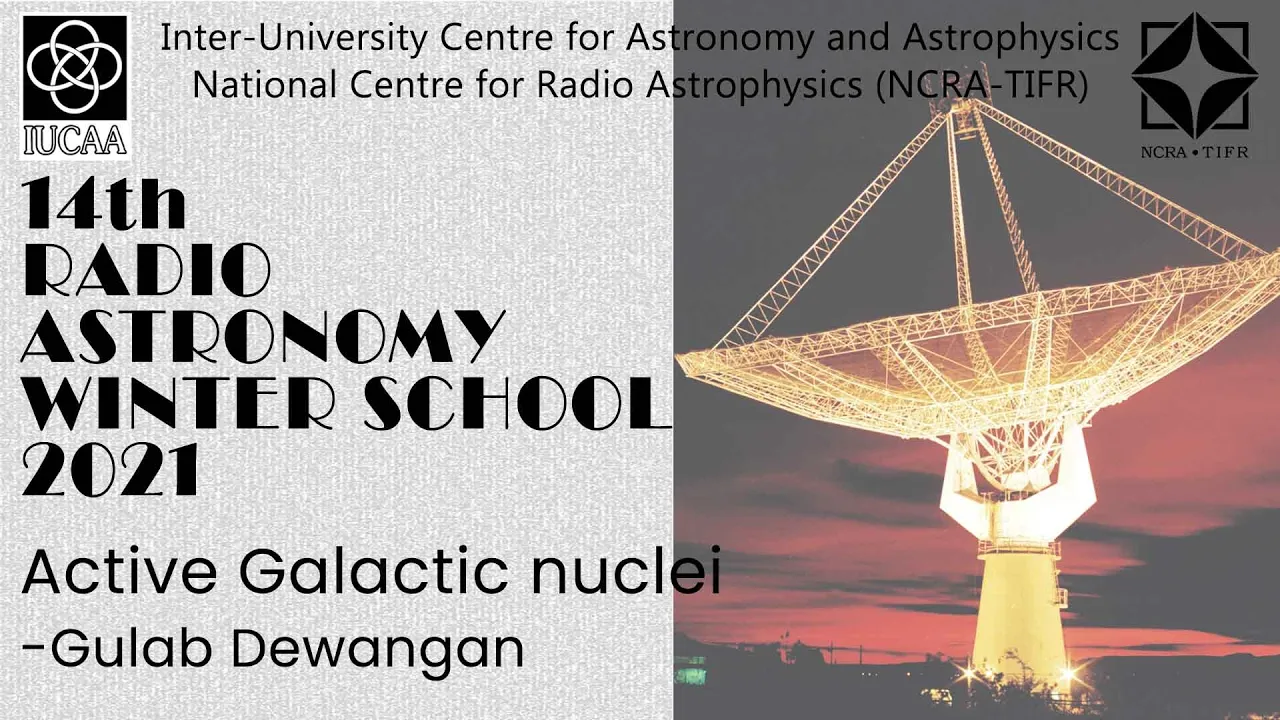
Why this video
This video directly addresses the geometric Unified Model of AGN. Prof. Dewangan explains how the orientation of the dusty torus relative to our line of sight determines whether we observe a Seyfert 1 galaxy (broad and narrow lines) or a Seyfert 2 galaxy (narrow lines only due to torus obscuration of the Broad-Line Region).
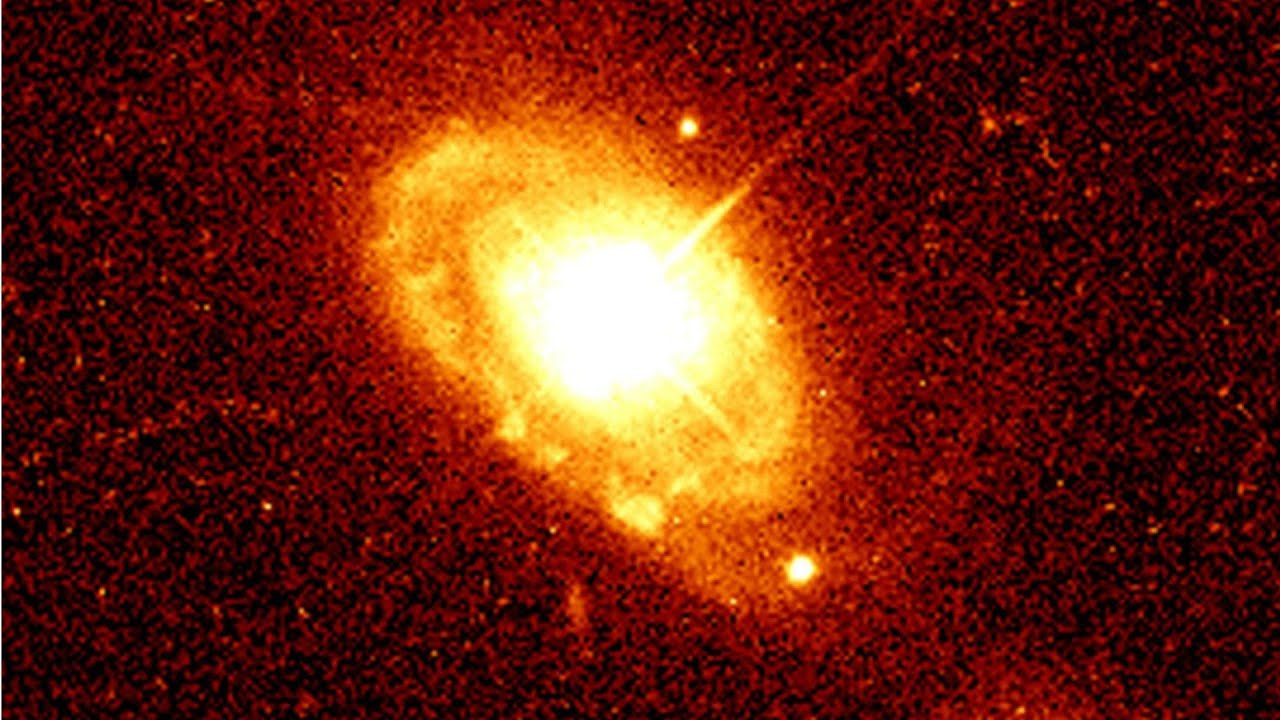
Why this video
This comprehensive lecture provides the historical taxonomy of AGN, starting from the first observations of M87's jet to the discovery of 3C 273 and the realization that "Quasi-Stellar Radio Sources" are highly redshifted, ultra-luminous galactic centers.
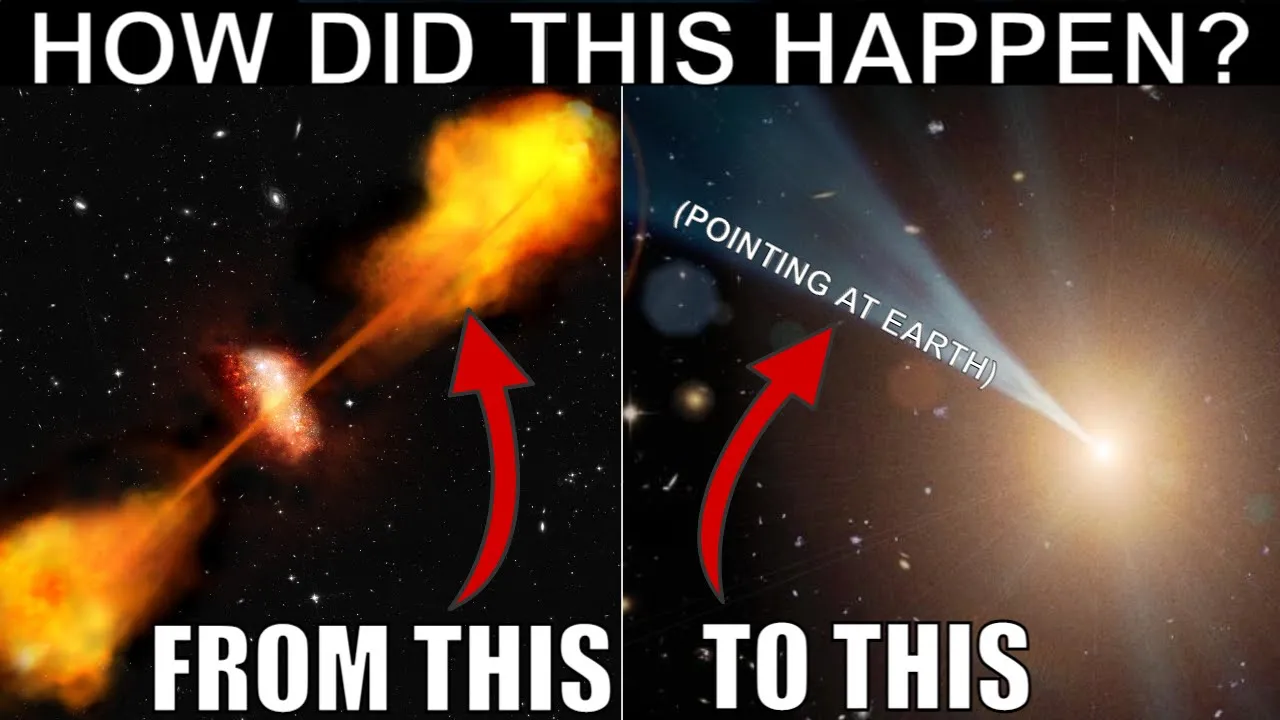
Why this video
This short conceptual video explains how viewing angles change our classifications. When a relativistic jet points directly at Earth, we observe a Blazar; if it points away, it appears as a standard radio galaxy.
Knowledge Checkpoint
- Draw and label the components of the AGN Unified Model, including the supermassive black hole, accretion disk, broad-line region (BLR), narrow-line region (NLR), and dusty torus.
- Distinguish between Seyfert 1 and Seyfert 2 galaxies based on their optical spectra.
- Explain the viewing angle orientation that defines a Quasar, a Blazar, and a Radio Galaxy.
Module 3: Physics of the Accretion Disk
To understand how AGN radiate so much energy, you must study the thermodynamics of the accretion disk. This module covers gravitational potential energy release, Keplerian shear, and the mathematical framework of the Shakura-Sunyaev (-disk) accretion model.
Video Resources
Why this video
A superb, visualization-rich explanation of Keplerian shear. Since inner disk orbits move faster than outer ones, friction and turbulence are generated between adjacent rings, converting gravitational potential energy into thermal energy and high-energy radiation.

Why this video
This video explains the famous 1973 Shakura-Sunyaev model. It breaks down how the highly complex turbulent viscosity of the accretion disk is simplified using a single dimensionless parameter (), which scales the internal shear stresses to the local pressure.

Why this video
For a rigorous mathematical treatment, Prof. Charles Gammie's lecture at the Institute for Advanced Study derives the equations of disk evolution. He shows how the outward transport of angular momentum is physically coupled with the inward flow of mass.
Knowledge Checkpoint
- Explain how half of the gravitational potential energy of infalling matter is converted into kinetic energy, while the other half is converted to thermal radiation in a thin disk.
- Define "Keplerian shear" and explain why viscosity is required for material to actually spiral into the black hole.
- State the core assumption of the Shakura-Sunyaev model and write down the scaling relation for turbulent kinematic viscosity ().
Module 4: Relativistic Jet Formation and Dynamics
Relativistic jets are narrow plasma streams launched from the poles of rotating black holes at nearly the speed of light. This module analyzes jet collimation, energy extraction via the Blandford-Znajek mechanism, and the mathematics behind apparent superluminal motion.
Video Resources

Why this video
This video offers a rigorous overview of the Blandford-Znajek mechanism. It details how magnetic field lines from the accretion disk thread the event horizon of a spinning (Kerr) black hole, extracting its rotational energy to power and accelerate relativistic jets.

Why this video
This presentation covers magnetohydrodynamic (MHD) collimation. It explores how plasma beta parameters dictate magnetic field configurations, showing how low-density magnetic funnels collimated around the black hole's rotation axis channel outflowing gas into narrow beams.

Why this video
This video derives the mathematical proof of apparent superluminal motion. Using a whiteboard, the presenter details the geometry of a plasma blob moving near the speed of light at a small angle to the observer's line of sight, showing how light-travel time compression creates the illusion of speed .
Why this video
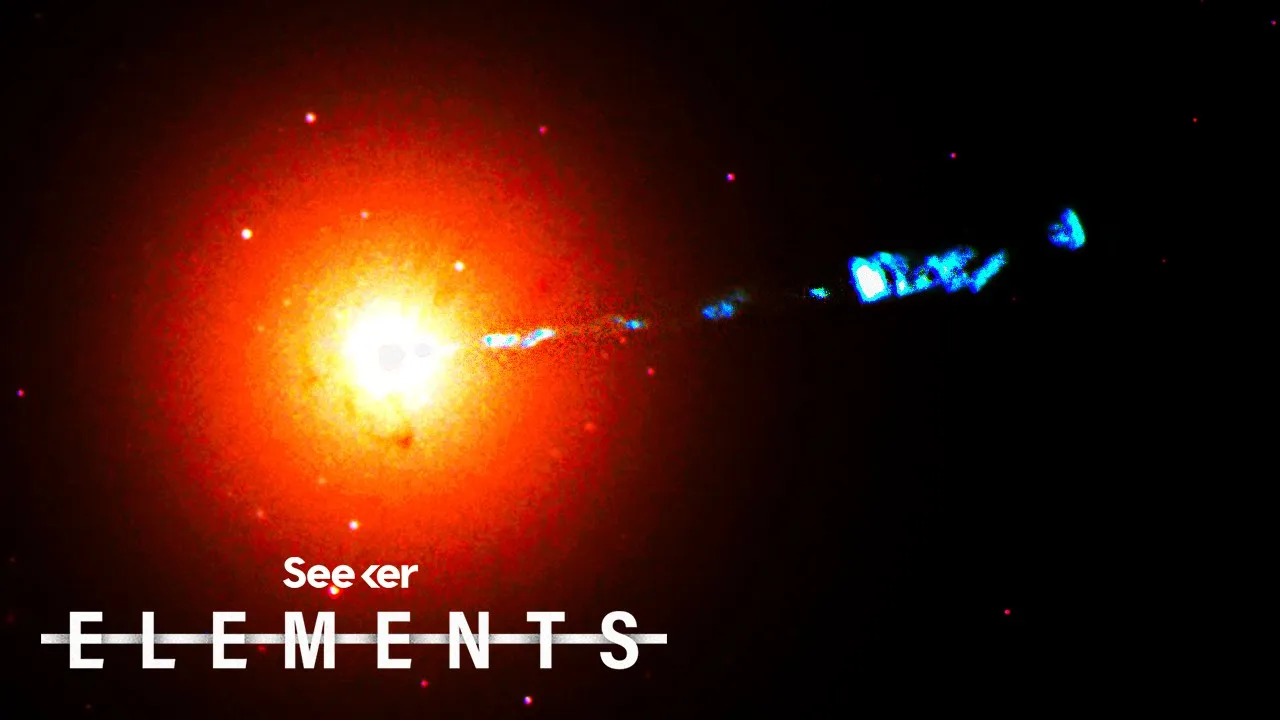
This video reviews observations of the M87* jet to ground these concepts in real-world data. It explains how astronomers measured jet knots traveling at apparent velocities 7 times faster than light and resolves this with relativistic beaming physics.
Knowledge Checkpoint
- Explain how a spinning black hole's frame-dragging effect twisted magnetic fields in the Blandford-Znajek mechanism.
- State the difference between high-plasma-beta and low-plasma-beta regimes in jet confinement.
- Derive the formula for apparent transverse velocity: Identify the angle () that maximizes .
Module 5: Multi-Wavelength Observations and Mass Measurement
Prerequisites: Module 2 & Module 3
How do we actually measure the physical properties of objects millions of light-years away? This module covers the observational techniques used to weigh SMBHs, focusing on optical spectroscopy, Doppler broadening in the Broad-Line Region, and reverberation mapping.
Video Resources

Why this video
Prof. Matthew Malkan provides an exceptional breakdown of the physics of Broad-Line Regions (BLR). He explains how high-velocity gas orbiting near the event horizon experiences extreme Doppler broadening, and how the time-lag between variations in the central accretion disk continuum and the surrounding BLR lines reveals the physical size of the system.

Why this video
This video details how space telescopes utilize ultraviolet spectroscopy (tracking line transitions of highly ionized CIV and MgII) to execute reverberation mapping across cosmic epochs.

Why this video
A concise breakdown of the exact mathematics used to calculate SMBH mass: You will see how we extract the velocity dispersion () from line widths (FWHM) and the radius () from reverberation mapping time delays.

Why this video
To complete the multi-wavelength picture, this advanced lecture focuses on high-energy X-ray spectra of AGN. You will study how photons from the optical/UV accretion disk undergo inverse Compton scattering within a hot corona, generating the characteristic hard X-ray power-law spectrum.
Knowledge Checkpoint
- Define "reverberation mapping" and explain how the time delay () relates to the physical radius of the Broad-Line Region ().
- Explain why Doppler broadening occurs in the spectral lines of the BLR but is significantly narrower in the Narrow-Line Region (NLR).
- Write down the virial mass equation for black holes, identifying what the dimensionless scaling factor () represents (orientation and geometry of the BLR).
- Describe the process of "thermal Comptonization" (inverse Compton scattering in the corona) and how it shapes the high-energy X-ray emission of an active galaxy.
Course Map
Key People Index
- Nikolai Shakura & Rashid Sunyaev: Developed the alpha-disk accretion model (1973), which remains the standard physical framework for thin, viscous accretion disks.
- Roger Blandford & Roman Znajek: Formulated the Blandford-Znajek mechanism (1977), proving that magnetic fields can extract rotational energy from a Kerr black hole to power jets.
- Avery Broderick: Renowned astrophysicist and member of the Event Horizon Telescope collaboration; heavily involved in modeling the relativistic signatures of event horizons.
- Charles Gammie: Professor of Physics and Astronomy at Illinois, specializing in numerical modeling of magnetized gas flows around black holes.
- Gulab Dewangan: Professor of X-ray astronomy, specializing in AGN spectroscopy, disk-corona models, and high-energy observations.
Final Self-Assessment
Complete this comprehensive self-assessment to verify your mastery of AGN mechanics:
- I can derive the orbital mass constraint equations from the S2 star data around Sgr A*.
- I can mathematically prove why an observer at small viewing angles sees apparent superluminal motions up to .
- I can explain the physical origin of disk viscosity and why a simple molecular viscosity is insufficient to explain accretion timescales (implying magnetorotational instability or alpha-turbulent models).
- I can detail the geometry of a Seyfert 1 vs Seyfert 2 galaxy and point out how dusty torus obscuration causes these spectral differences.
- I can write the virial equation used in optical spectroscopy to weigh black holes and explain how both parameters ( and ) are measured.
- I can explain how the Blandford-Znajek mechanism acts as a cosmic battery, drawing power from the spin of space-time.
- I can describe the physical difference between the Broad-Line Region (BLR) and the Narrow-Line Region (NLR) in terms of density, distance from the black hole, and orbital speeds.
- I can trace the spectrum of a typical radio-loud AGN from radio (synchrotron emission), through infrared (dusty torus), optical/UV (accretion disk thermal peak), to X-ray (coronal inverse Compton scattering).