Analyzing NMR: 1H & 13C Structure Elucidation
Learning Goal: Mastering the Principles and Interpretation of and NMR Spectroscopy for Organic Structure Elucidation.
- Prerequisites: High school level chemistry, basic understanding of covalent bonding, molecular formulas, and organic functional groups.
- Estimated Total Study Time: 18 Hours
Module 1: Organic Chemistry Foundations: Atoms and Bonds
Before diving into spectroscopic analysis, you must master how molecular symmetry, orbital hybridization, and chemical equivalence dictate how many signals will actually appear on an NMR spectrum. This module has been specially refocused to target chemical equivalence, homotopic/enantiotopic/diastereotopic environments, and carbon hybridization.
Recommended Videos

- Why this video: Understanding the difference between , , and carbon environments is vital. This video clearly explains how atomic s and p orbitals merge to form equivalent hybrid orbitals, directly influencing bond lengths and electronegativity (which determine chemical shift).
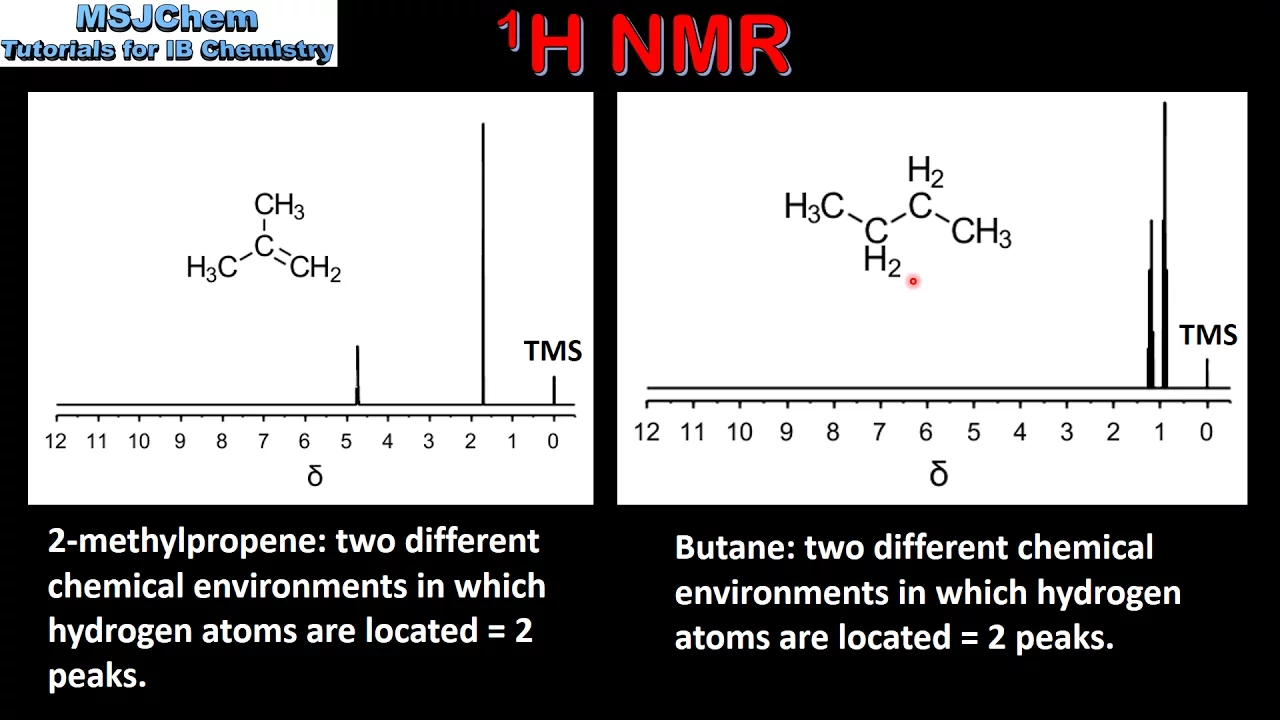
- Why this video: It bridges basic chemical structure to NMR peak counts. It teaches how to look at a structure, find planes of symmetry, and group hydrogens into equivalent chemical environments.

- Why this video: It provides secondary depth on how hybridization achieves equivalent tetravalency in carbon, laying the foundation for reading 3D structures and identifying diastereotopic faces.
⚠️ Curriculum Gap Alert: The video pool lacks a dedicated lesson on advanced stereochemical equivalence (homotopic, enantiotopic, and diastereotopic protons).
Recommended Independent Search: Search YouTube for "homotopic enantiotopic diastereotopic protons organic chemistry" to master how stereocenters split seemingly equivalent protons into distinct magnetic environments.
Knowledge Checkpoint
- Determine the hybridization () of every carbon in an unknown structure.
- Count the exact number of unique proton and carbon environments by analyzing molecular symmetry.
- Identify planes of symmetry to predict the exact number of expected peaks on an NMR spectrum.
Module 2: Physics of Nuclear Magnetic Resonance
NMR is not just a chemical tool; it is applied quantum mechanics. In this module, you will learn how subatomic particles possess spin, how they precess in an external magnetic field at the Larmor frequency, and how radiofrequency pulses excite these active nuclei.
Recommended Videos

- Why this video: An exceptional intuitive introduction to how nuclear spin acts as a microscopic magnet that aligns either with (-spin state) or against (-spin state) an external magnetic field.

- Why this video: It covers the classical and quantum mechanical mathematics of spin physics, introducing Larmor precession, the gyromagnetic ratio (), and the effect of magnetic field strength () on the energy gap ().

- Why this video: It clarifies the common misconception that spin-1/2 nuclei behave exactly like tiny macroscopic bar magnets, contextualizing nuclear spin as intrinsic angular momentum.
Knowledge Checkpoint
- Explain why nuclei with odd mass numbers (like and ) are NMR-active while even-even nuclei (like ) are not.
- Define the Larmor precession frequency and explain how it scales with external magnetic field strength ().
- Describe the energy transition between the lower-energy spin state and the higher-energy spin state.
Module 3: 1H NMR: Chemical Shifts and Integration
This module introduces the coordinate system of NMR spectra. You will master the concepts of shielding and deshielding (caused by surrounding electron clouds), chemical shift in parts per million (ppm), the Tetramethylsilane (TMS) standard, and peak integration (which corresponds to relative proton counts).
Recommended Videos
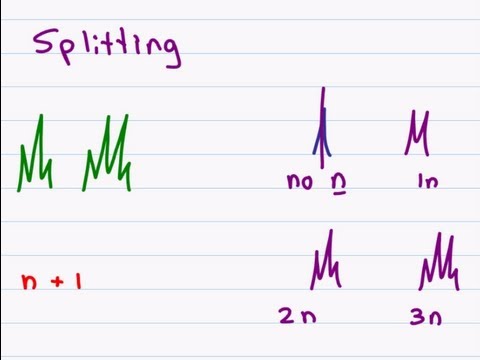
- Why this video: This is the ideal introductory walkthrough of the four parameters of NMR, breaking down chemical shift trends and peak integration with clear, color-coded examples.
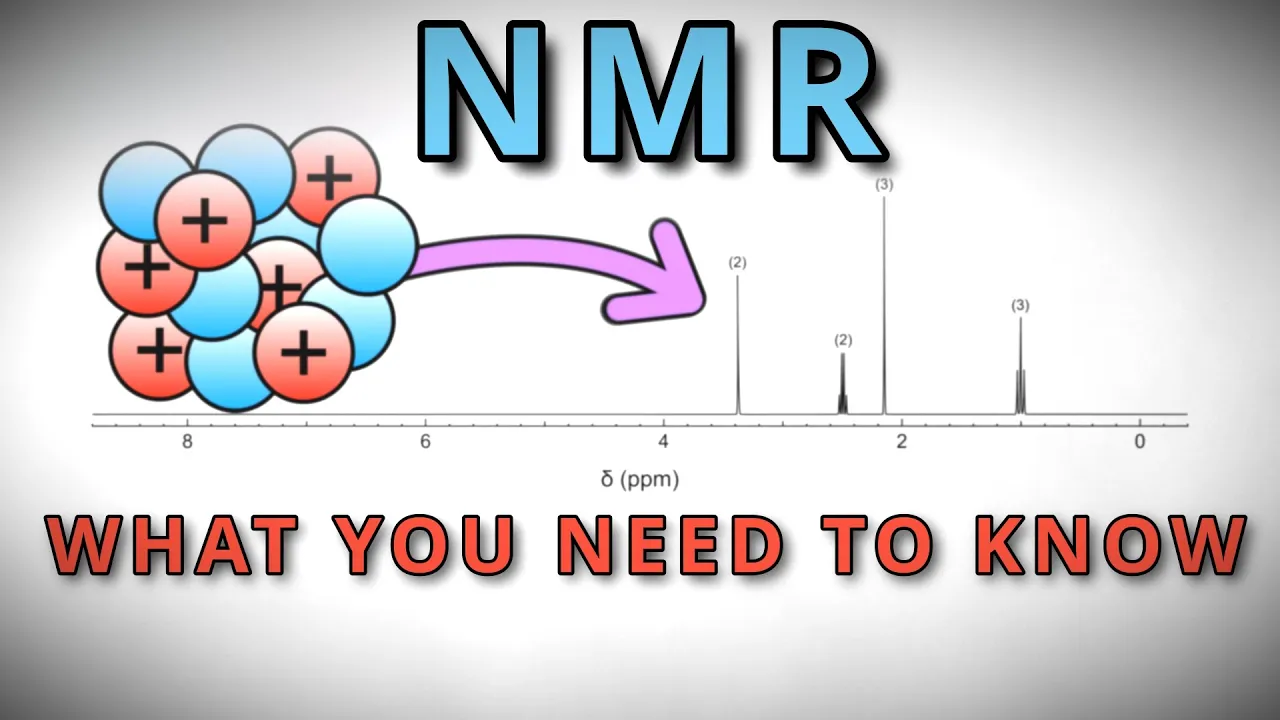
- Why this video: Uses excellent visual models to represent how electron density shields protons from the magnetic field, forcing upfield shifts, while electronegative atoms deshield them, shifting them downfield.

- Why this video: Provides practical, step-by-step interpretation practice focusing on chemical shifts and converting mathematical integration curves into exact proton ratios.
⚠️ Curriculum Gap Alert: If you need to perform manual calculus/geometry to calculate peak integrations from raw, stepped analog integration curves on older paper spectra, the current video pool does not show the physical ruler-measurement process.
Recommended Independent Search: Search YouTube for "how to measure NMR integration curves with a ruler" for analog spectrum analysis.
Knowledge Checkpoint
- Explain how electronegative substituents deshield protons and cause them to shift downfield (higher ppm).
- State why Tetramethylsilane (TMS) is used as the reference standard at .
- Measure the height of integration curves to determine the exact relative ratio of protons in each signal.
Module 4: Proton Coupling and Multiplet Splitting
Hydrogens do not exist in isolation. This module explores spin-spin coupling, the rule, coupling constants (-values), and complex splitting patterns (such as doublets of doublets) when different coupling relationships exist. Additionally, we introduce 2D COSY NMR to resolve complex coupling networks.
Recommended Videos

- Why this video: A short, high-yield animation showing the magnetic state combinations of neighboring protons that lead to singlet, doublet, triplet, and quartet splitting patterns.

- Why this video: Focuses entirely on the coupling constant ( value), showing that it is measured in Hertz and remains constant regardless of the spectrometer's operating magnetic field strength.

- Why this video: Demonstrates what happens when the simple rule fails. It teaches you how to construct and solve a "splitting tree" for complex multiplets like doublets of doublets ().
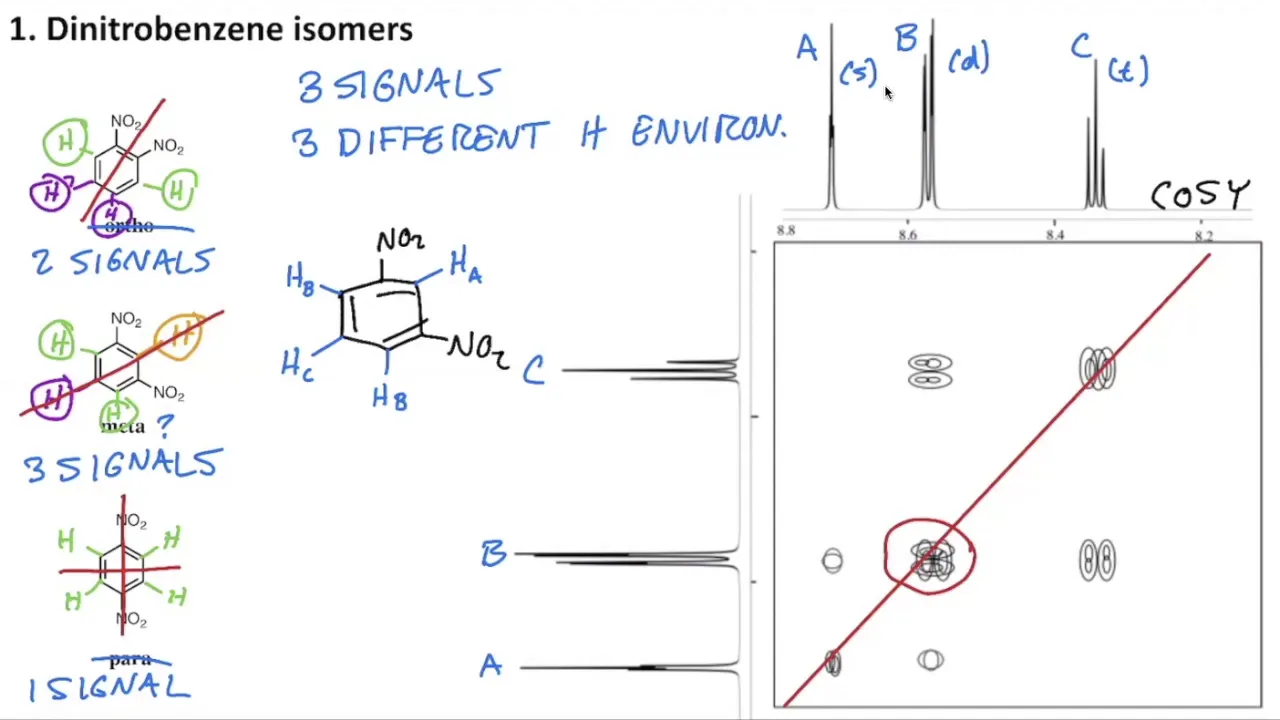
- Why this video: High-level expansion. It explains how to interpret a 2D Correlation Spectroscopy (COSY) spectrum by reading diagonal versus cross-peaks to track exactly which protons are coupled.
Knowledge Checkpoint
- Apply the rule to predict the splitting of a proton signal based on its adjacent neighbors.
- Calculate coupling constants ( values) in Hertz from chemical shifts given in ppm on different spectrometer frequencies.
- Build a splitting tree for a proton coupled to two non-equivalent neighboring protons with different values.
- Locate spin systems on a 2D COSY spectrum using off-diagonal cross-peaks.
Module 5: 13C NMR: Carbon Skeletal Analysis
While NMR yields hydrogen environments, NMR maps the core carbon skeleton directly. This module details principles, its unique 0–220 ppm scale, proton-decoupling, and DEPT (Distortionless Enhancement by Polarization Transfer) experiments.
Recommended Videos
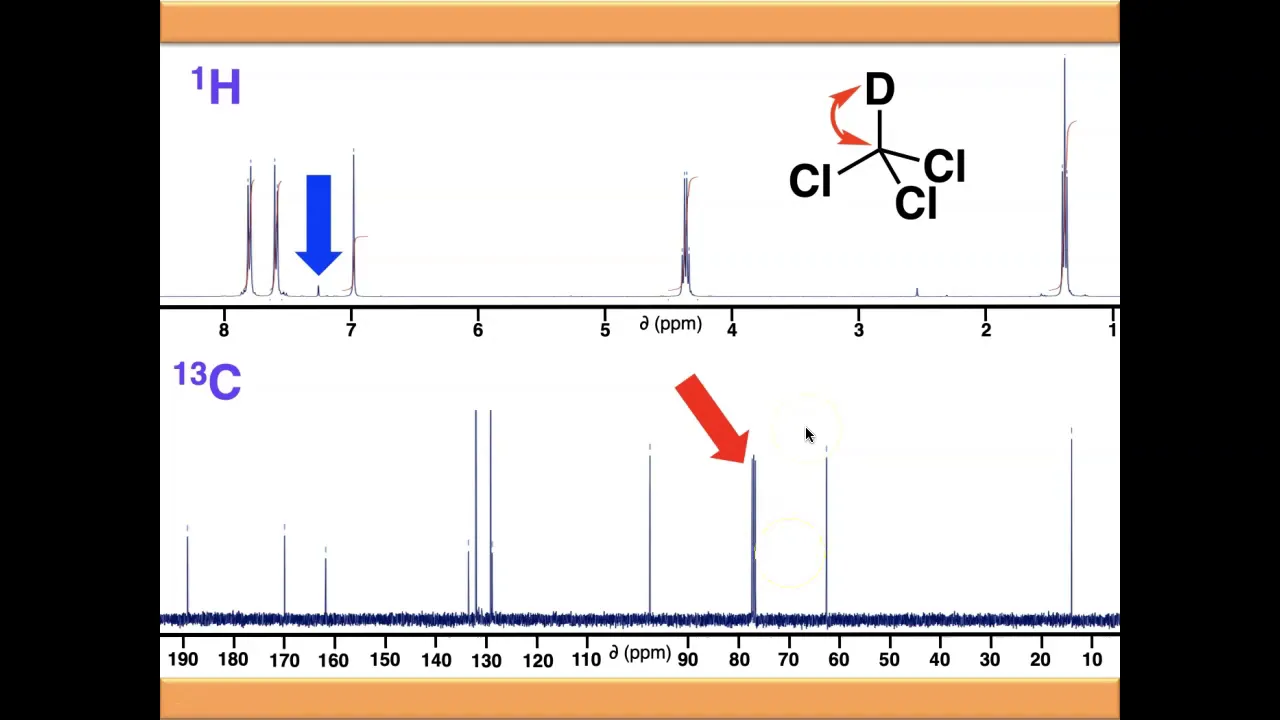
- Why this video: Excellent high-level contrast between proton and carbon NMR. It explains why is naturally insensitive (1.1% abundance) and walks through how DEPT-45, DEPT-90, and DEPT-135 differentiate , and carbons.
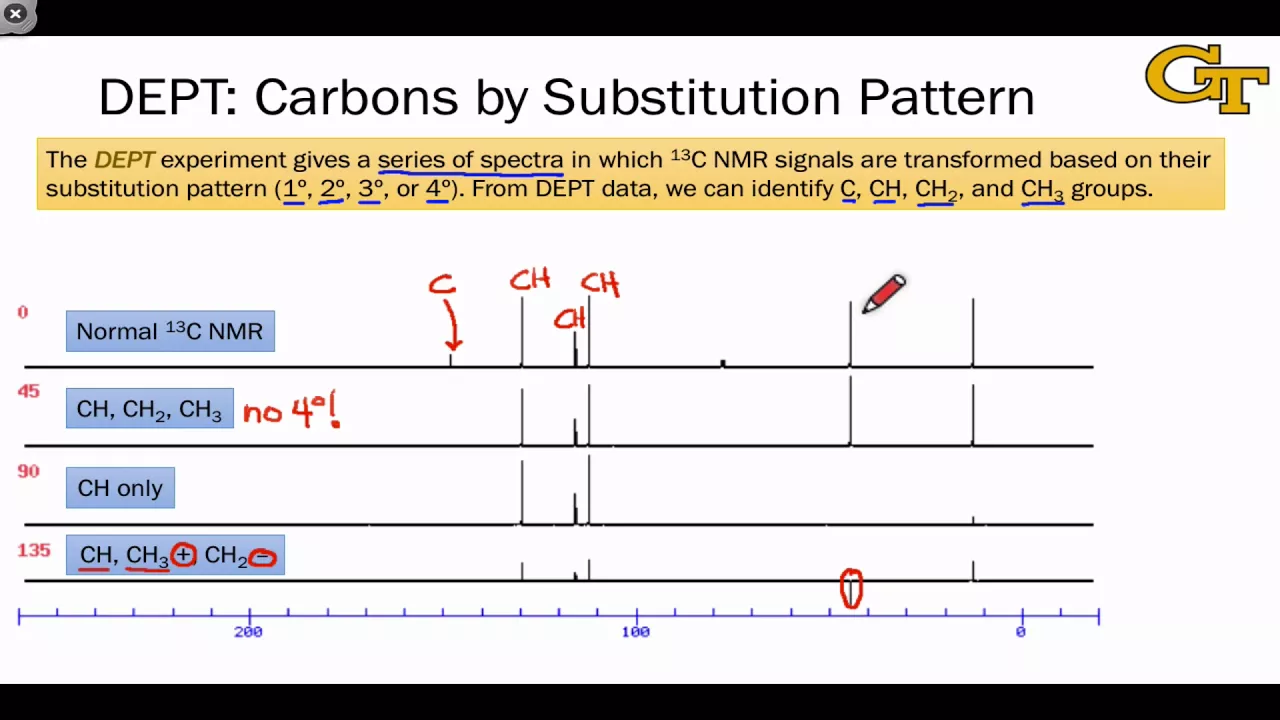
- Why this video: A concise, step-by-step breakdown of polarization transfer angles (, , ) showing which carbon types point up, point down, or disappear in each sub-experiment.
- Why this video: Specifically focused on practical workflow strategies for utilizing DEPT spectra to solve chemical formulas quickly.
Knowledge Checkpoint
- Contrast NMR with NMR regarding isotopic abundance, splitting patterns (decoupled spectra), and peak integration.
- Classify carbons as quaternary (), methine (), methylene (), or methyl () using DEPT-90 and DEPT-135 spectra.
- Identify which carbon types disappear completely in a DEPT spectrum (quaternary carbons).
Module 6: Joint Interpretation and Structure Elucidation
Structure elucidation is a puzzle. This final module synthesizes degrees of unsaturation (DBE), Infrared (IR) spectroscopy functional group data, and both and NMR to deduce complete unknown molecular structures step-by-step.
Recommended Videos

- Why this video: A masterful, logical walkthrough of how to solve a structure. The instructor calculates the degrees of unsaturation, uses IR to find functional groups (e.g., carbonyls), and uses the NMR peaks to assemble fragments like puzzles.

- Why this video: An advanced case study showing how to combine functional group identities from IR (such as carbonyl stretches at ) with multiplet splitting patterns to assemble larger carbon chains.
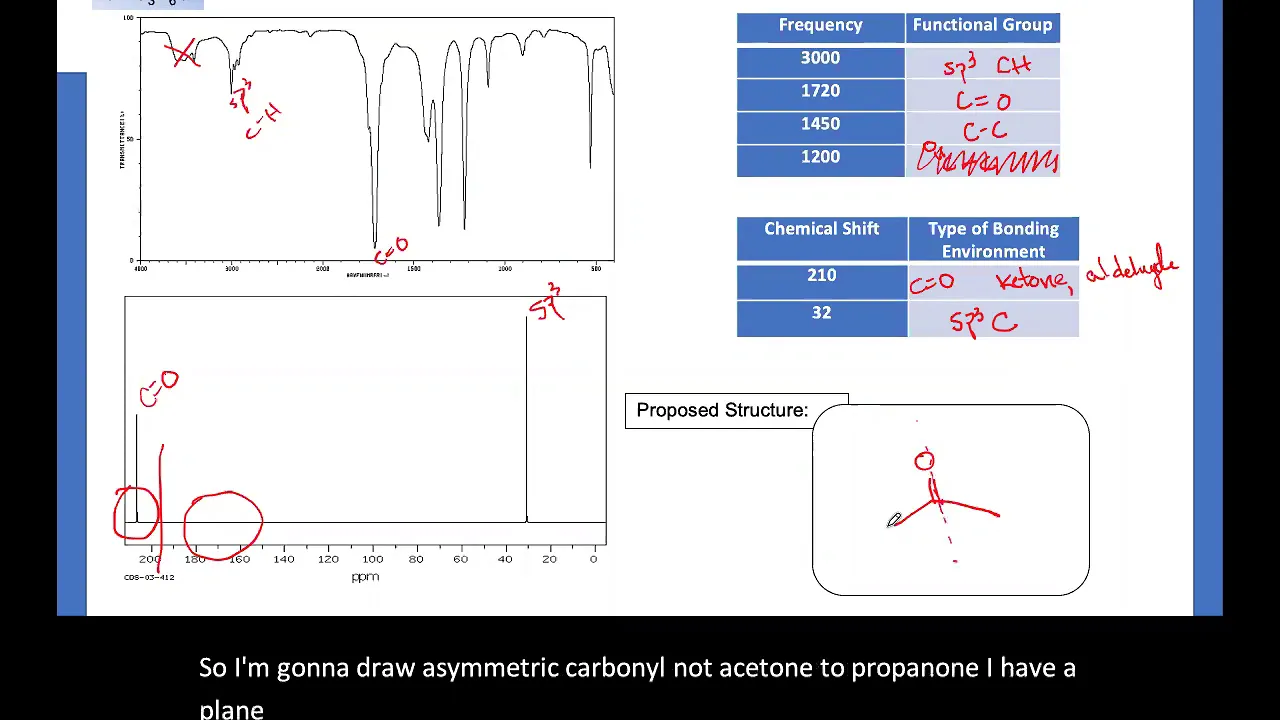
- Why this video: Focuses explicitly on coupling carbon shifts with IR data, a highly critical skill when proton data is ambiguous or limited.
Knowledge Checkpoint
- Calculate the Degree of Unsaturation / Double Bond Equivalent (DBE) using the formula .
- Use key IR stretching frequencies (e.g., broad stretch at , sharp stretch at ) to rule out or confirm functional groups.
- Assemble sub-structural fragments (e.g., ethyl groups, isopropyl groups, para-disubstituted benzene rings) from splitting and integration data.
- Propose and verify a single logical structure that matches all analytical datasets ( NMR, NMR, IR, and molecular formula).
Course Map
Key People Index
- Leah (Leah4sci): A renowned online educator specializing in making complex organic chemistry concepts accessible for visual learners. Her step-by-step guides on reading spectrum baselines are legendary.
- Professor Dave (Professor Dave Explains): Widely celebrated science communicator whose chemistry tutorials provide a vital bridge between rigorous physical theory and practical test-taking strategies.
- Tony St. John: An organic chemist and instructor whose highly systematic video guides on structure solving are widely used by university students to master multi-spectra synthesis.
- Dr. Daniel Allwood: A university-level academic chemist who excels in explaining the physical principles of advanced methods like spin polarization and DEPT angles.
Final Self-Assessment
Test your mastery of NMR Spectroscopy by checking off your ability to perform these tasks:
- Draw the expected NMR spectrum for ethyl acetate, including accurate chemical shifts, integrations, and splitting patterns.
- Calculate the gyromagnetic ratio if given the Larmor precession frequency of a proton in a () magnet.
- Distinguish between a terminal alkene proton () and an aromatic ring proton () based entirely on electronic shielding environments.
- Interpret a complex multiplet split by two different coupling constants (e.g., , ) and draw its corresponding splitting tree.
- Correctly identify diagonal and cross-peaks on a 2D COSY spectrum to trace spin-coupling pathways through 3 bonds.
- Analyze a NMR dataset paired with DEPT-90 and DEPT-135 spectra to classify all carbon peaks into , , , and groups.
- Deduce the molecular structure of an unknown compound with the formula that exhibits a sharp IR stretch at and a singlet integrating to 9 protons at in its NMR spectrum.
- Successfully solve a structure elucidation problem containing a halogen atom by calculating the correct Double Bond Equivalents (DBE).