Retrosynthesis: Disconnection & Design
Learning Goal: To master the art of retrosynthetic analysis by learning strategic single- and multi-group disconnections, utilizing protecting group chemistry to control chemoselectivity, and designing efficient, highly convergent multi-step organic syntheses from simple precursors.
- Prerequisites: Core understanding of general chemistry concepts (covalent bonding, electronegativity, steric hindrance, and basic molecular structure).
- Estimated Total Study Time: 24 hours
Module 1: Foundations of Organic Structures & Mechanisms
Module Overview
To dissect complex target molecules, you must first speak the graphical language of organic structures. This module establishes complete structural fluency. You will master skeletal line representations and learn to map polar reactions using standard electron-pushing curved arrow formalisms. This ensures that you can rapidly identify structural landmarks and trace electron movement before analyzing pathways in reverse.
Recommended Videos

- Why this video is valuable: This comprehensive tutorial bridges the gap between molecular formulas, condensed structures, and skeletal representations. Retrosynthetic targets are exclusively represented in skeletal line notation; mastering how to count carbons, find heteroatoms, and identify functional groups within this shorthand is an absolute prerequisite.

- Why this video is valuable: Retrosynthesis is the conceptual reverse of forward reaction mechanisms. This lesson breaks down the four core curved-arrow steps (nucleophilic attack, proton transfer, leaving group loss, and carbocation rearrangements). Understanding exactly how electron pairs shift is vital for visualizing bonds breaking.
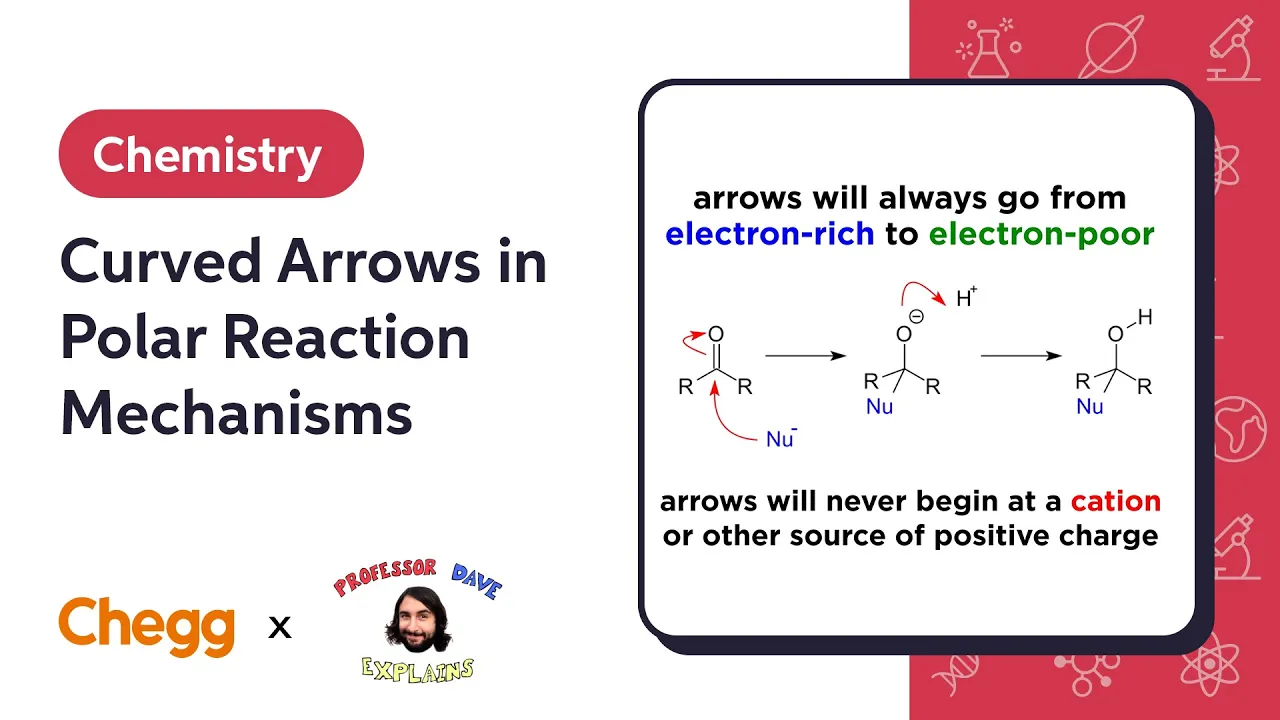
- Why this video is valuable: A rapid-fire conceptual recap on the absolute mathematical and geometric rules of electron-pushing arrows. It reinforces that arrows must start at electron-rich sources (nucleophile lone pairs or pi bonds) and terminate at electron-deficient targets (electrophiles), preventing fundamental mechanistic drawing errors.
Module 1 Knowledge Checkpoint
- Translate complex condensed molecular formulas containing branch lines and brackets into accurate skeletal line structures.
- Correctly identify formal charges on carbons, nitrogens, and oxygens, and deduce the number of implicit hydrogens on any skeletal vertex.
- Draw proper double-headed curved arrows representing polar mechanisms, ensuring they start at an electron pair and terminate directly on an atom or a bond.
Module 2: Core Functional Group Interconversions & Reactions
Module Overview
Retrosynthetic design relies heavily on your "synthetic toolbox"—the library of forward reactions you can deploy to build bonds. This module covers fundamental organic transformations: nucleophilic substitutions (), eliminations (), selective oxidations, and nucleophilic additions to carbonyls using powerful organometallic reagents.
Recommended Videos
- Why this video is valuable: Demystifies how to choose between substitution and elimination. Since single-group carbon-heteroatom disconnections rely on working backward from substitution products, understanding how substrate structure, nucleophilic strength, solvent, and temperature dictate these pathways is essential.
- Why this video is valuable: The Grignard reaction is the most common method for forming single carbon-carbon bonds. This video teaches the mechanistic preparation and addition of organomagnesium reagents to aldehydes and ketones, which forms the basis of many carbon-carbon disconnections.

- Why this video is valuable: This selected segment covers vital Functional Group Interconversions (FGIs). It teaches you how to transition between alcohols and carbonyls using selective reagents like pyridinium chlorochromate (PCC), illustrating the chemical transformations that alter a target's oxidation state without building carbon skeletons.
Module 2 Knowledge Checkpoint
- Predict the major and minor products of competing substitution () and elimination () reactions given a substrate, nucleophile/base, and solvent.
- Outline the complete mechanism of a Grignard reagent attacking a carbonyl, including the final acidic workup step to yield primary, secondary, or tertiary alcohols.
- Select appropriate reagents (e.g., PCC vs. strong chromic acid oxidants) to perform targeted Functional Group Interconversions (FGI) on alcohols, aldehydes, and ketones.
Module 3: Introduction to Retrosynthetic Analysis
Module Overview
This module introduces the conceptual framework of retrosynthetic analysis. Instead of starting with reactants, you will learn to start with a target molecule (TM) and logically disconnect it. You will explore critical vocabulary, including the retrospective arrow (), Functional Group Interconversion (FGI), imaginary fragments called synthons, and the real-world reagents known as synthetic equivalents.
Recommended Videos
- Why this video is valuable: This is the ideal introductory lecture on retrosynthetic logic. It establishes the core concept of working backward from a target molecule to identify strategic disconnections, using single-step transformations to demonstrate basic retrosynthetic planning.

- Why this video is valuable: Addresses a key conceptual gap by focusing on charge distribution patterns (consonant and dissonant systems). It introduces synthons and explains how to select realistic nucleophilic and electrophilic synthetic equivalents based on polar reactivity rules.
- Why this video is valuable: A thorough walk-through of one-group carbon-heteroatom (C-X) disconnections. You will learn to identify strategic bonds adjacent to oxygen, nitrogen, sulfur, or halogens, disconnect them to their respective synthons, and assign correct synthetic equivalents like alkyl halides and amines.
Module 3 Knowledge Checkpoint
- Define and explain the relationship between a target molecule (TM), a synthon, and a synthetic equivalent.
- Map out the consonant or dissonant polar patterns of a target molecule to identify logical sites for disconnection.
- Execute retrosynthetic steps for simple ethers, esters, and amines using one-group C-X disconnection rules to find appropriate starting materials.
Module 4: Protecting Group Chemistry
Module Overview
Note: In accordance with curriculum review recommendations, this module on protecting groups is positioned before strategic carbon-carbon bond disconnections. This ensures you understand how to control functional group selectivity before planning multi-step pathways.
Chemoselectivity is one of the greatest challenges in organic synthesis: how do you react one functional group while leaving an identical or more reactive group untouched? In this module, you will learn to use protecting groups to temporarily mask sensitive functional groups (such as alcohols and carbonyls) during synthesis, as well as the conditions required for their selective removal.
Recommended Videos

- Why this video is valuable: A highly engaging introduction to chemoselectivity. It explains the core concept of protecting groups as temporary "disguises" for reactive functional groups, demonstrating why they are indispensable tools in complex, multi-step synthetic pathways.
- Why this video is valuable: Alcohols are highly reactive toward acidic, basic, and oxidizing conditions. This video focuses on silyl ether protecting groups (specifically trimethylsilyl/TMS ethers), detailing how to install them to shield alcohols and how to selectively remove them using fluoride sources (like TBAF).
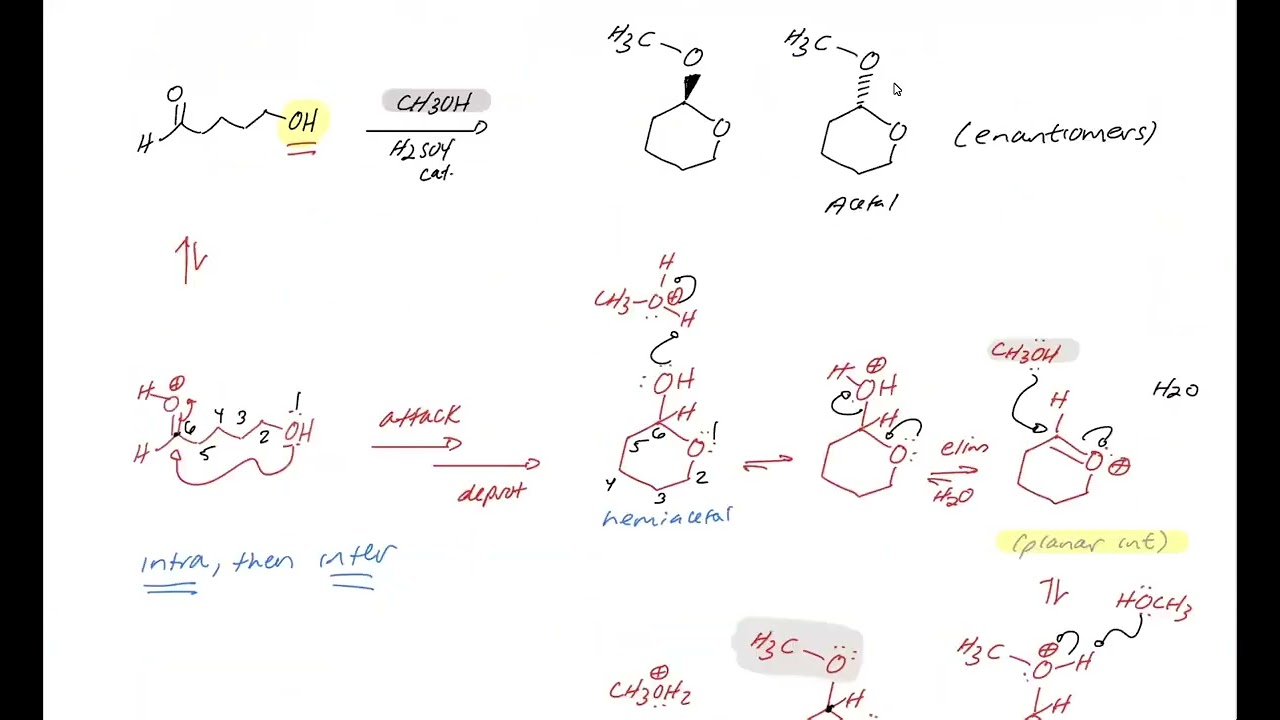
- Why this video is valuable: Carbonyl groups in aldehydes and ketones are highly electrophilic and will easily react with Grignard reagents or reducing agents. This video provides a step-by-step mechanism of cyclic acetal/ketal formation, showing how to mask these carbonyls as inert ethers using diols in acid.
Module 4 Knowledge Checkpoint
- Explain the requirements of an ideal protecting group (high yield installation, stability to target reagents, and high yield selective deprotection).
- Design synthetic steps that protect alcohols as silyl ethers (e.g., TMS or TBS ethers) and selectively cleave them using fluoride ions ().
- Write out the complete mechanism for the acid-catalyzed protection of a ketone using ethylene glycol, and its subsequent deprotection back to the carbonyl.
Module 5: Disconnection Strategies: C-C Bonds & Difunctionalized Compounds
Module Overview
Note: Renamed and expanded from the original plan to deeply address critical curriculum gaps in two-group C-C disconnections and difunctionalized compounds.
This module focuses on carbon-carbon bond disconnections. You will analyze target molecules with two functional groups and identify strategic disconnections based on their spatial relationships (- and -difunctionalized systems). You will also study the [4+2] Diels-Alder cycloaddition to identify and disconnect six-membered rings.
Recommended Videos

- Why this video is valuable: Directly addresses a key gap in the organic synthesis curriculum. It walks through retrosynthetic strategies for 1,3- and 1,5-disubstituted compounds, showing how functional group spacing guides disconnections back to classic carbon-carbon bond-forming steps.

- Why this video is valuable: Provides a clear summary of target molecules with two functional groups (2 FG TMs). It teaches you how to disconnect at the alpha-carbon to identify enolate nucleophiles and their corresponding electrophilic partners, linking retrosynthesis to the Aldol, Claisen, and Michael reactions.
- Why this video is valuable: Explains the forward mechanisms of Aldol and Claisen reactions. Seeing these carbon-carbon bonds form under basic conditions helps you recognize -hydroxy carbonyls and -ketoesters as retrosynthetic landmarks.
- Why this video is valuable: The Diels-Alder reaction is a powerful tool for constructing six-membered rings. This video explains the concerted mechanism, helping you identify cyclohexene structures in target molecules and work backward to a conjugated diene and dienophile.
Module 5 Knowledge Checkpoint
- Identify 1,3-difunctionalized compounds (e.g., -hydroxy carbonyls or -ketoesters) and disconnect them back to their aldol or Claisen starting materials.
- Analyze 1,5-difunctionalized carbon frameworks and disconnect them back to an enolate donor and an -unsaturated carbonyl acceptor (Michael addition).
- Recognize cyclohexene systems within target molecules and disconnect them back to their corresponding diene and dienophile starting materials via a retro-Diels-Alder pathway.
Module 6: Designing Multi-Step Organic Syntheses
Module Overview
In this final module, you will bring all these concepts together to design complete, multi-step synthetic pathways. You will learn to compare linear synthesis with convergent synthesis, calculating how each approach impacts overall yield and material efficiency. You will also develop step-by-step strategies to navigate functional group conflicts, chemoselectivity challenges, and complex retrosynthetic pathways.
Recommended Videos

- Why this video is valuable: Explains the systematic approach to designing the total synthesis of complex molecules, introducing the logical framework popularized by Nobel laureate E.J. Corey to work backward from a target structure to simple precursors.

- Why this video is valuable: Directly addresses a key curriculum gap by comparing convergent and linear synthesis. It explains how building separate fragments of a molecule and coupling them late in the synthesis dramatically improves overall yields and reduces material waste compared to a linear approach.

- Why this video is valuable: Outlines the practical considerations of multi-step organic synthesis, focusing on finding the shortest possible route, minimizing chemical steps, and selecting reactions that prevent side product formation.

- Why this video is valuable: Walks through multi-step retrosynthesis practice problems. It demonstrates how to plan reactions, adjust for functional group compatibility, and select appropriate reagents for multi-step pathways.
Module 6 Knowledge Checkpoint
- Calculate and compare the overall yield of a 6-step linear synthesis versus an equivalent 6-step convergent synthesis, assuming an 80% yield for each step.
- Design complete retrosynthetic plans for complex target molecules, showing all intermediate disconnections, FGIs, and protecting group steps back to commercially available starting materials.
- Propose detailed forward reaction conditions (reagents, solvents, and catalysts) to execute a planned multi-step retrosynthetic sequence.
Course Map
This flowchart shows the recommended learning order and dependencies between modules.
Key People Index
- E.J. Corey (Harvard University): Awarded the Nobel Prize in Chemistry in 1990 for his development of the theory and methodology of organic synthesis. He formalized retrosynthetic analysis, introducing key concepts like synthons, synthetic equivalents, and transforms.
- Chad (ChadsPrep): A prominent online chemistry educator widely recognized for his clear, structured tutorials on reaction mechanisms and arrow-pushing conventions.
- Professor Dave (Dave Farina): A popular science communicator and educator known for making complex organic chemistry mechanisms and retrosynthetic strategies accessible to students.
Final Self-Assessment
Test your understanding of the entire curriculum with this comprehensive checklist. You should be able to confidently perform each of these tasks:
- Draw skeletal structures from IUPAC names or condensed molecular formulas, accounting for formal charges and lone pairs.
- Write detailed reaction mechanisms using correct curved arrow conventions for polar addition, substitution, and elimination reactions.
- Determine whether a substitution reaction will proceed via an or pathway based on substrate structure, nucleophilic strength, solvent, and temperature.
- Design a Grignard reaction to construct a specific carbon-carbon bond, including the preparation of the organomagnesium halide and the final acidic workup.
- Explain the difference between a synthon (imaginary charged fragment) and its corresponding synthetic equivalent (real chemical reagent).
- Identify polar consonant and dissonant patterns in a target molecule to determine strategic disconnection points.
- Outline a retrosynthetic strategy for a target molecule containing a heteroatom using single-group C-X disconnections.
- Select, install, and selectively remove an appropriate protecting group (e.g., silyl ethers for alcohols, cyclic acetals for ketones) in a multi-step sequence.
- Analyze a target molecule with a 1,3- or 1,5-difunctionalized pattern and disconnect it back to its enolate donor and carbonyl electrophile precursors.
- Identify cyclohexene structures in a target molecule and work backward to its diene and dienophile starting materials using retro-Diels-Alder logic.
- Compare the overall yield and efficiency of a linear synthesis versus a convergent synthesis for a given multi-step target.
- Propose a complete, multi-step forward synthesis (including all reagents, solvents, and protecting group operations) based on a retrosynthetic plan.