Neo-Soul Harmony: Quartal, Minor 11 & Lo-Fi
Learning Goal: Decode the sophisticated harmonic architecture of Neo-Soul and modern R&B. By the end of this curriculum, you will master the construction of keyboard triads, extended seventh chords, lush minor 11th voicings, and open quartal stacks. You will learn to seamlessly connect these chords using chromatic passing lines and tritone substitutions, and ultimately record, process, and produce these progressions within a DAW to create finished, professionally styled lo-fi hip-hop beats.
- Prerequisites: None. Designed to scale from complete beginner keyboard layouts to advanced jazz-harmony production workflows.
- Estimated Total Study Time: 16 Hours
Module 1: Keyboard Basics & Triad Foundations
This module introduces you to the anatomy of the piano keyboard, finger notation, and scale patterns. You will progress from identifying keys to building major and minor triads—the essential physical structures underlying all advanced jazz and neo-soul chords.
Recommended Videos
Why this video: This is the definitive starting point for absolute beginners. Bill Hilton explains the physical geography of the piano keyboard. You will learn how to identify white keys (A through G) using the repeating black key patterns (groups of 2 and 3) as visual anchors, and practice correct hand posture to avoid tension during play.
Why this video: This tutorial builds key identification fluency. It details how the octave is divided and introduces "Middle C" as a central reference point. This keyboard geography is critical when we begin talking about split-hand voicings where bass notes are separated from upper harmonic extensions.
![Piano Chording Lesson 1 - The 12 Major Chords - [5-1] Video 65 - Beginner Piano Chording Tutorial](https://i.ytimg.com/vi_webp/XMSMTmfcNFw/maxresdefault.webp)
Why this video: This lesson bridges keyboard orientation with formal music theory. It breaks down the physical architecture of major triads. You will learn how to systematically build any major chord using the interval formula: Root, Major 3rd (skip 3 semitones), and Perfect 5th (skip 2 semitones from the 3rd).
Knowledge Checkpoint
- Locate any note (A through G) on the keyboard using black key clusters as reference markers.
- Build a Major triad on any key by counting half-steps (Root + 4 semitones + 3 semitones).
- Explain the structural difference between a Major triad and a Minor triad (lowering the third scale degree by one half-step).
- Play a C Major and a C Minor triad using the standard 1-3-5 fingering in your right hand.
Module 2: Seventh Chords and Extension Basics
In this module, you will expand three-note triads into four-note seventh chords (Major 7th, Minor 7th, Dominant 7th). You will also learn how to add upper extensions (9ths, 11ths, 13ths) specifically on the piano keyboard to add color and complexity.
Recommended Videos

Why this video: Michael New visually unpacks the stacked-third structure of seventh chords. This video demonstrates how seventh chords introduce controlled dissonance, creating an active harmonic tension that serves as the foundation of jazz and neo-soul styles.

Why this video: Addressing Feedback Gap: This comprehensive, piano-specific masterclass ensures you understand extensions on a keyboard layout without guitar-centric confusion. It introduces five structural methods to voice 9th, 11th, and 13th extensions. This helps you understand how these scale degrees (2nd, 4th, and 6th played an octave higher) stack cleanly above the root.
Why this video: This high-yield practice demonstration shows you how to play all diatonic seventh chords in C Major. It provides a visual template to quickly master Major 7th, Dominant 7th, and Minor 7th variations across the keyboard.
Knowledge Checkpoint
- Construct a Major 7th, Minor 7th, and Dominant 7th chord starting from any root note.
- Identify extensions (9th, 11th, 13th) as the 2nd, 4th, and 6th scale degrees played an octave higher.
- Play a "fifth chord exploration" layout: a perfect fifth in your left hand, with a triad or seventh shape in your right hand.
- Explain how a Dominant 7th chord differs from a Major 7th chord (flat 7th vs. major 7th interval).
Module 3: The Neo-Soul Sound: Minor 11th Chords & Open Voicings
This module introduces the signature lush, warm colors of Neo-Soul. You will learn to construct Minor 11th chords and discover how to voice them across both hands to achieve an open, non-muddy texture.
Recommended Videos

Why this video: This video teaches an elegant, highly applicable minor 11th layout. You will learn a formula to construct this chord: play the first five notes of the minor scale in the left hand (omitting the root) and build a major triad a whole-step below the root in your right hand. This produces a rich, uncluttered chord.

Why this video: This lesson analyzes a famous two-handed minor 11th chord layout used by jazz icon Herbie Hancock. It breaks down how to balance the frequency spectrum by placing a wide interval (a perfect fifth) in the bass register and stacking the upper extensions (flat 3rd, 11th, flat 7th, and 9th) in the right hand.

Why this video: Noah Kellman is an expert on modern R&B and Neo-Soul harmony. In this video, he teaches 10 essential R&B voicings. He covers minor 11ths, altered dominants, and major 6/9 chords, showing you how to apply these voicings to real-world progressions.

Why this video: This lesson focuses on how to make your chord transitions smooth and expressive. It covers voice leading (moving minimum physical distance between chords), chord inversions, and "bouncing" or repeating rhythmic patterns to establish a natural groove.
Knowledge Checkpoint
- Build a Minor 11th chord by identifying its components: Root, b3, 5, b7, 9, 11.
- Play a split-hand Minor 11 voicing (e.g., Root + 5th in the left hand; b3, 11, b7, 9 in the right hand).
- Play a major 6/9 chord voicing and explain its place in a neo-soul progression.
- Demonstrate smooth voice leading by resolving a minor 11th chord to a dominant 13th or major 9th chord with minimal hand movement.
Module 4: Quartal Harmony & Stacking Fourths
This module moves away from traditional chords built on major and minor thirds. Here, you will learn to build chords using intervals of fourths. This technique creates a modern, open, and beautifully ambiguous jazz/R&B sound.
Recommended Videos

Why this video: This deep-dive video explains the theory behind quartal voicings. You will learn how stacking fourths avoids the strong resolutions of traditional chords, creating suspended sounds that float beautifully and fit perfectly into modern soul music.

Why this video: This tutorial focuses on three-note quartal structures (such as Root-4th-7th or Root-2nd-5th stacks). By omitting the defining third, these "power stacks" offer a clean, modern sound that serves as a perfect foundation for soloing or adding R&B vocal melodies.
Why this video: This quick video shows how stacked fourths add a modern, percussive bite to your playing. It demonstrates how to add another fourth below an existing interval to create a thicker, more rhythmic funk and R&B feel.
Knowledge Checkpoint
- Define "quartal harmony" and explain how it differs from traditional "tertiary harmony" (thirds).
- Build a 3-note quartal chord (e.g., C - F - Bb) and a 4-note quartal chord (C - F - Bb - Eb).
- Explain why quartal chords sound harmonically ambiguous (they lack a defining major or minor third).
- Play a simple progression using stacked fourths in your right hand over a moving bass line.
Module 5: Chromatic Passing Progressions & Tension
This module teaches you how to connect your core chords. You will learn to use chromatic passing chords, tritone substitutions, and side-slipping techniques to add tension and smooth transitions to your chord progressions.
Recommended Videos
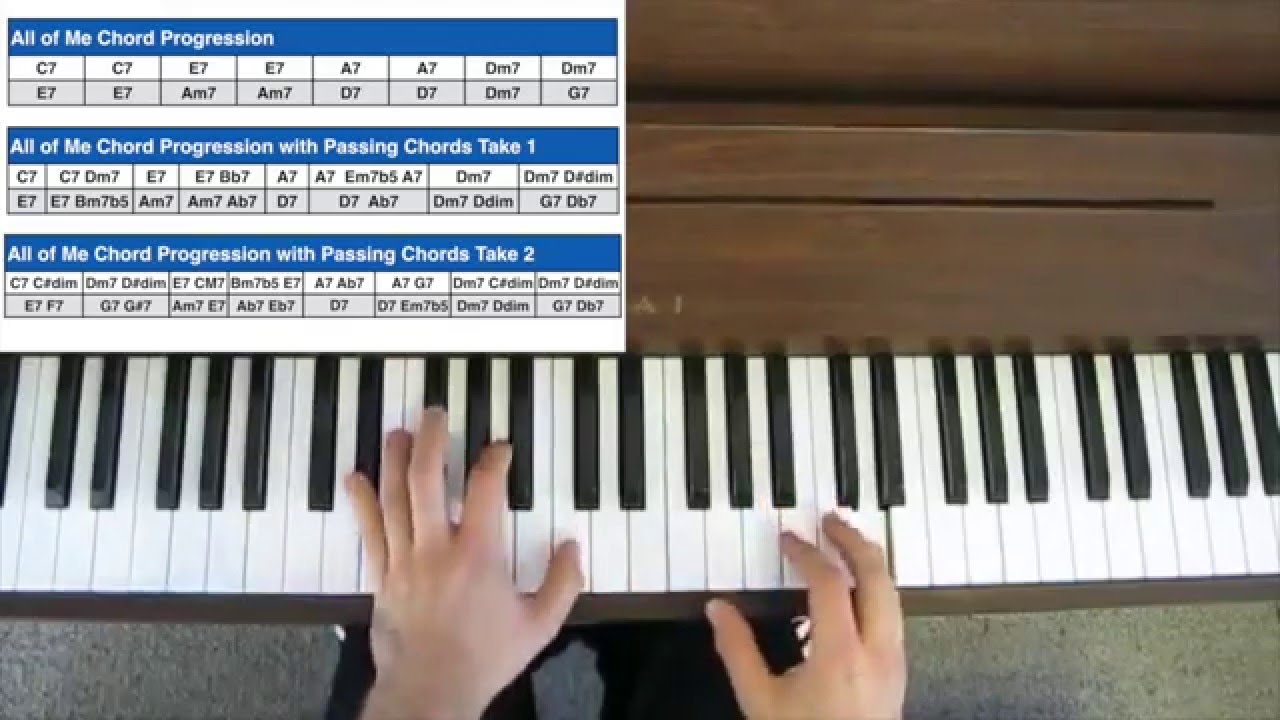
Why this video: This video provides a solid foundation in approach systems. It covers diatonic passing chords, chromatic approaches, and introduces the concept of the tritone substitution (for example, substituting Db7 for G7 to resolve smoothly to C Major 7).
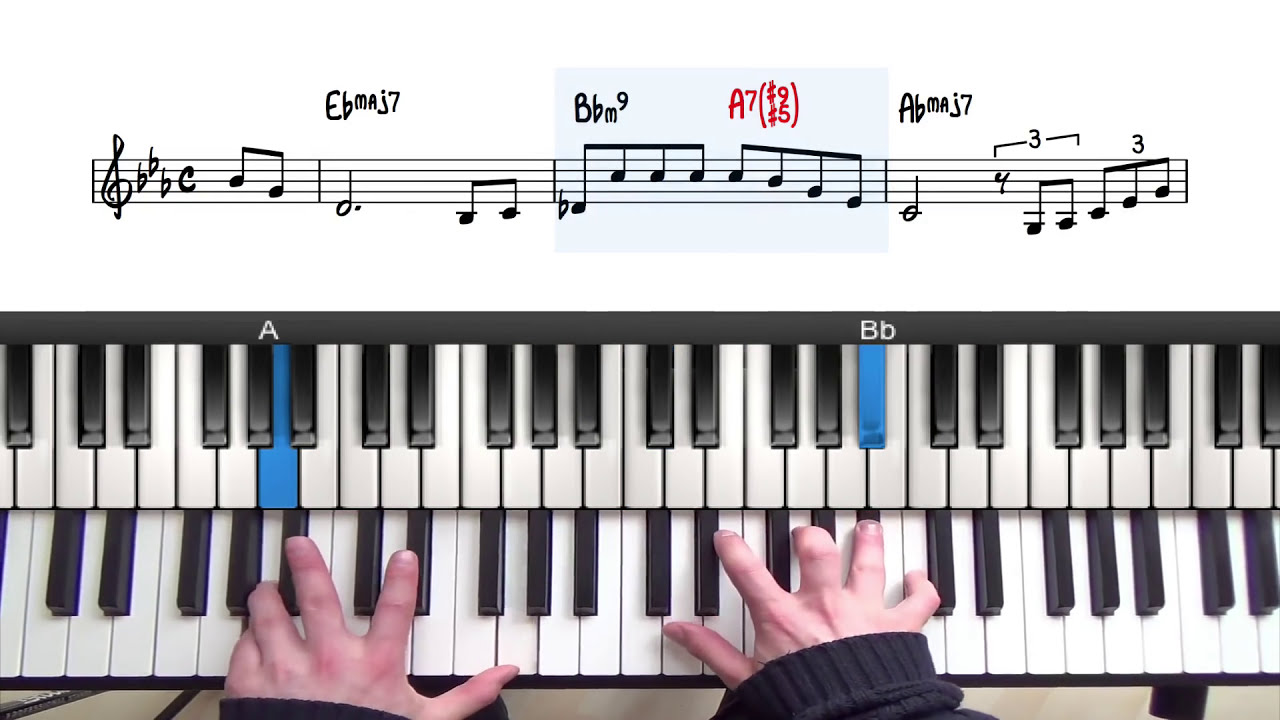
Why this video: This video is a detailed guide to understanding and playing tritone substitutions. It explains the mechanics of why they work: because two dominant chords a tritone apart share the exact same 3rd and 7th scale degrees, allowing for incredibly smooth chromatic resolution.
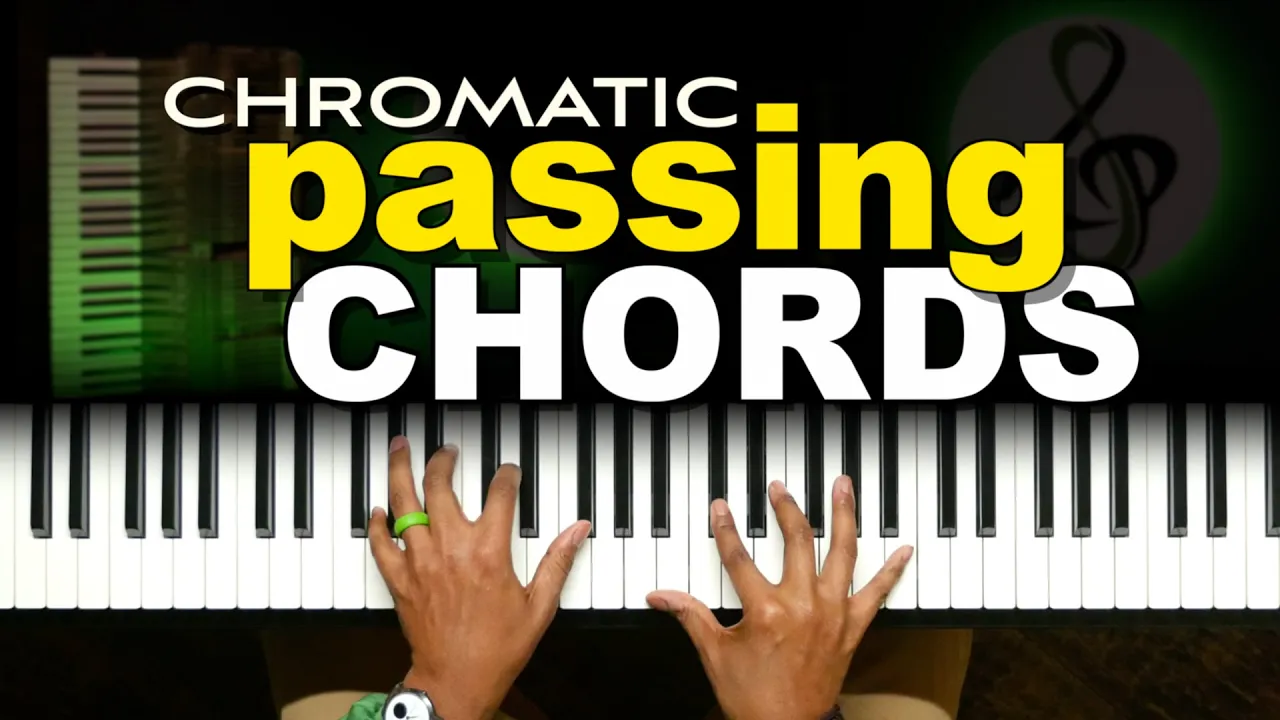
Why this video: This video focuses on practical keyboard application. It shows you how to use diminished seventh chords and half-step chromatic movements to bridge the gap between any two diatonic chords in all 12 keys.
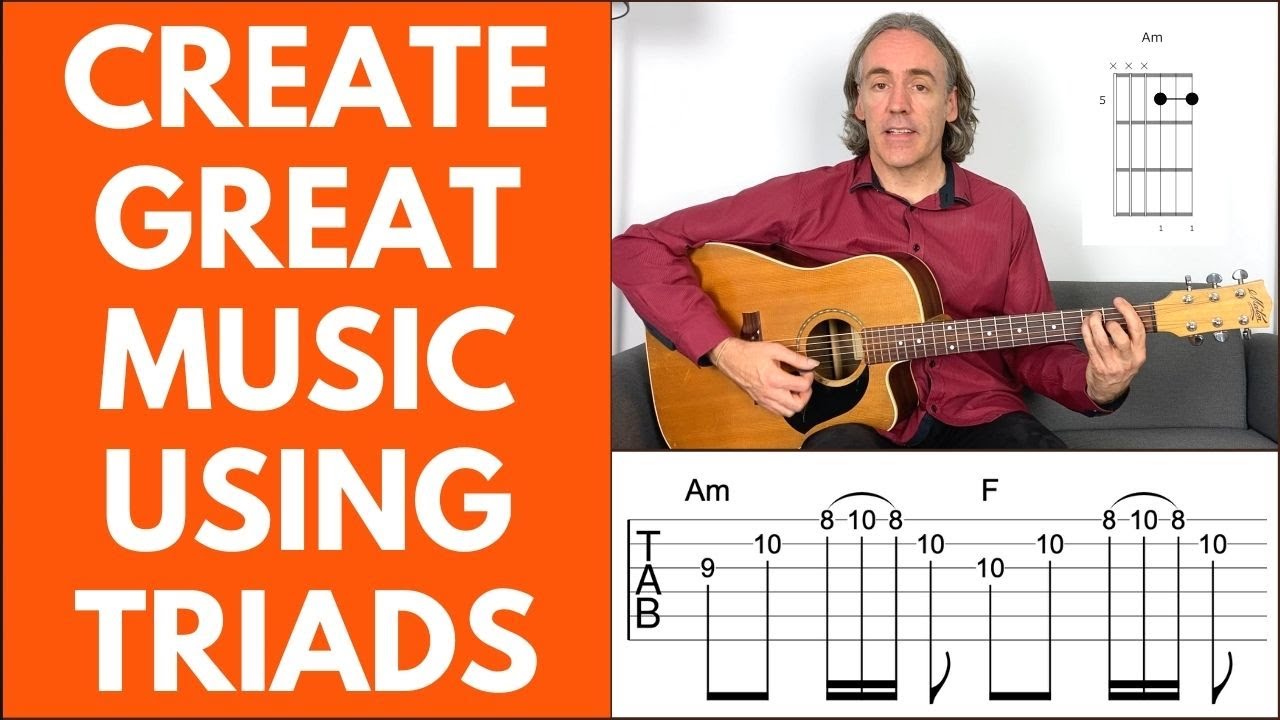
Why this video: Addressing Feedback Gap: While this video features a guitar, it clearly explains the core concept of side-slipping. Side-slipping is the technique of playing a chord shape, moving it up or down a single half-step (semitone) to create temporary tension, and then shifting it back to resolve. This theoretical concept translates directly to the piano: take your minor 11th or quartal shape, slide it up one half-step, and slip it back to resolve.
Knowledge Checkpoint
- Apply a tritone substitution to a standard ii-V-I progression (substituting the V7 chord with a dominant 7th chord a tritone away).
- Explain why a tritone substitution works (the shared 3rd and 7th degrees between the original and substituted chord).
- Create a chromatic passing path using a diminished 7th chord to connect a I major 7 and a ii minor 7 chord.
- Perform a "side-slip" on the keyboard: play a Minor 11 chord, shift the entire shape up a half-step, and resolve it back down to the target key.
Module 6: Producing the Beat: From Chords to Lo-Fi Track
In this final module, you will bring your chords to life. You will learn to record your progressions into a DAW, edit your MIDI notes for a relaxed human feel, program swinging lo-fi drum beats, and apply effects to get that nostalgic, warm, vintage sound.
Recommended Videos

Why this video: This video is a complete walkthrough of the production process. It covers establishing a relaxed tempo (90–96 BPM), choosing warm instrument presets, recording your chord progressions, and layering simple melodies to build a solid track.

Why this video: This tutorial explains how to turn a simple chord loop into a full song structure. It covers sound design, arrangement, and processing tips (like adding vinyl crackle, tape hiss, and subtle pitch warble) to give your music that authentic lo-fi feel.
Why this video: This video is excellent for learning how to sound design your own instruments without relying on samples. It explains how to use LFOs (Low Frequency Oscillators) to modulate pitch and volume, creating that warm, unstable tape warble effect.
Why this video: To get a relaxed, lay-back lo-fi feel, you need to understand swing. This video demonstrates how to adjust your DAW's quantize settings to add a natural human groove and swing to your programmed MIDI patterns.
Knowledge Checkpoint
- Set up a DAW project at a relaxed lo-fi tempo (typically between 75 and 95 BPM).
- Record a four-chord neo-soul progression using a MIDI keyboard or editor.
- Apply swing settings to your MIDI drums to create a relaxed hip-hop groove.
- Use plugins (like EQ, bitcrushing, or tape emulation) to filter out harsh high frequencies and add warm tape saturation to your master track.
Course Map
This flowchart shows the recommended learning path and how the modules build on one another.
Key People Index
- Herbie Hancock: A legendary jazz pianist and pioneer of modern keyboard harmony. His signature split-hand minor 11th voicing is a staple of R&B and Neo-Soul.
- Noah Kellman: A contemporary educator and composer specializing in modern jazz, R&B, and neo-soul piano styles. He is known for breaking down complex jazz theories into practical keyboard formulas.
- Bill Hilton: A popular piano educator celebrated for his accessible approach to teaching beginner piano mechanics, keyboard layout, and basic music theory.
Final Self-Assessment
Test your understanding of the entire curriculum with this comprehensive checklist:
- Keyboard Layout: Can you instantly identify any white or black key on the keyboard using the black key clusters as a reference?
- Triad Spells: Can you spell and play both major and minor triads starting on C, F, G, and Bb?
- Seventh Extensions: Can you explain the difference between a Major 7th, Minor 7th, and Dominant 7th chord structure?
- Extension Math: Can you identify the 9th, 11th, and 13th scale degrees for any root note on the piano?
- Minor 11 Voicings: Can you play a split-hand Minor 11th chord with a perfect fifth in your left hand and the extensions in your right hand?
- Quartal Stacks: Can you build a three-note quartal chord (stacked fourths) starting from any root key?
- Tritone Subs: Can you substitute a dominant 7th chord with another dominant 7th chord a tritone away to resolve smoothly to a target chord?
- Side-Slipping: Can you play a chord voicing, shift the entire shape up a half-step, and slide it back down to resolve?
- DAW Setup: Can you record your MIDI keyboard performance into a DAW project set to a lo-fi tempo (75-95 BPM)?
- Groove & Swing: Can you adjust your DAW's quantization settings to add swing to your drum programming?
- Lo-Fi Sound Design: Can you use low-pass filters and saturation plugins to create a warm, vintage tape sound?