Gut-Brain Axis: Biology, Microbes & Mood
Learning Goal: Understand the biological mechanisms of the gut-brain axis, specifically how the enteric nervous system, vagus nerve, and gut microbiota interact to influence brain function, mood, and behavior.
- Prerequisites: Basic high school level biology (cell structure, elementary nervous system concepts).
- Estimated Total Study Time: 12 Hours
Module 1: Introduction to Neurobiology & the Enteric Nervous System
Module Overview
This module establishes the foundational structural divisions of the human nervous system. You will learn to clearly distinguish between the Central Nervous System (CNS) and the Peripheral Nervous System (PNS), while receiving an introductory look at the gastrointestinal tract's autonomous neural network, often termed the "second brain."
Recommended Videos
Why this video
This video provides a rapid, high-yield breakdown of the nervous system's architecture. It establishes how the central nervous system (brain and spinal cord) processes sensory input and integrates it with motor outputs, providing the perfect baseline for understanding peripheral connections.

Why this video
This video delves deeper into the structural division of the nervous system, mapping out how the PNS sends and receives signals from the CNS. It ensures you have a firm grasp of systemic wiring before you isolate the gut's internal networks.

Why this video
This lecture segment introduces the Enteric Nervous System (ENS) as the third distinct component of the autonomic nervous system. It outlines how this massive mesh-like lining of approximately 100 million neurons coats the digestive tract, preparing you for the micro-anatomy covered in the next module.
Knowledge Checkpoint
- Explain the primary structural and functional differences between the CNS and the PNS.
- Define the Enteric Nervous System (ENS) and state its approximate neuron count compared to other peripheral nerves.
- Identify which embryonic tissue layers the ENS originates from and its general distribution from the esophagus to the anus.
Module 2: The Enteric Nervous System (ENS) in Detail
Module Overview
This module explores the detailed micro-anatomy and histology of the ENS. You will study its dual-plexus architecture (the myenteric/Auerbach's and submucosal/Meissner's plexuses), analyze how these neural networks operate autonomously via local reflexes, and examine how they coordinate gastrointestinal motility and secretion.
Recommended Videos
Why this video
This is a highly detailed, clinically focused lecture detailing the exact division of labor between the two major enteric plexuses. It explicitly teaches you the physical location, histological layers, and primary physiologic roles of both Meissner’s and Auerbach’s networks.
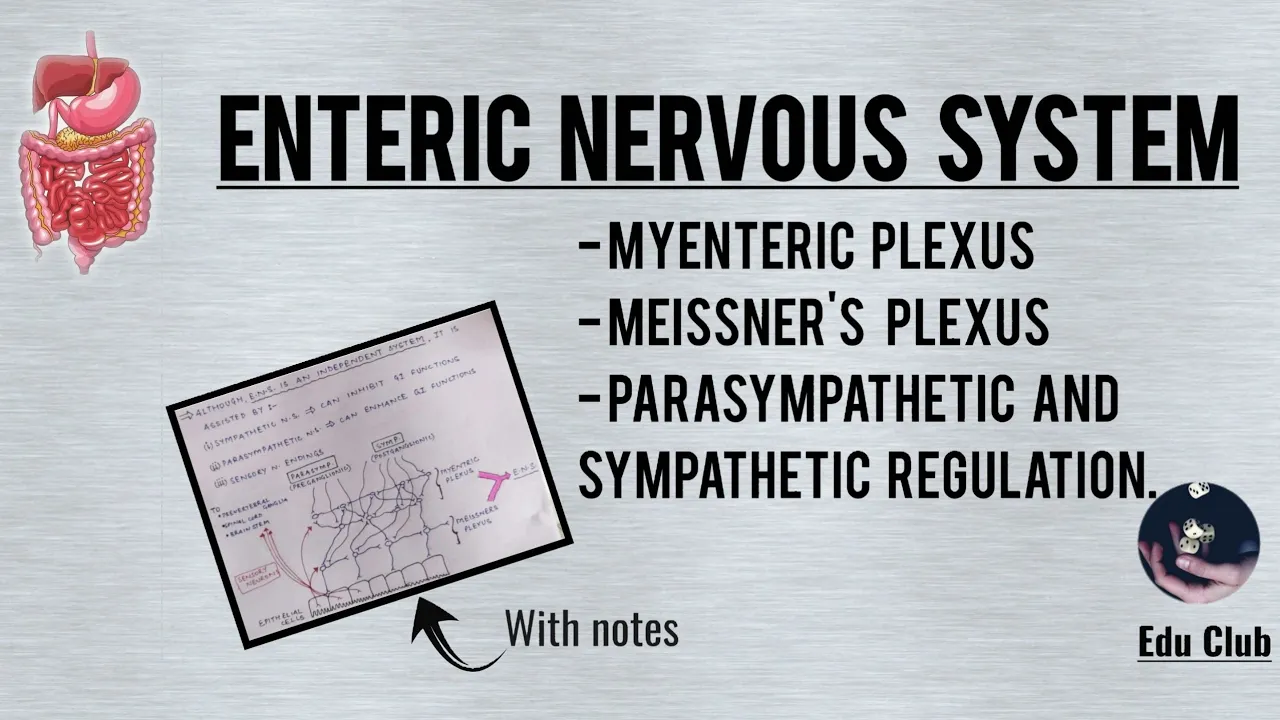
Why this video
A masterful deep dive focusing purely on the histology and signaling of the enteric nervous system. This video illustrates how sensory receptors in the gut wall detect stretch or chemical changes and communicate directly with local motor neurons to trigger peristalsis or secretion without brain intervention.
Why this video
This targeted tutoring session highlights key anatomical markers and high-yield study points regarding the submucosal (Meissner's) plexus—which controls local secretions and blood flow—and the myenteric (Auerbach's) plexus—which regulates gut muscular contractions.
Independent Study Guidance
Histological and anatomical details regarding the ENS can be highly visual. If you struggle to map these structures mentally, search independently for terms like "myenteric vs submucosal plexus histology slide" or "cross-section of the duodenum wall nervous layers" to visualize the exact tissue layers (submucosa vs. muscularis externa) housing these neurons.
Knowledge Checkpoint
- Differentiate between the Myenteric (Auerbach's) and Submucosal (Meissner's) plexuses based on anatomical location and primary physiological function.
- Describe a local enteric reflex arc, outlining how a sensory stimulus leads to motor changes (peristalsis) entirely within the gut wall.
- Explain how the ENS can maintain coordination and function even when completely severed from the vagus nerve and spinal cord.
Module 3: The Vagus Nerve Highway
Module Overview
The vagus nerve (Cranial Nerve X) serves as the primary physical bridge of the gut-brain axis. In this module, you will trace its path from the brainstem to the abdominal cavity. You will analyze the critical distinction between its afferent (sensory, bottom-up) and efferent (motor, top-down) pathways, learning why brain-gut communication is heavily weighted toward sensory reporting rather than executive command.
Recommended Videos

Why this video
This medical animation outlines the physical origin of CN X in the medulla oblongata, tracing its descent alongside major blood vessels into the thoracic and abdominal cavities. It clearly categorizes its mixed motor, sensory, and parasympathetic fibers.
Why this video
Dr. Habib explains the functional asymmetry of the vagus nerve. He details how roughly 80% to 90% of its fibers are afferent (carrying sensory data up to the brain), while only 10% to 20% are efferent (carrying regulatory commands down to the organs), transforming how we view the "direction" of mind-body signaling.

Why this video
A rigorous neuroanatomical tour of Cranial Nerve X. It maps the nuclei in the brainstem (including the dorsal motor nucleus and nucleus tractus solitarius) that coordinate autonomic reflexes, detailing how these pathways loop through the gut.
Independent Study Guidance
Because vagal pathways involve complex brainstem geography, it is beneficial to look up visual diagrams of the "Nucleus Tractus Solitarius (NTS) vagus afferents" to see exactly where visceral sensory information lands in the brain before being routed to emotional processing centers.
Knowledge Checkpoint
- Trace the anatomical path of the vagus nerve from its origin in the brainstem to its terminal branches in the large intestine.
- Calculate and explain the biological significance of the ratio of afferent to efferent fibers in the vagus nerve.
- Identify the specific brainstem nuclei (e.g., NTS, dorsal motor nucleus) that serve as receiving stations for gut-derived sensory signals.
Module 4: The Gut Microbiome and Its Metabolites
Module Overview
Trillions of microbes inhabit the human intestine, forming an intricate ecosystem that communicates directly with our nervous system. This module focuses on the biochemical products of these microbes, specifically short-chain fatty acids (SCFAs) like butyrate, acetate, and propionate. You will examine the mechanisms by which these metabolites protect barrier structures and cross or interact with the blood-brain barrier (BBB).
Recommended Videos

Why this video
In this biochemically-dense brief segment, the structural role of short-chain fatty acids (particularly butyrate) is explained. The speaker details how SCFAs fortify the tight junction proteins in both the intestinal barrier and the blood-brain barrier, preventing systemic leakiness.

Why this video
Renowned gastroenterologist Dr. Will Bulsiewicz walks through the clinical importance of the gut microbiome. He highlights how bacterial fermentation of fiber produces key metabolites that pass into systemic circulation, alter neuro-inflammation, and directly cross or stimulate the blood-brain barrier to impact mood and cognition.

Why this video
Dr. Leeming breaks down how gut bacteria metabolize complex fibers into active, anti-inflammatory compounds. This video helps clarify the biochemical mechanisms of how diet-derived fiber directly modulates brain-gut communication channels.
Independent Study Guidance
For a highly deep-dive understanding, search scientific databases (like PubMed or Google Scholar) using the query "SCFA blood brain barrier monocarboxylate transporters." This will reveal the exact molecular transport mechanisms (like MCT-1 receptors) that allow butyrate to physically enter brain tissue.
Knowledge Checkpoint
- Define the primary short-chain fatty acids (SCFAs) produced by microbial fermentation and identify their dietary precursors.
- Explain how butyrate protects cellular barriers by reinforcing "tight junction" proteins (e.g., claudin, occludin).
- Detail the physical and biochemical mechanisms by which circulating SCFAs influence the permeability of the blood-brain barrier.
Module 5: Biochemical Signaling & Systemic Pathways
Module Overview
This module explores the complex pathways of the gut-brain axis, tracking how endocrine cascades, immune cytokines, and gut-synthesized neurotransmitters interact. You will analyze the Hypothalamic-Pituitary-Adrenal (HPA) axis under stress, examine how intestinal cells produce the vast majority of our body's serotonin, and discover how inflammatory signals alter brain function.
Recommended Videos

Why this video
This video connects gut biology with clinical biochemistry. It details how the gut microbiome and specialized intestinal cells (enterochromaffin cells) synthesize approximately 95% of the body's serotonin, along with large portions of dopamine and GABA, and explains why these neurotransmitters cannot easily cross the BBB but still signal the brain via the vagus nerve.
Why this video
To master how stress affects the gut, you must first master the HPA axis. This video clearly explains the classic endocrine cascade: how the hypothalamus secretes CRH, signaling the pituitary to release ACTH, which ultimately triggers the adrenal glands to flood the body with cortisol.
Why this video
This lecture segment details how systemic inflammation—triggered by a damaged, hyper-permeable intestinal lining (leaky gut)—allows bacterial components (like LPS) to enter the bloodstream. It explains how these inflammatory cytokines cross and alter the blood-brain barrier, contributing to depressive behaviors.
Knowledge Checkpoint
- Trace the HPA axis cascade from stress perception to systemic cortisol release, including all hormones and glands involved.
- Explain how serotonin synthesized in the gut (95% of total) communicates with the brain despite its inability to cross the blood-brain barrier.
- Describe how systemic inflammation or lipopolysaccharides (LPS) from gut bacteria can compromise blood-brain barrier integrity.
Module 6: Clinical Implications: Mood, Behavior, and Psychobiotics
Module Overview
In this final module, you will apply your anatomical and biochemical knowledge to clinical realities. You will explore how imbalances in the gut-brain axis contribute to irritable bowel syndrome (IBS), major depressive disorder, and generalized anxiety. Finally, you will study therapeutic interventions, including diet, "psychobiotics" (probiotics targeting mental health), and Fecal Microbiota Transplantation (FMT).
Recommended Videos

Why this video
Dr. Tim Spector presents peer-reviewed evidence proving the bidirectional relationship between gut microbes and mental health. He highlights seminal animal trials (e.g., anxiety phenotypes transferred via fecal transplant in mice) and addresses how human gut dysbiosis underpins clinical depression, ADHD, and anxiety.

Why this video
An incredible documentary focusing on the therapeutic power of fecal microbiota transplantation (FMT). It showcases a patient’s recovery from severe bipolar disorder through gut microbiome reconstruction, vividly illustrating how manipulating gut biology can directly reset complex mood disorders.

Why this video
Dr. Rajsree provides a practical, clinically rigorous guide to "psychobiotics." She explains how specific probiotic strains work down in the gut lining to upregulate systemic neurotransmitters like GABA and serotonin, offering concrete therapeutic strategies for anxiety and gut disorders.
Knowledge Checkpoint
- Explain the concept of "psychobiotics" and name at least one pathway through which specific bacterial strains alter mental state.
- Detail the findings of rodent fecal transplantation studies regarding the transmissibility of anxiety-like behaviors.
- Analyze the clinical presentation of Irritable Bowel Syndrome (IBS) as a prime disorder of gut-brain interaction.
Course Map
Key People Index
- Dr. Michael Gershon, M.D.
- Context: Often regarded as the pioneer/father of "neurogastroenterology." He popularized the phrase "The Second Brain" and was key in discovering the vast quantity of serotonin synthesized within the enteric nervous system.
- Dr. Will Bulsiewicz, M.D., MSCI
- Context: A prominent gastroenterologist and author focusing heavily on the clinical application of dietary fiber. He explains how microbial fermentation produces short-chain fatty acids that improve gut barrier integrity and systemic brain function.
- Dr. Tim Spector, M.D., FMedSci
- Context: Professor of Genetic Epidemiology at King’s College London. He leads major studies on the human microbiome and genetic epidemiology, establishing empirical links between gut microbial diversity, dietary choices, and mental health.
- Dr. Navaz Habib, D.C.
- Context: Functional medicine practitioner and author specializing in vagus nerve stimulation. He translates the anatomical pathways of CN X into practical, clinical applications for modulating heart rate variability, digestion, and chronic inflammatory states.
Final Self-Assessment
Complete this comprehensive, high-yield self-assessment to ensure you have met the core learning goals of this curriculum:
- I can explain the anatomical differences between the central, peripheral, and autonomic nervous systems, highlighting where the enteric nervous system sits in this taxonomy.
- I can identify the physical boundaries of the submucosal (Meissner’s) and myenteric (Auerbach’s) plexuses within the histological layers of the gastrointestinal wall.
- I can describe how local sensory cells and enteric motor loops allow the gut to perform complex digestion and peristalsis independently of cranial commands.
- I can explain the anatomy of Cranial Nerve X (the vagus nerve), tracing its path from the medulla to the abdomen.
- I can outline the physiological difference between vagal afferent and efferent pathways, highlighting why bottom-up sensory signaling constitutes 80-90% of vagal fibers.
- I can define short-chain fatty acids (SCFAs), name the three main types (butyrate, acetate, propionate), and detail how they are produced via bacterial fermentation of fiber.
- I can diagram the biological cascade of the HPA axis (Hypothalamus-Pituitary-Adrenal axis) and explain how chronic cortisol release alters intestinal permeability.
- I can describe how systemic inflammation and bacterial byproducts (like lipopolysaccharides) damage the blood-brain barrier, allowing neurotoxic factors to trigger depressive states.
- I can define "psychobiotics" and outline how clinical tools like dietary adjustments, probiotic strains, and fecal transplants are utilized to treat mood disorders.