Mastering Complex Rhythms: Math Rock & Metal
Learning Goal: Mastering Complex Rhythms: Utilizing Odd Time Signatures, Polyrhythms, and Metric Modulation in Math Rock and Progressive Metal Composition
- Prerequisites: Basic proficiency in an instrument (guitar or drums preferred) or introductory experience with a Digital Audio Workstation (DAW) for MIDI programming. No advanced theoretical knowledge is required to start.
- Estimated Total Study Time: 24 Hours
Module 1: Foundations of Rhythm and Time
Before venturing into the asymmetrical landscapes of math rock and the shifting tempos of progressive metal, you must establish a flawless internal sense of time. This module solidifies your understanding of basic rhythm notation, time signatures, and the physical realization of steady pulses and subdivisions on your instrument. We pay special attention to building a solid rock-oriented foundation through guitar strumming subdivisions and basic kit coordination.
Recommended Videos
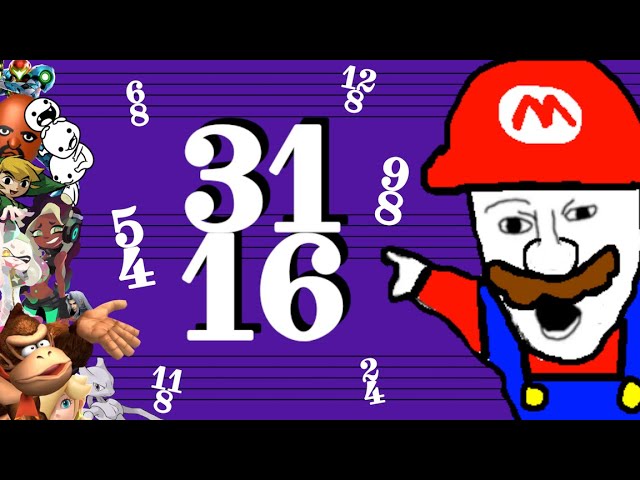
- Why this video: This video uses easily recognizable Nintendo melodies to demystify how time signatures operate. It clearly explains the mathematical meaning behind both numbers in a time signature (beats per measure over the relative note value) and shows how we subdivide standard bars, providing a perfect baseline for beginners.

- Why this video: Establishing an unwavering internal pulse is vital. This workshop focuses on the physical coordination of rhythm, demonstrating how quarter notes, eighth notes, and sixteenth notes function as interconnected elements. It bridges the gap between seeing notes on a page and physically feeling them.
- Why this video: This is a highly practical, rock-oriented guitar lesson that explains progressive subdivision. Learning to subdivide "1 and 2 and 3 and 4" using physical down-and-up strumming is an essential tactile skill that prepares guitarists to tackle odd and asymmetrical meters later on.

- Why this video: To compose math rock or progressive metal, you must understand standard drum kit coordination. This video introduces the basic rock drum pattern (quarter/eighth notes on the hi-hat, snare on 2 and 4, and kick on 1 and 3). Understanding this standard template is necessary before learning to subvert it.
Knowledge Checkpoint
- Understand what the numerator and denominator in a time signature (e.g., 4/4, 3/4) mathematically represent.
- Accurately clap or strum standard subdivisions (quarter, eighth, and sixteenth notes) over a steady 4/4 metronome pulse.
- Identify where the snare and kick drums traditionally land in a standard rock beat.
Module 2: Odd Time Signatures and Subdivision
Math rock and progressive metal rarely stay in 4/4. To master meters like 5/8, 7/8, or 11/8, you cannot think of them as long strings of individual beats. Instead, you must learn to subdivide these odd structures into digestible, asymmetrical blocks of 2s and 3s. This module teaches you how to count, feel, and play comfortably in odd meters.
Recommended Videos
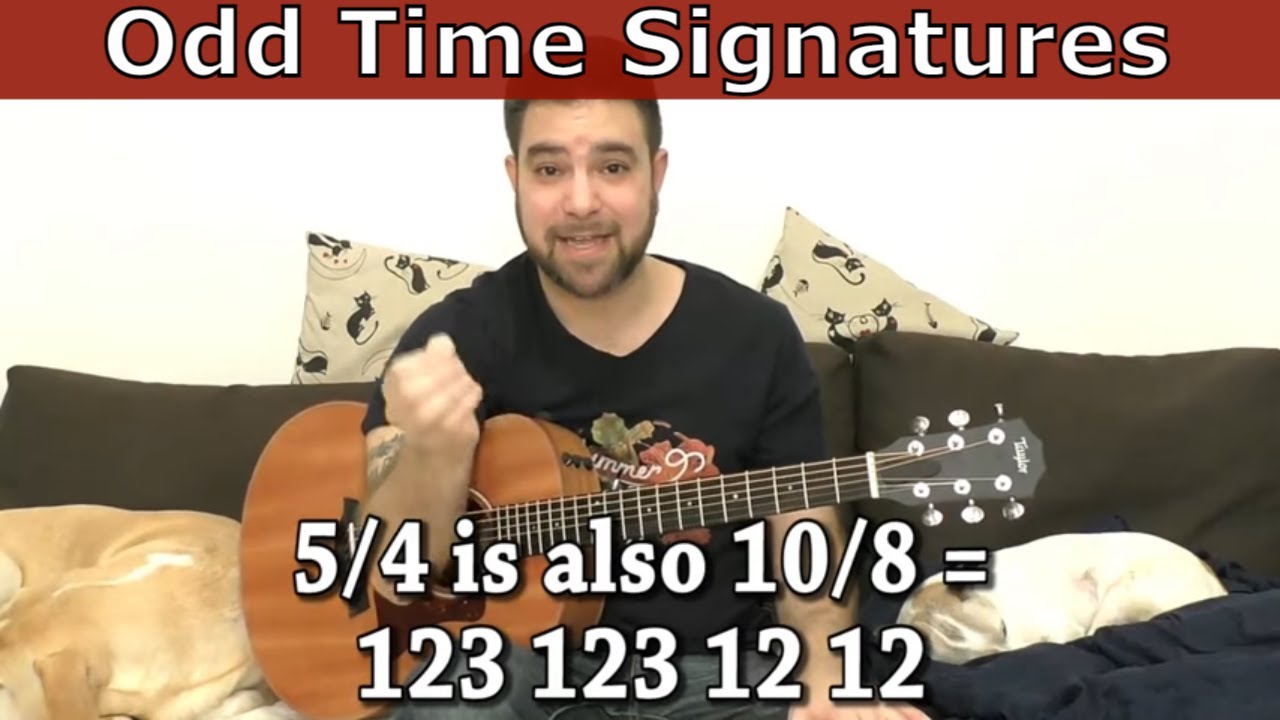
- Why this video: A premier tutorial for instrumentalists, this video breaks down odd meters into symmetrical and asymmetrical components. It teaches you how to conceptualize 5/4 as , 7/8 as , and 11/8 as . This makes odd meters intuitive to count and execute on guitar.
![Understanding and Using Odd Time Signatures - 6 Examples [MUSIC THEORY / RHYTHM]](https://i.ytimg.com/vi_webp/T8AaalPfxYk/maxresdefault.webp)
- Why this video: This video uses concrete examples to illustrate how odd meters (such as 5/4, 7/4, 9/8, and 7/16) create unique, off-kilter grooves. It demonstrates how to establish "accent patterns" by choosing which beats to stress, a fundamental technique when writing math rock riffs.

- Why this video: A concise, direct lesson on progressive rock and metal counting. Rick Beato explains how to actively dissect complex structures (like a rapid 13/8 time signature) by listening for internal micro-groupings of twos and threes (e.g., ).

- Why this video: This video demonstrates how to subdivide odd meters like 7/8 on the guitar. It emphasizes how breaking a complex signature into alternating patterns of twos and threes helps keep the music sounding natural, fluid, and danceable rather than rigid.
Knowledge Checkpoint
- Define what makes a time signature "odd" or "asymmetrical."
- Count aloud a bar of 7/8 using two different subdivision patterns: (1-2, 1-2, 1-2-3) and (1-2-3, 1-2, 1-2).
- Deconstruct an unfamiliar odd time signature (e.g., 11/8 or 13/8) into smaller rhythmic groups of 2s and 3s.
Module 3: Polyrhythms and Polymeters
This module transitions from single odd-meter lines to overlapping rhythms. Polyrhythms (playing two different subdivisions simultaneously within the same bar, like 3 against 4) and polymeters (playing different time signatures simultaneously, where the bar lines do not align) are key components of progressive metal and djent. This module explains the theory behind these concepts and provides exercises to help you master them.
Recommended Videos

- Why this video: This video provides a clear visual explanation of the differences between polymeter and polyrhythm. Using straightforward graphics, Andrew Huang shows how a polymeter shares a tempo but uses different bar lengths, whereas a polyrhythm crams different beat subdivisions into the exact same time duration.
- Why this video: This lesson dives deeper into the composition process. It shows how layering a complex meter (like 11/8) over standard 4/4 creates tension because the downbeats slowly drift apart and only occasionally realign, a core technique in progressive songwriting.
![POLYRHYTHM- Learn and MASTER 3:4 and 4:3 [MUSIC THEORY - RHYTHM- COUNTING]](https://i.ytimg.com/vi_webp/c1pejTgLuhA/maxresdefault.webp)
- Why this video: A masterclass on mastering the classic 3:4 and 4:3 polyrhythms. It provides mathematical step-by-step methods to count and feel these patterns. It shows how they divide time and highlights the rhythmic vocalizations (such as "pass the golden butter") used to internalize them.

- Why this video: This video analyzes Meshuggah's track "Clockworks." Host Yogev Gabay breaks down how the band uses simple groups of 2s and 3s to build incredibly complex polyrhythmic and polymetric structures within a steady 4/4 time signature.
Knowledge Checkpoint
- Explain the difference between a polyrhythm (e.g., 3:4) and a polymeter (e.g., 5/4 over 4/4).
- Calculate the grid resolution needed to plot a 4:3 polyrhythm (the lowest common multiple is 12).
- Tap a basic 3 against 2 polyrhythm with your hands (triplets against quarter notes).
Module 4: Metric Modulation
Metric modulation is a transition technique where you change to a new tempo or meter by using a shared note value as a pivot point. This creates a smooth transition between sections of a song. In this module, we cover the theory of metric modulation and look at practical ways to apply it to guitar riffs and drum grooves.
Recommended Videos

- Why this video: This video covers the historical and theoretical foundations of metric modulation. It explains how composers across classical, jazz, and rock genres establish a "rhythmic pivot point" to change tempos seamlessly.

- Why this video: This video takes a deep dive into the math of tempo changes. It explains how to calculate exact tempo ratios using pivot rhythms that fit into both the old and new time signatures.
- Why this video: This video addresses a common gap: how to apply metric modulation on the guitar. It shows how to use implied metric modulation to build tension in guitar riffs. The guitarist keeps the same riff pattern going while the drums shift the underlying pulse underneath.

- Why this video: A short, practical demonstration of how a drummer can use a shared pulse to transition between standard time and triplet-based feels.
A Note on Metric Modulation: Metric modulation is a complex, mathematical technique that takes time to master. If you find calculating the ratios challenging at first, focus on practical practice: try playing sixteenth-note triplets on your instrument, and then transition to treating those triplets as the new eighth-note pulse of your next section.
Knowledge Checkpoint
- Define metric modulation and explain the role of a "pivot note."
- Explain how a dotted eighth note can serve as a transition point to shift from a slower tempo to a faster one.
- Describe the difference between an explicit metric modulation (an actual change in tempo) and an implied metric modulation (where the drums shift their feel while the tempo remains the same).
Module 5: Math Rock and Progressive Metal Composition
In this final module, you will pull together everything you have learned. We will look at how to combine odd meters, polyrhythms, and metric modulation to write actual songs. We also address a key workflow step: how to program realistic MIDI drums in a DAW to back up your complex guitar riffs.
Recommended Videos
- Why this video: This video teaches you how to take a simple guitar riff and transform it into a math rock part. It covers how to add tension using dissonant intervals, shift downbeats, and break up straight 4/4 lines with odd time groupings.
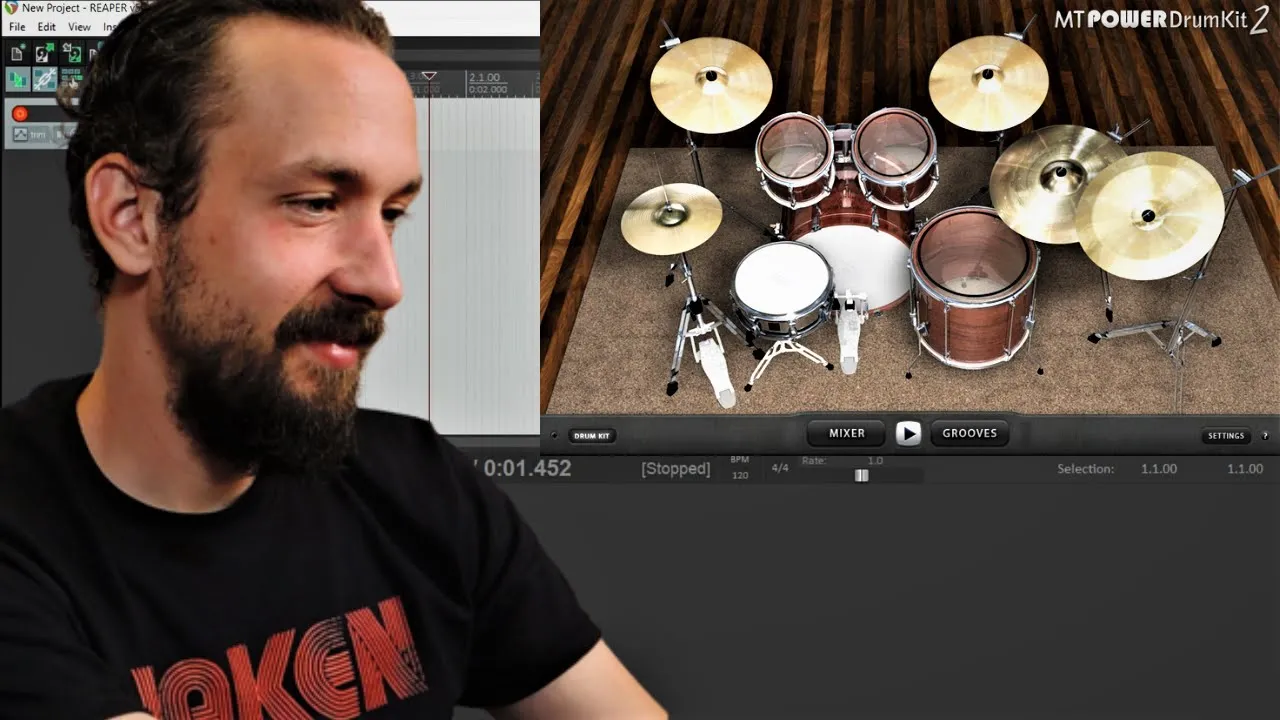
- Why this video: To write complex riffs, you need to know how to back them up with drums. This tutorial covers the basics of drum programming in a DAW. It walks you through setting up a free drum sampler (MT Power Drum Kit) in Reaper and programming custom patterns on the MIDI grid.
- Why this video: Complex MIDI drum parts can easily sound robotic and unnatural. This video teaches you how to make programmed drums sound like a real drummer. It explains how to respect physical drumming limits (like not programming three hands striking at once) and how to adjust MIDI velocity and timing for a more human feel.

- Why this video: This video analyzes the drum grooves of Matt Garstka from Animals as Leaders. It demonstrates how to combine complex guitar patterns with shifting drum grooves, such as repeating a 7/8 kick pattern across a 9/4 bar.
Knowledge Checkpoint
- Write a 2-bar guitar riff in an odd time signature (e.g., 5/8 or 7/8) that uses angular, dissonant intervals.
- Program a drum groove in your DAW that aligns with your odd-meter riff, ensuring the kick drum supports the guitar's main accents.
- Humanize your programmed MIDI drums by varying note velocities and adjusting some hits slightly off the grid.
Course Map
Key People Index
- Yogev Gabay: A music theorist, educator, and analyst known for his detailed rhythmic breakdowns of complex progressive metal, particularly the music of Meshuggah.
- Tomas Haake: The longtime drummer for Meshuggah. He is widely recognized for pioneering modern polyrhythmic metal drumming, often playing complex polymetric patterns with his limbs over a steady 4/4 pulse on his hi-hat or ride.
- Matt Garstka: The drummer for Animals as Leaders. He is celebrated for his command of odd meters, complex subdivisions, and blending jazz fusion techniques with progressive metal.
- Connor Kaminski: A modern fusion and progressive metal guitarist, composer, and educator who demonstrates how to use modeling software and modern guitar techniques in contemporary rock production.
- David Bruce: A composer and music educator who creates accessible videos breaking down advanced theoretical concepts, such as metric modulation, across classical, jazz, and rock music.
Final Self-Assessment
- I can define the difference between a time signature's numerator and denominator.
- I can count and clap a 5/8 or 7/8 pattern using distinct or subdivisions without losing the tempo.
- I can explain the core difference between a polyrhythm (different subdivisions in the same bar) and a polymeter (different bar lengths running together).
- I can tap a 3 against 2 polyrhythm (or a 4 against 3 polyrhythm) slowly and steadily.
- I can define metric modulation and explain how a shared note value acts as a "pivot."
- I can identify at least one song where a band uses implied metric modulation to build tension.
- I can write or program a short guitar riff in an odd meter (like 5/8 or 7/8) that uses shifting accent points.
- I can program a custom drum groove in a DAW (using a MIDI grid) that supports an odd-meter riff.
- I can apply humanization techniques (adjusting velocity and micro-timing) to keep programmed drums from sounding robotic.
- I can analyze a complex progressive metal riff and break down its underlying rhythmic structure into groups of 2s and 3s.