Particle Physics: Quarks, Leptons & Forces
Learning Goal: To understand the fundamental building blocks of the universe, detail the mechanics of the Standard Model of Particle Physics (including quarks, leptons, gauge bosons, and the Higgs field), interpret Feynman diagrams, and identify outstanding mysteries beyond the Standard Model.
- Prerequisites: Basic high school algebra and a general familiarity with classical physics (mechanics and electromagnetism). No advanced mathematics or prior quantum mechanics background is required.
- Estimated Total Study Time: 12 Hours
Module 1: Foundations of the Subatomic World
This module establishes a baseline understanding of scale and history. You will trace the evolution of atomic theory from classical models to the quantum revolution, and grasp the unimaginable relative sizes of the subatomic universe.
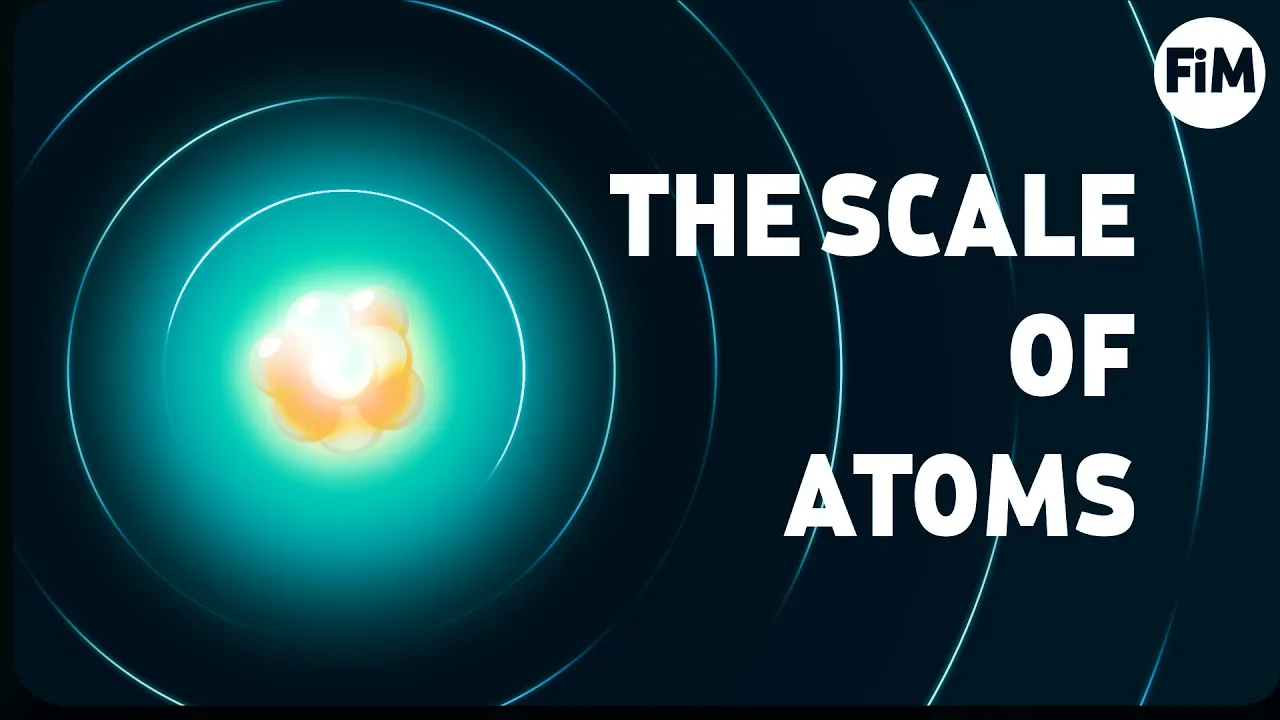
Why this video
To comprehend subatomic particle interactions, you must first transition your intuition away from macroscopic dimensions. This video relies on clear visual animations to demonstrate how small atoms actually are (e.g., comparing a carbon atom's 140 picometer diameter to the width of a human hair). It provides an essential baseline for physical intuition.
Knowledge Checkpoint
- Contrast the physical size of an entire atom with the size of its nucleus.
- Conceptualize the scale of a subatomic structure when scaled up to macroscopic everyday objects.
- Understand why direct optical observation of atoms is physically impossible.
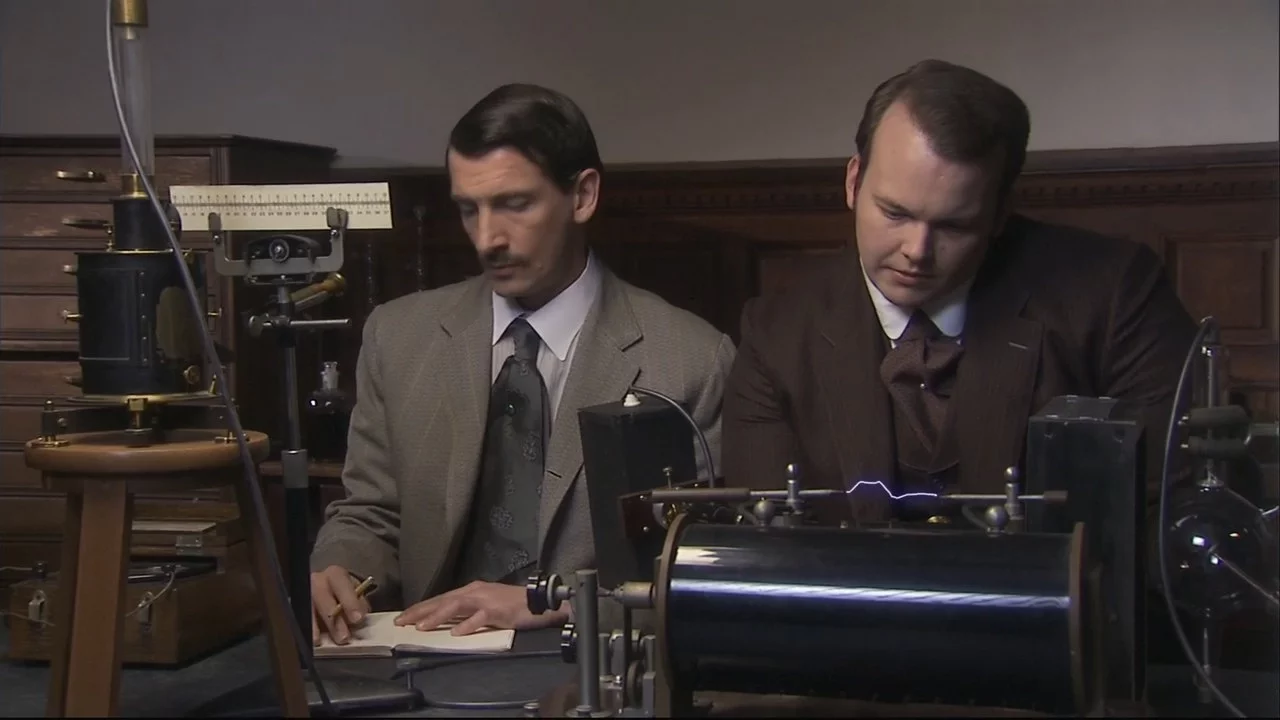
Why this video
This documentary details the historical experimental sequence that destroyed the concept of the "indivisible" Dalton atom. By walking through J.J. Thomson's cathode ray tube experiments and Rutherford's gold foil scattering, you will see how physicists were forced to accept the existence of internal atomic structures.
Knowledge Checkpoint
- Explain how J.J. Thomson proved that cathode rays were composed of negatively charged particles (electrons) rather than waves.
- Describe the gold foil experiment and how the pattern of alpha particle deflection led Rutherford to propose a compact, dense nucleus.
- Identify the limitations of the classical planetary model of the atom.

Why this video
Led by physicist Harry Cliff, this video acts as a bridge from atomic theory to modern high-energy collider physics. You will learn how the search for fundamental entities progressed from the nucleus to protons/neutrons, and eventually down to quarks.
Knowledge Checkpoint
- Summarize the modern hierarchical model of matter (Atom Nucleus Proton/Neutron Quark).
- Define what a "fundamental" or "elementary" particle is in the context of contemporary physics.
Module 2: Quarks and Leptons: The Matter Particles
This module investigates the fundamental fermions—the true building blocks of all matter. It introduces the six flavors of quarks, the three generations of leptons, and addresses the critical physics of neutrino oscillations and mass anomalies.

Why this video
This is a straightforward, beginner-friendly introduction to the classification of fundamental matter. It maps out the basic properties of the six quark flavors (up, down, strange, charm, top, bottom) and their fractional electric charges, distinguishing them clearly from leptons.
Knowledge Checkpoint
- Recall the six flavors of quarks and group them into their respective three generations.
- Distinguish the fractional electric charges of up-type quarks () from down-type quarks ().
- Calculate the net charge of a proton () and a neutron () using their constituent quark charges.

Why this video
This video resolves a common curriculum gap by focusing explicitly on the lepton family. It outlines the three generations of charged leptons (electron, muon, tau) and their corresponding neutral partners, the neutrinos.
Knowledge Checkpoint
- Define the characteristics of a lepton (e.g., spin-1/2 fermions that do not experience the strong nuclear force).
- List the three generations of leptons in order of increasing mass.
- Understand the role of charged leptons in electromagnetic interactions compared to the weakly interacting neutral neutrinos.
Why this video
This video addresses a major content gap identified in standard particle physics coursework: the physics of neutrino oscillations. It explains how neutrinos shift between flavors (electron, muon, and tau states) and why this behavior proves they have mass, directly contradicting the original massless neutrino prediction of the Standard Model.
Knowledge Checkpoint
- Describe the process of neutrino oscillation and what it implies about neutrino mass eigenstates.
- Explain how neutrino flavor change solved the historical "solar neutrino problem."
- Identify the implications of neutrino mass anomalies for the limits of the Standard Model.

Why this video
Featuring working academic physicists, this short video unpacks why quarks are organized into three distinct mass generations. It explains how high-energy experiments in the mid-to-late 20th century confirmed the presence of these heavier, highly unstable quark flavors.
Knowledge Checkpoint
- Explain the concept of generations or "families" of matter.
- Understand why heavy quarks (generations 2 and 3) are not typically found in stable, everyday matter.
Module 3: Gauge Bosons and the Fundamental Forces
This module covers the forces of nature and the particles that carry them. It repairs a common learning gap by diving deep into Quantum Chromodynamics (QCD), color charge, and Quantum Electrodynamics (QED), alongside the weak nuclear force.
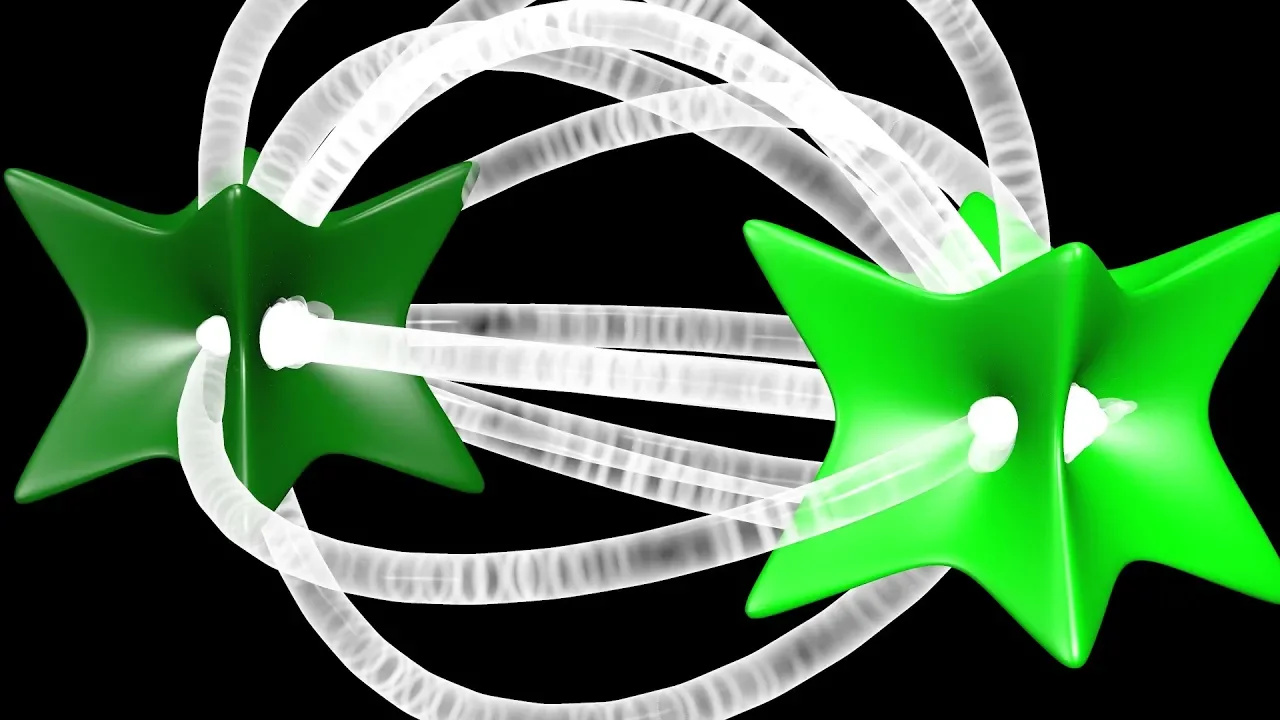
Why this video
This video corrects the common curriculum bias toward the weak force by delivering an animation of Quantum Chromodynamics (QCD). It shows how gluons mediate the strong force, explains "color charge" (red, green, blue), and illustrates how quarks are bound by "gluon flux tubes" which prevent them from ever being isolated individually (color confinement).
Knowledge Checkpoint
- Define color charge and explain how it differs from ordinary positive/negative electric charge.
- Describe color confinement and explain why quarks cannot be isolated as free particles.
- Detail the role of the 8 types of gluons in mediating the strong interaction.
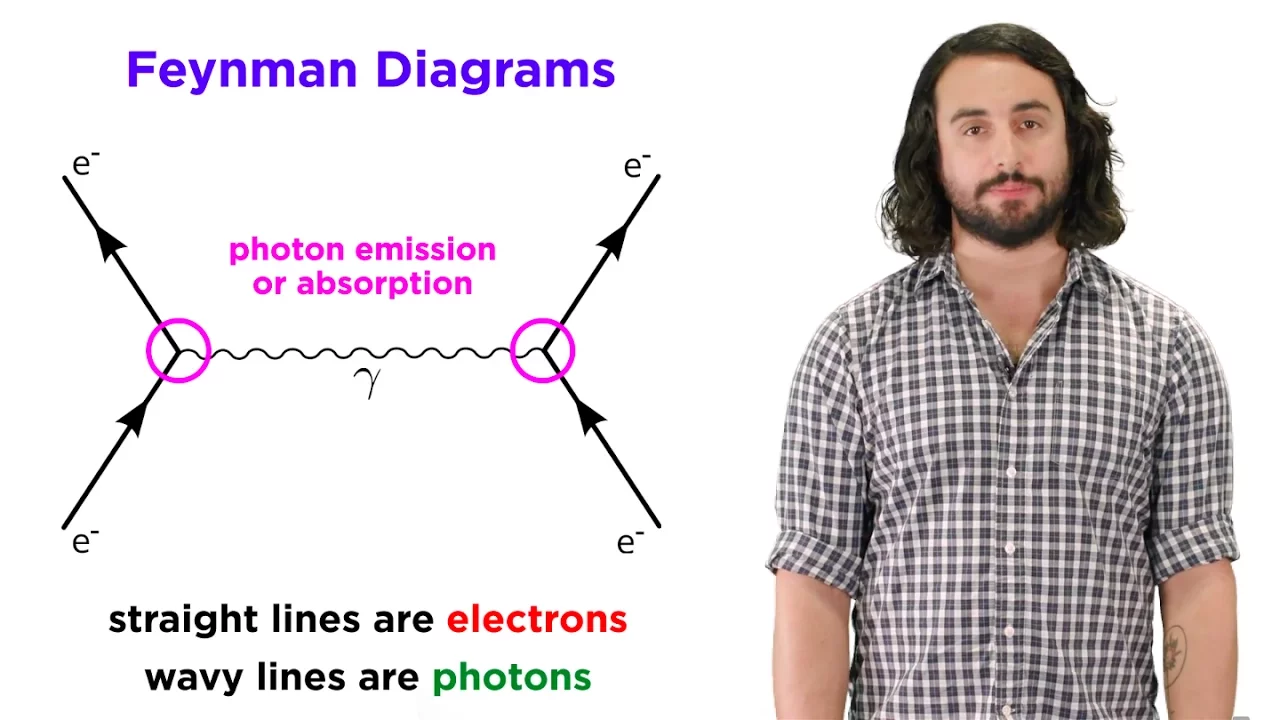
Why this video
This video bridges classical electromagnetism and quantum field theory. It introduces Quantum Electrodynamics (QED), explaining how forces are not continuous fields but are instead mediated by the exchange of discrete virtual photons between charged fermions.
Knowledge Checkpoint
- Contrast classical electromagnetic field lines with the QED model of virtual photon exchange.
- Explain what a "virtual particle" is in the context of force mediation.
- Understand the role of the electromagnetic coupling constant in the strength of QED interactions.
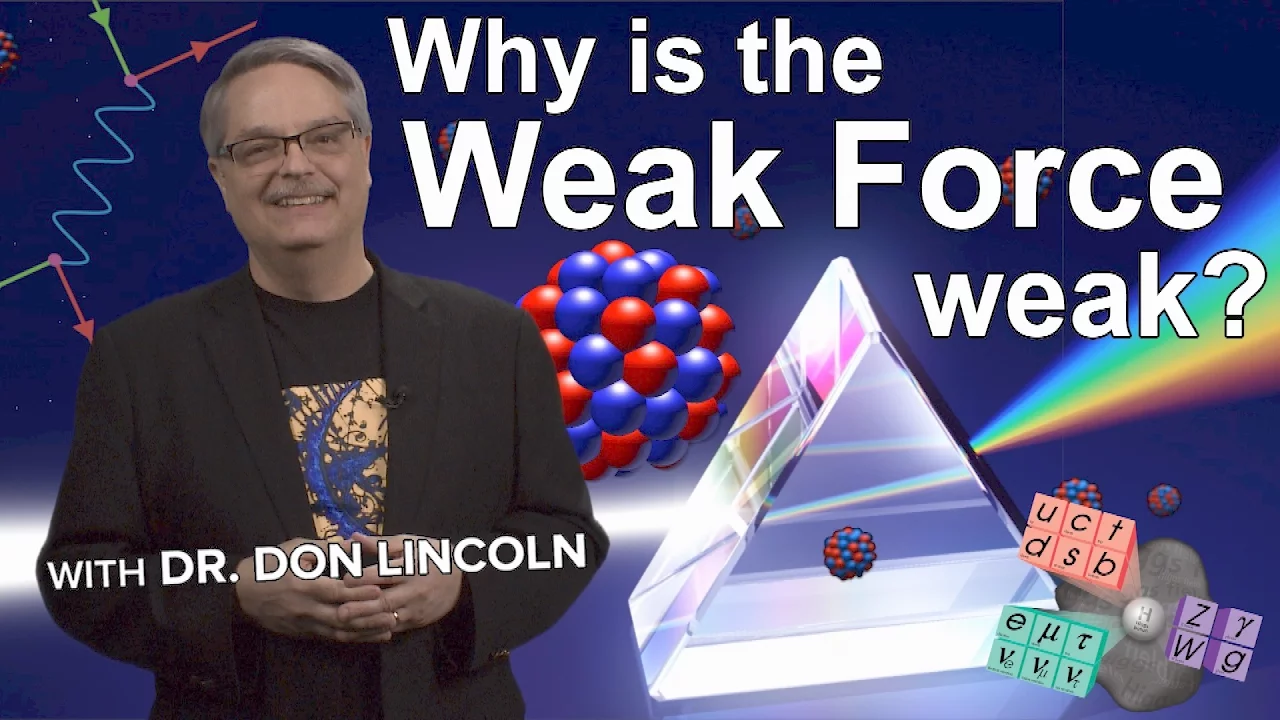
Why this video
Presented by Fermilab's Don Lincoln, this video demystifies the weak nuclear force. It explains why a force that is fundamentally quite strong appears weak and short-ranged to us: because its force carriers, the , , and bosons, are extraordinarily massive.
Knowledge Checkpoint
- Identify the three force-carrying bosons of the weak nuclear interaction.
- Explain how the high mass of the and bosons limits the range and rate of the weak interaction.
- Describe how the weak force is unique in its ability to change quark flavor (e.g., during beta decay).
Module 4: The Higgs Field and Mass Generation
This module introduces the mechanism that gives mass to the fundamental particles of the Standard Model: the Higgs field. You will explore spontaneous symmetry breaking, the nonzero vacuum expectation value of the Higgs field, and the discovery of the Higgs boson.

Why this video
Don Lincoln uses an intuitive visual analogy to explain how the Higgs field permeates space and slows down certain particles. This is the premier introductory video for distinguishing between the invisible Higgs field and the observable Higgs boson.
Knowledge Checkpoint
- Distinguish between the Higgs field (which permeates space) and the Higgs boson (the localized excitation of that field).
- Explain the analogy of inertia/mass generation through a particle's interaction with the Higgs field.
- Identify which fundamental particles do not interact with the Higgs field and therefore travel at the speed of light.
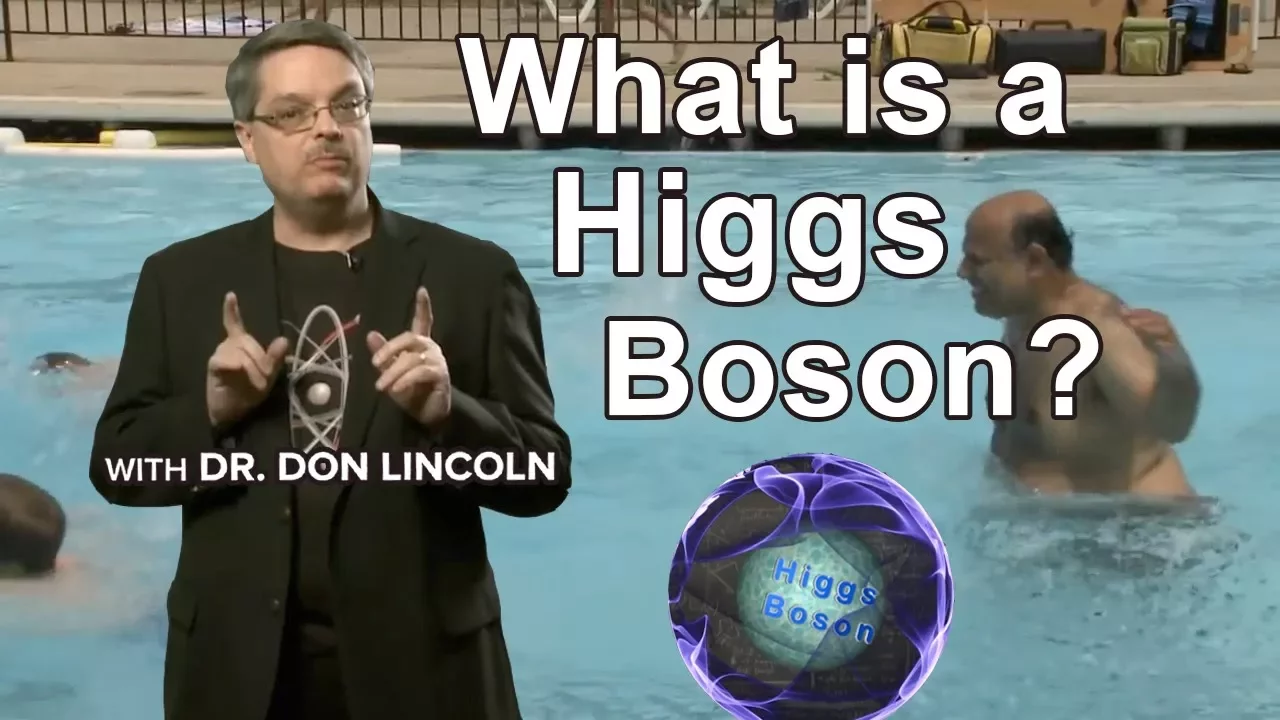
Why this video
This video explains the quantum mechanical nature of the Higgs boson itself. It clarifies how banging high-energy protons together at the Large Hadron Collider (LHC) can "excite" the ever-present Higgs field, producing an observable Higgs boson.
Knowledge Checkpoint
- Explain how high-energy particle collisions are used to excite quantum fields and "create" new physical particles.
- Summarize why the Higgs boson's decay signatures are used to confirm its existence rather than detecting the particle directly.

Why this video
This presentation tracks the timeline of the early universe (approximately seconds after the Big Bang) when the Higgs field went through spontaneous symmetry breaking. It explains how this cosmic transition permanently altered the nature of mass and electroweak interactions.
Knowledge Checkpoint
- Define spontaneous symmetry breaking in the context of the early universe.
- Understand why the Higgs field has a non-zero value in empty space (vacuum expectation value), unlike other known fields.
Module 5: The Standard Model and Feynman Diagrams
This module brings together everything you have learned. You will look at the Standard Model as a single unified framework, explore its underlying mathematical formulation (the Lagrangian), and master the visual grammar of Feynman diagrams to calculate and track particle interactions.
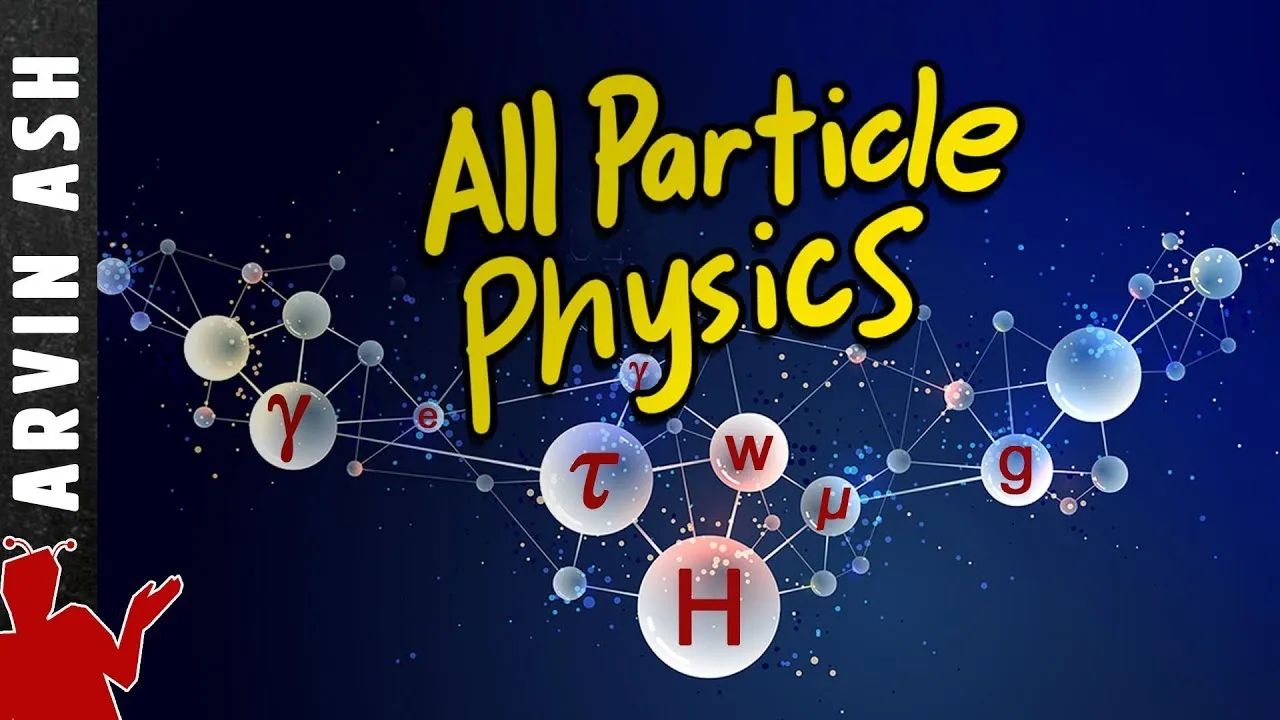
Why this video
This is a visual summary of the Standard Model. It integrates fermions, gauge bosons, and the Higgs boson into a single, cohesive map, while introducing the basic rules of Feynman diagrams to visually represent these particles interacting in space-time.
Knowledge Checkpoint
- Identify all 17 elementary particles of the Standard Model (6 quarks, 6 leptons, 4 gauge bosons, 1 scalar Higgs boson).
- Distinguish between the y-axis (typically time) and x-axis (typically space) on a standard Feynman diagram.
- Draw a basic Feynman diagram representing a simple electron-electron electromagnetic scattering event.
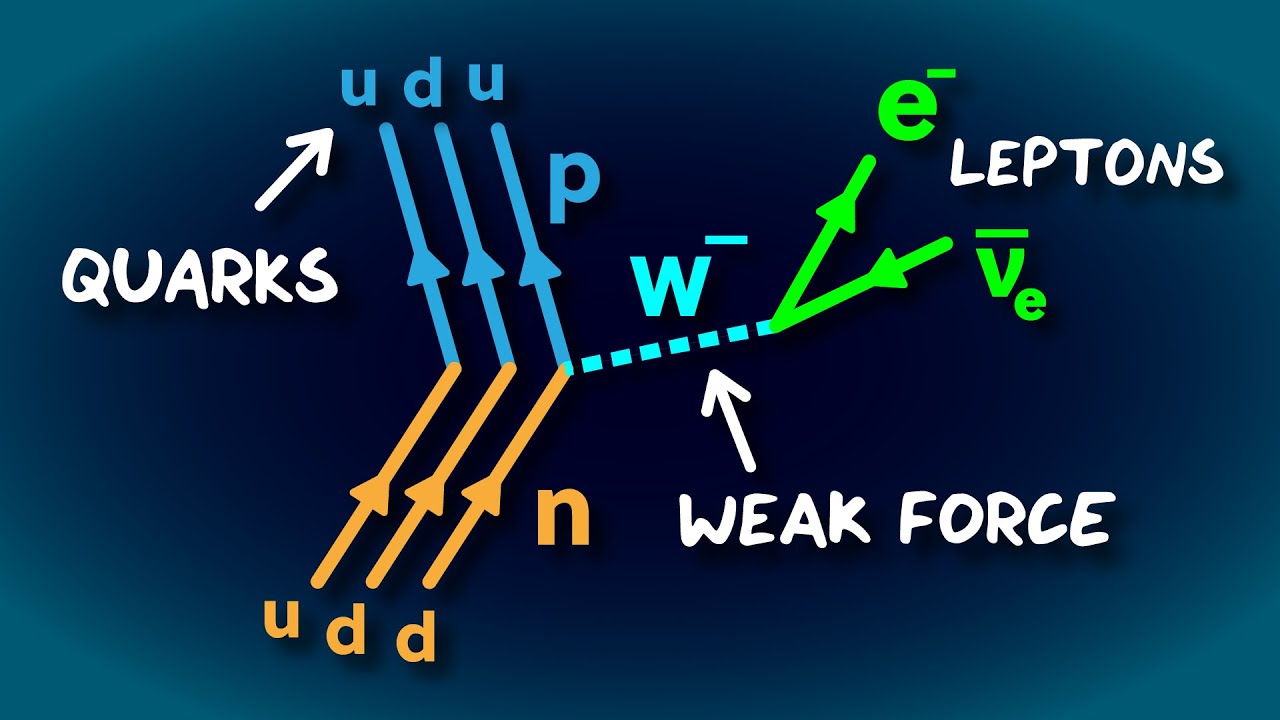
Why this video
A focused tutorial on the rules of Feynman diagrams. This video explains the visual language: what straight lines, wiggly lines, and vertices represent, how arrows show matter vs. antimatter, and how these diagrams simplify complex mathematical integrals.
Knowledge Checkpoint
- Read a Feynman diagram and identify the incoming particles, the force mediator, and the outgoing particles.
- Explain why antimatter particles have arrows pointing backward in time on Feynman diagrams.
- Understand the concept of vertex factor (how the coupling strength of a force dictates the probability of an interaction occurring at a vertex).

Why this video
This video takes a deep dive into the mathematical heart of particle physics: the Standard Model Lagrangian. While the math is complex, the video explains it piece-by-piece, mapping specific terms in the Lagrangian to real-world physical behaviors (like kinetic energies, force coupling, and Higgs interactions).
Knowledge Checkpoint
- Define what a "Lagrangian" is in classical and quantum mechanics.
- Identify the four main parts of the Standard Model Lagrangian (Gauge Boson term, Fermion kinetic term, Higgs-Fermion coupling/Yukawa terms, and the Higgs potential).
- Appreciate why this single equation is considered one of the most successful mathematical descriptions of nature ever devised.
Module 6: Unsolved Mysteries Beyond the Standard Model
The Standard Model is highly accurate, but it is not a complete theory of everything. This final module explores the major boundaries of modern particle physics: gravity, dark matter, supersymmetry, and string theory.
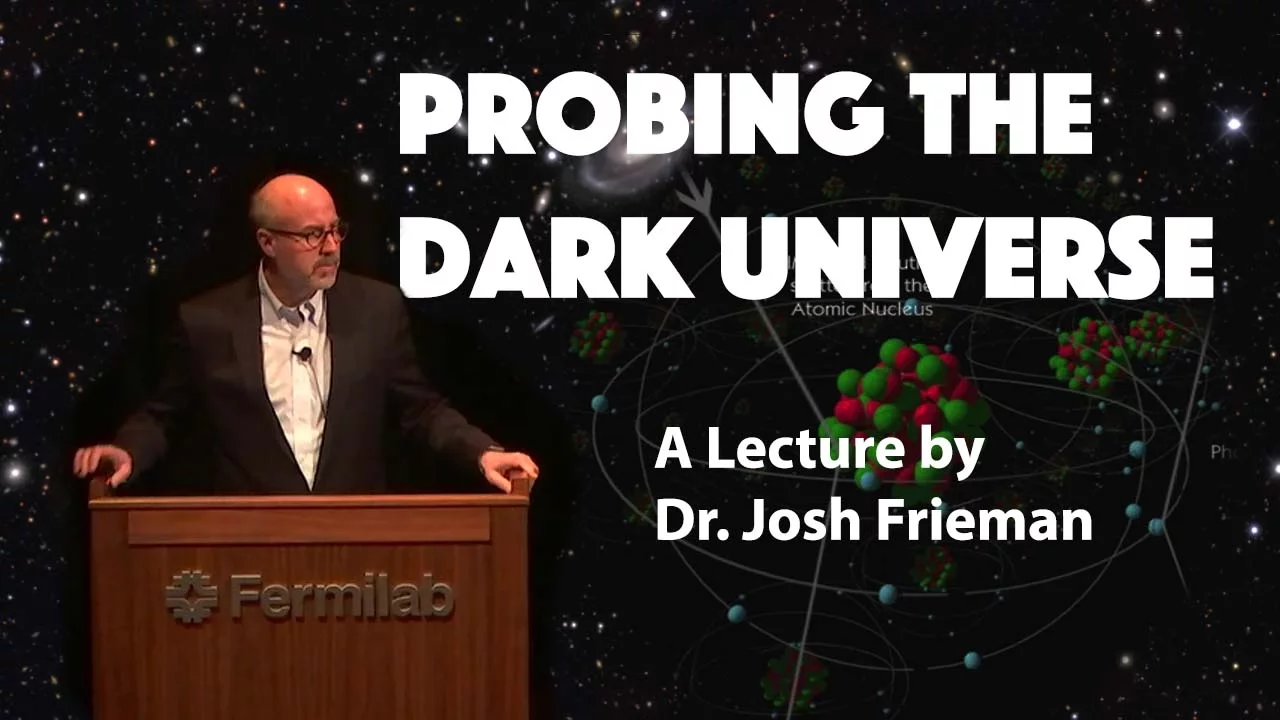
Why this video
This lecture from Fermilab details one of the Standard Model's most glaring omissions: dark matter. It explains how cosmological and astronomical observations prove that the vast majority of the universe's mass is composed of non-luminous, non-interacting matter that does not fit anywhere within the Standard Model.
Knowledge Checkpoint
- Cite observational evidence (such as galaxy rotation curves) that proves the existence of dark matter.
- Explain why dark matter cannot be made of any known Standard Model particles.
- Distinguish between the gravitational behavior of dark matter and our current understanding of the four fundamental forces.

Why this video
This video explains "Supersymmetry" (SUSY)—a leading theoretical framework designed to solve several mathematical flaws in the Standard Model (like the hierarchy problem). It shows how SUSY predicts a heavy "superpartner" for every known boson and fermion.
Knowledge Checkpoint
- Define supersymmetry (SUSY) and state the relationship it proposes between fermions and bosons.
- Explain the concept of superpartners (e.g., squarks, selectrons, photinos).
- Understand why we have not yet observed any supersymmetric particles in our colliders.

Why this video
This video introduces the mechanics of String Theory—the most prominent candidate for a "Theory of Everything" that attempts to reconcile quantum mechanics with general relativity. It outlines the core concept: replacing point-like particles with vibrating 1D strings, while explaining the historical challenges of the theory.
Knowledge Checkpoint
- Explain the fundamental premise of string theory (replacing point-like particle vertices with vibrating strings).
- Identify the major structural problems early string theory faced (tachyons, requirement of extra spatial dimensions).
- Understand why gravity is naturally integrated into string theory (via a closed-loop vibrating state that matches the graviton).
Course Map
Key People Index
- John Dalton (1766–1844): Proposed the first modern atomic theory, conceptualizing atoms as indivisible spheres of varying masses.
- J.J. Thomson (1856–1940): Discovered the electron in 1897 through cathode ray experiments, proving atoms have internal structure.
- Ernest Rutherford (1871–1937): Discovered the dense atomic nucleus via the gold foil scattering experiment.
- Richard Feynman (1918–1988): Nobel laureate who co-developed Quantum Electrodynamics (QED) and invented Feynman diagrams to simplify quantum field calculations.
- Peter Higgs (1929–2024): Proposed the existence of the Higgs field and spontaneous symmetry breaking to explain mass generation.
- Don Lincoln: Senior scientist at Fermilab and prominent science communicator who explains quantum fields and subatomic physics.
- Harry Cliff: Particle physicist at the University of Cambridge and researcher on the LHCb experiment at CERN.
Final Self-Assessment
Test your understanding of the entire curriculum by verifying you can confidently check off each of the following statements:
- I can explain the historic shift from Dalton's indivisible atomic model to the modern quantum field view of matter.
- I can list the six flavors of quarks, identify their electric charges, and calculate the charge of composite hadrons (like protons and neutrons).
- I can distinguish between quarks and leptons, and explain why leptons do not participate in strong force interactions.
- I can describe neutrino oscillations and explain why this phenomenon implies that neutrinos must possess a non-zero rest mass.
- I can explain color charge, color confinement, and how gluons mediate the strong force under Quantum Chromodynamics (QCD).
- I can describe the difference between the electromagnetic force carrier (the photon) and the weak force carriers ( bosons), particularly in terms of their mass.
- I can explain how the Higgs field generates mass for fundamental particles through spontaneous symmetry breaking.
- I can look at a basic Feynman diagram and trace the flow of space-time, identify matter vs. antimatter lines, and identify the force carrier.
- I can outline the main four sections of the Standard Model Lagrangian and describe what physical processes they govern.
- I can explain why gravity and dark matter are not currently accounted for in the Standard Model, and describe how theories like supersymmetry or string theory attempt to address these omissions.