Measure Theory: Lebesgue Integral & Convergence
Learning Goal: Transition from classical Riemann integration to abstract measure spaces, Lebesgue outer measures, Carathéodory's measurability criterion, the construction of the Lebesgue integral, and modern convergence theorems (Monotone Convergence, Fatou's Lemma, and Dominated Convergence).
- Prerequisites: Multivariable calculus, introductory proof-based real analysis (limits, epsilon-delta arguments).
- Estimated Total Study Time: 24 Hours
Module 1: Mathematical Foundations: Real Analysis & Set Theory
To transition successfully into measure theory, you must first master the topology of real numbers and the behavior of sequences. This module establishes critical tools such as the supremum/infimum, open and closed sets, and the limits of sequences, which serve as the primary framework for defining integration.
Recommended Videos

- Why this video: This video provides a mathematically rigorous, yet accessible introduction to supremum (least upper bound) and infimum (greatest lower bound). Understanding these concepts is vital because both Riemann upper/lower sums and Lebesgue integrals are defined using suprema and infima over sets of functions.
- Knowledge Checkpoint:
- Define the supremum and infimum of an arbitrary set .
- Explain why a bounded-above subset of must possess a supremum in (the Completeness Axiom).
- Identify the supremum and infimum of open intervals such as .

- Why this video: Topology on the real line forms the backbone of measurable spaces. This lecture details how open and closed sets are constructed in using epsilon neighborhoods, preparing you to understand the Borel -algebra.
- Knowledge Checkpoint:
- State the definition of an open set in terms of neighborhood inclusions.
- Prove that an arbitrary union of open sets is open, while only a finite intersection of open sets is guaranteed to be open.
- Formulate the definition of a closed set using its complement.

- Why this video: Limits of sequences underlie every approximation method in measure theory. This video reviews pointwise convergence, bounded sequences, and provides concrete analytical definitions that will reappear when taking limits of simple functions.
- Knowledge Checkpoint:
- Write down the formal - definition of a convergent sequence of real numbers.
- Describe the difference between pointwise convergence and uniform convergence.
Module 2: The Riemann Integral and Its Limitations
The classical Riemann integral is highly intuitive but functionally restricted. It fails when handling highly discontinuous functions and struggles with swapping limits and integrals. This module explores how the Riemann integral is built and analyzes the pathological cases—most notably the Dirichlet function—that motivate the transition to Lebesgue's integration theory.
Recommended Videos
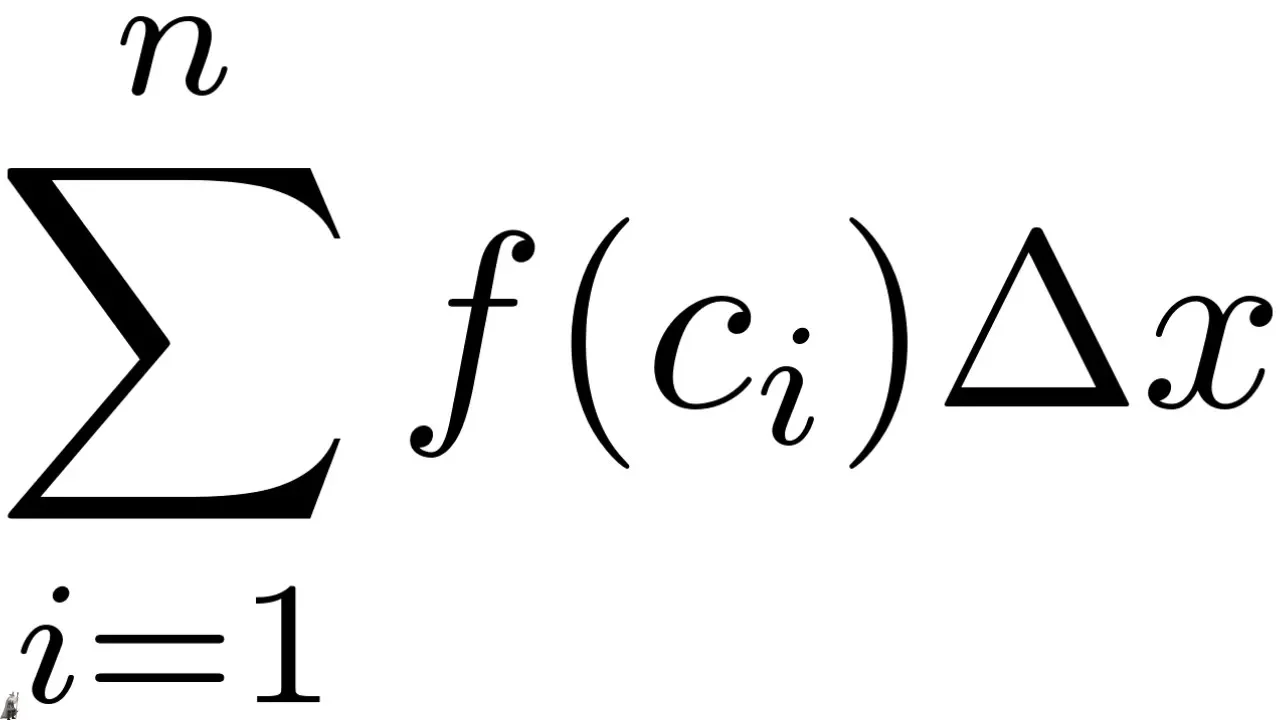
- Why this video: To understand why we must replace the Riemann integral, we must first master its precise mathematical setup. This video provides a deep dive into formal partitions, subintervals, sample points, and the convergence of Riemann sums.
- Knowledge Checkpoint:
- Define a partition of an interval and its mesh (norm).
- Formulate the Riemann sum for a function over a partition .
- Explain how the limit of Riemann sums defines the definite integral as the mesh approaches zero.
- Why this video: This video covers Darboux's approach to the Riemann integral using upper and lower bounds. Since modern integration theories rely on bounding functions above and below, this is a direct bridge to Lebesgue's formulation.
- Knowledge Checkpoint:
- Compute the Upper Riemann Sum and Lower Riemann Sum using suprema and infima.
- State the condition under which a bounded function is declared Riemann integrable.
- Explain why the upper integral is always greater than or equal to the lower integral.

- Why this video: This short lecture illustrates the Dirichlet function (indicator function of the rationals) and proves why it is not Riemann integrable. This pathological counterexample is the primary historical driver for the creation of Lebesgue's theory.
- Knowledge Checkpoint:
- Write down the analytical definition of the Dirichlet function on .
- Prove why the lower Riemann sum of the Dirichlet function is always , while the upper sum is always for any partition.
- Explain the relationship between uniform convergence and Riemann integration limits.
![Riemann Integral vs. Lebesgue Integral [dark version]](https://i.ytimg.com/vi/AczklPvD9Ug/maxresdefault.jpg)
- Why this video: A conceptual comparison of partitioning the domain (Riemann) versus partitioning the range (Lebesgue). It highlights the core limitations of Riemann integration (vector space completeness issues, lack of strong convergence theorems) and sets up the need for measure theory.
- Knowledge Checkpoint:
- Contrast "vertical slicing" (Riemann domain partition) with "horizontal slicing" (Lebesgue range partition).
- Explain the fundamental flaw of the Riemann integral when taking pointwise limits of integrable functions.
Module 3: Sigma-Algebras and Measure Spaces
To measure sets of arbitrary shapes, we need a consistent family of sets on which a "size" or "volume" function can be defined. This collection is called a -algebra. This module introduces the formal definition of a -algebra, explores the Borel -algebra generated by open sets, and formally defines a measure space.
Recommended Videos
- Why this video: This is the gold-standard introduction to the axiomatic definition of a -algebra. It walks you through why we require certain closure properties (complements, countable unions) to build a robust framework for calculation.
- Knowledge Checkpoint:
- List the three defining axioms of a -algebra on a set .
- Prove that a -algebra is automatically closed under countable intersections.
- Distinguish between an algebra (closed under finite unions) and a -algebra (closed under countable unions).
- Why this video: Explains the Borel -algebra—the most important structural algebra on the real line. Borel sets represent all subsets that can be constructed from open intervals using countable intersections, unions, and complements.
- Knowledge Checkpoint:
- Define the Borel -algebra as the -algebra generated by open sets.
- Explain why closed intervals, half-open intervals, and singletons are Borel sets.
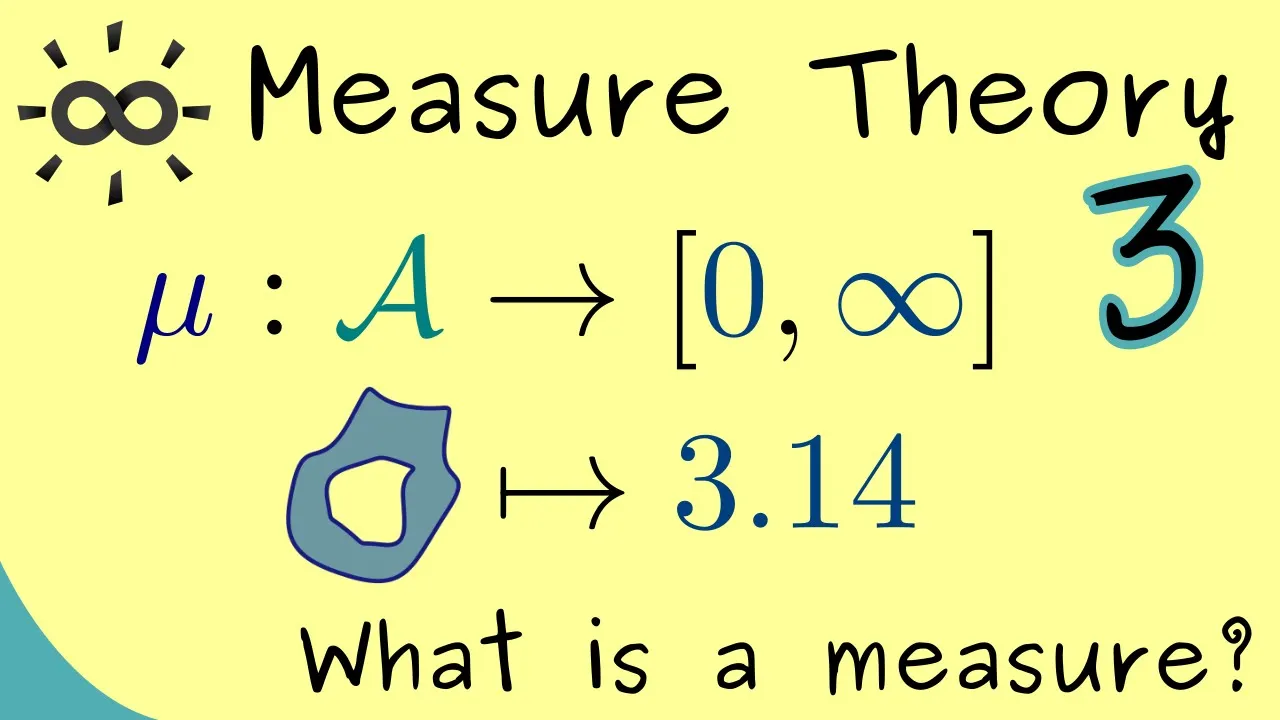
- Why this video: This video introduces the concept of a measure: a function that assigns a non-negative real value (or infinity) to sets in a -algebra, formalizing "length", "area", or "probability".
- Knowledge Checkpoint:
- State the three requirements of a measure on a measurable space .
- Define the axiom of -additivity (countable additivity) and write it out mathematically.
- Define a measure space as a triplet .

- Why this video: A concise, proof-oriented video that reinforces the properties of -algebras. It contains simple proofs showing why the full set and empty set are always members.
- Knowledge Checkpoint:
- Prove that the empty set belongs to any -algebra if .
- Deduce why closure under countable unions combined with complements naturally guarantees closure under relative set subtraction.
Module 4: Lebesgue Measure and Measurable Functions
The goal on the real line is to define a measure that extends the intuitive concept of "interval length" to arbitrary sets. However, assigning a translation-invariant measure to all subsets of leads to logical contradictions (such as the Vitali non-measurable set).
To resolve this, we construct the Lebesgue outer measure and restrict ourselves to a family of well-behaved sets defined by Carathéodory's criterion.
Recommended Videos

- Why this video: This video covers the construction of Lebesgue outer measure . It shows how we cover any arbitrary subset of with countable collections of open intervals, and define the outer measure as the infimum of the sum of their lengths.
- Knowledge Checkpoint:
- Define the Lebesgue outer measure for any set .
- State the three defining axioms of an outer measure (null empty set, monotonicity, and countable subadditivity).
- Explain why outer measure is defined for all subsets of , but fails to be countably additive on all subsets.

- Why this video: This video introduces Carathéodory's measurability criterion. A set is Lebesgue measurable if it cleanly splits any testing set into a piece inside and a piece outside . This step is critical for moving from an outer measure to a true countably additive measure.
- Knowledge Checkpoint:
- Write down Carathéodory's measurability condition for a set .
- Explain why the inequality is the only part of the equation that requires explicit proof.
- State how the family of Carathéodory measurable sets forms a -algebra.
- Why this video: This advanced, live classroom lecture from Rutgers University provides a rigorous mathematical defense of Carathéodory's criterion. It offers the topological and geometric intuition needed to understand why we restrict ourselves to measurable sets.
- Knowledge Checkpoint:
- Describe why outer measures alone are not countably additive.
- Follow and reproduce the proof that the collection of measurable sets defined by Carathéodory forms a -algebra.
- Why this video: This video proves why we cannot assign a translation-invariant, countably additive measure to every subset of . It details the construction of a Vitali set using rational equivalence classes, highlighting why non-measurable sets exist under the Axiom of Choice.
- Knowledge Checkpoint:
- Define the equivalence relation used to construct a Vitali Set on ().
- Explain why the assumption that a Vitali set is measurable leads to a contradiction of countable additivity (summing translated sets).
- Identify the role the Axiom of Choice plays in generating non-measurable sets.
Module 5: The Lebesgue Integral Construction
With measurable sets and functions defined, we can now construct the Lebesgue integral. This construction is executed in three stages: first for simple functions (finite linear combinations of indicator functions), then extended to non-negative measurable functions via suprema of simple functions, and finally to general integrable functions by splitting them into positive and negative parts.
Recommended Videos
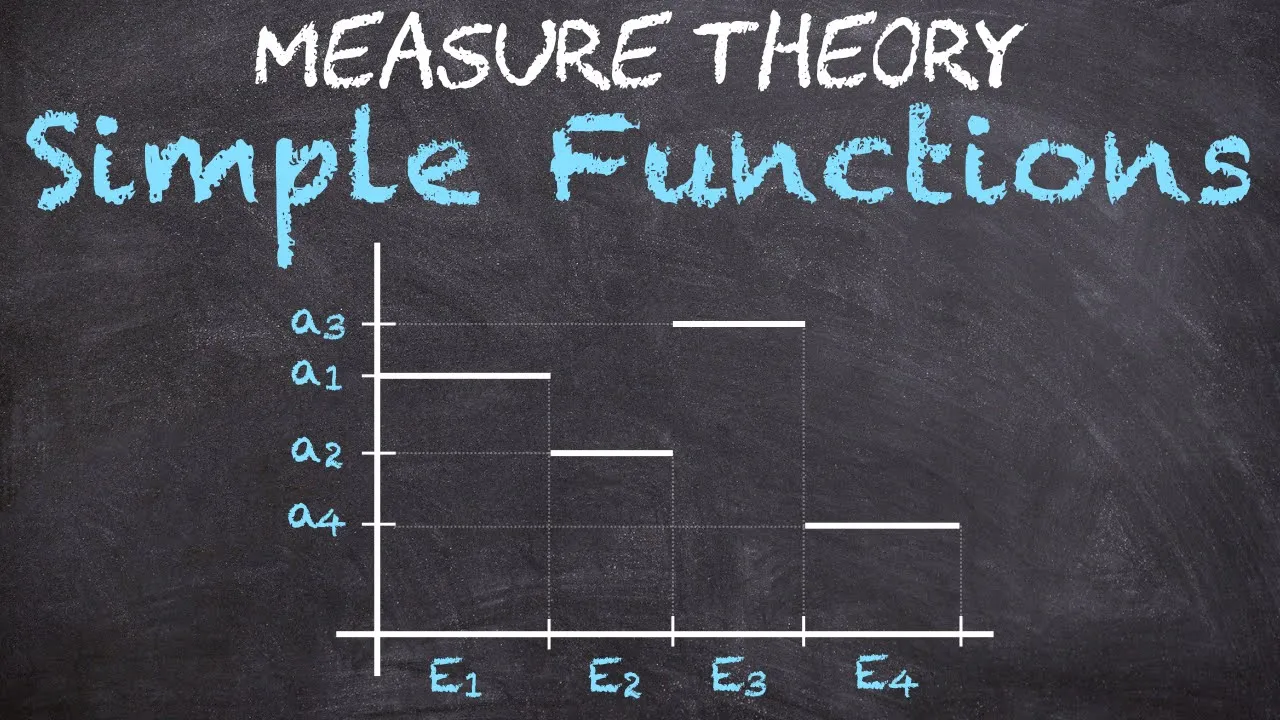
- Why this video: This video directly addresses the gap of approximating arbitrary measurable functions using simple functions. Pointwise approximation by simple functions is the standard method used to prove theorems for general integrable functions.
- Knowledge Checkpoint:
- Define a simple function and its canonical representation.
- Explain how to construct an increasing sequence of non-negative simple functions that converges pointwise to a non-negative measurable function .
- Explain the difference between pointwise approximation and uniform approximation on bounded sets.
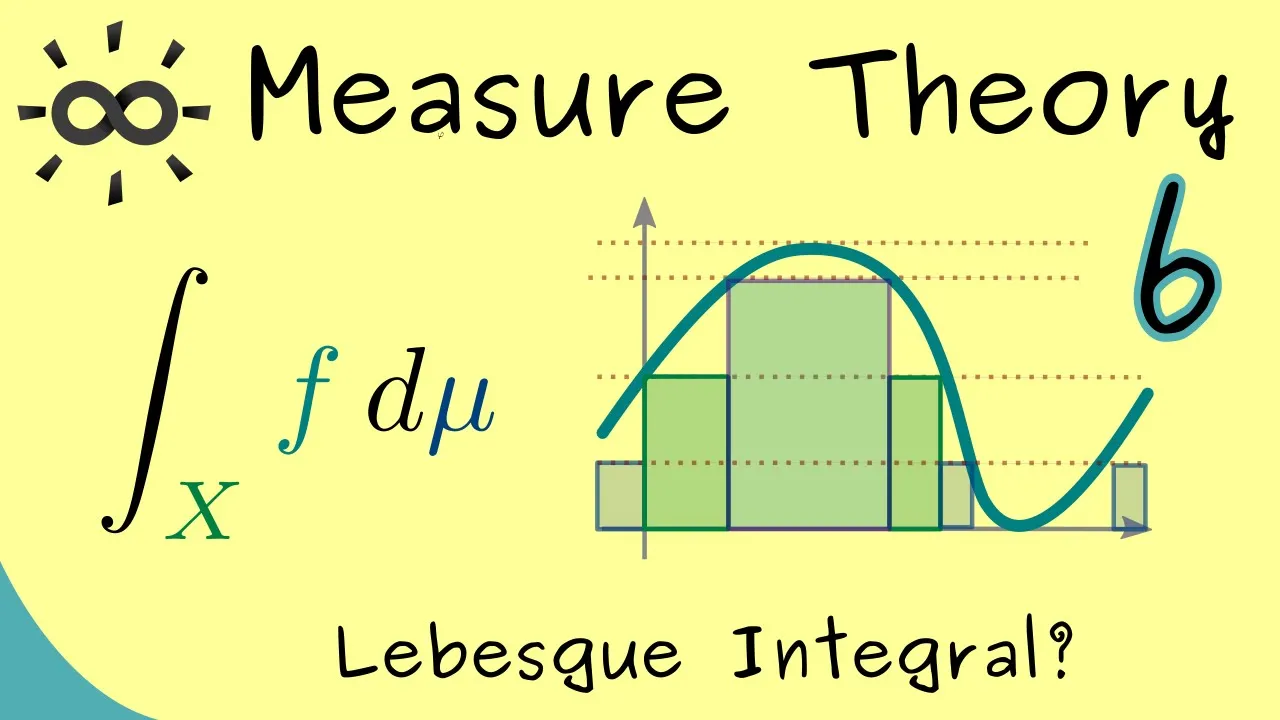
- Why this video: A comprehensive lecture that walks through the formal integration of simple functions and non-negative measurable functions. It defines the Lebesgue integral as a supremum over simple functions lying below the curve.
- Knowledge Checkpoint:
- Write down the formula for the Lebesgue integral of a simple function .
- Formulate the Lebesgue integral for a non-negative measurable function : .
- Show why the Lebesgue integral of the Dirichlet function over is exactly .

- Why this video: Dr. Peyam provides an intuitive and accessible overview of the entire construction process. This video is highly valuable for summarizing how the positive and negative parts of a function are integrated separately to define the general Lebesgue integral.
- Knowledge Checkpoint:
- Define the positive part and negative part of a function.
- Define the general Lebesgue integral as .
- State the condition under which a general measurable function is said to be Lebesgue integrable ().
Module 6: Convergence Theorems in Measure Theory
The crown jewel of Lebesgue's integration theory is the ease with which we can exchange limits and integrals: . Under Riemann integration, this requires the extremely restrictive condition of uniform convergence. In measure theory, we use three foundational theorems: the Monotone Convergence Theorem (MCT), Fatou's Lemma, and the Dominated Convergence Theorem (DCT).
Recommended Videos
- Why this video: This proof-centric lecture walks step-by-step through the proofs of the Monotone Convergence Theorem and Fatou's Lemma. These are the starting points for swapping limits and integrals.
- Knowledge Checkpoint:
- State the Monotone Convergence Theorem (MCT). What conditions must the sequence of functions satisfy?
- Explain how MCT fails if the sequence is not non-negative or not monotonically increasing.
- State Fatou's Lemma and describe why it is written as an inequality ().
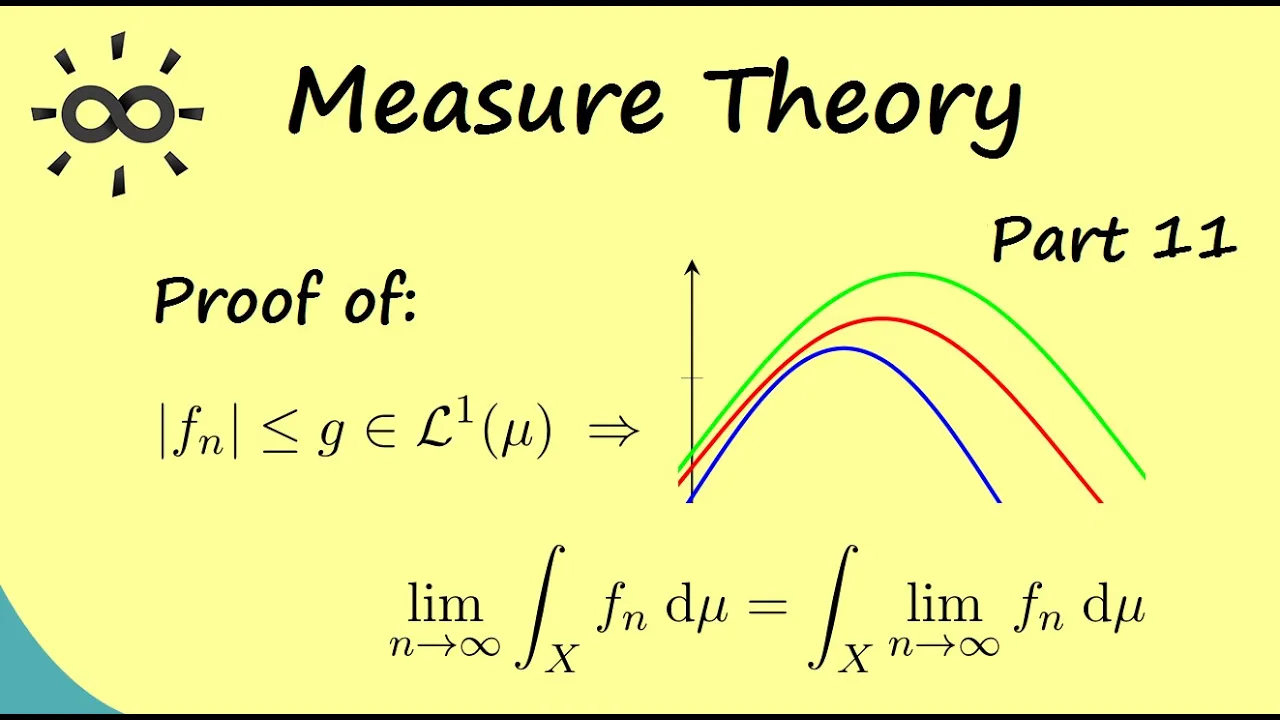
- Why this video: This video fills a key gap by delivering a complete, rigorous proof of the Dominated Convergence Theorem (DCT) using Fatou's Lemma. This is the most widely applied convergence theorem in analysis and probability.
- Knowledge Checkpoint:
- State the exact conditions of the Lebesgue Dominated Convergence Theorem.
- Explain what it means for a sequence to be "dominated" by an integrable function (i.e., almost everywhere).
- Reconstruct the proof of DCT by applying Fatou's Lemma to the non-negative sequences and .
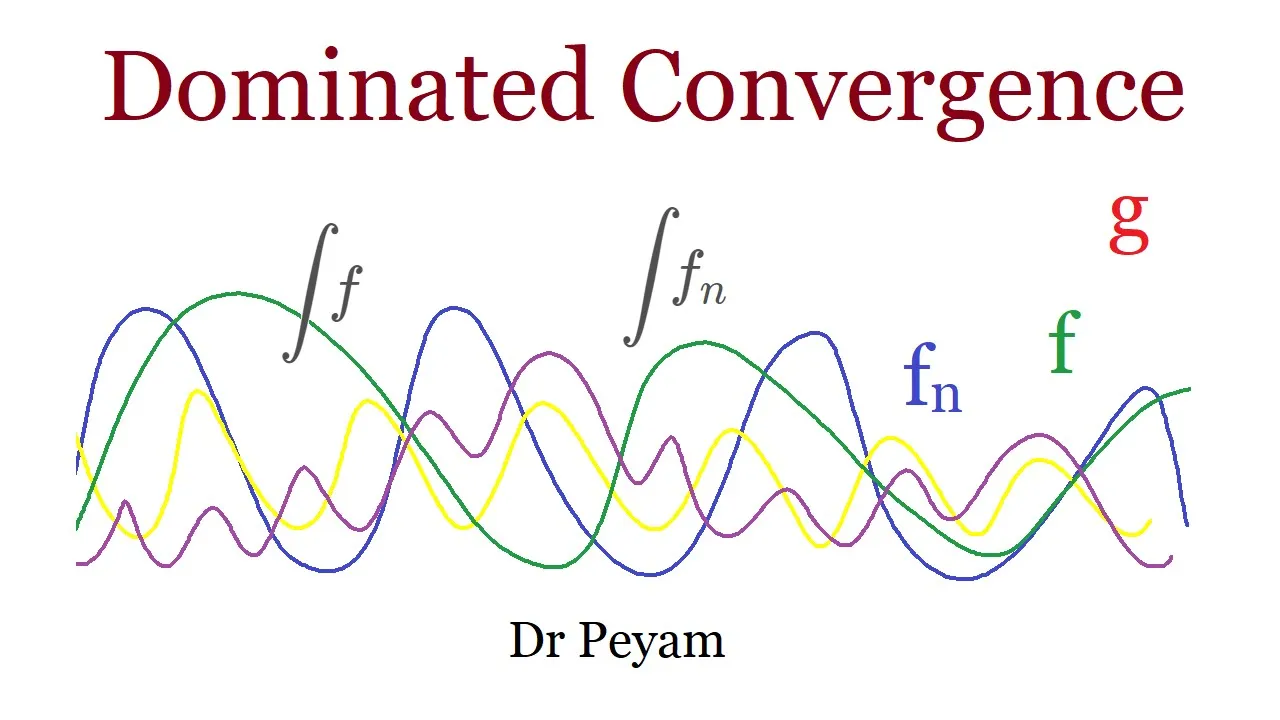
- Why this video: Dr. Peyam provides intuitive, concrete examples of how to apply the Dominated Convergence Theorem to solve complex limit-integral evaluations that are impossible using standard calculus tools.
- Knowledge Checkpoint:
- Show how to evaluate using DCT.
- Identify a dominating function for a given sequence of integrand functions.
Course Map
This map outlines your learning path. Do not skip modules, as each relies on the analytical structures built in the previous one.
Key People Index
- Bernhard Riemann (1826–1866): Introduced the first rigorous formulation of the integral of functions on an interval using upper and lower approximating sums over domain partitions.
- Henri Lebesgue (1875–1941): Developed the theory of measure and modern integration. By partitioning the range of a function rather than its domain, he expanded integration to a much broader class of functions.
- Constantin Carathéodory (1873–1950): Formulated the measurability criterion for outer measures, allowing mathematicians to define a true countably additive measure space starting from non-additive outer measures.
- Giuseppe Vitali (1875–1932): Constructed the first example of a non- Lebesgue-measurable subset of the real numbers, proving the impossibility of a universal, translation-invariant, countably additive measure on all subsets of .
Final Self-Assessment
Complete this checklist to verify your mastery of the curriculum:
- I can formally define the supremum and infimum of a subset of the real numbers.
- I can explain why the Dirichlet function is not Riemann integrable, but is Lebesgue integrable.
- I can state the three axioms of a -algebra.
- I can define the Borel -algebra and explain why it contains all open and closed intervals.
- I can define the Lebesgue outer measure and explain why it is countably subadditive but not countably additive on all subsets of .
- I can state and apply Carathéodory's criterion to prove whether a set is Lebesgue measurable.
- I can explain the structure of a Vitali set and why it cannot be Lebesgue measurable.
- I can define a simple function and write out its canonical form.
- I can explain how to construct the Lebesgue integral of a general function starting from simple functions, then non-negative functions, and finally general integrable functions.
- I can state the Monotone Convergence Theorem (MCT) and identify when it can be applied.
- I can state Fatou's Lemma and explain the direction of its inequality.
- I can state the Dominated Convergence Theorem (DCT) and use it to justify swapping a limit and an integral.